Denim Jeans Exporters in Bangladesh: Verified Supplier Checklist
A supplier checklist for denim jeans exporters in Bangladesh: export papers, fabric weight and weave, indigo dye and wash evidence, fit grading, rivets and trims, laundry capacity, and contract stop rules, with a printable summary table.
Short answer
Before paying a deposit, check a denim jeans exporter in Bangladesh on export papers, denim fabric weight and weave, indigo dye and wash evidence, fit grading across the full size curve, rivets and trims, laundry capacity, and contract stop rules. Record each item as pass, conditional, or stop with the evidence seen.

On this page
Key takeaways
Agree the fabric weight, weave, and fibre content in the tech pack, and check bulk fabric against it before cutting starts.
Require wash and rubbing fastness reports naming the test method, plus a signed physical wash standard with its recipe.
Measure a washed graded set across the full size curve, since a curve that fits the sample size can still fail at the ends.
Check rivets, buttons, and zips against the trim card, and treat any bulk substitution without written approval as a stop.
Make the ERC, BGMEA membership, maker identity, and acceptance rules part of the purchase order, not the invoice stage.
Jeans fail in ways a price sheet never shows: a waistband that gaps after washing, indigo that stains light upholstery, a rivet that pulls through a pocket corner, or a size curve that fits the sample size only. Test the exporter before paying a deposit, and record each item as pass, conditional, or stop, with the evidence seen.
Jeans are woven, cut, sewn, then washed as finished garments, so a supplier must prove control at each stage.
Why this checklist matters
A jeans order concentrates risk in fit, colour, and hardware. Fit is decided by the pattern and grading, not the sample alone. Colour is decided by indigo dyeing and the wash that follows, and indigo sits on the yarn surface and fades with washing and wear, so a swatch shade can drift across a bulk lot. Hardware is structural, and a weak trim fails in use.
Checking the exporter first protects the schedule, since fabric, wash, and trim problems surface late.
Before you start
Do not begin until the references are complete: the tech pack, the size chart with tolerances for waist, hip, inseam, rises, and leg opening, the wash standard for each finish, the fabric specification naming weight, weave, and fibre content, and the trim card naming every rivet, button, zip, and label. Agree in writing what counts as a stop.
Ask for evidence in the form it will be judged: dated documents, lab reports, wash recipes, and graded tables.
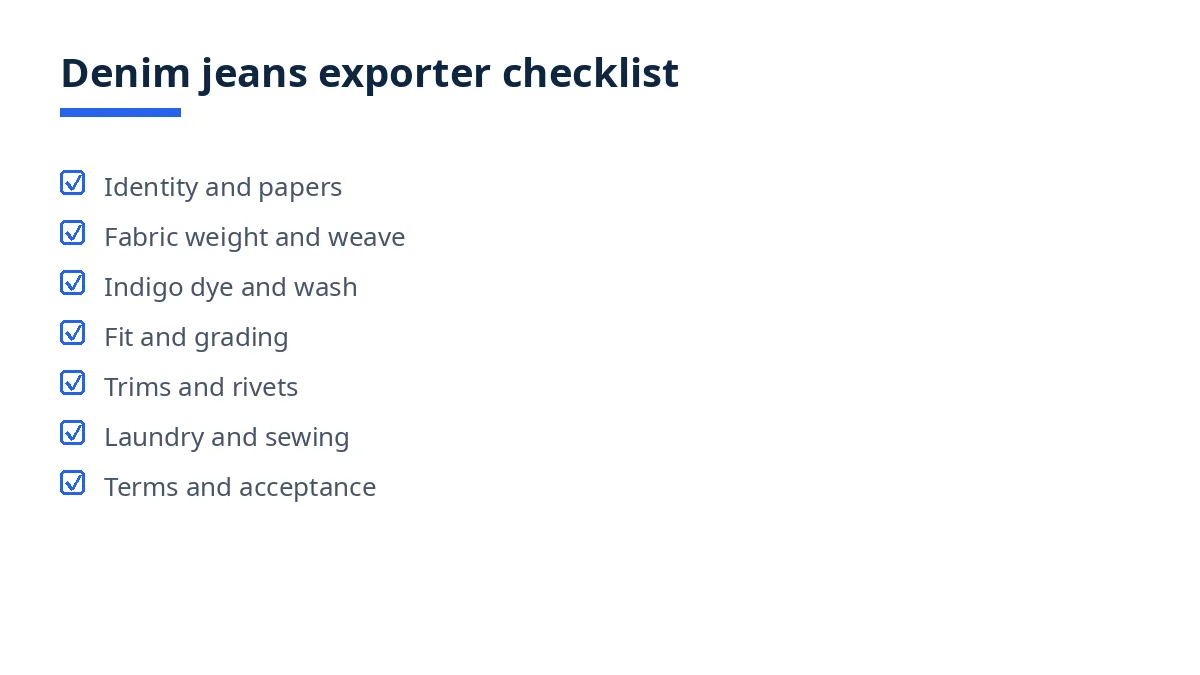
The full checklist
A. Identity and export papers
Confirm the legal name, address, and factory address match across the trade licence, tax registration, and bank details. Record any mismatch as a stop.
Ask for the Export Registration Certificate (ERC) and check its validity and the name it carries. An Export Registration Certificate is mandatory for exporters in Bangladesh, and the Office of the Chief Controller of Imports and Exports is its sole issuer.1
Check BGMEA membership status and ask for the membership certificate the supplier holds. BGMEA runs an online Membership Management System through which member factories can update their information and generate an e-certificate of membership.2
Confirm who actually makes the jeans, who ships, and who receives payment: the candidate's own cutting, sewing, and laundry lines, or subcontracted stages, with the name and address of each subcontractor. Record that arrangement in the contract.
B. Denim fabric weight and weave
Ask for the fabric specification for each style: weight in ounces per square yard and grams per square metre, weave, and fibre content. Check bulk fabric against it before cutting, including width and shade continuity across rolls.
Check the weave on a fabric sample and a cut panel. Denim is characterised by indigo-dyed warp yarns interwoven with undyed weft yarns in a 3 by 1 or 2 by 1 twill construction.3
Compare the stated weight with the weight class the style needs. One published guide classes lightweight denim at 5 to 12 ounces per square yard, medium weight at 12 to 16 ounces, and heavyweight at 16 ounces and above.3 The binding figure is the tech-pack weight.
For stretch jeans, ask for the elastane content, stretch percentage, and recovery figure the supplier guarantees, and check them against a bulk-fabric report. Check selvedge or non-selvedge construction where the style specifies it.
C. Indigo dye and wash evidence
Ask for the indigo dye source and dyeing route for each colour: rope, slasher, or sheet dyeing, and whether the shade is pure indigo, indigo with sulphur bottoming, or a black or coloured denim.
Ask for wash fastness evidence for each colour, naming the method. ISO 105-C06 specifies methods for determining the resistance of textile colour to domestic or commercial laundering using a reference detergent.4
Ask for rubbing fastness evidence, dry and wet, for dark indigo shades. ISO 105-X12 specifies a method for determining the resistance of textile colour to rubbing off and staining other materials.5
Check the wash standard itself: a physical pair, not a photograph, signed by both sides, with the wash recipe, chemical list, and finishing steps that reproduce it.
For stone, enzyme, bleach, ozone, or laser finishes, ask for the equipment list and the safety and effluent controls, and confirm the finish is done in-house or by a named laundry.
Check dimensional change evidence after washing for waist, inseam, and leg length. ISO 5077 specifies a method for determining dimensional change in specified washing and drying procedures.6 One published guide describes sanforized denim as pre-shrunk with under 1 percent shrinkage.3
D. Fit and size grading
Ask for the graded measurement table covering the full size curve, not only the sample size, and check the grade rules for waist, hip, thigh, knee, leg opening, inseam, and rises.
Measure a graded set from bulk fabric after washing, and compare every size against the table and its tolerance. A curve that fits at the middle size and drifts at the ends is a pattern problem.
Check the fit on a form or a fit model for the base size and at least one size at each end of the curve, and record waistband gaping, pocket placement, knee position, and leg twist.
For stretch styles, check recovery after wear: ask the supplier to show a washed and worn test pair, and record bagging at the knee and seat against the approved standard.
E. Trims and rivets
Check every trim against the trim card: rivet type and finish, button shank and tack, zip brand and gauge, thread type, and pocketing fabric. Allow no substitution in bulk without written approval.
Pull-test sampled rivets and buttons by hand and ask for the test method and result the supplier uses for bulk. A rivet that holds in the sample and pulls through in bulk points to a setting-pressure change.
Check zip function across the full size curve: slider movement, top and bottom stops, and fly construction, including on the smallest and largest sizes where grading shifts the fly angle.
Check labels before bulk printing: fibre content, care symbols, size, and origin. For the EU, fibre names and composition marking fall under Regulation (EU) No 1007/2011.7 ISO 3758 establishes the system of graphic symbols used for care labelling.8
F. Laundry, sewing, and finishing capacity
Visit or video-check the laundry line: washing machines, dryers, ozone or laser units where claimed, and the shade-approval area under consistent lighting. Confirm capacity against the order quantity and delivery date.
Check sewing capacity for jeans-specific operations: waistband attaching, belt-loop setting, pocket setting, hemming, and bartack reinforcement, and ask for the stitch-per-inch figures agreed for each seam.
Ask for the in-line and end-line inspection records from a recent jeans order, showing what was checked, what failed, and what was reworked. Treat a supplier with no record as a conditional pass at best.
G. References, terms, and acceptance
Call at least two recent jeans buyers as references, and ask about on-time delivery, wash consistency across repeat orders, and how claims were handled. Record the answers, not just the call.
Agree commercial terms before the deposit: price basis, payment terms, minimum order quantity per style and colour, lead time from fabric approval, and the cost and ownership of samples and wash standards.
Agree acceptance in the purchase order: the sampling plan, tolerances, test methods for wash, rubbing, and dimensional change, stop rules for each section, and the remedy for each failure: sorting, rework, partial acceptance, or rejection.
Common failures and how to fix them
The most frequent failure is a wash that cannot be reproduced: the standard pair was washed one way and the bulk another, so shades drift from carton to carton. Stop, re-wash a bulk sample against the signed standard using the recorded recipe, and only then release the remaining pairs. Next is a size curve that fits the sample and fails at the ends: re-check the grading table and cut a fresh graded set before more fabric is cut, because re-sewing cannot fix a pattern error.
Indigo crocking usually traces to unfixed dye or an untested dark shade: re-test rubbing fastness on the bulk colour and adjust the wash before packing. Rivets that pull through point to wrong setting pressure or a skipped pocket reinforcement: re-set a test pair and check the reinforcement before the line restarts. Above the agreed level, options are sorting, rework, partial acceptance, or rejection.
Summary table
Copy the checklist into your supplier file and record a result per item.
Section | Checks | Evidence |
|---|---|---|
Identity and papers | ERC, membership, maker, payment route | Documents seen, names matched |
Fabric weight and weave | Weight, weave, fibre, stretch, shade | Fabric specification, bulk sample |
Indigo and wash | Dye route, wash and rubbing fastness, recipe | Lab reports, signed wash standard |
Fit and grading | Full size curve, fit, recovery | Graded tables, measured set |
Trims and rivets | Rivets, buttons, zips, labels | Trim card, pull checks |
Laundry and sewing | Wash line, jeans operations, inspection | Line check, recent records |
Terms and acceptance | References, terms, stop rules | Calls logged, purchase order |
How Exportain helps
Agree the checklist specifications at enquiry stage: browse suppliers, read how supplier verification works on Exportain, and compare MOQ guidance.
FAQs
When should this checklist be used?
Use it before paying a deposit or signing a purchase order, and again when renewing terms, changing wash, or changing fabric supplier.
Who should complete it?
The buyer, a local agent, or an independent inspector, using the tech pack, size chart, and wash standards.
What are the most common failures?
An unreproducible wash, a size curve that fails at the ends, indigo crocking on dark shades, and rivets that pull through the pocket fabric are the failures buyers find most often.
Can a third party do it?
Yes, if you share the tech pack, wash standards, tolerances, and stop rules first.
Next steps on Exportain
Before approaching a supplier, agree your fabric specification, wash standards, size chart, and stop rules, then read the denim jeans manufacturers in Bangladesh guide, check wholesale denim jeans in Bangladesh, and review denim jeans MOQ in Bangladesh. You can also post a free RFQ via RFQs and compare quotes from Bangladeshi suppliers.
Sources
- Bangladesh Trade Portal FAQ: Export Registration Certificate (ERC). Bangladesh Trade Portal (accessed )
- BGMEA launches Membership Management System to provide faster and simpler services. BGMEA (accessed )
- Denim Fabric Guide: Complete Manufacturing, Sourcing and Quality Specifications. Global Sources (accessed )
- ISO 105-C06:2010 Textiles — Tests for colour fastness — Part C06: Colour fastness to domestic and commercial laundering. International Organization for Standardization, (accessed )
- ISO 105-X12:2016 - Textiles — Tests for colour fastness — Part X12: Colour fastness to rubbing. International Organization for Standardization (accessed )
- ISO 5077:2007 - Textiles — Determination of dimensional change in washing and drying. International Organization for Standardization (accessed )
- Regulation (EU) No 1007/2011 on textile fibre names and related labelling and marking of the fibre composition of textile products. European Union, (accessed )
- ISO 3758:2023 - Textiles — Care labelling code using symbols. International Organization for Standardization (accessed )
About the author
Sourcing from Bangladesh?
Post a request for quotation and suppliers on Exportain can send you their quotes directly.
Post an RFQ