DDP for Small Importers: Is It the Right Incoterm for Your First Order?
DDP puts import clearance and duty on the seller, which helps a first-time importer only when the seller can actually act as importer at destination. Test the importer proof, the duty figure and the small-order maths before you sign.
Short answer
DDP suits a first-time importer who cannot yet run an import file, but only when the seller proves it can stand as importer at destination, clear the goods, and pay duty and taxes. Test the importer proof, the duty figure, unloading and insurance, and the small-order maths before signing, and compare the DDP price with DAP on the same goods, quantity, and named place.
On this page
Key takeaways
Under DDP the seller takes on import clearance, duty and taxes, and delivers goods ready for unloading at the named place, while the buyer unloads; under DPU the seller unloads and the buyer clears import.
The sea and inland waterway only rules are four: FAS, FOB, CFR and CIF; DDP, DPU and CPT are any-mode rules.
Prove the import route first: the named importer, the registration number, and the broker, confirmed by the broker, plus the VAT treatment where the buyer is VAT-registered.
Split the DDP price into goods, carriage, export clearance, import clearance, and duty and taxes, and check the duty figure against a broker estimate before signing.
On a small order, fixed clearance charges weigh most per unit: a $190 fee is $0.48 per bag on 400 bags and $1.90 on 100 bags in the example in this guide.
A first order from Bangladesh is small on purpose. You want to test the supplier, the product, and the route before committing real money. DDP, Delivered Duty Paid, looks made for that test, because the seller takes on import clearance and pays duty and taxes. The help is real only when the seller can do that import job in your country. This is the DDP for small importers test, run before any price is ranked.
Under DDP the seller delivers import-cleared goods to the named place, still on the arriving vehicle, for the buyer to unload.1 The seller arranges and pays for carriage, completes export and transit formalities, and carries out and pays for import formalities.1 The buyer assists by supplying documents the import authorities ask for, under article B7, while the seller stays responsible for the clearance.1
Four rules stay with sea and inland waterway carriage only: FAS, FOB, CFR and CIF. CPT, DPU and DDP run on any mode of transport.2 3 The distinction from DPU, the neighbouring rule for small importers, is the import job: under DPU the seller unloads and the buyer clears import and pays duty, while under DDP the seller clears import and pays duty and the buyer unloads.3
Start with the importer question, not the price
Every DDP decision starts with one fact: who stands as importer at destination, under what registration, through which broker. In the United States, an importer of record is established through CBP Form 5106, the Importer Identity Form, which assigns an importer number linked to an employer identification number, a Social Security number, or a CBP-assigned identification number, and is a prerequisite for becoming an importer of record.4 Ask for the names and numbers before signing, not after the vessel sails.
In the European Union, customs clearance requires an EORI number — Economic Operators Registration and Identification — and a person holds only one valid EORI number at a time.5 An operator with no establishment in the customs territory of the European Union is assigned an EORI number by the country where it intends to carry out its first customs operation.5
For the United Kingdom and the United Arab Emirates, demand the same proof in local form: the broker's name, the registration the entry will be filed under, and the person who will answer a customs query on arrival day. If the buyer will file the entry, the term on offer is not DDP in substance.1
Why a small first order changes the DDP maths
A small order does not change the rule. It changes the weight of every fixed charge. Clearance fees, broker charges, and the work of setting up an import file do not shrink because the order is small, so each unit carries more of them. DDP moves those lines to the seller, which is why it appeals to a first-time importer.
Work the comparison on the same goods, quantity, and named place. A DDP price and a DAP price for the same shipment share the same carriage, because under both rules the seller arranges and pays for transport to the named place.1 The difference should be the import lines: clearance, duty, and taxes, plus the seller's margin for carrying the duty risk. If DDP is higher by far more than those lines, the extra amount is the price of convenience.
A first order also teaches you how your market's import file works. Under DDP you learn less of that, because the seller holds the file: a fair trade for a trial, a poor one when repeat orders are already planned.
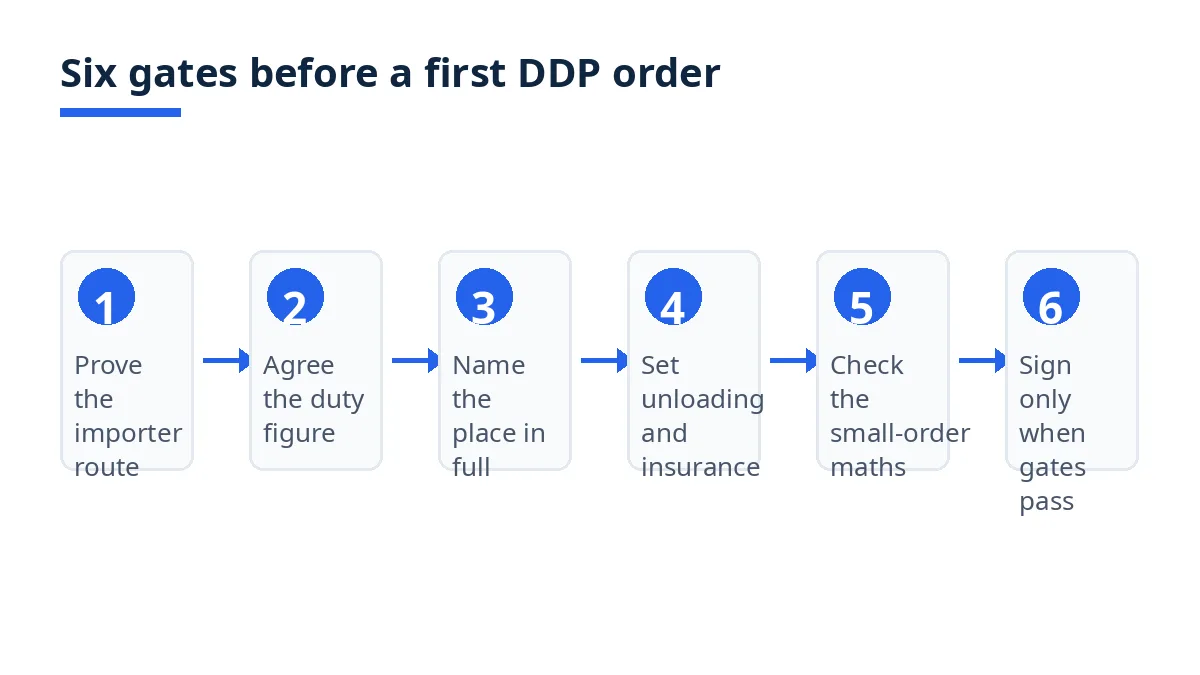
Gate one: prove the seller can stand as importer
Ask for four items in writing: the name of the person or company that will be named as importer, the registration number that person will file under, the broker that will lodge the entry, and the written arrangement between the seller and that broker. For a United States delivery, the registration answer should connect to the CBP Form 5106 process.4 For a European Union delivery, it should connect to the EORI number and the member state where the first customs operation will take place.5
Some customs authorities make the local importer itself handle import clearance. Where that is the position, choose DAP instead; DDP is not available there.1 The ICC Academy guidance puts the point plainly: import clearance under DDP may be difficult for a foreign seller, and where local rules prevent the seller from managing it, DAP suits the order better.1
Gate one also covers tax. Import VAT is normally recoverable by the importer of record, and under DDP the importer of record is the seller, a foreign business that frequently cannot register for, or reclaim, VAT in the destination country.3 The irrecoverable VAT is then priced into the goods, so a DDP price can be worse value than a DAP price plus the buyer's own recoverable import VAT.3
Gate two: see the duty and tax figure before you agree
A DDP price that cannot be split cannot be checked. Ask the seller to separate five lines: goods, carriage, export clearance, import clearance, and duty and taxes. Get a broker estimate on the same classification and value, and compare it with the seller's duty and tax line.
No duty rate is stated in this guide, because no rate is safe without the tariff schedule for the destination country and the classification of the exact goods. Confirm the rate with the broker before the order is placed. The seller should also state what taxes the DDP figure includes. The parties may vary DDP so that specified taxes are excluded, but the variation must be written into the contract; a quotation that says "DDP" with no qualification should be read as duty and taxes included.1
Agree what happens if the duty figure moves between signing and arrival. Under DDP the seller carries the import bill, so the seller carries that movement unless the contract says otherwise.1 Make the cap explicit: the DDP price includes duty and taxes as assessed on arrival, and no further import charge will pass to the buyer.
Gate three: unloading, insurance, and the named place in full
Under DDP the buyer unloads, bearing the unloading risk and typically the cost, unless the transport contract puts the cost on the seller.1 A first-time importer working from a home address, a shared warehouse, or a storage unit without a loading bay must plan for labour, equipment, and receiving hours before the goods arrive.
Insurance needs a separate written line. DDP puts no insurance duty on the seller, although the seller carries transit risk and may insure its own interest.1 Agree who insures the journey, for what value, over which leg, and who claims if the goods arrive damaged. If the seller is to insure for the buyer's benefit, name the buyer as entitled to claim, and get the policy wording or a certificate before the goods move.
Name the place as a full address, not a city, port, or region. Delivery and risk transfer happen at the named place, so a vague place leaves the delivery point open.1 Write the term in full: "DDP, [full address], Incoterms 2020", with the bay or gate, receiving hours, a delivery-day contact, and the seller's arrival notice.
What a first DDP order looks like, in example figures
The example below is a trial order of 400 handloom cotton tote bags from Bangladesh to a buyer's studio in Manchester, United Kingdom, on DDP terms to the studio address. All figures are example figures. No duty rate is stated; the duty and tax line is an allowance the broker must confirm before an order is placed.
Price line | Example figure (USD) |
|---|---|
Goods, 400 tote bags at $4.20 | 1,680 |
Export packing | 140 |
Export clearance and documents | 110 |
Inland transport and port handling | 260 |
Ocean freight, Chattogram to Liverpool | 1,150 |
Insurance for the seller's own risk | 70 |
Subtotal before import | 3,410 |
Import clearance and broker fee | 190 |
Duty and import taxes, allowance | 520 |
DDP price to the studio address | 4,120 |
The arithmetic is 1,680 + 140 + 110 + 260 + 1,150 + 70 = 3,410, and 3,410 + 190 + 520 = 4,120, which is $10.30 per bag. Priced as DAP, the same shipment costs $3,410 before import, plus a buyer-side clearance fee of $150 and the same $520 duty and tax allowance, giving $4,080, or $10.20 per bag. The clearance fee alone shows the fixed-charge point: $190 is $0.48 per bag on 400 bags, since 190 divided by 400 is 0.475, but $1.90 per bag on 100 bags.
Bangladesh departure: what DDP does not change at origin
At destination, DDP moves clearance to the seller. The export file in Bangladesh stays the same. Loading for export is barred until the Bill of Export, also called the shipping bill, is submitted to and approved by the customs authority.6 The Bill of Export enclosures for all export consignments include the authorised-dealer-certified EXP form, the certificate of origin, the taxpayer identification number, the VAT registration certificate, the commercial invoice, the packing list, and the export letter of credit or contract.6
Confirm two origin points before shipment. First, the invoice and packing list must describe the same goods, quantity, and value as the Bill of Export, because a mismatch commonly delays goods at destination. Second, any product-specific paper the goods require must be in hand before loading.6 DDP gives no shortcut past the origin file: export clearance sits with the seller under DDP, as under every other Incoterm except EXW.1
Six offers to decline before you sign
Decline an offer that names no importer, no broker, and no registration. If the seller says the freight company will "handle customs" and gives no name, the import route is unproved.
Decline a DDP price with no duty basis. A single figure with no split between goods, carriage, clearance, and duty cannot be checked against a broker's estimate, or ranked against a DAP quotation.
Decline a quotation that leaves the VAT position silent where the buyer is VAT-registered. The seller may be unable to reclaim import VAT, and the cost may sit inside the price where the buyer cannot recover it.3
Decline a named place that is a depot, a port area, or a city. A depot delivery can leave the buyer paying onward transport it never budgeted for, while the seller has performed the contract.1
Decline a term written without its edition. "DDP" alone, with no named place and no "Incoterms 2020", leaves the delivery point and the version of the rules open to argument.3
Decline an offer that asks the buyer to file the import entry while calling the sale DDP. Filing the entry, paying the duty, and standing as importer are the seller's duties under DDP.1 If the buyer is to do them, write the sale as DAP or DPU.
Your first-order decision, in one page
Answer every line in writing before you sign.
The importer is named, with the registration number and broker, confirmed by the broker itself.
The duty and tax figure is split out, checked against a broker estimate on the exact goods, and the contract states no further import charge will pass to the buyer.
The VAT treatment is confirmed in writing, and the DDP price has been compared with a DAP price plus the buyer's own recoverable VAT where that applies.
The named place is the full receiving address, with bay or gate, receiving hours, and a delivery-day contact, written into the term with "Incoterms 2020".
Unloading labour and equipment are arranged, the waiting position is agreed, and the seller's arrival notice is fixed.
Insurance is agreed in writing: who insures, for what value, over which leg, and who claims if the goods arrive damaged.
The Bangladesh export file is confirmed: the Bill of Export approved before loading, and the invoice, packing list, and product-specific papers matching the declaration.6
The DAP price for the same goods, quantity, and named place is on file, so the DDP premium is visible, not guessed.
If every line is yes, DDP fits a first order well. If a line is no, complete it, price it, or change the rule to DAP or DPU.
Should a first-time importer choose DDP for a trial order?
Choose DDP for a trial order only when the seller proves it can stand as importer at destination, the duty figure is split out and checked, and unloading is arranged at the named place.1 DDP suits a trial where the lesson concerns the supplier and the product, not the import file.
How much extra does DDP add to a small first order?
DDP sets no standard charge, so the extra amount is whatever the seller adds for import clearance, duty, taxes, and the risk of carrying them, over the carriage-paid price.1 In the example above, DDP added $40 over the DAP all-in figure on 400 tote bags, or $0.10 per bag.
Which papers does a first-time buyer still need under DDP?
The buyer still needs to supply the documents and information the import authorities ask for, promptly, when the seller or its broker requests them, because the buyer assists the seller under article B7 while the seller stays responsible for the clearance.1 Hold business identification details, product specification and classification inputs, any destination certificate the goods require, and the unloading contact ready before shipment. At origin, the seller's export file must match the import entry.6
What first-order DDP error costs the most?
The costliest error is signing a DDP sale whose seller cannot act as importer at destination, because the goods then arrive with no lawful route to clearance and the buyer must build an import file under time pressure or change the term mid-shipment.1 Next is ranking a bundled DDP price against a DAP price without separating duty and taxes, which hides the real premium for the seller's import work.
Next steps on Exportain
Start with the guide that sets out each Incoterms 2020 rule for Bangladesh shipments, and read the explanation of the seller-insured sea alternative where a sea shipment with seller-paid freight and insurance is the comparison you need. When the importer proof, the duty figure, and the unloading plan are fixed, check the steps for buying through Exportain and ask each supplier to quote DDP and DAP side by side, with the import lines separated.
Post a free RFQ on Exportain and get quotes from verified Bangladeshi suppliers
Sources
- DAP & DDP Incoterms 2020 explained: Key differences. ICC Academy (accessed )
- Incoterms® 2020. International Chamber of Commerce (ICC) (accessed )
- Incoterms® 2020: DAP, DPU and DDP. Eastwest Medico, (accessed )
- CBP Form 5106 - Create/Update Importer Identity Form. U.S. Customs and Border Protection (accessed )
- Economic Operators Registration and Identification number (EORI). European Commission, Taxation and Customs Union (accessed )
- Customs Clearance Procedures for Export. Bangladesh Customs, National Board of Revenue (accessed )
- Incoterms
- landed cost
- cargo insurance
- buyer guide
- customs clearance
- importing from Bangladesh
- First-time importers
About the author
Sourcing from Bangladesh?
Post a request for quotation and suppliers on Exportain can send you their quotes directly.
Post an RFQ