Netherlands LED Bulb Imports From Bangladesh: Step-by-Step Guide
Netherlands buyers importing LED bulbs from Bangladesh: name the Dutch importer and producer, build the CE and energy-label file for the exact lamp, register with Stichting OPEN, and confirm duty and 21 percent VAT with a broker.
Short answer
To import LED bulbs from Bangladesh to the Netherlands, name the Dutch importer and producer first, then build the CE file for the exact lamp: safety, electromagnetic compatibility, hazardous substances, ecodesign and energy labelling, plus Stichting OPEN producer registration. Have the broker confirm the tariff code, duty, origin proof and 21 percent VAT treatment, agree the specification, trial order and delivery term in writing, and price landed cost on broker-confirmed figures.
On this page
Key takeaways
The Dutch importer checks the conformity assessment and keeps the declaration and technical documentation for 10 years, while the Dutch producer registers with Stichting OPEN and reports annually.
No duty rate is stated: no EU tariff schedule page for LED bulbs was opened, so the broker must confirm the tariff line, rate, origin proof and EBA preference for each consignment.
The energy label is printed on the packaging and the product information values go into the public product database, with label, database entry and lamp marking agreeing on model and class.
Import VAT is worked at the 21 percent general tariff as a cash-flow figure, with the broker and accountant confirming the value it is charged on and its recovery position.
A Netherlands buyer who treats an LED bulb order as a price negotiation first will meet the Dutch border as a second negotiation, with different parties and different evidence. The importer identity, the producer registration, the conformity file and the advance cargo filing are all settled before the container reaches a Dutch port. This guide works in that order: the Dutch roles first, the product file second, and the commercial terms only once the file is in place. No typical price, minimum order, transit time or duty rate is presented here as fact: none came from a Netherlands or EU tariff source opened for this product, so every commercial figure below is an example figure, and duty is priced only on a broker-confirmed line.
Start with who the Dutch importer and producer are
Two Dutch roles decide most of the later work, and they can sit with two different businesses. The importer is the person in the European Union who first places goods from a third country on the EU market. Under the low voltage rules, an importer must check that the manufacturer carried out the conformity assessment correctly, must tell the safety monitoring authority if the equipment does not conform, and must indicate contact details on the equipment.1 Under the electromagnetic compatibility rules, an importer must likewise check the assessment, ensure the technical documentation was drawn up, the CE marking is present and the required documents travel with the apparatus.2 In both regimes the documentation must be kept for 10 years.1 2 Settle, in the order, who the importer is, whose name and postal address go on the product or its packaging, and who holds the declaration and the technical documentation.
The producer role under Dutch waste rules is separate. Extended producer responsibility applies to a business that is first to market equipment under its own name or brand in the Netherlands, first to trade in equipment under its own brand, first to import and market equipment, or that sells directly to end users in the Netherlands from abroad.3 A Netherlands buyer importing LED bulbs from Bangladesh and selling them under its own brand should therefore expect the producer question to point at itself, not at the Bangladeshi factory. Name both roles before any supplier is shortlisted.
Name the lamp, the module and the containing product before quoting
A quotation cannot be compared until the goods in it have one agreed description. The ecodesign regulation defines a light source as an electrically operated product made to emit light, with a colour rendering index above zero, luminous flux from 60 to 82,000 lumen, and using LED among the listed lighting technologies.4 Under that definition, LED dies, chips and packages do not count as light sources, and products holding light sources that can be taken out for checking are also outside it.4 A containing product is a product holding one or more light sources or separate control gears, such as a luminaire that can be taken apart so the contained source can be checked separately; where a containing product cannot be taken apart for checking, the whole product counts as a light source.4
That distinction decides the paperwork: a capped bulb for household fitting is handled as a finished light source, with its own label and declaration, whereas a bare board that functions only once built into a fitting the buyer assembles belongs in a different file altogether. The energy labelling regulation applies the same distinction: its requirements cover light sources with or without integrated control gear, and also light sources placed on the market in a containing product.5 Write the description once, in the order, the invoice and the conformity file, using the same words in all three: finished lamp or module, cap type, whether the source can be removed, and whether any wireless control is fitted.
The CE file, split by who must hold what
CE marking is a claim that the product meets every applicable EU requirement, and the file behind the mark is what a market surveillance authority will ask to see. Under the low voltage summary, every item of electrical equipment sold in the EU carries the CE marking, the manufacturer must conduct a safety and conformity assessment, prepare the technical documentation, then sign and issue an EU declaration of conformity, and the declaration and technical documentation must be kept for 10 years.1 Instructions and safety information must use a language end users can easily understand, as the national authority concerned determines, and manufacturers and importers must indicate their contact details on the equipment.1 Agree Dutch wording for instructions and safety information with your adviser at the start, and agree whose contact details appear where, rather than discovering a language gap when cartons are already printed.
Divide the file by actor. The manufacturer in Bangladesh produces the assessment, the technical documentation and the signed declaration for the exact model. The Netherlands importer checks that the assessment was carried out, that the documentation exists, that the marking is present and that the required documents accompany the goods.1 2 Ask for the file model by model, and check that the model identifier, the cap, the rated values and the standards named in the declaration describe the lamp in the order, not a neighbouring model. A declaration for a different wattage, a different driver or a bare module does not cover the finished lamp. If the supplier answers with a brochure, or says the paperwork will follow after shipment, treat the file as missing and hold the order.
Safety and interference: two assessments, one declaration
Electrical safety and electromagnetic compatibility are separate checks on the same lamp, and a pass on one does not imply a pass on the other. The low voltage directive covers electrical equipment designed for a voltage rating of 50 to 1,000 volts where the current alternates, and 75 to 1,500 volts where it is direct, and covers health and safety risks so equipment is used safely for the applications for which it was made.1 A mains-voltage LED bulb for Dutch homes sits inside that band. The driver is the part to question first: it prepares the mains supply for the format the light source requires, and a change of driver can change the safety and interference evidence even when the bulb looks the same from outside.
Electromagnetic compatibility has its own aim: equipment must not introduce intolerable electromagnetic disturbance, and must be able to perform as intended without degradation in the presence of electromagnetic disturbance.2 Ask what assessment was carried out for this exact model and driver, what evidence supports it, and whether the declaration covers the electromagnetic compatibility rules for that model. Re-check whenever the driver, the LED package or the cap changes, and record the change rule in the order: the supplier must tell the buyer before a changed driver ships. A bulb with wireless control adds a further question: ask in writing, before sampling, whether any wireless function brings an additional conformity file with it.
Hazardous substances: ten limits, checked material by material
Restriction of hazardous substances is a materials check, not a product-level average. The directive aims to strengthen rules on hazardous substances such as lead, mercury and cadmium in electrical and electronic equipment, to protect human health and the environment and to enable sound recovery and waste treatment.6 Its Annex II sets maximum concentration values tolerated by weight in homogeneous materials, and the 2020 consolidated text lists ten substances: lead at 0.1 percent, mercury at 0.1 percent, cadmium at 0.01 percent, hexavalent chromium at 0.1 percent, polybrominated biphenyls at 0.1 percent, polybrominated diphenyl ethers at 0.1 percent, and the four phthalates DEHP, BBP, DBP and DIBP each at 0.1 percent.6
Substance | Maximum concentration by weight in a homogeneous material |
|---|---|
Lead | 0.1% |
Mercury | 0.1% |
Cadmium | 0.01% |
Hexavalent chromium | 0.1% |
Polybrominated biphenyls (PBB) | 0.1% |
Polybrominated diphenyl ethers (PBDE) | 0.1% |
Bis(2-ethylhexyl) phthalate (DEHP) | 0.1% |
Butyl benzyl phthalate (BBP) | 0.1% |
Dibutyl phthalate (DBP) | 0.1% |
Diisobutyl phthalate (DIBP) | 0.1% |
A homogeneous material is a material of uniform composition throughout, or a combination of materials that cannot be separated by mechanical actions such as unscrewing, cutting, crushing or grinding. The solder on a circuit board, the plastic of the housing and the plating on a connector pin are therefore separate materials, and each must sit under its own limit. Ask for material-level evidence for the exact model, and ask whether any exemption is claimed for a specific application, with the entry and its expiry position stated in writing. Exemption lists are updated in line with technical progress, and several exemptions have been added while others have expired, so an exemption that applied to a fluorescent lamp must not be carried across to an LED lamp without checking.6
Ecodesign and the label: the database entry comes before the carton
Ecodesign sets the performance floor and energy labelling sets the information buyers and authorities see, and both run through the same technical documentation. The ecodesign regulation establishes requirements for placing light sources and separate control gears on the market, and those requirements also apply to light sources and control gears placed on the market in a containing product.4 It also requires that light sources and separate control gears in containing products can be replaced with common available tools and without permanent damage, unless a technical justification related to functionality is given in the technical documentation, and that information on replaceability and dismantling at end of life is provided.4 This guide states no efficiency, lifetime or flicker threshold from the ecodesign annexes, because those annexes were not opened line by line for this product. Ask the supplier to name the requirements that apply to the exact model, to show the calculation and test evidence behind the declared values, and to confirm that the declared values match the values on the packaging.
The label follows the same evidence. Under the energy labelling regulation, suppliers must ensure a label printed on the packaging accompanies each light source sold as a standalone product in packaging, that the values in the product information sheet are entered into the public part of the product database, and that the content of the technical documentation is entered into the product database.5 Suppliers must also make an electronic label and an electronic product information sheet available to dealers for each model.5 Agree at sample stage who acts as supplier for the database entry: the manufacturer established in the EU, its authorised representative, or the importer who places the product on the EU market. Check the label on the carton, the database entry and the lamp marking together before printing: all three must agree on model, class and declared values.
Dutch producer registration: OPEN, the register and the annual return
Waste duties in the Netherlands run through one foundation and one register, and they start when goods are first put on the Dutch market, not when they are sold at retail. A business with extended producer responsibility must sign up with the OPEN foundation (Stichting OPEN), and will then be registered with the National (W)EEE Register.3 It must report annually on the number of electrical appliances and energy saving light bulbs put on the market, exported, collected or processed, and the OPEN foundation arranges collection of discarded appliances.3 The wider duties are that e-waste must be collected separately, the set collection rate must be achieved, collected equipment must be processed properly, information on reuse and disposal must go to waste processing installations, batteries and accumulators must be easily removable, and e-waste must be registered and reported on annually.3
Settle the producer position in writing before the first shipment: who registers with Stichting OPEN, who files the annual return, who pays the waste management contribution, and who holds the evidence. If the buyer sells under its own brand, the Business.gov.nl triggers point at the buyer as first to market under its own name or brand, or first to import and market the equipment.3 Retail duties sit alongside the producer duties: a retailer selling a new appliance must collect discarded appliances from customers free of charge where it sells comparable appliances, and that requirement applies to energy-efficient light bulbs and to web shops.3 Plan take-back handling at the same time as the first order, not after the first customer asks where a spent bulb goes.
Evidence from a Bangladeshi supplier: what to request, in what order
Work from a checklist, and check every answer against the model named on the order. Begin with the trading entity: the registered name and address of the business that will sign the export documents, and confirmation that one name runs unchanged across quotation, invoice, declaration of conformity and any origin proof. A name that varies between documents is a query to settle before production starts, not a detail to chase at the port.
Then ask for the conformity evidence for the model on the order: the signed EU declaration, the test reports supporting it, the specification those reports were measured against, and the label and packaging artwork. Confirm that the model identifier, rated values and driver named in the reports match the lamp ordered. Finish with the materials evidence behind the hazardous substances table, the ecodesign calculation and test evidence, and the energy label artwork with its database entry details. A supplier able to show the complete file for the model on the order, with names and numbers consistent throughout, has cleared the first gate. A supplier offering only a catalogue, or promising documents after shipment, has not. File the complete set with the order so it can be handed over as one bundle if an authority asks.
Specification, samples and lot checks that match the Dutch file
Put the specification in one table where each claimed value sits beside its proof. Start with the driver: its type, whether it sits inside the lamp or apart from it, and how it dims where dimming is offered. Then the cap, and the voltage the lamp is rated for. Then the light itself: wattage claimed, lumen output claimed, colour temperature, and any lifetime claim. Then any claim about outdoor use or ingress protection. Beside each claim, note the test method or standard the supplier relied on and the report holding the result. A claim with no report behind it stays unproven: leave it out of pricing, labelling, advertising and the database entry until the report exists.
Use two sample stages, and record both in the same document. A development sample shows whether the factory can build the lamp to the cap, flux and colour temperature in the specification. A pre-production sample, made from production parts — module, driver and cap — is the unit to approve for bulk, with marking, label and packaging identical to the bulk run. Test samples at the Dutch rated voltage, compare measured flux and colour temperature with the declared values, look for colour variation across the set, and run a burn-in trial to catch early failures. Approve in writing and retain one sealed counter-sample of each model alongside its test report. Check each lot before shipment against the specification and the approved sample: count, cap and marking, label and database data, carton markings, declaration model number and pack condition. Put the counting and packing rules in the same document, and settle the failure terms there too: what follows a failed lot, who re-tests, who pays, and what evidence closes the matter.
Order size, price parts and the trial shipment
Treat every price and minimum as supplier-specific. No industry minimum for this product was found in the Netherlands or EU material opened for this guide. Negotiate the minimum per supplier and per variant, and write down whether it applies per model, cap type, colour temperature or packaging variant. Run a trial order first, under the same paperwork bulk will use. When comparing quotations, split the price: lamp, packaging, testing and file work, transport and insurance on the chosen delivery term, and any charges for labels, artwork or inspection. Compare like with like — one delivery term, one file — and record the currency and the charging basis (shipped quantity, or quantity usable when the goods arrive), plus who absorbs lamps that cannot be used.
The Dutch border sequence: advance filing, declaration, duty and VAT
Goods entering the EU pass through an advance filing stage before they reach the Dutch declaration stage. Under the Import Control System 2, economic operators must submit a complete Entry Summary Declaration in the ICS2 system for all goods transported to or through the EU before their arrival, with a minimum set of information also filed before loading for air transport.7 A complete declaration holds the data elements required for the mode of transport or business model, single or multiple filings may be used depending on contractual arrangements, customs authorities perform pre-loading or pre-arrival safety and security risk analysis, and goods must be presented to customs on arrival.7 To connect to ICS2, operators must obtain an EORI number from an EU Member State customs authority.7 Confirm with the carrier and forwarder, in writing, who files each part of the declaration and what data the buyer must supply. The buyer supplies the product description, the tariff code and the party details the filing needs.
The Dutch declaration follows. Goods brought from outside the EU into the Netherlands must be declared to Dutch Customs, which calculates the duty on the declaration and decides whether other customs rules apply, for example on safety, health, economy and environment.8 Declarations must be made electronically through the DMS system, and a business with little import experience should hand the declaration to a shipper, logistics provider or customs agent.8 For goods imported through a Dutch port, a Container Release Message (CVB) is also needed: with the CVB in place, the import declaration follows unloading rather than preceding it, and the CVB applies to containers, trailers, general cargo and bulk cargo.8 An EORI number is required when first submitting a customs declaration, having one submitted on your behalf, or applying for an authorisation with Customs, and a business filing its own declarations in the Netherlands can create its own number starting with NL followed by its RSIN padded to nine digits, free of charge, while a business using a third party to file must always apply for one.9 Settle the EORI position before the goods sail.
The EU tariff schedule page for this product was not opened during preparation, so this guide carries no duty rate. Ask the broker to identify the tariff code for the lamp ordered, the rate applying on the import date, the supplementary unit the declaration requires, and to cost duty from that confirmed line alone. Preference could change the outcome, but only where origin and proof are in order. Under Everything but Arms, least developed countries may send all products except arms and ammunition into the EU Single Market free of duty and without quotas.10 The Commission list of GSP beneficiary countries as of 1 January 2025 places Bangladesh under the EBA column.11 Whether preference applies to a particular consignment turns on the origin rules and valid proof of origin, so have the broker confirm both before duty is costed at zero. Import VAT is charged separately from duty. The Netherlands has three VAT rates, 0 percent, 9 percent and 21 percent, and the 21 percent general tariff applies to all other products and services unless an exemption or a reverse-charge reason applies.12 Work on the 21 percent general tariff as a cash-flow figure and have the broker and accountant confirm the value it is charged on and how it is accounted for in the buyer's VAT position.
Delivery terms for a container bound for a Dutch port
The delivery term decides where delivery and risk transfer happen, who arranges carriage and insurance, and who clears the goods for import, so it must match how containerised bulbs actually move. Of the eleven Incoterms 2020 rules, FAS, FOB, CFR and CIF — and no others — are confined to carriage by sea or inland waterway.13 CPT, DPU and DDP each apply across modes; DDP goes further, placing import clearance and duty on the seller, with unloading still the buyer's job.13 Where containers are involved, the ICC Academy guidance favours FCA over FOB even on a sea leg, since FCA lets delivery and risk pass at handover to the carrier, not only at loading on board.13
With a C rule, the seller bears the cost of carriage to the agreed destination, yet risk moves sooner — at handover to the carrier, or on loading aboard the vessel — and under CIP and CIF the seller must also insure the goods against loss or damage for the buyer's benefit.13 The D rules put delivery and risk at the named place of destination. DPU adds unloading by the seller; DDP adds import clearance by the seller.13 For a first container order to a Dutch port, compare FCA at the named terminal with FOB at the Bangladeshi port, and name the terminal, the carrier handover point and the import clearance plan in the contract. Agree separately, in the contract, what happens if the Dutch file fails at the border — no delivery term prices that refusal — and who handles import clearance, since DDP puts clearance on the seller and other terms leave it with the buyer. No transit figure for this route was opened, so none is stated here.
Landed cost example in euros
The figures in this section are examples only, chosen to show the calculation, not to predict a price. Substitute broker-confirmed figures for every line before ordering. Duty is entered at 0.00 euros as an example only, assuming the broker confirms a zero rate for the confirmed tariff line, with qualifying origin proof and valid proof of origin. Import VAT is entered as a cash-flow figure at the 21 percent general tariff, on the example customs value in the table.
Cost line | Example figure (EUR) | Basis |
|---|---|---|
Goods, 7,500 bulbs at 1.60 euros per bulb | 12,000.00 | Example figure |
International freight and insurance | 1,450.00 | Example figure |
Customs duty, entered as 0.00 example figure only | 0.00 | Broker to confirm tariff line, rate and origin proof |
Customs value for VAT (goods, freight and insurance combined) | 13,450.00 | Sum of the lines above |
Import VAT at 21 percent, working figure only | 2,824.50 | 21 percent of the customs value shown |
Broker and handling | 310.00 | Example figure, entered outside the VAT value in this example |
Total cash outlay | 16,584.50 | Sum of the lines above |
Cost per bulb shipped, 7,500 bulbs | 2.21 | Total divided by shipped quantity, rounded |
Cost per usable bulb, 7,350 bulbs at an assumed 2 percent loss | 2.26 | Total divided by usable quantity, rounded |
The calculation runs: 12,000.00 plus 1,450.00 plus 0.00 gives 13,450.00; twenty-one percent of that is 2,824.50; adding 310.00 gives 16,584.50, or 2.21 euros per bulb shipped and 2.26 euros per usable bulb at the assumed 2 percent loss. Ask the broker whether broker and handling charges sit inside the VAT value for the actual consignment, and whether import VAT can be recovered in the buyer's own VAT position. Run the same calculation through the worked example for landed cost on imports from Bangladesh, replacing every example figure with one the broker has confirmed.
The Netherlands import run, in order
Work through this run in sequence. The diagram gives the same run in one view.
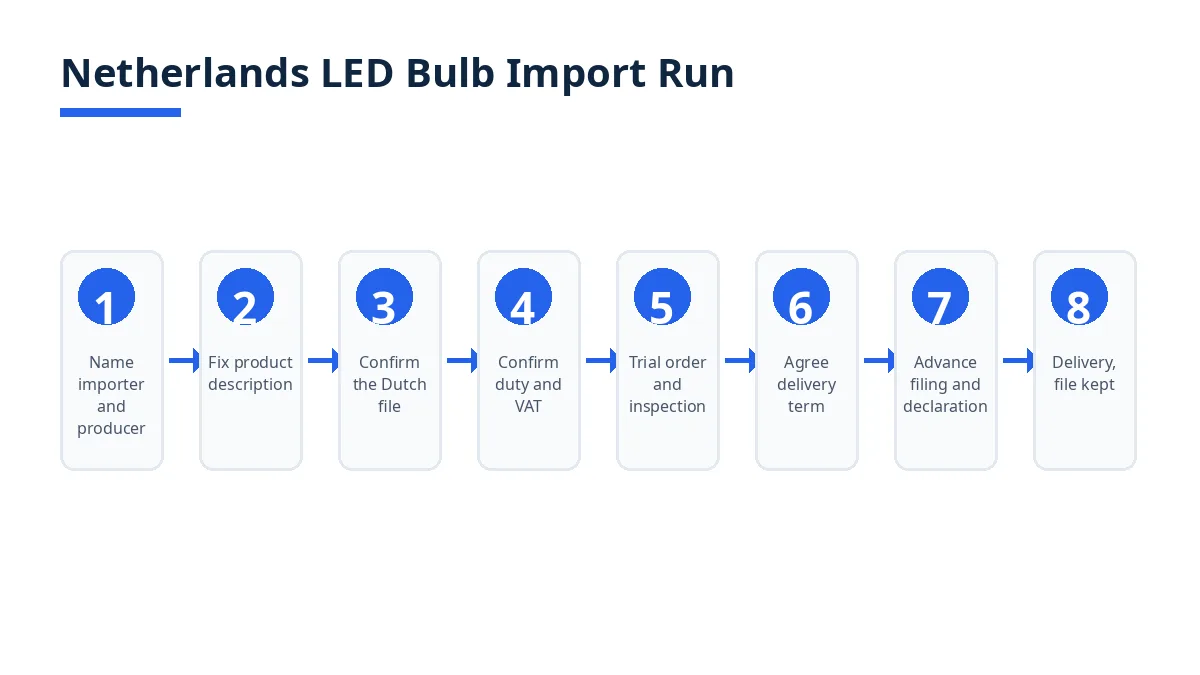
Name the Dutch importer and the Dutch producer, and record who holds the declaration, the technical documentation and the producer registration.
Fix the product description: finished lamp, module or containing product, cap type, wireless features, and whether the source can be removed.
Confirm the Dutch file for that product: safety, electromagnetic compatibility, hazardous substances, ecodesign, energy labelling and producer registration.
Confirm the tariff line, the duty position, the origin proof and the VAT treatment with the broker and accountant, before pricing.
Shortlist suppliers against the Dutch file, and record each answer model by model.
Agree the specification, counting basis, price parts, trial order, inspection points and failure rule in writing.
Ship a trial order on bulk paperwork; measure it against the specification and file, and keep photographs of marking and label.
Agree the delivery term, named places, import clearance plan, advance filing owner and conformity failure plan, in writing.
Approve packaging artwork, including the energy label and database data, before printing.
Manufacture, inspect each lot, and ship the consignment with its invoice, packing list, transport document, origin proof and conformity file, completing the advance filing before arrival.
Submit the declaration through DMS, take the CVB step where it applies, settle confirmed duty and VAT, present the goods if called for inspection, tally and examine them on arrival, and keep declaration, payment records and lot file in one bundle.
What order size should a buyer in the Netherlands agree for LED bulbs from Bangladesh?
This guide gives no typical minimum for LED bulbs bound for the Netherlands. The Netherlands and EU material opened for it contains no such figure. Fix the minimum supplier by supplier and variant by variant, in the contract, with the counting basis stated — by model, by cap, by colour temperature, or by packaging variant — and test the arrangement with a trial order on full paperwork before committing to bulk.
How long should a Netherlands buyer allow for LED bulbs to reach a Dutch port from Bangladesh?
This guide gives no transit time for the Bangladesh–Netherlands route; none was found in the material opened. How long loading-to-release takes depends on routing, carrier schedules, the delivery term, the advance filing, customs and any inspection, plus the CVB step at a Dutch port. Ask the carrier to put routing and scheduled times in writing, and ask the broker what customs and inspection may add at the port.
What duty and VAT apply when LED bulbs from Bangladesh enter the Netherlands?
This guide gives no duty rate for LED bulbs: the EU tariff schedule page for this product was not among the sources opened during preparation. The Everything but Arms scheme grants full duty-free and quota-free access to least developed countries for all products except arms and ammunition, and the Commission list as of 1 January 2025 places Bangladesh under the EBA column, but preference turns on the origin rules and valid proof of origin.10 11 Have the broker confirm the tariff code, the duty rate and whether preference applies. Import VAT is separate: the general tariff in the Netherlands is 21 percent, applying to all other products and services unless an exemption or reverse-charge reason applies.12
How does a buyer in the Netherlands check a Bangladeshi LED bulb supplier before ordering?
Check the Dutch file, not the catalogue. Request the registered name and address of the business, the signed EU declaration with its test reports for the model on the order, the materials evidence behind the hazardous substances limits, the ecodesign calculation and test evidence, the energy label artwork with its database entry details, the origin proof position, and the producer registration position for the Dutch market. Confirm that the names and model numbers on the quotation, invoice, declaration, reports and packaging all match, and that the trial shipment bears the same marking and label the bulk run will bear.
Next steps on Exportain
Begin with the import process for Bangladesh in general, then look through the directory of Bangladeshi suppliers with the specification and the file questions set out above ready to send. Before ordering, read the steps for buying on Exportain. Post a free RFQ on Exportain and get quotes from verified Bangladeshi suppliers
Sources
- Directive 2014/35/EU on electrical equipment designed for use within certain voltage limits — summary. EUR-Lex, European Union (accessed )
- Directive 2014/30/EU on electromagnetic compatibility — summary. European Union (accessed )
- Disposal of electrical and electronic appliances. Business.gov.nl (accessed )
- Commission Regulation (EU) 2019/2020 laying down ecodesign requirements for light sources and separate control gears. European Union, (accessed )
- Commission Delegated Regulation (EU) 2019/2015 with regard to energy labelling of light sources. European Union (accessed )
- Directive 2011/65/EU on the restriction of the use of certain hazardous substances in electrical and electronic equipment (consolidated text, 1 March 2020). EUR-Lex (accessed )
- Import Control System 2. European Commission (accessed )
- Declaring goods to the Dutch Customs. Business.gov.nl (accessed )
- How to obtain an EORI-number. Dutch Customs (accessed )
- Trade arrangements. European Commission, Access2Markets (accessed )
- List of GSP beneficiary countries as of 01 January 2025. European Commission (accessed )
- VAT rates and exemptions. Business.gov.nl (accessed )
- Place of delivery & risk transfer in trade contracts. ICC Academy (accessed )
About the author
Sourcing from Bangladesh?
Post a request for quotation and suppliers on Exportain can send you their quotes directly.
Post an RFQ