Custom Leather Shoes Manufacturer in Bangladesh: OEM Process From Tech Pack to Bulk
A custom leather shoe order is built to the buyer's design from a versioned tech pack: last, pattern, sample gates, grading, and a signed PP pair before bulk cutting.
Short answer
A custom leather shoe order in Bangladesh is built to the buyer design from a versioned tech pack, not taken from a catalogue. The buyer supplies the last reference, measurements, materials, and construction notes; the factory makes the pattern and the samples. Bulk cutting starts only after the proto, fit, size set, and pre-production gates are approved in writing.
On this page
Key takeaways
A custom order is built to the buyer's design from a versioned tech pack; a private label order puts the buyer's brand on a shoe the factory already makes.
The last fixes shape, fit, and size range, so the pack is built around the last reference, flats, tolerances, and bill of materials.
Bulk cutting starts only after the proto, fit, size set, and pre-production gates are approved, each against the current pack version.
Grading, widths, and the size curve decide the last forms and the pair count: six sizes need twelve forms, and a second width doubles the count.
A custom leather shoe order in Bangladesh begins with a design that belongs to the buyer, not with a shoe already on a factory shelf. The buyer supplies the shape, the measurements, the materials, and the way the shoe is built. The factory supplies the last, the pattern, the cutting, and the production line. When those two sides meet in one written pack, sampling has a fixed target.
This guide is for buyers in the USA, UK, EU, or UAE who want a leather shoe made to their own design in Bangladesh, from the first last reference to the bulk cutting decision. It states no price, minimum, or lead time as fact. Example figures are labeled and checked below.
A shoe you designed, or a shoe you branded
Settle which route the order takes first, because the two routes ask for different documents. A custom order, often called OEM, means the shoe is built to the buyer's design: the buyer hands over the design and the specification, and the factory makes a shoe it has not made before. A private label order means the buyer's brand goes on a shoe the factory already makes.
Three questions separate the routes. Who chose the last and the shape of the shoe? Who wrote the measurements, the material list, and the construction notes? Would the factory need a new pattern before it could cut the first pair? If the answers point to the buyer on all three, the order is custom work. If the shoe already exists and only the brand changes, the order belongs on the private label route.
A manufacturing agreement should state, before the first pattern is cut, who owns the drawings, the pack, and any pattern or tooling built from the buyer's design, what the factory may do with the design beyond the buyer's order, and what happens to patterns and tooling when the order ends.1 Send the full pack in stages, under a written confidentiality term, rather than sending every detail to every factory asked for a price.1
Build the pack around the last, not around a picture
A tech pack is the instruction manual a factory uses to price, sample, and make a style.1 For shoes, the pack must be built around the last, because the last fixes the shape, the fit, and the size range before any leather is cut. Assessment of a last checks its dimensions and suitability for its intended market, including fitting trials on new ranges.2
A shoe pack carries these parts, each filled in and versioned, with a version number and date on every page: cover and style summary; technical flats; last reference; points of measure; bill of materials; construction notes; grading and size curve; colorways and artwork; labels and packaging; commercial terms; compliance and change log.1
The flats do the work a photograph cannot. Technical sketches show what a pair of shoes must look like when manufactured, from the side, the top, and the bottom of the sole, and the pattern maker develops the pattern from those sketches.3 A fashion illustration or a reference photo leaves proportions and hidden details to the factory to interpret. State color by reference number for each component, and name the supplier for each material in the bill of materials.3
Measurements for shoes need their own list: full height of the shoe, heel height, sole length, shoe width, shoe opening length, and sole height, with callouts showing how each measurement is taken.3 Give every point of measure a tolerance. Without a tolerance, there is no agreed line for accepting or rejecting a sample or a bulk pair.1 The bill of materials is the section factories cost from: shoes are complex products made of many parts, from outer materials like leather, heels, and soles to inner materials like steel shanks, shoemaking nails, and reinforcement glue.3 1 A costing sheet turns that list into a price for one pair and for the whole run.3
From last to pattern to first pair: closing, lasting, and sole attaching
Work moves in a fixed order, and skipping a step moves its cost into a later round. First, the last is settled and the pattern is developed in the base size from the flats and the measurement table.3 Next, the upper is cut and closed: panels are stitched together, linings are attached, and reinforcements, eyelets, and trims go in at the points the flats call out. Then the upper is lasted, pulled over the last and held in the shoe shape, and the insole, shank, and sole are attached by the build named in the pack.
Name the sole build in the pack in plain words, and name the outsole material beside it. A welted build and a cemented build use different operations and different tooling, so a quotation that mixes the two builds in one pair count is pricing two different shoes. Heel height, heel material, and heel attachment belong in the construction notes. If a last must be made or changed for the order, say so in the pack.
Keep every pack version, and bump the version and withdraw the old version whenever a change is agreed.3 1
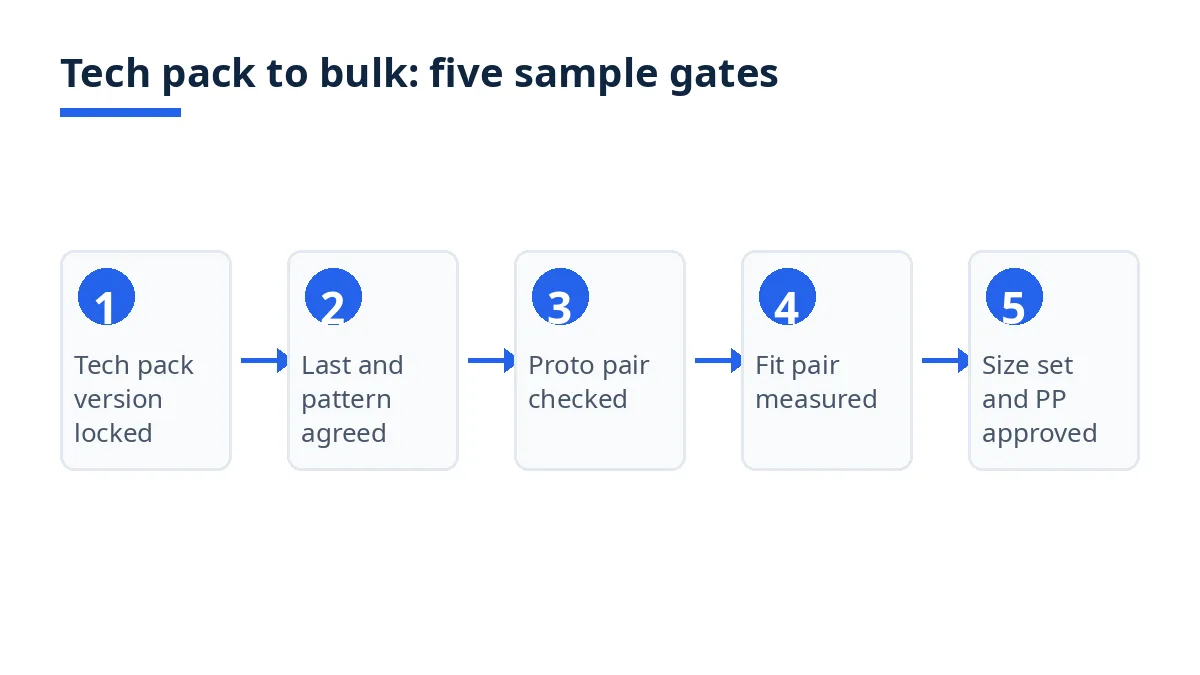
Sample gates: proto, fit, size set, PP, and TOP
Samples arrive in rounds, and each round answers a different question. The pack is updated after every round, because each stage has a different job.1 Judge each pair against the pack version current at that round, in person, not from photographs alone.
Proto pair. The first physical pair tests whether the design works at all, often in substitute leather. Judge construction, proportions, and trims.1
Fit pair. The fit round checks fit and measurements point by point at the base size, on a form or a wearer.1
Size set. One pair per size checks the grade rules across the full range. No bulk cutting starts on a base-size approval alone.3
Pre-production pair. The PP pair is made in bulk leather and bulk trims, with the final labels and packing, and it becomes the approved standard for bulk.1 Keep the approved PP pair with the matching pack version: if bulk arrives wrong, those two things are the evidence.1
Top-of-production pair. A TOP pair is pulled from the first bulk run to confirm that bulk matches the PP pair.1
The diagram below shows the gates in order, with the decision each gate must produce before the next gate opens.
Grading, widths, and the curve bulk is cut to
Grading takes the approved base-size pattern and extends it across the size range, using grade rules written into the pack before the size set is made. A last assessment can compare last dimensions with foot-dimension data to estimate how much of a population a last is likely to fit.2 The factory's own size chart governs the order: write it into the pack, with the mapping to the sizes the buyer sells in, and check the whole run with the size set before PP approval.
Widths are a second range hiding inside the first. One width grade does not prove another, so a narrow, standard, and wide version of the same style needs its own last reference and fit check. Example figures only: six sizes need twelve last forms, six left and six right, and a second width doubles the count to twenty-four (6 sizes x 2 feet x 2 widths = 24).
The size curve is the split of pairs across sizes inside the order total, and it must add up before bulk is cut. Example figures only: sizes 41 to 46 at 15, 25, 35, 35, 25, and 15 pairs total 150 pairs (15 + 25 + 35 + 35 + 25 + 15 = 150). A curve agreed after the PP pair can reopen the minimum, the material order, and the carton plan. Put the curve in the pack at the grading stage, and repeat it on the purchase order.
Price and calendar: what each gate adds
A custom shoe quotation is built from blocks, and each block reads a different part of the pack: materials from the bill of materials and grading, labor from the flats and construction notes, decoration from the artwork page, and testing from the construction and compliance pages.1 Overhead, margin, and delivery follow the quantity, the deadline, and the delivery term.1 Ask every factory to quote on the same delivery term. Under the Incoterms rules, an FOB price covers goods loaded onto the vessel at the port of shipment, with the buyer paying freight, insurance, and import costs from there, while a DDP price means the seller delivers with duties paid.1
Fixed setup costs fall per pair as the order grows. Example figures only: a last and tooling charge of USD 600 spread over 600 pairs adds USD 1.00 per pair (600 / 600 = 1.00). The same charge spread over 3,000 pairs adds USD 0.20 per pair (600 / 3,000 = 0.20). Each extra proto or fit round adds its own charge. Price the rounds in the quotation before sampling starts, and compare quotations only on one identical specification.
The calendar follows the gates, with a date and an owner for each one. No day count is stated here as a standard. Agree each gate date before sampling starts.
Bangladesh checks: lot identity, classification, and delivery terms
Check Bangladesh supply lot by lot, not by a general claim about a factory. Ask each factory for the producing site, and check that the name and address agree on the quotation, the invoice, and the packing list. Ask for the tannery name and the leather lot identity from the shoe maker evidence, with the test record that covers the lot offered.
Classification follows the shoe in front of the buyer. Footwear is classified by the material of the upper and the outer sole, the type and purpose of the shoe, whether it covers the ankle, the insole length, the heel height, and the intended wearer.4 The upper is decided by the material covering the greatest external surface area, with add-ons and reinforcements such as ankle patches left out of the count.4 Where leather covers the greatest area, the footwear falls under heading 6403; where textile covers the greatest area, it falls under heading 6404.4 Read 6403 as a starting point only. Settle the exact national line in the destination tariff, and ask a customs broker to confirm the duty rate for that line.
Only four Incoterms 2020 rules are restricted to sea and inland waterway carriage: FAS, FOB, CFR and CIF. The rest work on any mode, including CPT, DPU and DDP — DDP leaves import clearance and duty with the seller. Name the rule, the named place or port, and the Incoterms year in every quotation, and agree who unloads under DDP in a separate contract line.
On Exportain, read the guide that explains how supplier checks are recorded before shortlisting, and start the conversation with the pack written. Exportain takes no part in the goods contract. It does not examine the goods, arrange transport, or deal with customs. Check the export registration and trade license, and agree the Incoterm, payment, inspection, and shipment terms in writing before money moves.
Seven restarts that begin with a missing line
A pack with measurements but no tolerances, so no sample or bulk pair can be judged pass or fail.
A last changed after the fit pair, so the fit approval belongs to a shoe that bulk will not use.
A color agreed after the dye lot is fixed, so shade, lot, and count must be settled again.
Two sole builds counted as one order, so operations and tooling are priced for the wrong shoe.
Bulk approved from photographs, which cannot show fit, stretch, shade, or closure hold.
Ownership of the pattern and tooling left unwritten, so the first successful order becomes the dispute.
A catalogue shoe and a custom shoe mixed in one purchase order, so the gates and the price basis no longer match.
The sign-off file before bulk cutting starts
If a line is blank, the gate it belongs to is not closed.
Line | Record it exactly |
|---|---|
Pack version | Version number, date, pages confirmed received |
Last and fit | Last identifier, heel pitch, size system, width, fit-pair result |
Pattern and grading | Base-size approval, grade rules, size chart, size-set result |
Upper leather | Animal, grain treatment, finish, color reference, shade standard, lot identity |
Sole build | Build, outsole material, heel build, heel attachment |
Size curve | Pairs per size, adding to the total, per last, color, build |
Labels and packing | Wording, placement, artwork version, pairs per carton, carton marks |
Gates approved | Proto, fit, size set, PP approvals, signer, date, pack version |
Price basis | Unit price, delivery term, validity, payment terms |
Inspection and ownership | Inspection standard, defect classes, inspector, design, pattern, tooling ownership |
What should I settle first about a custom leather shoe order in Bangladesh?
Settle the route first: a custom order is built to your design from your pack, while a private label order puts your brand on a shoe the factory already makes. Then settle the last, the fit target, and the pack version, and put ownership in writing before the first pattern is cut.1
What do custom leather shoe costs and timelines look like?
Costs follow the pack blocks, with fixed last and tooling charges falling per pair as the order grows. Timelines follow the sample gates, so agree a date and an owner for each gate in writing.1
Which documents carry a custom leather shoe order?
The order is carried by the versioned tech pack, pattern and grading records, gate approvals, the approved PP pair with its matching pack version, the quotation, the ownership agreement, and the invoice and packing list.1 Documents should repeat the last, the leather lot, the color, the size curve, and the sole build agreed for the PP pair.
Where does a first custom shoe order usually go wrong?
A first custom shoe order usually goes wrong at a gate judged from the wrong evidence or a line left out of the pack: measurements without tolerances, a last changed after fit approval, a color changed after the dye lot, two builds counted as one, bulk approved from photographs, or ownership left unwritten. Close each gate from a pair, before the next gate opens.
Next steps on Exportain
Start with the pack written and the last reference named, then open the supplier listings for your shortlist and read how checks are recorded before sending the pack. Test the pair count against the minimum-counting rules, and send one pack version to each factory.
Sources
- Fashion Tech Pack: What a Factory Needs to Quote You. Fashion Law Journal, (accessed )
- Footwear fit and comfort. SATRA (accessed )
- How To Create a Tech pack for Footwear Products. Techpacker, (accessed )
- Classifying footwear for import and export. GOV.UK (accessed )
About the author
Sourcing from Bangladesh?
Post a request for quotation and suppliers on Exportain can send you their quotes directly.
Post an RFQ