France LED Bulb Imports From Bangladesh: Buyer's Import Checklist
For France, LED bulbs from Bangladesh need the EU conformity file for the precise lamp plus French producer registration, the Info-tri mark and the eco-fee, with duty and VAT confirmed by a broker before the landed cost is priced.
Short answer
Buying LED bulbs from Bangladesh for France starts with the lamp file: the energy label, ecodesign, RoHS, electromagnetic compatibility and safety, followed by the French producer duties of registration, the unique identification number, the Info-tri mark and the eco-fee. The broker confirms the tariff line, the duty rate and the Everything But Arms origin position before pricing, and the specification, sample and delivery term are fixed in writing, with landed cost built from figures the broker confirmed.
On this page
Key takeaways
French producer duties sit on top of the EU file: registration, a unique identification number, an Info-tri sorting mark in French and an eco-fee shown apart from the price.
Duty for LED lamps is broker-confirmed only: no rate is quoted here, and any Everything But Arms nil rate needs qualifying origin and valid proof.
Check ecodesign with the Ponmax formula on each model declared values, and obtain the label, information sheet and database entry before shipment.
Build the landed cost from illustrative figures only, then swap every line for a broker-confirmed number before ordering.
Price first and paperwork later is the expensive way to buy LED bulbs for France. The French market adds a national producer layer to the European Union rules that already govern the product: registration, a number that belongs in sales terms, a French sorting mark and an eco-fee shown apart from the price. The sections below work through that sequence in the order a buyer should act on it — product description, European file, French producer duties, supplier evidence, commercial terms, delivery terms and border charges — so no order is placed before the check it depends on.
Points to fix before anything else in France
Description first. A capped LED lamp, an uncapped LED module and a containing product such as a luminaire fall under different checks, and a wrong description sends the whole file down the wrong track.
European file second. For the precise model, the file must hold CE marking with a declaration of conformity, technical documentation, safety and electromagnetic compatibility assessment, RoHS evidence, ecodesign compliance and an energy label backed by a database entry for the product, all before bulk production.
French producer duties third. Before the first sale, settle registration for electrical equipment and lamps, the unique identification number for the scheme, the Info-tri sorting mark and the eco-fee displayed apart from the price.
Border figures last. Do not price duty until the broker has confirmed the tariff line and the origin position. Bangladesh has duty-free, quota-free access under Everything But Arms, but access depends on origin and proof and is confirmed for each consignment, never presumed.
All commercial numbers here are illustrative. No typical minimum order, price, transit time or duty rate is presented as fact, because no such number turned up in a source read for this product and route.
A shortlist in Bangladesh, judged on evidence
A buyer gains from a Bangladesh shortlist when the factories on it can be compared on the same evidence: a written specification, a sample and a conformity file for the precise model. Ask every candidate the same questions, record the replies in the same form, and let the documents do the ranking. A factory that replies promptly with papers for the exact model deserves more attention than one that replies promptly with a price and nothing behind it.
Hold the list at three names. Three candidates, each tested on the same file, show clearly enough which operation controls its own production and which one is reselling a catalogue. Note for each one the legal name, the contact, the model numbers discussed, the papers received, the sample result and the date of each reply. The note becomes the foundation of the purchase order and the reference point if a model changes after the first shipment.
Lamp, module or containing product: get the description right
Heading 8539 carries a tariff note that settles much of the later work. A module, in the note wording, lacks a cap made for easy fitting or replacement in a luminaire and for mechanical and electrical contact; a lamp has a cap of that kind.1 On that test, a bulb with a screw or bayonet cap that the end user can fit and swap is a lamp. A circuit board with no fitting of its own, which only functions once built into equipment the buyer makes, counts as a module. A finished fitting holding LED sources is a containing product, and where the fitting cannot be opened up to check the source inside, the fitting as a whole is treated as a light source for ecodesign and labelling.2 3
Put the description in writing before any price or test is quoted: the cap, whether the control gear sits inside the bulb or apart from it, whether dimming or wireless control is offered, and whether the item sells on its own or inside a fitting. Wireless control can bring a further set of rules into play, so ask in writing whether radio equipment rules reach that model. Any later change to the description means the file, the label and the tariff line all need checking again.
CE marking: the file behind the mark, and the importer role
The CE mark is the last thing applied, not the first thing proved. An importer based in the European Union must, before the product goes on the market, check that the manufacturer completed the conformity assessment, prepared the technical documentation, applied the marking and labels and met the traceability duties, which include a type, batch or serial number and the manufacturer contact details.4 Your own name, trade name or trade mark and contact address must appear on the product, its packaging or an accompanying document, and the instructions and safety information must be in a language end users can readily understand under the importing country rules.4 A product that fails to conform cannot be imported, and one already on the market that fails to conform must be withdrawn or recalled.4
Ask for the file while the goods are still in Bangladesh. It should contain the EU declaration of conformity stating which legislation and standards were applied, the test reports that support it, the specification used for the tests, and the label and packaging artwork. Compare the model identifier, the manufacturer name and the declared values across the declaration, the reports, the quotation, the invoice and the packaging, and treat any mismatch as an open question. A report naming another company needs a written explanation. A report for another driver, cap or housing says nothing about the model on the order.
RoHS sits inside the same file as a distinct test. Ten substances are restricted under Directive 2011/65/EU, each capped by weight within homogeneous materials: lead, mercury, hexavalent chromium, polybrominated biphenyls, polybrominated diphenyl ethers and the phthalates DEHP, BBP, DBP and DIBP at 0.1 percent, with cadmium capped tighter, at 0.01 percent.5 Homogeneous material means a material uniform in composition throughout, or a mix of materials that mechanical action — unscrewing, cutting, crushing, grinding or abrasion — cannot pull apart into different materials.5 Request material evidence for each homogeneous material rather than one blanket statement for the bulb, and ask whether any exemption is relied on for the precise application, citing its entry and its expiry. An exemption written for fluorescent lamps settles nothing about an LED lamp. On safety and electromagnetic compatibility, ask whether this exact driver has been assessed and what evidence backs the assessment. No emission or immunity limit is quoted here, since no such limit was read in a source for this product. Any change of driver, LED package, cap or housing calls for a fresh look at the file, even when the model name is unchanged.
Ecodesign and energy labelling: check Ponmax, then register
Ecodesign rules for light sources and separate control gears are laid down by Regulation (EU) 2019/2020, and they reach light sources and separate control gears sold inside a containing product as well.2 The regulation defines a light source as an electrically operated product meant to emit light and meeting listed optical characteristics, among them a luminous flux from 60 to 82,000 lumen and a colour rendering index above zero, with LED among the technologies covered.2 LED dies and LED packages fall outside that definition. Whether the precise product sits inside the scope, and whether any Annex III exclusion helps it, is a question for your adviser.
Energy efficiency under the regulation follows a formula rather than a fixed wattage. Since 1 September 2021 the declared on-mode power, Pon, may not pass a ceiling, Ponmax, worked out as C x (L + useful luminous flux / (F x threshold efficacy)) x R, with the threshold efficacy and end loss factor taken from the table for the source type, C the correction factor for type and features, F at 1.00 for non-directional sources and 0.85 for directional ones, and R tied to the colour rendering index.2 Sources in scope that the table does not list separately take a threshold efficacy of 120 lumen per watt and an end loss factor of 1.5 watt, and a non-directional mains source takes a basic correction factor of 1.08.2 Worked check on illustrative declared values: a non-directional mains bulb declaring 1,100 lumen of useful flux and a colour rendering index of 82 gives R = (82 + 80) / 160 = 1.0125, so Ponmax = 1.08 x (1.5 + 1,100 / 120) x 1.0125 = 11.66 watt. A declared on-mode power higher than that fails the check at those declared values. Apply the same calculation to each model on its own declared values and keep the working with the file. Standby power is capped at 0.5 watt for a light source, and networked standby power for a connected source is capped at 0.5 watt as well, without adding the two caps together.2
Further ecodesign tables govern colour rendering, displacement factor, lumen maintenance, survival, colour consistency, flicker and stroboscopic effect for LED mains sources, with colour rendering set at an index of 80 or above subject to stated exceptions.2 Treat none of those values as usable in advertising or labelling until test evidence for the precise model backs them. Packaging for a light source sold outside a containing product must carry, in the form the regulation prescribes, the useful luminous flux, correlated colour temperature, beam angle where the source is directional, electrical interface details, L70B50 lifetime, on-mode power, standby and networked standby power, colour rendering index and any dimming or mercury warnings.2
Labelling runs under its own regulation. Regulation (EU) 2019/2015 governs labelling and supplementary product information for light sources, whether or not the control gear is integrated, and it reaches light sources inside a containing product too.3 For a light source sold on its own and in packaging, the supplier must provide a label printed on the packaging in the Annex III format, enter the product information sheet values and the technical documentation content in the product database, and provide dealers an electronic version of the label plus the electronic product information sheet, model by model.3 Request the label artwork, the information sheet and the database entry for the precise model, and match the class and values against the ecodesign file. Commission guidance confirms the label goes on the individual packaging, or may be fixed to the packaging in a stable manner.6
Producer duties in France: registration, sorting mark, eco-fee
Extended producer responsibility in France operates through approved eco-organisms, and lamps belong to the electrical and electronic equipment stream, together with household and professional equipment and batteries.7 Importers are among the companies caught by the scheme. They must join an approved eco-organism and pay a financial contribution, or run an approved individual system instead.7 Contributions fund prevention, collection, transport and treatment of waste, and they vary with environmental performance criteria agreed when the contract with the eco-organism is signed.7 Because the duties arise when the product is placed on the French market, settle them before the first sale.
Registration comes first. Producers register on the national producer register run by ADEME, the French Agency for Ecological Transition, and declare yearly the equipment they place on the market. Members of ecosystem, a producer responsibility organisation, have the registration formalities handled for them and declare the products placed on the market over the previous three years when joining, then each year after.8 The unique identification number proves registration for the scheme in question, through an individual system or a producer responsibility organisation, and it belongs in the French general terms and conditions of sale, in every other contractual document meant for a buyer, and on the internet site.8 Each scheme needs its own number.7 Find out who holds the registration for the bulbs you will sell, for which scheme, and obtain the number in writing. Selling under your own brand may move the producer duties to you, so confirm the point with your adviser.
Display duties come next. The eco-fee must show visibly, apart from the product price, for every item of electrical and electronic equipment and every lamp, on sales bills included, and retailers carry the same display duty.8 One Info-tri pictogram, in French, must appear on products, packaging, warranty documents and instruction manuals, combining the Triman logo or the barred bin pictogram and setting out the sorting rules for each element, packaging and accessories included.8 Producers must also publish information on the environmental properties of their products in a product information sheet, adopt and carry out a five-year waste prevention and eco-design plan, and pay into reuse and repair funds.8 Sign off the artwork for the marks, the eco-fee display and the information sheet before anything is printed, and photograph the sample marking before bulk production. Cartons and retail packs fall under a separate packaging stream in France, so ask your adviser whether they need their own registration and number.
Evidence from the supplier: papers, sample, change control
A catalogue proves a supplier can photograph a bulb. It says nothing about whether the photographed bulb matches the bulb in the conformity file. Put the same evidence request to every shortlisted supplier and log what comes back, what is absent and what conflicts. The request covers the registered name and address of the business signing the export papers, the EU declaration of conformity and test reports for the precise model, the energy label artwork with the product information sheet and database entry, the RoHS material evidence, the specification behind the tests, and the stance on origin proof and on French producer registration where the supplier claims a role in either.
Change control is where a factory and a trading desk part company. The driver, LED package, cap, housing, control gear and packaging can each be swapped while the model name stays put, so ask which changes force a fresh test, a fresh declaration or a fresh label, who must warn you before a changed unit is shipped, and what happens to units already made when a change surfaces. Write the answer into the order. A brochure in reply to a document request, or a promise that papers will follow later, means the file is incomplete, at any price.
The specification, the sample and lot inspection
Set the specification out as a table where each claimed value cites its source: colour temperature, cap, claimed lumen output, rated voltage, claimed wattage, any lifetime claim, driver type with integrated or separate mounting, dimming behaviour where dimming is offered, wireless control where present, and any outdoor or ingress protection claim. Against each field, note the value, the test method or standard the supplier cites, and the report proving it. A value without a report is unproven: leave it out of pricing, labelling and advertising until the report exists.
Put counting and packing in the same document — per bulb or per carton, bulbs in each carton and each master carton, carton markings, Info-tri and energy label artwork, and the treatment of a short carton. Sign off the packaging artwork before printing, and obtain a photograph of the sample marking, label and carton before bulk goes ahead. Check every lot against the specification before it ships: count, cap and marking, label and information sheet data, pack condition, declaration model number, carton markings, and whether the reports cover that lot and model. Looking at a bulb cannot confirm a lumen, lifetime or efficacy figure; inspection confirms identity and condition, reports confirm performance. Agree before production what counts as a failure, who judges it, who pays for re-testing, and what evidence closes it.
Order size and price parts, with a sample first
No typical minimum order or price is quoted here, because no such number appeared in a source read for LED bulbs from Bangladesh bound for France. Settle all commercial numbers supplier by supplier and shipment by shipment, in writing, and order a sample before bulk. Counting the minimum per model, per cap, per colour temperature and per packaging variant commits the buyer to something quite different from a minimum counted over a mixed order, so the counting basis belongs in the order itself.
Split each quotation into parts before comparing: the bulb, the packaging, the test and file costs, transport and insurance under the delivery term agreed, and any charges for labels, artwork or inspection. Quotations compared on different delivery terms or different files are not comparable, and a cheaper bulb with a thinner file is not a cheaper purchase. Fix the currency, the price basis, whether payment follows quantity shipped or quantity usable on arrival, and who absorbs the loss on unusable bulbs. Place the sample order on the same paperwork as bulk, with identical specification, marking, label and packaging, and test the sample against the file before bulk is ordered.
Delivery terms and the handover point
Incoterms 2020 allocate delivery, risk, costs and customs formalities between seller and buyer, so the term must fit the physical movement. Sea and inland-waterway carriage alone takes FAS, FOB, CFR and CIF; the other rules are not so restricted. CPT, DPU and DDP each span modes, with DDP adding seller-side import clearance and duty, and DPU distinguished by the seller unloading at destination. Containerised LED bulbs usually suit FCA better than FOB: FCA delivers to the carrier or designated person at the agreed place, which may be a container terminal, and it covers any mode including multimodal legs, while FOB delivers when the goods are on board the vessel at the named shipment port and covers maritime or inland waterway carriage only.9
Three matters need separate written agreement. The conformity failure plan comes first, since no delivery term apportions the cost of a border refusal caused by a failed European file. Second comes the import clearance plan: DDP assigns clearance to the seller, the remaining terms assign it to the buyer, and French producer registration is independent of the delivery term in both cases. Third, every named place needs spelling out: the FCA delivery point, the destination under CPT, CIP, DAP, DPU or DDP, and the shipment port under FOB, CFR or CIF. No transit time is quoted here, since none was read for this route. Obtain routing and scheduled times from the carrier in writing, and the broker view on the time customs and any inspection may add before release.
Duty, VAT and the papers at the French border
The broker confirms the tariff line for the precise lamp first. Heading 8539 takes in electric filament or discharge lamps, arc lamps and LED light sources, and the Chapter 85 note separates LED modules from LED lamps on the cap.1 Heading 8539 is therefore the starting point, with the broker confirming the subheading and any extra digits for the precise lamp, the rate on that line at the import date, and the supplementary unit for the declaration. No duty rate for LED lamps appears in this guide, because the tariff schedule for the lamps line was not among the sources read. Duty is priced only from the broker-confirmed line.
Preference can change the duty result, subject to origin and proof. Bangladesh, as a least developed country, has the most favourable regime in the European Union Generalised Scheme of Preferences — the Everything But Arms arrangement — giving the 46 least developed countries, Bangladesh included, duty-free, quota-free entry for all products other than arms and ammunition.10 For a given consignment, preference rests on the origin rules for the exact goods and on acceptable proof of origin, so the broker verifies origin and proof before any zero duty figure is used, and verifies the arrangement in force at the import date rather than trusting an earlier shipment.
VAT falls separately from duty. On import, VAT is charged when customs clearance takes place so the goods can be released for circulation, and the taxable amount adds the customs value, the duties and other taxes due on importation, and supplementary costs such as transport and insurance as far as the place of destination.11 The worked example below uses 20 percent VAT as a working figure only; the broker and accountant must confirm the rate and the base for the real consignment, including the treatment of broker and handling charges. Ask the broker who lodges the declaration, what registration or identification the declarant requires, and which papers accompany the consignment: commercial invoice, packing list, transport document, origin proof where preference is claimed, declaration of conformity with the test file for the model, energy label and information sheet data, and French producer registration evidence.
Worked landed cost in euros
The figures in this table are illustrative only, showing the method rather than predicting a price. Swap each line for a broker-confirmed figure before ordering. Duty appears at 0.00 euro purely as an illustrative figure, on the basis that the broker confirms a nil rate on the confirmed line, with origin proof that qualifies.
Cost line | Illustrative figure (EUR) | Note |
|---|---|---|
Goods: 6,000 bulbs at 1.85 euro each | 11,100.00 | Illustrative figure |
Freight and insurance, international | 1,650.00 | Illustrative figure |
Duty at 0.00, illustrative figure only | 0.00 | Broker must confirm the code and origin proof |
Value for VAT: goods, freight and insurance added | 12,750.00 | Sum of the lines above |
VAT at 20 percent, working figure only | 2,550.00 | 20 percent of the value shown |
Broker and handling charges | 380.00 | Illustrative figure; treated as outside the VAT base here |
Cash outlay in total | 15,680.00 | Sum of the lines above |
Cost for each bulb shipped, 6,000 bulbs | 2.61 | Total divided by shipped quantity, rounded |
Cost for each usable bulb, 5,820 bulbs after an assumed 3 percent loss | 2.69 | Total divided by usable quantity, rounded |
In words: 11,100.00 plus 1,650.00 plus 0.00 makes 12,750.00; twenty percent of that makes 2,550.00; adding 380.00 makes 15,680.00, which is 2.61 euro for each bulb shipped and 2.69 euro for each usable bulb after a 3 percent assumed loss. On the real consignment, ask the broker whether the VAT base takes in broker and handling charges or leaves them out, and confirm the duty line and origin proof before treating the nil duty figure as real.
Import run for France, step by step
Work through the run in this order. The diagram gives the same run in one view.
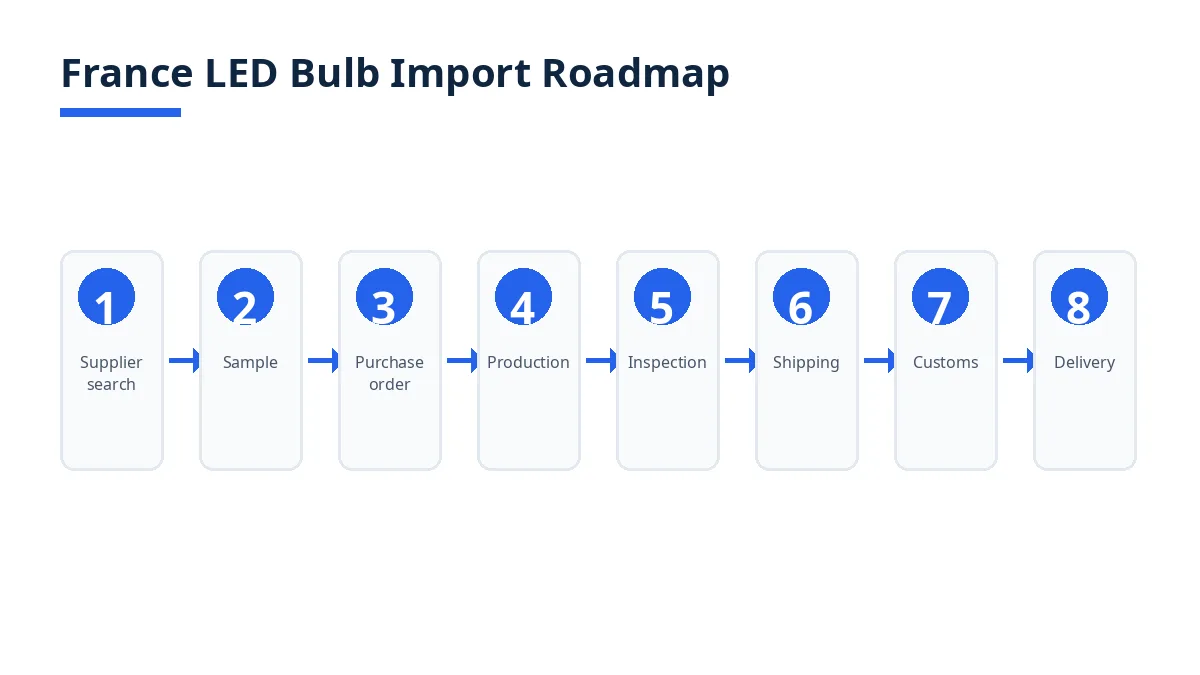
Describe the product in writing: lamp or module, cap, control gear, wireless control, and sale on its own or inside a containing product.
Check the European gates for that product: the CE file, safety, electromagnetic compatibility, RoHS, ecodesign, energy labelling and the database entry for the product.
Fix the French producer position: the scheme, registration, unique identification number, Info-tri marking, eco-fee display and information sheet.
Ask the broker to confirm the tariff line, the duty rate and the preference and origin position, before any price is fixed.
Test shortlisted suppliers against the French file, and log every reply.
Put the specification, the quantity-counting basis, the price split, the sample, the inspection points and the failure rule in writing.
Order the sample on bulk paperwork, test it against the specification and the file, and take photographs of its marking, label and carton.
Put the delivery term, each named place, the import clearance plan and the conformity failure plan into a written agreement.
Sign off the packaging artwork — energy label, Info-tri mark and eco-fee display — before printing.
Manufacture, inspect lot by lot, and send the consignment with its origin proof, transport document, packing list, commercial invoice and conformity file; then declare, pay duty and VAT as confirmed, attend any inspection, count and check on arrival, and keep the declaration, payment records and lot papers in one file.
How big should a first France order of LED bulbs from Bangladesh be?
No usual minimum is quoted here, because no minimum figure was read in a source for this product and route. Fix the minimum supplier by supplier and variant by variant in writing, saying whether it runs per model, cap, colour temperature or packaging variant, and order a sample on full paperwork before bulk. A minimum running per variant binds the buyer to far more units than one running across a mixed order.
How long should a France buyer allow for shipping LED bulbs from Bangladesh?
No transit time is given here, because none was read for this route. The time between loading and release turns on the route, the carrier timetable, the delivery term, border checks and any inspection. Obtain routing and scheduled times from the carrier in writing, and the broker view on the time customs and inspection may add before the goods are released.
What duty and VAT will a France buyer pay on LED bulbs from Bangladesh?
No duty rate is given here for LED lamps, because no tariff schedule for the lamps line was read. The broker confirms the current tariff line for the precise lamp, the rate on that line, and whether an Everything But Arms preference holds with qualifying origin and valid proof of origin.10 VAT falls separately from duty, charged on the customs value plus duty and supplementary costs as far as the place of destination.11 Price duty and VAT only from the broker-confirmed answer, and rework the worked example with those figures before ordering.
How can a buyer in France check a Bangladeshi LED bulb supplier before ordering?
Look at the file, not the catalogue. Request the legal name and address, the EU declaration of conformity and test reports for the precise model, the energy label artwork with the product information sheet and database entry, the RoHS material evidence, the origin proof stance, and the French producer registration stance. Match names and model numbers across quotation, invoice, declaration, reports and packaging, and make sure the sample bears the same marking and label bulk will bear. Ask what forces a fresh test or label when the driver, LED package, cap or housing changes, and put the change rule in writing.
Next steps on Exportain
The importing guide covers the general process for Bangladesh. Use the supplier search with the specification and the file questions in this guide. The buying steps explain how an order works on Exportain. For the costing method, see the costing example, using figures the broker has confirmed. Post a free RFQ on Exportain and get quotes from verified Bangladeshi suppliers
Sources
- Chapter 85 notes (Note 11) - Northern Ireland Online Tariff: LED modules and LED lamps distinguished by the cap. GOV.UK (accessed )
- Commission Regulation (EU) 2019/2020 laying down ecodesign requirements for light sources and separate control gears. European Union, (accessed )
- Commission Delegated Regulation (EU) 2019/2015 with regard to energy labelling of light sources. European Union (accessed )
- General product compliance. European Union (accessed )
- Directive 2011/65/EU on the restriction of the use of certain hazardous substances in electrical and electronic equipment (RoHS) (consolidated version, 1 September 2020). European Union (EUR-Lex) (accessed )
- Are light sources in scope of Energy Labelling obliged to have a packaging?. European Commission (accessed )
- Extended Producer Responsibility (EPR) streams. Service-Public (accessed )
- Your obligations as a Producer (marketer). ecosystem (accessed )
- FCA & FOB Incoterms 2020 explained: Key differences. ICC Academy (accessed )
- EU trade relations with Bangladesh. European Commission, (accessed )
- Value added tax. European Commission (accessed )
About the author
Sourcing from Bangladesh?
Post a request for quotation and suppliers on Exportain can send you their quotes directly.
Post an RFQ