Belgium LED Bulb Imports From Bangladesh: Costs, Duties, Suppliers
Belgium buyers importing LED bulbs from Bangladesh: settle the Recupel producer question and the CE, ecodesign and energy-label file first, confirm duty and preference with a broker, and price the landed cost on labelled example figures.
Short answer
To import LED bulbs from Bangladesh to Belgium, settle the Belgium producer question: register, join the Recupel scheme or appoint an authorised representative. Then build the Union file for the lamp: CE marking, electrical safety, electromagnetic compatibility, hazardous substances, ecodesign and the energy label with its database entry. Have the broker confirm tariff code, the Everything But Arms preference and origin proof, agree specification, sample, inspection and delivery term, and price landed cost on broker-confirmed figures.
On this page
Key takeaways
Belgium's take-back obligation runs through Recupel, and the WEEE producer must register, finance collection and treatment, and appoint an authorised representative by written mandate where the directive requires one.
No duty rate, import VAT rate, RoHS limit or EMC limit is stated in this guide: each must be confirmed from the broker, the laboratory or the tariff line for the exact lamp before ordering.
The ecodesign maximum allowed power is computed from the declared flux and colour rendering index, and the energy label, product information sheet and technical documentation must sit in the product database for the exact model.
Bangladesh benefits from duty-free, quota-free access under Everything But Arms, but preference needs qualifying origin and a statement on origin from a Registered Exporter, confirmed by the broker.
Price the landed cost on labelled example figures only, and rework every line with broker-confirmed duty, VAT and origin proof before ordering.
For a buyer in Belgium, an LED bulb order placed in Bangladesh is settled in two places: at the factory, where the bulb is built and tested, and in Belgium, where the bulb is first offered for sale and where its end-of-life duties attach. The second settlement has to come first in the buyer's planning. Until the producer registration, the conformity papers and the customs file are in order for the precise model, price talks rest on nothing solid. This guide therefore takes the Belgian paperwork before the commercial paperwork: producer duties and the Recupel system, the description of the product, the Union conformity papers, supplier checks, specification and inspection, delivery terms, duty and VAT, and a worked cost example. It states no typical price, minimum order, transit time, duty rate or import VAT rate as fact, because no such figure appears in a source opened for this product and this market.
The Belgium producer question comes before the catalogue
Recupel describes the Belgian system as a take-back obligation that has applied since 2001, with dedicated rules for electrical and electronic equipment from 2008 and a move from ten categories to six in 2022, covering the whole of Belgium for shops and online sellers alike.1 Sellers of electro-appliances and light bulbs must comply with the categories in the appliance list.1 On behalf of its members, Recupel arranges the collection, transport, sorting, selection for re-use and proper treatment of returned light bulbs and electro-appliances.1 A retailer must accept, without charging the customer, the used appliance or bulb handed over when a similar new one is bought.1
The Union directive behind that system places the money duty on the producer. Each Member State must see to it that producers fund, at a minimum, the collection, treatment, recovery and environmentally sound disposal of waste equipment from private households left at collection facilities, and a producer may meet that duty alone or through a collective scheme.2 Each Member State must keep a register of producers that also covers producers selling by distance communication, and a distance seller must be on the register of the Member State where it sells, or be registered there through an authorised representative.2 Where a producer is established in another Member State, that Member State must allow it to name a person established on its territory as authorised representative, responsible for meeting the producer's duties there, and the appointment must be made by written mandate.2 Equipment placed on the market must carry the symbol in the directive's Annex IX, preferably following European standard EN 50419, so the date it was placed on the market can be fixed.2
Before the first shipment, put the answers in writing with an adviser who knows the Belgian rules. Which party is the producer for these bulbs: the Belgian importer who first offers them in Belgium, or a later seller who markets them under its own brand? Which party registers, which party joins the Recupel scheme, which party pays, and which party keeps the registration evidence? A seller who offers equipment at a distance into Belgium from another Member State without being established in Belgium should confirm the authorised-representative route before stock starts moving. Keep the producer role and the customs role apart in the contract: the party lodging the import declaration is not necessarily the party carrying the producer duty, and both names should appear expressly.
Name the product: lamp, module or containing product
The description of the goods decides both the tariff line and the conformity route, so it must be fixed before any quotation or code is discussed. Guidance on classifying lamps puts LED lamps under subheading 8539 52 00, and the same subheading covers LED bulbs that use light emitting diodes instead of conventional filaments.3 Chapter note 11 to heading 8539 explains the split: an LED module has no cap made for easy fitting or replacement in a luminaire with mechanical and electrical contact, while an LED lamp is an electrical light source holding one or more LED modules plus further elements, and the cap is what separates a lamp from a module.4 A screw-cap or bayonet-cap bulb a householder can fit and swap is a lamp on that test. A bare board that only functions inside a fitting built by the buyer is a different item, and a finished fitting holding LED sources raises the containing-product question. Let the broker decide which line fits the goods in hand; a supplier code or a catalogue heading must not decide it.
The ecodesign rules apply a separate product test that is narrower than the catalogue word "bulb". A light source there means an electrically operated product meant to emit light, with flux between 60 and 82 000 lumen and a colour rendering index greater than zero, using technologies that include inorganic light emitting diodes, and verifiable as a light source under the Annex IV procedure; LED dies, LED chips and LED packages fall outside that definition.5 A containing product holds one or more light sources, or separate control gears, or both, and where it cannot be taken apart so the contained light source and gear can be checked, the whole containing product counts as a light source.5 The energy labelling rules cover light sources with or without integrated control gear, and they reach light sources offered inside a containing product as well.6 Use one description everywhere: lamp or module, cap type, integrated or separate driver, and whether the bulb is sold alone or inside a fitting. For a bulb with wireless control, an app or a sensor, ask in writing whether radio-equipment rules bite on that model, and keep the reply with the papers.
The EU conformity file: CE marking, safety, EMC and hazardous substances
Under the Union's CE marking system, the manufacturer states that the product satisfies the Union product rules, and the marking lets the product move and be marketed freely across the Union wherever it was made.7 Marking is only called for by products under harmonised Union rules that expressly require it, and a product under several Union requirements at once must satisfy every relevant requirement before the marking goes on.7 No central Union body hands out permission to use the mark. The manufacturer has to find every requirement that applies, decide whether it can assess conformity itself or must bring in a notified body, collect the evidence, and sign an EU declaration of conformity.7 That declaration and the technical documentation supporting it must stay current and be kept for at least 10 years after the product goes on the market.7
Electrical safety is governed by the Low Voltage Directive, which reaches equipment made for use at 50 to 1,000 V alternating current and 75 to 1,500 V direct current, and requires all such equipment offered in the Union to carry the CE marking as proof it meets the essential safety requirements in Union legislation.8 The manufacturer has to run a safety and conformity assessment, prepare the technical documentation and sign the EU declaration before marking; the importer has to check that the assessment was done properly and alert the safety monitoring authority if it judges the equipment non-conforming.8 Declaration and documentation are kept for 10 years, safety information and instructions must be in a language end users can readily understand as the national authority determines, and maker and importer must put their contact details on the equipment.8 Ask your adviser which languages Belgium requires on instructions, safety information and packaging; do not take it for granted that a single language version serves the whole Belgian market.
The driver inside the bulb is the part most likely to raise an electromagnetic compatibility question, because it switches power. No emission or immunity limit is stated in this guide, because none was opened in a source for this product. Ask the laboratory to say, for the precise model and the precise driver, whether an electromagnetic compatibility assessment is called for, which standard it applied, and what evidence backs it, and ask again whenever the driver changes. The hazardous-substances check runs on the same discipline. The waste equipment directive points to exemptions allowed under Directive 2011/65/EU, the directive restricting hazardous substances in electrical and electronic equipment.2 No substance limit and no substance list is stated here, because none was opened in a source for this guide. Ask the supplier for its declaration under that directive for the precise model, and where it claims an exemption, ask which entry it relies on, when that entry expires, and whether the entry covers the LED use in hand rather than a fluorescent-lamp use.
Do not treat a mark printed on the bulb or its box as proof of anything. Proof sits in the papers behind the mark: the assessment, the test reports behind it, and the declaration naming the legislation and standards applied. Request the declaration drawn for the precise model, confirm it names the bulb on the order, and keep the full set in hand before the goods leave: the declaration itself, the reports behind it, the specification those reports tested against, plus the label and packaging artwork. Find out how the supplier manages change. The driver, the LED package, the cap, the housing and the packaging may each be altered while the model name remains unchanged, so agree what forces a fresh test, declaration or label, and require notice before any such change is shipped. A brochure, or an assurance that papers will follow, is not a conformity file.
Ecodesign numbers and the energy label: work the formula, check the database entry
Ecodesign turns catalogue numbers into a calculation that has to be worked, not taken on trust. Annex II to the regulation sets the requirements, and from 1 September 2021 the declared on-mode power of a light source, P-on, may not pass the maximum allowed power, P-on-max, worked out from the declared useful luminous flux and the declared colour rendering index.5 The threshold efficacy in Table 1 is a fixed number used in the calculation; it is not a true property of any light source, and it is not the lowest efficacy allowed, which is found by dividing the useful flux by the computed maximum power.5 Standby power for a light source may not pass 0.5 W, networked standby for a connected light source may not pass 0.5 W, and the two allowances may not be added together.5
Take one worked calculation with assumed inputs, so the method can be followed. Assume a non-directional source running on mains, with a declared useful flux of 800 lumen and a declared colour rendering index of 80. For a non-directional source the efficacy factor is 1.00, the colour rendering factor is (80 + 80) over 160, which is 1.00, the correction factor for a non-directional mains source is 1.08, and the Table 1 row for other in-scope light sources gives a threshold efficacy of 120 lumen per watt with an end loss factor of 1.5 W.5 Maximum allowed power is then 1.08 times (1.5 plus 800 over 120), that is 1.08 times 8.17, which is 8.82 W. The inputs are assumed for illustration. The declared power of the actual model, and whether it falls under its own computed maximum, is for the supplier and the laboratory to confirm for the precise model; this guide gives no pass or fail verdict on any real bulb from the formula.
The same Annex II table carries the functional duties. From 1 September 2021 the colour rendering index must reach at least 80, save for high-intensity discharge sources over 4,000 lumen and for sources meant for outdoor, industrial or other uses where lighting standards permit a lower index, provided the packaging and all relevant documentation say so clearly.5 The table also sets displacement factor bands for LED and OLED mains sources, a lumen maintenance factor linked to the declared L70B50 lifetime, a survival factor after endurance testing, colour consistency inside a six-step MacAdam ellipse or less, flicker at P-st LM of 1.0 or under at full load, and stroboscopic effect at SVM of 0.4 or under at full load.5 The packaging list has to be checked item by item: useful flux and the cone it refers to, correlated colour temperature, beam angle for directional sources, interface details such as cap type and supply, L70B50 lifetime in hours, on-mode power, standby and networked standby power, colour rendering index, any warning about dimming with the compatible dimmers named, any mercury warning, and, for a source inside the waste equipment directive's scope, a warning against disposal as unsorted municipal waste.5
The energy label is a second file that must match the ecodesign file. A supplier of light sources has to see that every light source offered on its own and in packaging carries a label printed on the packaging in the Annex III format, that the product information sheet values go into the public part of the product database, and that the technical documentation contents go into the product database too.6 The supplier must also give dealers an electronic label and an electronic product information sheet for each model, and every visual advertisement or technical promotional item for a given model must show that model's energy efficiency class and the range of classes on the label.6 At the point of sale, dealers must see that each light source outside a containing product carries the supplier's label where it can be clearly seen, and in distance selling the label and the product information sheet must be supplied.6 Request the label artwork, the product information sheet and the database entry for the precise model, and compare the class and the values with the ecodesign papers. No energy class bands are stated in this guide, because no class table was opened in the text read for it; read the class off the model's own label and database entry, never off a catalogue claim.
Test a supplier against the Belgium file, not its catalogue
A supplier's catalogue shows it can photograph a bulb. It does not show that the photographed bulb is the bulb in the conformity papers. Rate a supplier on whether it can assemble the Belgium file for the precise model, and on whether the names, numbers and artwork in that file line up. Ask which legal name and registered address belong to the party signing the export documents, and confirm one consistent name across the quotation, invoice, declaration of conformity and origin evidence. Where test reports name another company, ask for the reason and keep the explanation in writing. Ask for the Belgian producer registration evidence and the Recupel position, the database entry for the model, and the packaging artwork in the languages Belgium requires. Ask whether the same model has gone into the Union before under the same file, and ask for the papers rather than the assurance: the declaration, the reports and the database entry from that earlier shipment, with a matching model identifier.
Find out how the supplier handles change, failed lots and replacement speed. Where it cannot produce the declaration, the label artwork or the database entry for the precise model, the file is unfinished, and price must not decide the matter. Place a pilot order under the full document set before bulk, using the same specification, the same packaging and the same inspection scope, and link each payment to a document that can be checked: specification signed and reports received ahead of production, inspection report received ahead of shipment, and shipping papers matching the consignment.
Fix the specification and inspect each lot against it
Put the specification in a table where every claimed value names its source. Fix, in turn, the cap type and the rated voltage, the wattage and lumen output claimed, the colour temperature and the colour rendering index, any lifetime claim measured on the L70B50 basis, the kind of driver and whether it sits inside the bulb or apart from it, dimming behaviour where dimming is claimed, any wireless control feature, and any outdoor or ingress protection claim. For every field, note down the value, the method or standard the supplier claims was used, and the report that backs it. A value with no report behind it goes down as unproven, and must not be used in pricing, labelling or advertising until the report exists. Put the counting and packing rules in the same document: bulbs counted singly or by carton, bulbs per carton and per master carton, carton markings, and the rule for a short carton. Require the packaging artwork to be approved before printing, including the energy label, the product information sheet data and the waste-equipment marking, and require a photograph of the sample marking before bulk is shipped. Agree the failure rule as well: what follows a failed lot, who tests again, who pays, and what evidence closes the failure.
Check every lot against that specification before it ships: count, cap and marking, label and product information sheet data, carton markings, the model number on the declaration, pack condition, and whether the reports cover the lot and the model. A look at the goods cannot confirm a lumen, lifetime or efficacy value. When the goods arrive, count again, test a sample drawn from each carton group for function and dimming, and log each failure with its model, carton and number of units. Where model, cap, marking or label does not match, hold the lot until it is put right and checked again, and keep the lot file together with the declaration and the payment records.
Minimum order and price: agree the counting basis and the parts
No typical minimum order quantity or price is stated in this guide, because no such figure appears in a source opened for LED bulbs from Bangladesh for the Belgian market. For each shipment, pin down every commercial figure with the supplier in writing, and order a sample before anything else. The obligation changes with the counting basis: a minimum set model by model, cap by cap, colour temperature by colour temperature and packaging variant by packaging variant is not the same as a minimum spread over a mixed order, so the order must say which basis governs. Before quotations are compared, split each price into parts: bulb, packaging, testing and file costs, carriage and insurance under the agreed delivery term, and any charges for labels, artwork or inspection. Quotations only compare fairly on an identical delivery term and against an identical file. State the currency, the price basis, whether the price runs on quantity shipped or quantity usable on arrival, and who carries the loss on unusable bulbs. Run the sample under bulk's own paperwork, with bulk's specification, marking, label and packaging, and judge it on the specification and the file rather than on the catalogue photograph.
Delivery terms, the ENS filing and the move into Belgium
The Incoterms 2020 rules decide who delivers, who carries the risk, who pays which costs and who deals with customs duties, so the rule picked must fit the way the goods actually travel. Just four rules — FAS, FOB, CFR, CIF — apply only where the carriage is by sea or inland waterway. CPT, DPU and DDP are mode-neutral: any single mode or combination qualifies, and DDP additionally makes the seller responsible for import clearance and duty payment. Containers change the sensible choice. The ICC Academy guidance observes that FCA is typically a better fit than FOB even for maritime transport, since delivery and risk under FCA can happen when the goods are handed to the carrier, rather than only once they are on board the vessel.9 With CPT and CIP the seller bears the carriage cost to the named destination, while risk moves when the goods are handed to the carrier, and CIP adds an insurance duty for the seller.9 With CFR and CIF, risk moves at the moment the goods are loaded onto the vessel the seller contracted, and CIF adds insurance.9 With DAP, DPU and DDP, delivery and risk move at the named destination, DPU standing apart because the seller unloads, and DDP standing apart because the seller must clear the goods for import.9
Before the goods travel, the safety and security filing has to be settled. A complete Entry Summary Declaration must go into the Import Control System 2 for all goods carried to or through the Union before they arrive, and an operator connecting to that system has to hold an Economic Operators Registration and Identification (EORI) number issued by a Member State customs authority.10 Customs may turn back an incomplete declaration or send risk-mitigating referrals in the pre-loading or pre-arrival phase asking for the missing data, which can hold up processing and entry.10 Agree in writing who files the declaration, who holds the EORI number and who acts as declarant, and ask the broker how long customs and any inspection may add at the Belgian point of entry. No transit time is stated in this guide, because none was opened for this route. Get the routing and the scheduled times from the carrier in writing.
Agree two plans apart from each other, in writing: a plan for a conformity failure, since no delivery term spreads the cost of a border refusal caused by a failed Belgium file; and a plan for import clearance, since under DDP the seller clears the goods, while under the other rules the buyer arranges its own clearance. Name the places exactly in the contract: the place of delivery, the port or terminal of entry, and the destination named for the D rules, so that no party is left disputing which terminal was meant.
Customs duty, import VAT and the document set for Belgium
Classification comes first, and the broker must settle the line for the precise lamp. LED lamps sit under subheading 8539 52 00.3 The chapter note separates modules from lamps on the cap, so a capless module and a capped lamp must not be declared on one line out of habit.4 Ask the broker to confirm the current 10-digit commodity code for the precise lamp and the supplementary unit for the declaration. This guide gives no duty rate for LED lamps, because no tariff schedule page for Belgium was opened. Price duty only from the line the broker confirms for the date of import.
Preference can change the duty answer, but only where origin and proof are in order. As a least developed country, Bangladesh benefits from the Union's Everything But Arms arrangement, granting duty-free, quota-free access for all exports except arms and ammunition, and Bangladesh enjoys the most favourable regime under the Union's Generalised Scheme of Preferences, namely that arrangement.11 A claim to preference needs proof of origin, a document certifying where a product was made, without which customs cannot check the claim and preferential treatment such as reduced or zero tariffs cannot be given.12 Exporters under the Generalised Scheme of Preferences must be on the Registered Exporter system, and the statement on origin is made by registered exporters on the invoice or another commercial document; exporters without registration may make statements on origin for consignments of originating products worth no more than EUR 6,000 on an ex-works basis.12 Whether preference holds depends on the origin rules for the precise goods, so the broker must confirm origin and proof before duty is priced at zero, and the statement on origin should travel with the consignment papers.
Import VAT sits apart from duty. No Belgian import VAT rate and no VAT base is stated as fact in this guide, because no Belgian VAT source was opened for it. Ask the broker and the accountant which rate applies to LED lamps, what value the VAT is charged on, how it is treated in your VAT position, and whether any deferment arrangement fits your flow. The party filing the customs and security declarations needs an EORI number, as described above.10 The papers for one consignment should comprise the commercial invoice, packing list and transport document, origin proof where preference is claimed, the model's declaration of conformity with its test file, the energy label and product information sheet data, producer registration evidence for the waste equipment file, and the Entry Summary Declaration reference.
A worked landed-cost example in euros, with example figures
The table below uses illustration numbers only, to show the working. It predicts no price. Every line must be replaced with a broker-confirmed number before an order is placed. Duty appears at 0.00 euro as an illustration number only, on the assumption that the broker settles on a zero rate for the settled code with qualifying origin proof. Import VAT is worked at 21 percent as an illustration number only; no Belgian import VAT rate is stated as fact in this guide, and the broker and accountant must confirm the rate and the base before ordering.
Cost line | Illustration figure (EUR) | Basis |
|---|---|---|
Goods, 10,000 bulbs at 1.20 euro per bulb | 12,000.00 | Illustration figure |
International freight and insurance | 2,100.00 | Illustration figure |
Customs duty, 0.00 shown as illustration only | 0.00 | Broker to settle code, rate and origin evidence |
Value for VAT, goods plus freight and insurance | 14,100.00 | Sum of the lines above |
Import VAT at 21 percent, illustration only | 2,961.00 | 21 percent of the value shown |
Broker and handling | 450.00 | Illustration figure, left out of the VAT base in this worked example |
Total cash outlay | 17,511.00 | Sum of the lines above |
Cost per bulb shipped, 10,000 bulbs | 1.75 | Total divided by shipped quantity, rounded |
Cost for each usable bulb, 9,700 bulbs after an assumed 3 percent loss | 1.81 | Total divided by usable quantity, rounded |
The working runs as follows: 12,000.00 plus 2,100.00 plus 0.00 gives 14,100.00; twenty-one percent of that is 2,961.00; adding 450.00 gives 17,511.00, or 1.75 euro for each bulb shipped and 1.81 euro for each usable bulb at the assumed 3 percent loss. Check with the broker whether broker and handling charges sit inside or outside the VAT value on the actual consignment, and settle the duty and VAT lines before the example is used for any order.
The import run for Belgium, step by step
Work through this run in sequence. The diagram below shows the run in one view.
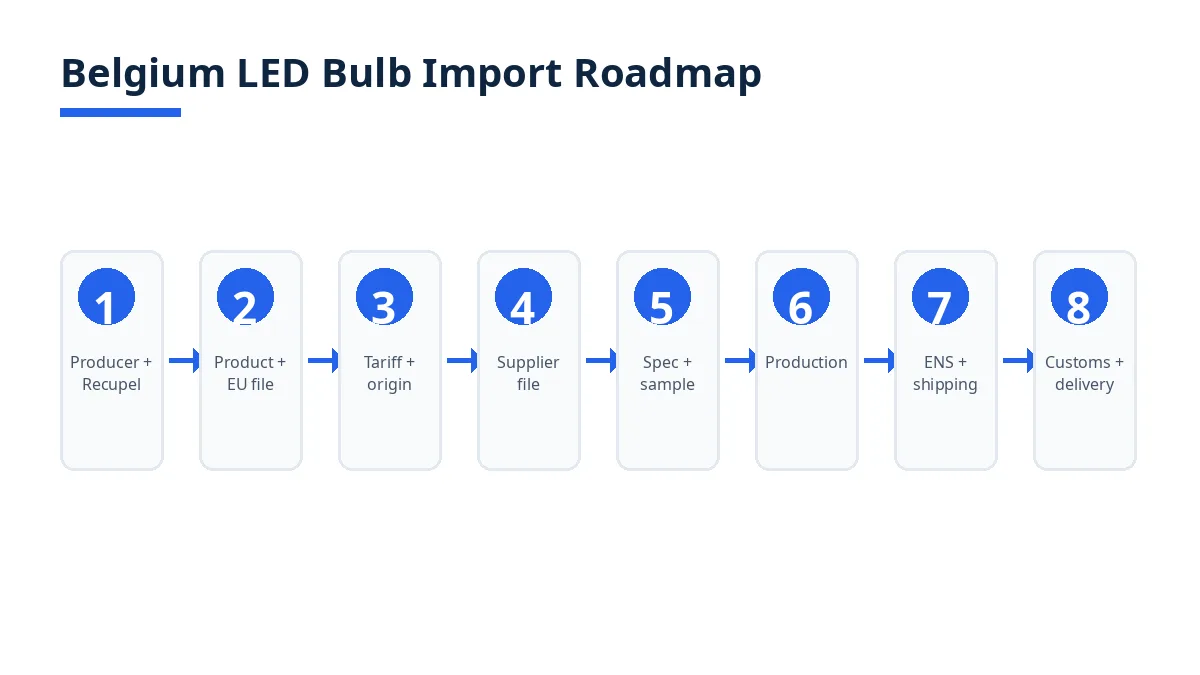
Settle the producer position for Belgium: registration, Recupel scheme membership, who pays, and whether a Belgian authorised representative is required.
Fix the product description: lamp, module or containing product, cap type, driver, and any wireless control.
Confirm the Union file gates for that product: CE marking, electrical safety, electromagnetic compatibility, hazardous substances, ecodesign, energy labelling, database entry and waste-equipment marking.
Confirm the tariff code, the preference and origin position, the EORI position and the Entry Summary Declaration roles with the broker, before pricing.
Shortlist suppliers against the Belgium file, and write down each answer.
Put into a written agreement the specification, how quantities are counted, how the price is split, the sample, the inspection points and the rule for failures.
Place the sample order under bulk's paperwork, test it against the specification and the file, and photograph its marking and label.
Settle the delivery term, the named places, the import clearance plan and the conformity failure plan in writing, and name the party that files the Entry Summary Declaration.
Approve the packaging artwork, including the energy label, product information sheet data, languages and waste-equipment marking, before printing.
Run production, check each lot as it is made, and ship with the invoice, packing list, transport document, origin proof and conformity file belonging to that consignment.
Lodge the declaration, pay the duty and import VAT figures as confirmed, present the goods for inspection, count and check them on arrival, and file the declaration, payment records and lot papers together.
What minimum order should a buyer in Belgium agree for LED bulbs from Bangladesh?
No typical minimum is quoted here, because no minimum figure was opened in a source for this product and this market. Fix the minimum with each supplier and for each variant in a written agreement, saying whether it is reckoned model by model, cap by cap, colour temperature by colour temperature or packaging variant by packaging variant, and order a sample under the full paperwork before bulk. A minimum spread across mixed variants is a different obligation from a minimum for one variant, and the order should say which applies.
How long does shipping LED bulbs from Bangladesh to Belgium take?
This guide gives no transit time, because no figure for this route was opened. How long loading to release takes turns on the route chosen, the carrier's timetable, the delivery term, the Entry Summary Declaration, customs and any inspection. Get the routing and the scheduled times from the carrier in writing, and ask the broker how long customs and inspection may add at the Belgian point of entry.
What import duty and import VAT apply to LED bulbs entering Belgium?
This guide states no duty rate for LED lamps, because no tariff schedule page for Belgium was opened. Bangladesh benefits from duty-free, quota-free access under the Everything But Arms arrangement for all exports except arms and ammunition, but preference depends on the origin rules for the precise goods and on valid proof of origin, such as a statement on origin from a Registered Exporter.11 12 Ask the broker to confirm the current commodity code for the precise lamp, the duty rate on that line, and whether the preference holds with qualifying origin and valid proof. No import VAT rate or base is stated as fact in this guide; the landed-cost example works VAT at 21 percent as an illustration number only, and the broker and accountant must confirm the rate and the base before ordering.
How does a buyer in Belgium check an LED bulb supplier in Bangladesh?
Look at the papers, not the catalogue. Ask for the supplier's legal name and address, the declaration of conformity with the test reports for the precise model, the energy label artwork, product information sheet and database entry, the origin proof position, and the producer registration and Recupel position for Belgium. Check that names and model numbers match across quotation, invoice, declaration, reports and packaging, that the sample bears the same marking and label bulk will bear, and that change control is agreed in writing before any change is shipped.
Next steps on Exportain
Begin with the general guide to bringing goods in from Bangladesh, then open the supplier search pages carrying the specification and the questions this guide raises. Go through the buying steps explained on Exportain before ordering, and test the example table against the worked-cost method in the landed-cost guide with figures your broker has confirmed. Post a free RFQ on Exportain and get quotes from verified Bangladeshi suppliers
Sources
- The take-back obligation. Recupel (accessed )
- Directive 2012/19/EU on waste electrical and electronic equipment (WEEE). European Union (EUR-Lex) (accessed )
- Classifying electric lamps for import and export. GOV.UK (accessed )
- Discharge lamps, other than ultraviolet lamps - Northern Ireland Online Tariff. GOV.UK (accessed )
- Commission Regulation (EU) 2019/2020 laying down ecodesign requirements for light sources and separate control gears. European Union, (accessed )
- Commission Delegated Regulation (EU) 2019/2015 with regard to energy labelling of light sources. European Union (accessed )
- CE marking – obtaining the certificate, EU requirements. European Union (accessed )
- Directive 2014/35/EU on electrical equipment designed for use within certain voltage limits — summary. European Union (accessed )
- Place of delivery & risk transfer in trade contracts. ICC Academy (accessed )
- Import Control System 2. European Commission (accessed )
- EU trade relations with Bangladesh. European Commission, (accessed )
- Proof of origin. European Commission (accessed )
About the author
Sourcing from Bangladesh?
Post a request for quotation and suppliers on Exportain can send you their quotes directly.
Post an RFQ