DDP Shipping From Bangladesh to UAE: Costs, Steps and Timeline
DDP from Bangladesh to UAE turns on the UAE entry paper: the importer, its trade licence and customs code, and the 5% import VAT route, through Jebel Ali or Khalifa Port.
Short answer
Under DDP, a Bangladeshi seller delivers goods to a named place in the UAE, cleared for import, with duty and import VAT handled, bearing risk until delivery. The deal stands or falls on the UAE entry paper: the importer, its trade licence and customs code, its broker, and the 5% import VAT route. A DDP price that does not name the importer, the named place, and the VAT route is not a price you can rely on.
On this page
Key takeaways
Under DDP, the seller delivers goods to the named UAE place cleared for import, with duty and import VAT handled, bearing risk until delivery.
A UAE DDP deal stands or falls on the entry paper: the named importer, its trade licence and emirate customs business code, its broker, and the agreed VAT route.
Standard UAE duty is 5% of CIF for most non-GCC goods, and import VAT is 5% on the CIF value plus duty plus excise where relevant; a registered importer accounts through its return while a non-registered importer pays before release.
The named place must state mainland or designated zone and the port of entry, Jebel Ali or Khalifa Port, because a zone delivery is a different VAT and duty event from a mainland delivery.
Exportain verification is a document and photo review, not a factory inspection, and a badge is not a guarantee of capacity, quality, or delivery.
Under DDP, a Bangladeshi seller delivers goods to a named place in the UAE, cleared for import, with duty and import VAT handled, bearing risk until delivery. The deal stands or falls on the UAE entry paper: the importer, its trade licence and customs code, its broker, and the 5% import VAT route. A DDP price that does not name the importer, the named place, and the VAT route is not a price you can rely on.
The Incoterms 2020 rules are 11 rules with a clear allocation of cost, risk, and obligations.1 DDP is the only rule where the seller clears import customs and pays import duty.2 That single difference is why a UAE DDP quote needs more checking than a DAP or CIF quote for the same goods: the seller is taking on obligations inside your country, and those obligations need a licensed route to perform.
Why this matters for buyers and sellers
For the buyer, DDP looks like the simplest purchase: one price, goods at the warehouse, no customs queue. The risk does not disappear, it moves. If the seller's UAE import route fails, the goods sit at the port, and the buyer has no declaration in its own name to fix. For the seller, DDP means pricing and performing work it may not be set up for: a UAE declaration, duty and VAT accounting, and inland delivery.
The named place decides much of the deal. A delivery to a mainland warehouse in Dubai and a delivery into a designated zone such as Jebel Ali Free Zone are different VAT and duty events, even when the port of entry is the same. State the full delivery address and its zone status; a quote that only says "DDP Dubai" has not answered that question.
The gateway matters too. Jebel Ali Port in Dubai is the largest port in the Middle East, and its four terminals handle over 15 million 20-foot equivalent units (TEUs) a year of container cargo.3 Khalifa Port, in Taweelah between Abu Dhabi and Dubai, is the gateway to Abu Dhabi, with the adjacent Kizad zone.4 The DDP price should say which port the goods clear through.
The UAE entry needs a registered importer: to import commercially in Dubai, a business must hold a valid UAE trade licence and an active customs business code, and without a valid customs code no import declaration can be filed.5 The 5% import VAT follows the importer paper, not the freight invoice, so the VAT route must be agreed before shipment, not discovered at the port.
Step-by-step: how it works
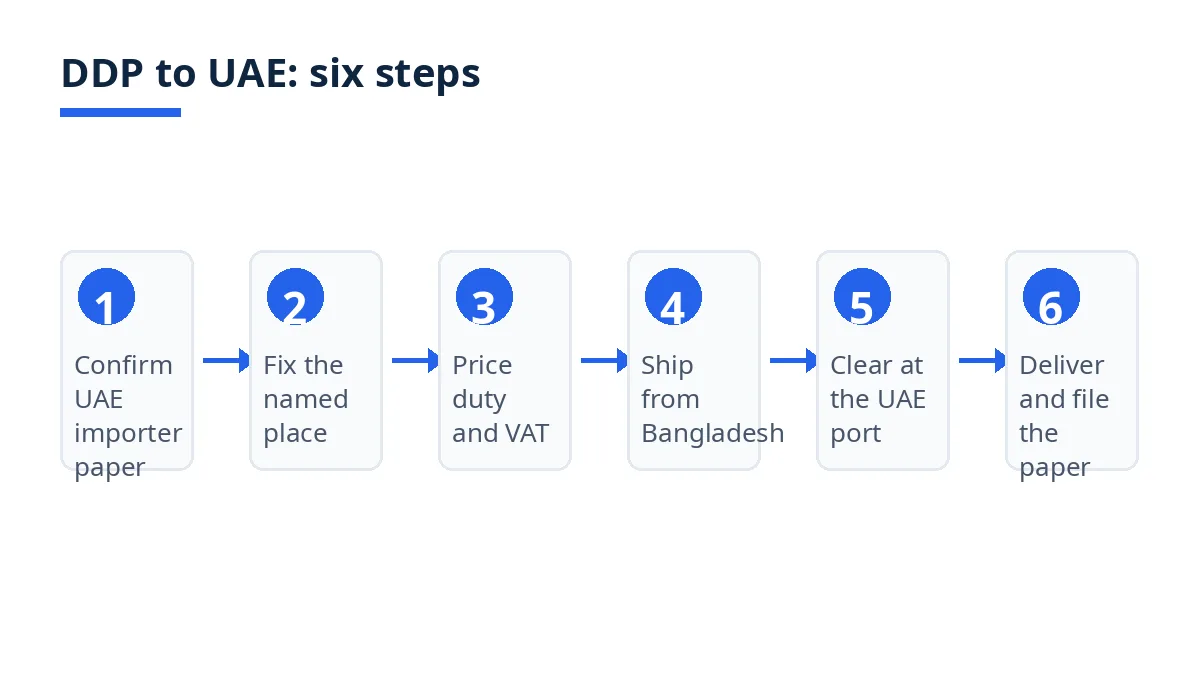
Confirm the UAE import paper first. Name the importer, its trade licence, its customs business code, its tax registration number where it holds one, and the customs broker who will file. If the seller has no UAE route of its own, the contract must name the UAE-registered importer or broker who will act.
Fix the named place in full words. Write the delivery address, the port of entry (Jebel Ali or Khalifa Port), and whether delivery is to the mainland or into a designated zone. DDP delivery happens at the named place, cleared for import and ready for unloading, so an imprecise place leaves the risk point open.
Price duty and VAT from the classification, not the description. Confirm the product classification for the shipment, then work duty from the CIF value and VAT from the duty-paid value. The standard customs duty rate in the UAE is 5 percent applied to the CIF value of most non-GCC goods,6 and import VAT is 5 percent calculated on the sum of CIF value, customs duty, and excise tax where relevant.6
Complete the Bangladesh export set. Goods may not be loaded for export unless an export declaration, the Bill of Export or Shipping Bill, is submitted to Customs and approved.7 The enclosed documents include the export contract or purchase order, the commercial invoice, the packing list, the EXP form certified by an authorized dealer, and a certificate of origin issued by the EPB or a Chamber of Commerce and Industry.7
Ship, then clear through the UAE system. For Dubai, the customs declaration is submitted through the Mirsal 2 platform, by a licensed customs broker or a registered importer, and it carries the importer code, the HS code per line, the CIF value, the origin, and the duty and VAT calculation.5 Without the delivery order from the shipping line, cargo cannot be collected from the port even after customs approval.5
Deliver, then close the VAT paper. A VAT-registered importer files returns and pays the VAT due at the time of filing its VAT return for taxable goods imported into the UAE mainland.8 A non-registered importer pays the applicable taxes before clearing the goods, with import VAT calculated on the value of the goods inclusive of any customs duty and excise tax that may also be due.8 The owner of the goods, its representative, or the customs broker must keep the records for five Gregorian years from the date of completion of the customs process.9
Costs, timelines and documents
What are the typical costs and timelines?
There is no single DDP cost or timeline a guide can state as fact. The price for your shipment is built from your product, route, classification, and the named place, and the timeline from sailing, clearance, and inland legs. Never accept a single "delivery week" in place of sailing, clearance, and delivery dates.
The two rates fixed by the UAE system, rather than by quotation, are duty and VAT. The standard duty rate is 5 percent on the CIF value for most non-GCC goods, while alcohol faces 50 percent and tobacco 100 percent before excise tax.6 Import VAT is 5 percent on the CIF value plus duty plus excise tax where relevant,6 and the Federal Tax Authority guide confirms the same base: import VAT is calculated on the value of the goods inclusive of any customs duty and excise tax.8
Example figures: structure only, not a quotation or a rate for any product or route.
Line | Example figures (AED) |
|---|---|
CIF value at the UAE port | 100,000 |
Customs duty at 5% of CIF | 5,000 |
VAT base (CIF plus duty, no excise) | 105,000 |
Import VAT at 5% of the VAT base | 5,250 |
Illustrative broker, port, and inland charges | 2,800 |
Example figures total of duty, VAT, and charges | 13,050 |
A VAT-registered buyer that can recover input VAT treats the 5,250 as a cash-flow item, not a final cost. A buyer that cannot recover it carries the full 5,250 as cost. The DDP quote must state who recovers the VAT, and on whose return.
For timelines, the clearance leg is where DDP shipments most often slip. Every document must be present, accurate, and consistent before submission; even a small discrepancy holds the declaration for manual review.5 Goods are also subject to inspection according to risk criteria.9 Build the timeline from sailing, clearance, and inland dates, with a buffer for manual review.
Which documents are needed?
The Bangladesh export set and the UAE import set must agree line by line, because the UAE declaration is built from the same invoice, packing list, and origin documents.
Set | Documents |
|---|---|
Bangladesh export | Bill of Export approved by Customs, export contract or purchase order where there is no export letter of credit, commercial invoice, packing list, EXP form certified by an authorized dealer, certificate of origin, VAT registration certificate, TIN.7 |
UAE import | Original invoice, original certificate of origin, delivery permit for air or sea import, bill of lading for air or sea import, multi-item packing list including the Harmonized System Code.9 |
UAE declaration | Mirsal 2 declaration with importer code, HS code per line, CIF value, origin, invoice and bill of lading references, permit references, and the duty and VAT calculation.5 |
Regulated goods | Food and beverages, pharmaceuticals, medical devices, telecom equipment, chemicals, animals, plants, and vehicles each carry their own permit or approval, from authorities such as Dubai Municipality or the Ministry of Health and Prevention.5 |
Product-specific Bangladesh documents sit on top of the standard set: ERC for jute, jute goods and tea, a phytosanitary certificate for agricultural goods, and a quality control certificate where it is obligatory, such as fisheries certification for frozen fish.7 Confirm which of these your product needs before the goods are stuffed.
Bangladesh-specific rules and tips
Keep one legal name across every paper. The export declaration names the exporter and the foreign buyer,7 and the UAE side requires the consignee name to match the importing entity exactly as registered with Dubai Customs, where even a minor difference in company name formatting can cause a clearance hold.5
Confirm the origin document before claiming any preference. A certificate of origin should be issued by the Chamber of Commerce or authorised body in the origin country, matching the commercial invoice.5 If it does not meet the requirement for a duty claim, the reduction will not be applied.5
Check the emirate, not just the country. Dubai Customs runs Mirsal 2, while Abu Dhabi Customs uses its own platform, and an importer clearance code is emirate-specific.6 A DDP route that works for Dubai does not automatically work for Abu Dhabi.
Mistakes and red flags
What are the most common mistakes?
Accepting a DDP price with no importer named. If the quote does not name the importer, its customs code, and its broker, there is no UAE entry route behind the price. Ask for all three in writing.
Naming a free-zone delivery as if it were mainland delivery. Goods inside a designated zone sit outside the mainland VAT and duty event. A DDP price to a mainland warehouse cannot be performed by delivering into a zone. Name the zone status in the contract.
Treating import VAT as always recoverable. A VAT-registered importer accounts for import VAT through its return,8 but a non-registered importer pays before the goods are released.8 If the buyer cannot recover the VAT, the DDP price must carry it as a real cost.
Pricing duty from a product description. Duty attaches to the classification code, not the commercial description.6 A wrong code produces a confident, wrong DDP price and a reassessed bill at the port.
Submitting inconsistent documents. The description on the commercial invoice must match the packing list, the bill of lading, and the customs declaration, and the consignee name must match the registered importer name.5 A proforma invoice cannot substitute for the formal commercial invoice at clearance.5
Reading a badge as a guarantee. A badge is not a guarantee of production capacity, product quality or delivery.10 Sample approval, inspection, and the import paper stay with the buyer and seller.
Assuming DDP is risk-free for the buyer. DDP moves risk to the seller until delivery, but it does not remove the buyer's exposure: a failed import route, a held container, or a reassessed duty bill still lands on the buyer's timeline. DDP is a risk allocation, not risk removal.
Checklist
Before you confirm, every line should be answered.
Importer named, with trade licence, emirate customs business code, and broker.
Named place written in full: delivery address, port of entry, mainland or designated zone.
Product classification confirmed for the shipment.
Duty priced at 5% of CIF for standard goods, with higher-rate or excise goods flagged.6
VAT route agreed: registered importer through its return, or non-registered payment before release.8
Bangladesh export set agreed: Bill of Export, invoice, packing list, EXP form, certificate of origin.7
UAE import set agreed: invoice, packing list with HS codes, bill of lading, origin certificate, delivery permit.9
Regulated-goods permits identified and referenced in the declaration.5
Document consistency checked across every paper.
Delivery order, port charges, and inland delivery confirmed as included or excluded.
Record-keeping agreed: the full set kept for five years from completion of the customs process.9
How Exportain helps
On Exportain, browse suppliers and post a request for quotation (RFQ) on the RFQ board stating DDP, the named place with its zone status, and the port of entry, and requiring the seller to name its UAE importer and broker. Ask each reply for its classification and duty and VAT treatment, so quotes compare on the same named place. When you accept a quotation, Exportain creates one order and issues one proforma invoice from the accepted terms.10
Read the badges for what they record. Exportain Verified means Exportain has checked identity, phone, email and business registration, and Export Verified means it has checked the Export Registration Certificate (ERC).10 Factory Verified and Trading Company Verified mean it has reviewed photos of the factory or of the office or warehouse.10 Verification is a document and photo review by staff, not a factory inspection,10 11 and it is free and never purchased.10 It is not a guarantee of capacity, quality, or delivery.
FAQs
What should I know first about DDP?
DDP is the only Incoterms 2020 rule where the seller clears import customs and pays import duty.2 For the UAE, the seller needs a working import route: a registered importer with a valid trade licence and customs business code,5 a broker, and an agreed VAT route. Confirm those three before you accept the price.
What are the typical costs and timelines?
There are no typical figures a guide can state as fact for your shipment. The fixed system rates are 5% duty on CIF for most non-GCC goods and 5% import VAT on the CIF value plus duty plus excise where relevant.6 Everything else comes from live quotations, and timelines from sailing and clearance dates, with a buffer for manual review.5
Which documents are needed?
The Bangladesh set is the Bill of Export, commercial invoice, packing list, EXP form certified by an authorized dealer, and certificate of origin.7 The UAE set is the original invoice, original certificate of origin, delivery permit, bill of lading, and a multi-item packing list including the HS code.9
What are the most common mistakes?
The most common mistakes are accepting a DDP price with no importer named, confusing a designated-zone delivery with a mainland delivery, treating import VAT as always recoverable, pricing duty from a product description instead of the classification code,6 and submitting documents that disagree with each other.5 A badge is not a guarantee of capacity, quality, or delivery.10
Next steps on Exportain
Browse suppliers, then post your DDP requirement, named place with its zone status, and port of entry on the RFQ board so sellers name their UAE importer and broker in the reply. Before you confirm, read the landed cost guide and price every quote to the same warehouse finish line.
Sources
- Incoterms® 2020. International Chamber of Commerce (ICC) (accessed )
- Incoterms for Shipments From Bangladesh. Exportain (accessed )
- All Jebel Ali terminals are operating normally: DP World. Aletihad News Center (WAM) (accessed )
- Khalifa Port - Abu Dhabi's gateway to the future. AD Ports Group (accessed )
- Documents Required for Customs Clearance in Dubai. TTL (accessed )
- UAE Customs Duty on Imports: Requirements and Calculation Guide. GlobalTradePlaza (accessed )
- Customs Clearance Procedures for Export. Bangladesh Customs, National Board of Revenue (accessed )
- VAT Import Declaration User Guide. UAE Federal Tax Authority (accessed )
- Import. Fujairah Customs (accessed )
- Trust & Safety Center. Exportain (accessed )
- Supplier verification: Earn trust badges buyers can see. Exportain (accessed )
About the author
Sourcing from Bangladesh?
Post a request for quotation and suppliers on Exportain can send you their quotes directly.
Post an RFQ