DDP Shipping From Bangladesh to Saudi Arabia: Costs, Steps and Timeline
DDP from Bangladesh to Saudi Arabia, through a Saudi-entry lens: Jeddah or Dammam entry, the named importer and broker, SABER PCoC and SCoC, ZATCA customs and 15% import VAT, costs, steps and documents.
Short answer
Under DDP, a Bangladeshi seller delivers goods to a named place in Saudi Arabia, cleared for import, with duties and taxes paid, bearing risk until delivery. The deal stands or falls on the Saudi entry: the named importer and ZATCA-accredited broker, the port of entry at Jeddah or Dammam, SABER conformity certificates, and 15% import VAT on the duty-inclusive value. Confirm the importer, broker and SABER route in writing before accepting a DDP price.
On this page
Key takeaways
Under DDP, the seller delivers goods to the named Saudi place cleared for import, with duties and taxes paid, bearing risk until delivery; the buyer unloads.
A Saudi DDP deal stands or falls on the entry paper: the named importer of record, a ZATCA-accredited broker, the port of entry, and the agreed duty and VAT payer.
Saudi import VAT is 15% on the customs value plus duty, and only a Saudi VAT-registered importer can recover it as input tax, so the VAT recovery position must be agreed in writing.
SABER conformity runs on two certificates: the PCoC for the product type, valid for up to one year, and a SCoC for each shipment, which must exist before the goods arrive.
Example figures only: on a SAR 100,000 customs value at 5% duty, duty is SAR 5,000 and 15% VAT on SAR 105,000 is SAR 15,750, before broker, SABER, freight and inland lines.
A DDP shipment from Bangladesh to Saudi Arabia is decided at the Saudi border, not on the sea leg. Under Delivered Duty Paid, the seller delivers the goods to a named place in Saudi Arabia, cleared for import, with duties and taxes paid, and bears the risk until that delivery. That single sentence hides the work that decides whether the deal succeeds: who acts as the importer in Saudi Arabia, which port the goods enter through, whether the product holds SABER conformity certificates, and how the 15% import VAT is paid and recovered.
The Incoterms 2020 rules give each rule a clear allocation of cost, risk and obligations, and DDP places the greatest obligation on the seller among the eleven rules.1 The seller arranges carriage, completes export and import clearance, pays duties and taxes, and delivers the goods ready for unloading at the named place.2 The buyer unloads and accepts delivery. Nothing in that allocation makes the shipment risk-free for the buyer: if the seller cannot clear the goods, if a SABER certificate is missing, or if the named place is vague, the buyer waits while the seller solves a problem abroad.
This guide follows the Saudi entry, with Jeddah Islamic Port as the main gateway and King Abdulaziz Port at Dammam as the Gulf-side alternative. Jeddah, the largest Red Sea port with 62 berths, handles about 65% of the Kingdom's imported maritime trade.3
Why this matters for buyers and sellers
For a Saudi buyer, DDP answers one question before the order is placed: what will the goods cost, landed and cleared, at the named place. The buyer does not arrange a Saudi customs broker or pay duty at the port. For a Bangladeshi seller, DDP is the opposite of a simple price: the seller takes on Saudi customs law, tax, conformity rules and inland delivery, and must price all of them before quoting.
The risk sits with the seller until delivery, but the consequences of a failed clearance land on both sides. A shipment held at Jeddah for a missing Shipment Certificate of Conformity still misses the buyer's selling season, even though the seller pays the storage.
What should I know first about DDP?
Know three things before you discuss price. First, DDP means the seller clears the goods for import in Saudi Arabia and pays the duties and taxes, delivering them ready for unloading at the named place.2 Second, the named place must be a full address, not a city. Third, the seller needs a lawful route to import into Saudi Arabia, which in practice means a Saudi importer of record arrangement and a ZATCA-accredited customs broker. The contract must name the importer, the broker and who pays each border charge.
Step-by-step: how it works
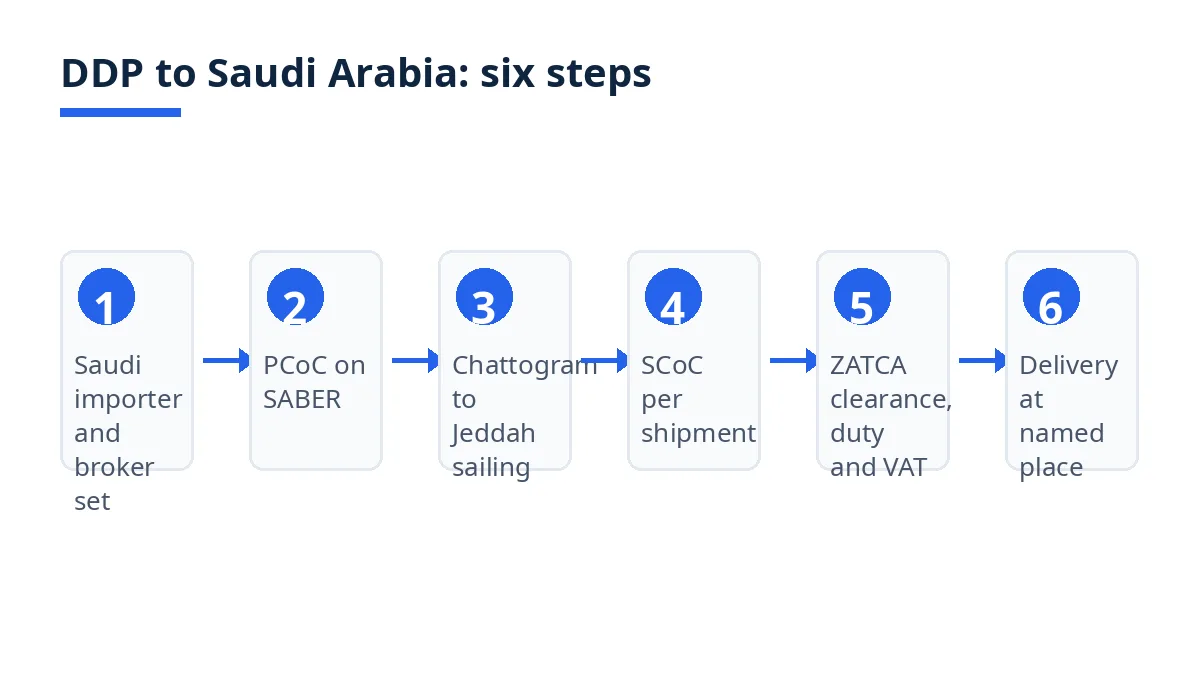
Fix the named place and the Saudi importer in writing. State the full delivery address, the Saudi importer of record, and the ZATCA-accredited broker who will file the declaration. Agree who pays duty, import VAT and broker fees, and who bears the cost if clearance is delayed or refused.
Classify the goods and check SABER scope before production. Confirm the HS classification and whether the product is regulated under a Saudi technical regulation. Regulated products must be registered on SABER before they can clear Saudi customs,4 and the check must happen per product, not per shipment.
Obtain the Product Certificate of Conformity (PCoC). The importer registers the product on SABER and a recognised body assesses it against the relevant Saudi technical regulation; the PCoC covers the product type for up to one year.4 Start before production finishes, not after the goods sail.
Complete the Bangladesh export set and load at Chattogram. Goods may not be loaded for export unless a Bill of Export, also called a Shipping Bill, is submitted to Bangladesh Customs and approved.5 The full set is listed under documents below.
Obtain the Shipment Certificate of Conformity (SCoC) for this consignment. A SCoC is issued per shipment and is required for customs clearance.4 It must be in place before the goods arrive: a certificate applied for after arrival does not cure a clearance failure.
Ship, clear and deliver. The goods sail from Chattogram to Jeddah for western Saudi Arabia, or to King Abdulaziz Port at Dammam for the Gulf side and Riyadh. At the port, the declaration is prepared, the shipment passes security inspection, the declaration is audited against the goods, and only then is it approved and the duties and VAT paid.6 The seller then delivers inland to the named place, where the buyer unloads.
Costs, timelines and documents
What are the typical costs and timelines?
There is no typical DDP cost a guide can state as fact, because every element is priced per shipment: the goods value, the freight rate, the duty rate for the product's classification, the VAT base, broker and conformity fees, and inland delivery to the named place. The two rates that shape the structure are a GCC common external tariff that commonly applies 5% duty on imports, with exceptions for specific goods, and Saudi import VAT at 15%, charged on the customs value plus duty.7
Example figures: take a shipment with a customs value of SAR 100,000. At a 5% duty rate, duty is SAR 5,000. The VAT base is then SAR 105,000, and 15% import VAT is SAR 15,750. Total border taxes in this example are SAR 20,750, before other lines. These are example figures only, not a quotation or a typical cost, and the duty rate for the actual product must be confirmed by the broker against its classification.
Cost line | Who pays under DDP | How it is fixed |
|---|---|---|
Goods and export clearance in Bangladesh | Seller | Contract price and Bill of Export set5 |
International freight, Chattogram to Jeddah or Dammam | Seller | Carrier booking for the sailing chosen |
SABER PCoC and per-shipment SCoC | Agreed in the contract, usually seller | Conformity body fees for the product and shipment4 |
Saudi customs duty | Seller | Broker-confirmed rate for the classification |
Saudi import VAT at 15% | Seller pays at the border; recovery depends on the importer paper | VAT on customs value plus duty7 |
Inland delivery to the named place | Seller | Named place in full, not a city |
Unloading at the named place | Buyer | Agreed in the contract |
For timelines, ask for separate lines, not a single delivery week: PCoC issue before production ends, SCoC issue before sailing, the sea leg to the chosen port, ZATCA clearance at the port, and inland delivery to the named place. A shipment with complete documents does not wait at the port, while delays follow from late declaration submission, false or missing information, or a clearance permission still awaited from another party.6
Which documents are needed?
The Bangladesh export set is the Bill of Export with the export contract or purchase order, commercial invoice, packing list, EXP form certified by an authorized dealer, and certificate of origin.5 The Saudi entry set is the commercial invoice, packing list, bill of lading, certificate of origin, the SABER certificates, and the customs declaration filed by the broker.
Two document rules deserve special attention. First, Arabic labelling: warnings and safety instructions must be in Arabic or in Arabic and English, and instruction manuals must be in Arabic or in both Arabic and English.8 For prepackaged food, labels must be in Arabic or carry an Arabic translation, showing product name, packer, origin, ingredients, end-use instructions and shelf life.8 Second, the invoice, packing list and certificate of origin must agree with each other and with the declaration, since a mismatch is one of the causes of delay ZATCA names.6
Bangladesh-specific rules and tips
Start SABER before the goods are ready. The test reports, technical file and product registration behind the PCoC must exist before the SCoC can be issued.4 Build the PCoC step into the production calendar; never let a sailing date sit before the SCoC date.
Keep one name and one value across every paper. The Bill of Export names the exporter and the foreign buyer,5 and the Saudi declaration is audited against the goods and the documents.6 Names, description, quantity and value must match across the invoice, packing list, certificate of origin and declaration, or clearance can move to inspection.
Price the VAT recovery question, not just the VAT rate. Import VAT is collected in all cases except what the VAT system excludes, regardless of the value of the shipment, and ZATCA calculates it on the goods, shipping, insurance, customs fees and declaration fees.6 Under DDP the seller pays that VAT at the border, but only a Saudi VAT-registered importer can recover it as input tax. State in writing who that importer is and who bears the VAT if it is not recoverable.
Choose the port by the delivery address, not by habit. Jeddah serves western Saudi Arabia and the Red Sea route from Chattogram; Dammam serves the Gulf side and the road to Riyadh. The named place decides the port, and the port decides the inland leg inside the DDP price. A DDP price that does not name the port of entry has not priced inland delivery at all.
Do not treat DDP as a substitute for checking the seller's Saudi setup. A seller who cannot name its Saudi importer, broker and SABER route has not priced DDP. Ask for those three names before accepting a quotation.
Mistakes and red flags
What are the most common mistakes?
Accepting a DDP price without a named place in full. A price to a city is not a DDP price: the named place fixes the inland leg, the port and the point where risk passes.
Leaving the Saudi importer unnamed. If the contract does not say who imports the goods, who files the declaration and who pays duty and VAT, the first border problem becomes a dispute about responsibility. The seller's DDP obligation includes import clearance,2 but only a named importer and broker turn it into a file ZATCA can process.
Treating SABER as a port formality. The PCoC covers the product type for up to one year and the SCoC covers the single shipment.4 A seller who starts SABER after the goods sail has missed the window, since the SCoC must exist before arrival.
Quoting VAT on the goods value alone. Import VAT is charged on the customs value plus duty, and ZATCA calculates it on the goods, shipping, insurance, customs fees and declaration fees.6 7 Applying 15% to the goods value only understates the border tax.
Ignoring Arabic labelling until the goods arrive. Warnings and safety instructions must be in Arabic or in Arabic and English, and manuals must be in Arabic or bilingual.8 Labels are fixed at origin, not at the port.
Reading a marketplace badge as a guarantee. Exportain's verification is a document review by staff, not a factory inspection, and a badge is not a guarantee of production capacity, product quality or delivery.9
Checklist
Before you confirm a DDP order to Saudi Arabia, every line should be answered in writing.
Named place in full, with the port of entry named.
Saudi importer of record and ZATCA-accredited broker named.
Duty and VAT payer named, with the VAT recovery position stated.
HS classification and duty rate confirmed by the broker.
SABER scope checked per product; PCoC date fixed before production ends.
SCoC date fixed before sailing, per shipment.
Bangladesh export set agreed: Bill of Export, contract or purchase order, invoice, packing list, EXP form, certificate of origin.5
Arabic labels and manuals checked before packing.8
Freight, port charges, broker fees and inland delivery priced as separate lines.
Unloading responsibility and delivery evidence stated.
If ZATCA or SABER holds the shipment: who pays storage, who acts, and by when.
How Exportain helps
On Exportain, browse suppliers and post a request for quotation on the RFQ board with the named place in full, the port of entry, the product and its SABER position, and the DDP basis, so suppliers quote against the same Saudi entry. Ask each reply to name its Saudi importer, broker and SABER route before you compare prices. When you accept a quotation, Exportain creates one order and issues one proforma invoice from the accepted terms.9
Read the badges for what they record. Exportain Verified means Exportain has checked identity, phone, email and business registration; Export Verified means it has checked the Export Registration Certificate; Factory Verified and Trading Company Verified mean it has reviewed photos of the factory or office or warehouse.9 Verification is a document review, free, and never granted by membership plans.9 It is not a factory inspection, so sample approval, SABER verification and inspection stay with you. See how supplier verification works on Exportain.
FAQs
What should I know first about DDP?
DDP means the seller delivers the goods to the named place in Saudi Arabia, cleared for import, with duties and taxes paid, bearing risk until delivery.2 Before price, fix the named place in full, the Saudi importer of record and the broker, and the SABER position of the product. A DDP price without those three is not a price you can rely on.
What are the typical costs and timelines?
There are no typical figures a buyer can rely on, because duty depends on classification, VAT is 15% on the customs value plus duty,7 and freight, SABER fees, broker fees and inland delivery vary per shipment. Example figures: on a SAR 100,000 customs value at 5% duty, duty is SAR 5,000 and 15% VAT on SAR 105,000 is SAR 15,750, a total of SAR 20,750 in border taxes before other lines. Timelines must be quoted as separate lines: PCoC, SCoC, sailing, ZATCA clearance and inland delivery.
Which documents are needed?
The Bangladesh set is the Bill of Export with the contract or purchase order, commercial invoice, packing list, EXP form and certificate of origin.5 The Saudi set is the invoice, packing list, bill of lading, certificate of origin, SABER PCoC and per-shipment SCoC, and the customs declaration.4 Arabic labels and manuals must be checked before packing.8
What are the most common mistakes?
The most common mistakes are a DDP price without a full named place, an unnamed Saudi importer, SABER started after sailing, VAT applied to the goods value alone,7 and Arabic labelling ignored until arrival.8
Next steps on Exportain
Browse suppliers, then post your named place, port of entry and product on the RFQ board so suppliers state their Saudi importer, broker and SABER route. Before you confirm, read the Incoterms guide for shipments from Bangladesh and the landed cost guide for imports from Bangladesh.
Sources
- Incoterms® 2020. International Chamber of Commerce (ICC) (accessed )
- DDP Shipping (Delivered Duty Paid) Explained. TecEx (accessed )
- Mawani launches Blue Ocean's BOS Service at Jeddah Islamic Port. GCC Ports (accessed )
- What Is a SASO Certificate? SABER Certification Guide. Tetra Inspection (accessed )
- Customs Clearance Procedures for Export. Bangladesh Customs, National Board of Revenue (accessed )
- E-Store Customers. Zakat, Tax and Customs Authority (ZATCA) (accessed )
- Guide to Import VAT in Saudi Arabia for Foreign Companies. Commenda (accessed )
- Saudi Arabia - Labeling/Marking Requirements. International Trade Administration, US Department of Commerce (accessed )
- Trust & Safety Center. Exportain (accessed )
About the author
Sourcing from Bangladesh?
Post a request for quotation and suppliers on Exportain can send you their quotes directly.
Post an RFQ