DDP Shipping From Bangladesh to Canada: Costs, Steps and Timeline
DDP from Bangladesh to Canada, through a Canada-entry lens: CARM importer setup, GST/HST on the duty-paid value, LDCT origin proof, and the named-place price lines to confirm.
Short answer
Under DDP, a Bangladeshi seller delivers goods to a named place in Canada, cleared for import, with duties and taxes paid, bearing risk until delivery, while the buyer unloads. The Canadian side decides whether the price holds: the importer must be registered in CARM, the tariff treatment and origin proof must be confirmed, and GST/HST on importation must be priced with its recovery route agreed. Confirm the importer, the treatment, and the tax route in writing before accepting a DDP price.
On this page
Key takeaways
Under DDP, the seller delivers goods to the named Canadian place cleared for import, with duties and taxes paid, bearing risk until delivery; the buyer unloads.
The importer registers itself in CARM with a BN9 and RM account, then delegates access to the broker; a non-resident importer obtains its BN9 from the CRA first.
GST/HST on importation is charged on the value for duty plus duty; commercial importers pay the federal part at the border, may self-assess the provincial part, and only registrants can generally claim an input tax credit.
LDCT duty-free entry needs origin rules met, direct shipment to Canada, and the right proof: Form A or an Exporter's Statement of Origin, or Form B255 for HS Chapters 50 to 63 apparel; confirm the treatment code per shipment.
Exportain verification is a document and photo review, not a factory inspection, and a badge is not a guarantee of capacity, quality or delivery.
Under DDP, a Bangladeshi seller delivers goods to a named place in Canada, cleared for import, with duties and taxes paid, bearing risk until delivery, while the buyer unloads. The Canadian side of the deal decides whether the price holds: the importer must be registered in the CBSA Assessment and Revenue Management system (CARM), the tariff treatment and origin proof must be confirmed for that shipment, and GST/HST on importation must be priced with its recovery route agreed in writing.
DDP places the greatest level of obligation on the seller among the Incoterms rules: export clearance, international transport, import clearance, payment of duties and taxes, and delivery to the named place, with risk of loss or damage until delivery.1 The Incoterms 2020 rules comprise 11 rules with a clear allocation of cost, risk and obligations for each rule.2 That allocation is why DDP looks simple to the buyer and demanding to the seller. It is not risk-free for the buyer either: without a workable Canadian import setup, goods can stall at the border, and a reassessment after delivery can still change the deal economics.
Canada adds three entry questions: who registers as importer in CARM and how, how GST/HST is charged on the duty-paid value and who recovers it, and which tariff treatment the goods claim. This guide works through those questions, then gives the cost lines, documents and checks to put in writing before accepting a DDP price.
Why this matters for buyers and sellers
For the buyer, DDP offers one landed price and no border bill on arrival. The exposure sits underneath that price: a quotation that does not name the importer, treatment, GST/HST route and named place prices an undefined import, not delivered goods. If the seller cannot act as importer, or the broker cannot file under the claimed treatment, delivery fails even though the goods have left Bangladesh.
For the seller, DDP means working capital and compliance liability arrive together: the seller prepays freight, duty and GST/HST, and bears full liability if declarations are incorrect.1 The seller also needs a Canadian import route, since a foreign company cannot simply assume the importer of record role without local registration.1 Either the buyer acts as importer, the seller registers as a non-resident importer, or a qualified third party acts as importer of record. That choice decides whose business number appears on the declaration, who pays the CBSA, and who recovers the GST/HST.
Step-by-step: how it works
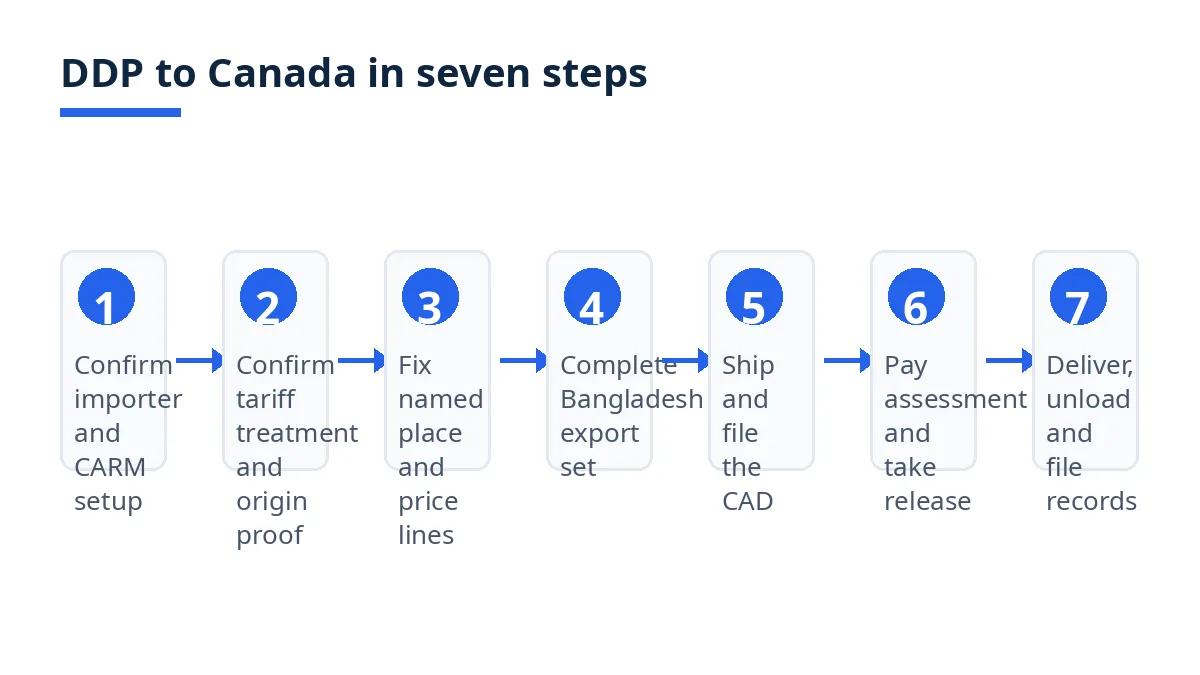
Name the importer and complete the CARM setup. The importer needs a nine-digit business number (BN9) and an import-export program (RM) account. Most new resident commercial importers can obtain a BN9 through the CARM Client Portal, but a non-resident importer must obtain a BN9 from the Canada Revenue Agency (CRA) first.3 The business account manager registers the business in the portal and then delegates access to the broker; the broker cannot complete the initial registration.4 Enroll in Release Prior to Payment (RPP) and post the required financial security if goods are to be released before payment.4
Confirm the tariff treatment and origin proof for this shipment. Check the classification, the treatment claimed in the commercial accounting declaration (CAD), and the exporter's proof of origin. For Least Developed Country Tariff (LDCT) claims, goods must satisfy the rules of origin, meet proof of origin requirements, and be shipped directly to Canada from the beneficiary country.5 The CAD uses code 08 for LDCT, 09 for the General Preferential Tariff (GPT), and 02 for Most-Favoured-Nation (MFN) treatment.5
Fix the named place and the DDP price lines in writing. State the named place: a Toronto warehouse delivery and a Vancouver port delivery are different DDP prices. List each line separately: goods, freight, insurance, export clearance, duty, GST/HST, broker charges, and inland delivery. State who bears storage and demurrage if clearance is delayed.
Complete the Bangladesh export set. Goods may not be loaded for export unless an export declaration, the Bill of Export or Shipping Bill, is submitted to Customs and approved.6 The set includes the export contract or purchase order where there is no export letter of credit, invoice, packing list, EXP form certified by an authorized dealer, and certificate of origin.6
Ship, then file the declaration through the broker. The broker files the CAD in the CARM Client Portal under the importer's RM account, using the classification, value for duty, treatment and origin proof from step 2. Keep the invoice, packing list, bill of lading and origin proof consistent: the same description, value and origin on every document.
Pay the assessment and take release. The CBSA assesses duty and GST/HST, and goods are released once payment or RPP security is in place. The person responsible for paying GST/HST on imported goods is the person responsible for paying the customs duty, or who would be responsible if the goods were dutiable.7 For taxable commercial goods imported by a resident of a participating province, only GST is payable at importation, with possible provincial self-assessment afterwards.8
Deliver, unload and file the records. The seller delivers to the named place and the buyer unloads, unless otherwise agreed.1 The importer keeps the proof of origin and all other import documents for six years.9 A registrant importer claims an input tax credit for the GST or federal part of the HST paid at importation for its commercial activities, while a non-registrant cannot claim input tax credits.7
Costs, timelines and documents
What are the typical costs and timelines?
No typical costs or timelines hold across shipments: duty depends on classification and treatment, GST/HST on the duty-paid value and destination province, and freight on the sailing and named place. Price the lines below for your shipment, and ask for each timeline separately.
Cost line | What decides it | Confirm in writing |
|---|---|---|
Goods and export clearance | Contract price and export set | Invoice, packing list, Bill of Export, EXP form |
Freight and insurance | Route, mode, named place | Freight line; insurance inclusion; seller bears risk until delivery |
Canadian duty | Classification and treatment | Broker-confirmed code; treatment 08, 09 or 02 |
GST/HST | Value for tax, destination province | Federal part at importation; provincial self-assessment where it applies |
Broker, inland, storage | Broker scope, named place | Broker charges, inland line, storage and demurrage payer |
Example figures: on a value for duty of CAD 100,000 with no duty payable under an LDCT claim, the value for tax is CAD 100,000 and GST at 5% is CAD 5,000, so border charges in the example are CAD 5,000 before broker, freight and inland lines. The value for tax adds any duty to the value for duty, so duty raises the GST base as well. The CBSA calculates tax on the value of the goods for duty purposes plus all duties and taxes payable on importation other than GST/HST.7 These example figures show structure only, not market rates or a quotation.
Which documents are needed?
The Bangladesh export set is the Bill of Export, invoice, packing list, EXP form certified by an authorized dealer, and certificate of origin, plus VAT registration and taxpayer identification documents.6 The Canada set is the invoice, packing list, bill of lading, the CAD filed in CARM, and the proof of origin: Form A or an Exporter's Statement of Origin for most LDCT goods, and Form B255 for HS Chapters 50 to 63.9 Add the broker delegation in CARM, labeling artwork, and written price lines from step 3. See the landed-cost guide linked in Next steps for how these lines add up to a landed cost.
Bangladesh-specific rules and tips
Claim the treatment per shipment, not per relationship. Almost all goods originating in a least developed country can enter duty-free under the LDCT if they meet the origin rules, except supply-managed dairy, poultry and egg products over quota.5 Failing LDCT, goods may still qualify for a reduced GPT rate, then MFN treatment.5 Canada extended duty-free access for Bangladesh until 2034 under its preference scheme, as reported after the 2023 finance bill.10 The extension does not remove the per-shipment work: the broker must still confirm the classification, treatment code and origin proof for the goods actually shipped.
Get the origin form right for apparel. Textile and apparel goods of HS Chapters 50 to 63 use Form B255, while other LDCT goods use Form A or an Exporter's Statement of Origin, each completed and signed by the exporter where the goods were finished.9 An apparel DDP price built on the wrong form is built on a failed claim. When the CBSA verifies origin, the exporter or producer must return its questionnaire as directed, and goods that do not qualify are charged duty at the next most beneficial rate.5
Protect the direct-shipment condition. LDCT and GPT qualification requires shipment directly to Canada from the beneficiary country.5 A routing change, split shipment or transshipment breaking direct shipment can break the claim even when the goods qualify. Confirm the routing with the broker before the goods leave Bangladesh, and keep the through bill of lading with the origin proof.
Print bilingual labels at the factory. Consumer goods sold in Canada must carry mandatory label information in English and French: the product identity declaration in both languages and the net quantity declaration, while the dealer's name and address may appear in either language.11 Quebec requires French on product labeling with equal prominence, and the Charter of the French Language also covers manuals and instructions.11 Agree the artwork before production: relabeling after arrival means handling every unit.
Mistakes and red flags
What are the most common mistakes?
Assuming the broker registers the importer. The business account manager registers the business in CARM and delegates access to the broker afterwards.4 A plan that leaves registration to the broker, or starts it after shipment, is already late.
Pricing duty from a product description. Duty follows the broker-confirmed classification and treatment code in the CAD, not a catalogue description.5 A quotation stating duty without naming both has not priced duty at all.
Treating GST/HST at the border as the final tax cost. For commercial goods, only the federal part is payable at importation in a participating province, with possible provincial self-assessment afterwards;8 a registrant can generally claim an input tax credit, a non-registrant cannot.7 The price must state who bears the GST/HST and who keeps any recovery.
Losing the origin claim on paper. A missing or unsigned Form A, Statement of Origin or B255, or a broken direct shipment, turns a duty-free claim into a duty bill.5 9 Keep the signed proof with the shipment documents.
Shipping English-only consumer packaging. Mandatory information must appear in both English and French, and Quebec adds French prominence rules.11 Check the artwork before production, including Quebec if the goods will be sold there.
Reading a badge as a guarantee. Exportain verification is a document and photo review, not a factory inspection, and a badge is not a guarantee of capacity, quality or delivery.12 Sample approval, inspection and the written DDP terms stay with the buyer and seller.
Checklist
Before you accept a DDP price to Canada, every line should be answered.
Importer named: buyer, seller as non-resident importer, or third-party importer of record.
BN9 and RM account confirmed, business registered in CARM, broker delegated.3 4
RPP and financial security confirmed, or pay-before-release accepted.
Classification and treatment code confirmed by the broker: 08, 09 or 02.5
Origin proof form confirmed: Form A, Statement of Origin, or B255 for HS Chapters 50 to 63.9
Direct shipment route confirmed with the broker.
Named place stated precisely, with each DDP price line listed separately.
GST/HST route agreed: federal part at importation, provincial self-assessment where it applies, who keeps any input tax credit.7 8
Bangladesh export set agreed: Bill of Export, invoice, packing list, EXP form, certificate of origin.6
Bilingual label artwork approved, including Quebec French prominence where goods will be sold there.11
Storage, demurrage and reassessment risk allocated in writing.
Delivery, unloading and six-year record keeping assigned.1 9
How Exportain helps
On Exportain, browse suppliers and post a request for quotation (RFQ) on the RFQ board with the named Canadian place, the product specification, and three questions: who will be the importer, which treatment the price assumes, and how GST/HST on importation is handled. Ask each reply to state its classification basis and origin proof form. On acceptance, Exportain creates one order and issues one proforma invoice from the accepted terms.12
Read the badges for what they record. Exportain Verified means identity, phone, email and business registration have been checked; Export Verified means the Export Registration Certificate (ERC) has been checked; Factory Verified and Trading Company Verified mean factory or office and warehouse photos have been reviewed.12 Verification is a document and photo review by staff, free, and never granted by membership plans.13 It is not a factory inspection,12 13 so sample approval, classification checks and written terms stay with you.
FAQs
What should I know first about DDP?
Under DDP, the seller delivers goods to the named place in Canada, cleared for import, with duties and taxes paid, bearing risk until delivery; the buyer unloads.1 First settle the import setup: named importer, BN9 and RM account in CARM, tariff treatment, and GST/HST route. A price without those four items is incomplete.
What are the typical costs and timelines?
No typical costs or timelines apply across shipments. The lines are goods, freight, insurance, export clearance, Canadian duty by classification and treatment, GST/HST on the duty-paid value, broker charges, and inland delivery. Example figures: on a CAD 100,000 value for duty with no duty under an LDCT claim, GST at 5% is CAD 5,000 in the example. For timelines, ask for production, booking, sailing, release and inland delivery separately, and confirm whether RPP security allows release before payment.4
Which documents are needed?
The Bangladesh set is the Bill of Export, invoice, packing list, EXP form certified by an authorized dealer, and certificate of origin.6 The Canada set is the invoice, packing list, bill of lading, the CAD filed in CARM, and the origin proof: Form A or an Exporter's Statement of Origin, or Form B255 for HS Chapters 50 to 63.9 Keep the broker delegation, label artwork and written price lines with the same set.
What are the most common mistakes?
The most common mistakes are leaving CARM registration to the broker, pricing duty from a description, losing the origin claim through a missing form or broken direct shipment, shipping English-only packaging, and assuming border GST/HST is the final tax position.4 5 9 7 11
Next steps on Exportain
Post your named Canadian place, product specification and the three importer questions on the RFQ board, then read the Incoterms for shipments from Bangladesh guide and the landed cost imports from Bangladesh guide before you accept a DDP price.
Sources
- DDP Shipping (Delivered Duty Paid) Explained. TecEx (accessed )
- Incoterms® 2020. International Chamber of Commerce (ICC) (accessed )
- Register for or modify an import-export program account. Canada Border Services Agency (accessed )
- CARM: Assess and pay duties and taxes on imported commercial goods. Canada Border Services Agency (accessed )
- Claim the least developed countries preferential tariff rate. Canada Border Services Agency (accessed )
- Customs Clearance Procedures for Export. Bangladesh Customs, National Board of Revenue (accessed )
- Doing Business in Canada - GST/HST Information for Non-Residents (RC4027). Canada Revenue Agency (accessed )
- Memorandum D13-2-5 - Customs Valuation: Effects of the Goods and Services Tax. Canada Border Services Agency (accessed )
- Memorandum D11-4-2 - Proof of Origin of Imported Goods. Canada Border Services Agency (accessed )
- Canada extends duty-free access for Bangladesh till 2034. The Business Standard (accessed )
- Canada - Labeling/Marking Requirements. International Trade Administration, US Department of Commerce (accessed )
- Trust & Safety Center. Exportain (accessed )
- Supplier verification: Earn trust badges buyers can see. Exportain (accessed )
About the author
Sourcing from Bangladesh?
Post a request for quotation and suppliers on Exportain can send you their quotes directly.
Post an RFQ