DDP Pros and Cons: When Should Importers Use It?
DDP gives an importer one delivered price with duty paid, and takes away control over import clearance. This verdict framework scores the rule for first orders, repeat orders, small loads and duty-heavy destinations, so the choice follows the order.
Short answer
DDP suits an importer when the seller can lawfully clear the goods for import in the destination country, the duty position is clear enough to price, and the buyer values one delivered price over control of carriage and clearance. It suits the buyer poorly when the seller cannot act as importer, when duty or classification is disputed, or when the buyer already runs its own broker and carrier at lower cost.
On this page
Key takeaways
DDP moves import clearance, duty and tax payment, and transit risk to the seller, and delivery ends when goods stand ready for unloading at the named place.
The rule wins for first orders and buyers without an import setup, and loses where the seller cannot clear imports or duty is hard to price.
A DDP price can carry a margin for the seller's duty risk; separate duty, tax, freight and unloading before comparing it with DAP.
DDP imposes no duty on the seller to insure for the buyer, and unloading risk stays with the buyer; agree both in writing.
A DDP quotation asks what goods cost delivered to a named place, with import duty and taxes already paid. That single price is easy to compare, and easy to misread. This article scores DDP against the order in front of you, so a simple-looking price is judged on the work behind it.
Score the order first, then choose the rule
DDP is Delivered Duty Paid, one of the eleven rules in Incoterms® 2020, the trade terms set out by the International Chamber of Commerce (ICC).1 Under DDP the seller takes the goods, cleared for import with duty and taxes settled, to a named place, and carries the journey's cost and risk until the goods are ready to unload.2 DDP applies across transport modes, alone or combined.2 Only FAS, FOB, CFR and CIF are confined to sea and inland waterway transport; CPT, DPU and DDP sit in the any-mode group.3
Order feature | Points toward DDP | Points away from DDP |
|---|---|---|
Import experience | First order, or no broker and no import setup | Repeat orders with a broker already in place |
Order size | Small load where one broker fee weighs heavily | Large load where the buyer spreads its own clearance cost |
Duty position | Duty and classification are clear and stable | Duty is disputed, or classification is open to argument |
Seller position abroad | Seller can lawfully act as importer at destination | Seller is barred from import formalities, or has no presence there |
Control wanted | Buyer wants one price and one party to chase | Buyer wants its own carrier, broker and delivery timetable |
No single row decides the choice. Test the rows that matter most with the seller and a broker.
Where DDP earns its price for the buyer
The first gain is a single landed figure. Under DDP the seller books and pays for transport to the named place, handles export, transit and import formalities, and pays duty and taxes.2 The buyer can compare that figure with the resale price without adding a separate duty estimate. For a first order, that removes the largest unknown in the landed cost, which is the import bill at destination.
The second gain is risk held by the seller for longer. The seller bears the risk of loss or damage during transit, from origin to the agreed point of delivery at the named destination.2 Delivery and risk transfer happen at the same point under DDP, when the goods are placed at the disposal of the buyer, ready for unloading.4 The seller therefore remains responsible until the goods reach the named place.5
The third gain is fewer parties to manage, and planning placed on the seller. One seller contracts the carriage, handles the export and import paperwork, and gives notice so the buyer can receive the goods.2 The seller must deliver on the agreed date or within the agreed period, and must notify the buyer in time to receive the goods.6 That does not promise a transit time, which depends on the route and the carrier.
Where DDP takes value away from the buyer
The first loss is control. Under DDP the seller chooses the carrier, the route and the broker at destination.2 A buyer who has negotiated freight rates, who consolidates loads from several suppliers, or who needs a specific arrival day cannot use those arrangements under a DDP sale unless the contract says otherwise.
The second loss is price transparency. A DDP price bundles goods, packing, carriage, clearance, duty and taxes into one figure.6 The buyer cannot see how much is duty, how much is freight, or how much margin the seller added for carrying the duty risk. One ICC Academy commentator warns that the cost of having the seller handle logistics is reflected in the selling price, most likely with a margin for error as well as a profit margin.3 That margin is the price of shifting risk. It still means a DDP price cannot be compared with a DAP or FOB price until the import lines are separated.
The third loss is the seller's exposure. In some destination countries, foreign sellers face legal barriers, or even a prohibition, on completing import formalities.6 Even where import clearance is allowed, complying with the legal and administrative requirements of the buyer's country can be difficult and costly, and that burden falls hardest on small and medium-sized sellers.6 A seller who accepts DDP without an import route may delay the goods or ask the buyer to clear them after all.
The fourth loss sits in insurance and unloading. DDP creates no duty for the seller to arrange insurance that pays the buyer directly.5 The seller may take out cover for its own account while it bears the risk, and that cover need not pay the buyer.6 Unloading is the buyer's job: the buyer bears its risk, and pays the cost unless the carriage contract puts that cost on the seller.2
What the seller actually takes on under DDP
A DDP sale moves five jobs to the seller, to be confirmed in writing before the goods move. The seller packs the goods, draws up the invoice and packing list, and files the export clearance. The seller contracts and pays for carriage to the named place, by any mode or combination of modes, and meets the transport security requirements for that carriage.2 The seller completes transit formalities where the goods pass through a third country.2 The seller completes import clearance at destination and pays duty and taxes.2 The seller gives the buyer notice of arrival so the buyer can take delivery.2
The buyer keeps three duties. The buyer assists the seller in obtaining documents or information the import authorities require, under article B7 of the Incoterms® 2020 rules, while the seller stays responsible for the clearance itself.2 The buyer takes delivery when the goods arrive ready for unloading. The buyer unloads the goods, bearing the unloading risk, and arranges and pays for onward transport after the named place.2
Two points are often missed. The named place must be a full address, terminal or warehouse, not a city: a vague place leaves the seller free to choose a delivery point inside that city that suits the seller.6 The insurance position must also be agreed separately: cover that pays the buyer for loss or damage in transit must be named in the contract, because DDP alone does not provide it.5 For the full set of rules, see the Incoterms overview; for the closest alternative term, see DAP pricing.
Bangladesh export papers under a DDP sale
DDP changes who clears the goods at destination. It does not change the export papers at origin. Customs approval must be in place before loading: no goods may be loaded for export until the Bill of Export, the export declaration also called a shipping bill, has been submitted and approved.7 The declaration states the description and value of the goods, the exporter, the foreign buyer and the transport operator.7
The enclosures for all export consignments include the commercial invoice, the packing list, the EXP form certified by an authorised dealer bank, the VAT registration certificate, the taxpayer identification number, the certificate of origin, and the export letter of credit or, where there is none, the export contract, purchase order or export guarantee approved by the negotiating bank.7 Product-specific papers may also apply, such as an export registration certificate for jute, jute goods and tea, or a phytosanitary certificate for agricultural goods.7
A seller who answers the export half promptly and the import half vaguely has not yet solved the DDP half of the order. Confirm with a broker in the destination country whether the seller, or an agent acting for the seller, can stand as importer there.
Two orders, one rule, two different verdicts
All figures below are example figures. The shipment is 2,000 cotton cushion covers from Bangladesh to a warehouse in Rotterdam, Netherlands, on DDP terms to that warehouse address. No duty rate is stated: a broker must confirm the duty amount before an order is placed.
Line | Example figures |
|---|---|
Goods: 2,000 covers at $3.80 | $7,600 |
Export packing | $320 |
Export clearance | $150 |
Inland transport and port handling | $410 |
Ocean freight, Chattogram to Rotterdam | $1,900 |
Insurance for the seller's own risk | $95 |
Import clearance and broker fee | $260 |
Duty and import taxes allowed | $1,180 |
DDP price | $11,915 |
$7,600 + $320 + $150 + $410 + $1,900 + $95 = $10,475 before import, and $10,475 + $260 + $1,180 = $11,915, or $5.96 per cover. The DAP price for the same shipment, before import, is the same $10,475.
A first-time buyer with no broker pays the same $260 clearance fee and $1,180 duty and taxes, plus an example allowance of $180 for arranging clearance it has never done before, giving an all-in DAP cost of $12,095, or $6.05 per cover. DDP wins by $180. A repeat buyer with a broker already engaged pays $140 for clearance and the same $1,180 duty and taxes, giving an all-in DAP cost of $11,795, or $5.90 per cover. DAP wins by $120.
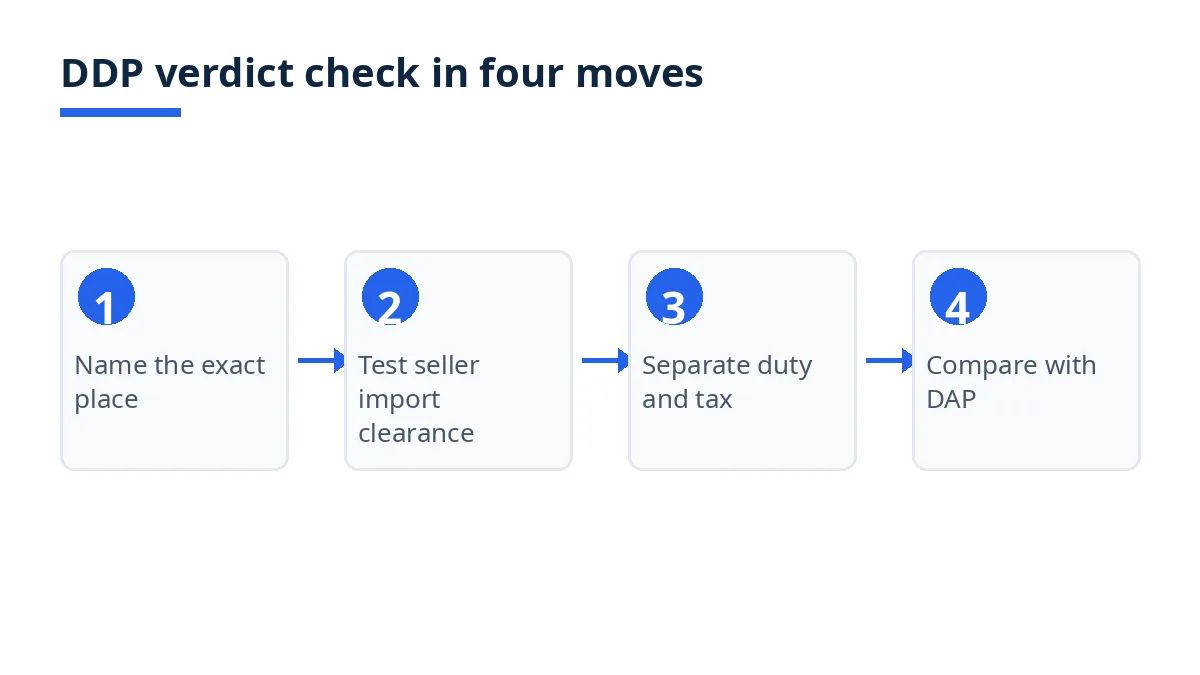
The diagram states the four checks that decide the verdict before a price is compared.
Warning signs that point away from DDP
A seller who will not name the import agent at destination is the first warning sign. Under DDP the seller must carry out import formalities, and the buyer assists only with documents and information.2 A quotation that says "DDP, duty paid" with no named broker, no import declaration route and no duty basis is a promise without a mechanism.
A second warning sign is a DDP price that cannot be split. If the seller will not separate goods, carriage, import clearance, duty and taxes, the buyer cannot check the duty figure with a broker or compare the freight with a DAP quotation. Separation is the only way to test whether the single price is fair.
A third warning sign is a named place that is a city, a port area or a region. Delivery under DDP happens at the named place, and risk passes there.4 A city name leaves the exact delivery point open, and the seller may deliver to the point inside that city that costs the seller least.6
A fourth warning sign is silence on insurance and unloading. DDP imposes no insurance duty for the buyer, and unloading risk stays with the buyer.5 2 If the contract says nothing about either, get both points confirmed before shipment.
A fifth warning sign is a product whose classification is contested at destination, or a destination where duty rules are changing. A disputed classification can leave the seller facing a bill it did not allow for, or the buyer facing a delay. Where classification is open, a rule that leaves duty with the buyer, such as DAP, keeps the dispute with the party that owns the import file. CIF explained covers the sea-only alternative, where risk passes on board and the buyer clears imports.4
A five-point check before you agree DDP
Do not agree the term until each point has an answer in writing.
Named place. Is the full address, terminal or warehouse stated, with "Incoterms® 2020" after it, and does the seller confirm delivery means ready for unloading at that address?
Import route. Who files the import declaration, under whose name, and through which broker? Has a broker in the destination country confirmed that route is lawful?
Duty basis. What duty and tax amount has the seller allowed, on what classification and value, and will the seller hold that figure if the schedule changes before arrival?
Unloading and insurance. Who pays for unloading, who bears its risk, and what insurance, if any, pays the buyer directly for loss or damage in transit?
DAP comparison. What is the same order priced as DAP, with the import lines shown separately, so the DDP margin for duty risk can be seen and judged?
If any point has no answer, the order is not ready for DDP. A seller who can answer all five has usually already solved the import half of the sale, which is the half that decides whether DDP works.
What should a first-time importer settle before agreeing DDP?
A first-time importer should settle the named place, the seller's import route, the duty basis and the unloading and insurance positions before agreeing DDP. The seller must be able to clear the goods for import in the destination country, and the buyer must assist with documents the import authorities require.2 Confirm the import route with a broker in the destination country first, because a seller barred from import formalities there cannot perform DDP however willing it may be.6
How do DDP costs and timing compare with DAP on the same order?
DDP and DAP share the same delivery point and the same seller-arranged carriage, so the freight and the transit timetable do not differ by the rule alone. The difference is the import bill: under DDP the seller pays import clearance, duty and taxes, while under DAP the buyer does.2 Compare the two terms only after the import lines are separated, as in the worked example above.
Which papers does the buyer still have to supply under DDP?
The buyer still has to supply the documents and information the seller needs for import clearance, when the import authorities ask for them. The seller remains responsible for the clearance, and the buyer assists under article B7.2 The buyer should expect requests for identification, import details and any destination-specific document, and should answer them promptly, because a late answer can hold the goods at the border even though the clearance duty sits with the seller.
What goes wrong most often when DDP fits the wrong order?
The most common failure is accepting DDP where the seller cannot complete import clearance, followed by comparing a bundled DDP price with a DAP price without separating duty and tax, and by assuming insurance and unloading are included. If the destination authorities require the local importer to file the declaration, DDP is unavailable and DAP fits the order instead.2 Put the named place, the import agent, the duty basis, unloading and insurance in the contract before shipment, and the three failures are largely avoided.
Next steps on Exportain
When you seek quotations, ask each supplier to show the import lines separately within its DDP figure, and have a broker check the duty figure before you accept. The buying steps walk through enquiry, quotation and order.
Post a free RFQ on Exportain and get quotes from verified Bangladeshi suppliers
Sources
- Incoterms® rules. International Chamber of Commerce (ICC) (accessed )
- DAP & DDP Incoterms 2020 explained: Key differences. ICC Academy (accessed )
- Insider thoughts: Bob Ronai on Incoterms 2020 Rules; What are they about?. International Chamber of Commerce (accessed )
- Place of delivery & risk transfer in trade contracts. ICC Academy (accessed )
- Incoterms® 2020 C rules vs D rules: Risk transfer explained. ICC Academy (accessed )
- DDP & EXW Incoterms® 2020 explained: Key differences. ICC Academy (accessed )
- Customs Clearance Procedures for Export. Bangladesh Customs, National Board of Revenue (accessed )
About the author
Sourcing from Bangladesh?
Post a request for quotation and suppliers on Exportain can send you their quotes directly.
Post an RFQ