DAP Shipping From Bangladesh to UK: Costs, Steps and Timeline
DAP from Bangladesh to the UK explained: the seller delivers to your named place, while you clear UK customs, pay duty and handle import VAT. Includes CDS entry, postponed VAT accounting, DCTS preference checks and a buyer checklist.
Short answer
Under DAP, a Bangladeshi seller delivers goods to a named UK place ready for unloading, while you as buyer act as importer of record, file the CDS import entry, and pay duty and import VAT. Agree the full delivery address in writing, set up your GB EORI number, and instruct postponed VAT accounting in writing before the entry is filed.
On this page
Key takeaways
Under DAP, the seller delivers to your named UK place ready for unloading, while you as buyer act as importer of record, file the CDS entry, and pay duty and import VAT.
A country or a port is not a named place: write the full UK delivery address into the contract, with Incoterms 2020 stated.
Postponed VAT accounting must be instructed in writing before the entry is filed, with your VAT number on the declaration, or import VAT is paid at the border instead.
A DCTS preference must be checked for your exact commodity code with origin evidence, not assumed from Bangladesh origin alone.
Verification on Exportain is a document review, not a factory inspection, and a badge is not a guarantee of capacity, quality or delivery.
Under DAP, a Bangladeshi seller delivers your goods to a named place in the United Kingdom, ready for unloading, and you, as the UK buyer, act as the importer of record, complete the UK import entry and pay any duty and import VAT that apply. That split is the whole point of DAP shipping from Bangladesh to the UK: the seller carries the journey to your premises, while UK customs clearance stays with you.
DAP stands for Delivered at Place, one of the 11 Incoterms 2020 rules, which give a clear allocation of cost, risk and obligations between seller and buyer.1 Under DAP the seller does not unload the goods, which is the one difference from the related DPU rule, where the seller does unload.1 If you want the seller to clear UK customs and pay UK duty for you instead, that is DDP, and it needs to be written into the contract as DDP, not assumed from a DAP price. A DAP quotation is therefore not a landed price: your UK-side costs sit outside it.
Why this matters for buyers and sellers
For the buyer, DAP keeps control of the UK import side in your own hands. You choose your customs agent, you hold the GB EORI number, you decide whether to use postponed VAT accounting, and you claim any duty preference that applies to your goods.
For the seller, DAP avoids taking on UK customs, duty and VAT questions for a market it may not know well. The seller still carries the export side and the main carriage, and still bears the transit risk until the goods are available at the named place, ready for unloading. That is why the named place and the unloading arrangements need to be exact in writing.
The risk for both sides sits in the gap between arrival and release. GOV.UK sets out the UK clearance steps, from setting up for import declarations through submitting and managing the declaration to paying VAT and duty, and it warns that goods may be held at the border if the right duty or VAT has not been paid, if the right import licences are missing, or if the goods did not pass inspection.2 Under DAP, that hold lands on the buyer timetable, even though the seller arranged the transport.
Step-by-step: how it works
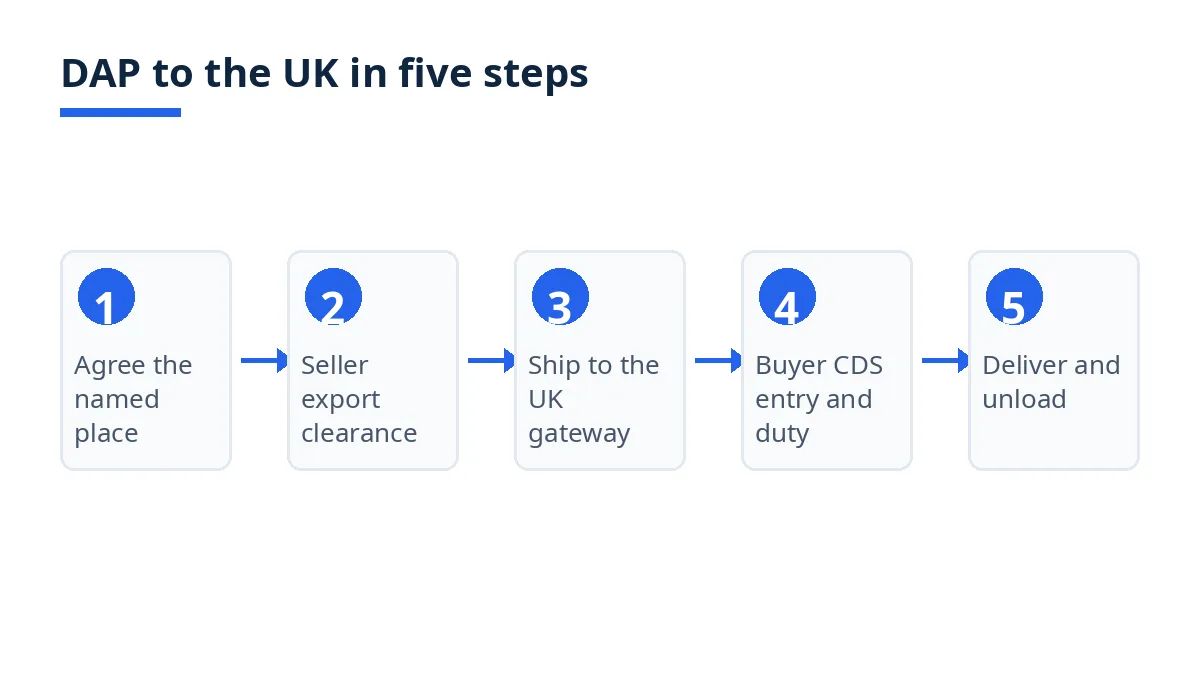
Agree the named place in full. Write the term as DAP followed by the complete delivery address, plus Incoterms 2020. A port name alone, such as Felixstowe, leaves the inland leg unclear, so state whether the seller delivers to the port or to your premises.
Confirm who does what in writing. The seller handles Bangladesh export clearance and carriage to the named place. You handle the UK import declaration, duty, import VAT and unloading.
Get the Bangladesh export set from the seller. The seller prepares the export declaration and the documents listed below, and confirms the goods, quantities and values match the commercial invoice and packing list.
Set up your UK import position before shipment. Confirm your GB EORI number, appoint a customs agent if you use one, and agree in writing whether you will use postponed VAT accounting. GOV.UK notes that you need an EORI number that starts with GB to import goods into England, Wales or Scotland.2
Check the commodity code and duty position for your exact goods. Look up the code on the UK Trade Tariff, check whether a DCTS preference applies, and confirm what proof of origin your agent needs on the entry.
Track the shipment to the UK gateway. Typical gateways for Bangladesh container traffic are Felixstowe, London Gateway and Southampton. Confirm which port the booking uses and who books onward transport if the named place is inland from the port.
File the UK import declaration through the Customs Declaration Service. Your agent files the entry, or you file it yourself if you have the systems and registration in place. GOV.UK lists submitting and managing the import declaration as a distinct step, followed by paying VAT and duty.2
Pay duty and settle import VAT by your chosen route. Duty is paid or deferred under your arrangement. Import VAT is either paid at the border or accounted for on your VAT return through postponed VAT accounting, if you are eligible and have instructed it correctly.
Take delivery at the named place and unload. Under DAP, unloading is the buyer job. Book labour, forklift capacity and warehouse space for the arrival window.
Close the file. Keep the import declaration, the duty and VAT evidence, the delivery note and the commercial documents together. Your postponed import VAT statement, if you used that route, supports your VAT return entry.
See the DAP quotation comparison guide before you compare seller prices.
Costs, timelines and documents
What the buyer pays for under DAP
The seller DAP price covers the goods and carriage to the named place, including Bangladesh export clearance. The buyer side starts at the UK border and includes the UK import declaration and agent fee, any UK duty that applies, import VAT as applicable, UK port charges where they fall to you, onward transport from the port where you arrange it, and unloading.
Example figures: for a hypothetical shipment of cotton towels with a goods value of 20,000 pounds, the buyer-side build-up could be shown as an import agent fee in the low hundreds of pounds, UK port charges in the low hundreds of pounds, duty at 0 pounds where a DCTS preference is claimed and accepted for that code, and import VAT accounted for on the VAT return rather than paid in cash at the border where postponed VAT accounting is used. These are example figures only, not a quotation.
What the timeline depends on
There is no single transit figure that fits every DAP shipment from Bangladesh to the UK, because the total time depends on the sailing schedule, the routing, port congestion at both ends, customs examination and the inland leg to the named place. Treat the timeline as a chain of stages: Bangladesh export clearance, main carriage, UK entry and release, and delivery to the named place. Ask the seller for the sailing date and port of arrival, ask your agent how long entry and release usually takes, and build a buffer around the delivery week.
Which documents are needed?
For export clearance in Bangladesh, goods may not be loaded unless an export declaration, the Bill of Export or Shipping Bill, is submitted to Customs and approved.3 Enclosed documents include the export contract or purchase order where there is no export letter of credit, the commercial invoice, the packing list, the EXP form certified by an authorized dealer, and a certificate of origin issued by the EPB or a Chamber of Commerce and Industry.3 A VAT registration certificate and a taxpayer identification number are also listed among the enclosed documents.3
For the UK import entry, your agent will need the commercial invoice, the packing list, the transport document, the commodity code, the origin information that supports any preference claim, and your EORI and VAT details where applicable. Keep the seller documents and the UK entry consistent on description, quantities and values.
Bangladesh-specific rules and tips
Check the DCTS position for your code, not for Bangladesh in general. The Developing Countries Trading Scheme supports developing countries exporting to the UK with zeroed or reduced tariffs, and Bangladesh sits in the Asia regional cumulation group under the scheme.4 Under the scheme guidance, exporters in countries entitled to Comprehensive Preferences face a 0 percent import tariff on 99.8 percent of products, with arms and ammunition excepted.5 That does not mean every shipment is duty-free: the rate depends on your commodity code, the origin rules for that product, and a correct preference claim on the UK entry. Ask your agent to confirm the code and the claim before the goods sail.
Watch the origin rules when inputs come from elsewhere. The DCTS cumulation rules allow materials sourced from specific countries in a region to be processed and exported without losing preferences, provided the final processing takes place in the DCTS country and the cumulated materials meet the scheme conditions.4 For garments, the UK government liberalised the product-specific rules for apparel so that Enhanced Preference countries use the same apparel rules as Comprehensive Preference countries, including sourcing a share of inputs from another country for final manufacture in the DCTS country.4 If your seller sources inputs from outside Bangladesh, ask how the finished goods still meet the origin rule for your code before you rely on a 0 percent duty figure.
Mistakes and red flags
Common mistakes to watch for
Accepting DAP UK as a named place. A country is not a place. Without a full delivery address, the seller and buyer can disagree about who pays for the inland leg, who books the haulier and where risk passes. Write the full address into the contract.
Assuming DAP means duty paid. Under DAP, the buyer clears the goods and pays duty and import VAT. Under DDP, the seller does. A DAP price that looks cheaper than a DDP price is usually cheaper because the UK duty and VAT are still to come, so compare the two terms on a landed basis, not on the seller price alone. See the DDP shipping from Bangladesh to UK guide for the duty-paid alternative.
Forgetting postponed VAT accounting until after the entry. Postponed VAT accounting lets a VAT-registered business declare and recover import VAT on the same VAT return, rather than paying it upfront and recovering it later.6 You must be registered for VAT in the UK to use it, and you do not need approval.6 If someone imports on your behalf, give them that instruction in writing before they file, include your VAT number on the declaration, and note that you cannot change the VAT treatment once the declaration is submitted.6 Miss that instruction and the VAT is paid at the border instead, with a C79 certificate as evidence rather than a monthly postponed import VAT statement.
Claiming a preference without origin evidence. A 0 percent DCTS rate on paper is not a claim on its own. Your agent needs the right code, the right origin information and a declaration that matches the goods. A failed preference claim can lead to duty at the standard rate, plus delay.
Checklist
Before you confirm a DAP order from Bangladesh to the UK, every line should be answered in writing.
Named place written in full, with the delivery address and Incoterms 2020 stated.
Seller scope confirmed: Bangladesh export clearance and carriage to the named place.
Buyer scope confirmed: UK import declaration, duty, import VAT, unloading and onward transport where applicable.
GB EORI number confirmed, and customs agent appointed where you use one.
Postponed VAT accounting instruction given in writing to your agent, where you use it, with your VAT number on the declaration.6
Commodity code checked, and DCTS preference position confirmed for that code.4 5
Origin evidence agreed with the seller, including how sourced inputs meet the origin rule where relevant.4
Bangladesh export set agreed: Bill of Export, commercial invoice, packing list, EXP form and certificate of origin.3
UK gateway agreed: Felixstowe, London Gateway or Southampton, with inland transport assigned.
Unloading labour and warehouse space booked for the arrival window at the named place.
Landed-cost build-up written out: seller DAP price plus agent fee, port charges, duty, import VAT treatment and unloading.
How Exportain helps
On Exportain, browse suppliers and post a request for quotation on the RFQ board stating DAP plus your full UK delivery address, so sellers quote against the same named place and the same scope. Ask each reply to confirm the export documents it will supply, the UK gateway it will use, and whether its price includes the inland leg to your address. When you accept a quotation, Exportain creates one order and issues one proforma invoice from the accepted terms.7
Read the badges for what they record. Exportain Verified means Exportain has checked identity, phone, email and business registration, and Export Verified means it has checked the Export Registration Certificate.7 Factory Verified means it has reviewed photos of the manufacturer factory, while Trading Company Verified means it has reviewed photos of the trading company office or warehouse.7 Verification is a document review, free, and never granted by membership plans.7 It is not a factory inspection, so sample approval, a clear DAP clause and your own UK import preparation stay with you. See the landed cost imports from Bangladesh guide to build the full buyer-side cost picture.
FAQs
What should I know first about DAP?
Know the split before you compare prices. Under DAP, the seller delivers the goods to your named place in the UK, ready for unloading, and you, as the UK buyer and importer of record, complete the UK import declaration and pay any duty and import VAT. The seller does not unload the goods, and the seller does not clear UK customs. If you want the seller to do those jobs, you need DDP in the contract, not DAP.
What are the typical costs and timelines?
There are no typical costs or timelines a guide can state as fact, because each shipment prices differently by goods value, commodity code, duty position, port, agent and inland leg. The seller DAP price covers carriage to the named place. Your buyer-side costs are the agent fee, port charges where they fall to you, any duty, import VAT treatment and unloading.
Which documents are needed?
The Bangladesh export set is the Bill of Export, commercial invoice, packing list, EXP form certified by an authorized dealer, and certificate of origin issued by the EPB or a Chamber of Commerce and Industry, with a VAT registration certificate and taxpayer identification number also listed among the enclosed documents.3 For the UK entry, your agent needs the commercial invoice, packing list, transport document, commodity code, origin information for any preference claim, and your EORI and VAT details where applicable.
What are the most common mistakes?
The most common mistakes are naming only a country or a port instead of a full delivery address, assuming DAP means duty paid, forgetting to instruct postponed VAT accounting in writing before the entry is filed, claiming a DCTS preference without origin evidence, and booking no unloading capacity for the arrival window. Each of these mistakes is avoidable in writing before the goods sail, and each is expensive to fix after arrival.
Next steps on Exportain
Browse suppliers, then post your DAP requirement with your full UK delivery address on the RFQ board so sellers quote on the same named place. Before you confirm, read the Incoterms for shipments from Bangladesh guide to check your delivery term against the alternatives.
Sources
- Incoterms® 2020. International Chamber of Commerce (ICC) (accessed )
- Get UK customs clearance when importing goods into the UK: step by step. GOV.UK (accessed )
- Customs Clearance Procedures for Export. Bangladesh Customs, National Board of Revenue (accessed )
- Updates to rules of origin under the Developing Countries Trading Scheme (DCTS). GOV.UK (accessed )
- Identify tariffs by product under the Developing Countries Trading Scheme (DCTS). UK Government, Department for Business and Trade (accessed )
- Check when you can account for import VAT on your VAT Return. GOV.UK (accessed )
- Trust & Safety Center. Exportain (accessed )
About the author
Sourcing from Bangladesh?
Post a request for quotation and suppliers on Exportain can send you their quotes directly.
Post an RFQ