DAP Shipping From Bangladesh to UAE: Jebel Ali, VAT and Costs
DAP shipping from Bangladesh to UAE explained: seller and buyer responsibilities, Jebel Ali clearance, 5% duty and 5% VAT, typical transit and documents — a buyer guide.
Short answer
Under DAP, the Bangladeshi seller arranges carriage and delivers your goods to a named place in the UAE, ready for unloading, while you, the buyer, clear UAE import customs, pay duty and 5% import VAT, and unload the goods. The DAP price is not a landed, duty-paid price: budget the UAE duty and VAT separately, name a precise delivery address, and confirm cargo insurance in writing.
On this page
Key takeaways
Under DAP, the seller bears cost and risk to the named place in the UAE; the buyer handles UAE import clearance, duty, import VAT and unloading.
The named place must be a precise address, and "Jebel Ali" alone is not precise enough when the goods must reach a warehouse or a free-zone facility.
Budget separately for the DAP price, UAE customs duty (generally 5% of CIF value for most goods) and 5% import VAT charged on the CIF value plus duty.
VAT-registered UAE importers generally account for import VAT on their VAT return rather than paying it at the border, provided their importer code is linked to their Tax Registration Number.
Confirm the HS code, permits for regulated goods, and who books onward transport from the port before the goods sail from Chattogram.
Under a DAP Bangladesh to UAE shipment, the Bangladeshi seller arranges carriage and delivers your goods to a named place in the UAE, ready for unloading. You, the buyer, then clear UAE import customs, pay any duty and import VAT, and unload the goods. That split is the whole point of a DAP shipment from Bangladesh to UAE, and it is also where most first orders on this lane go wrong: a DAP price is a delivered-to-the-named-place price, not a landed, duty-paid price.
The Incoterms 2020 rules set out 11 rules with a clear allocation of cost, risk and obligations.1 Under DAP the seller does not unload the goods, unlike Delivered at Place Unloaded (DPU), where the seller does unload.1 Under DAP, the seller delivers the goods to a place named by the buyer and carries out export formalities, while the buyer arranges unloading and import formalities.2 Delivered Duty Paid (DDP) is the rule that puts import clearance and duty payment on the seller. If your quotation says DAP and you budgeted as though it said DDP, the duty and import VAT bill at the UAE border will come as a surprise. Write the rule, the named place and the edition together, for example "DAP Warehouse 4, Jebel Ali Free Zone, Dubai, UAE, Incoterms® 2020", so the delivery point is a real address, not a city name.
Why this matters for buyers and sellers
For the buyer, DAP keeps control of the UAE side. You choose your own customs broker, hold your own importer code, and see the duty and import VAT assessment on your own import declaration rather than inside a seller-priced lump sum. That control matters because the tax bill depends on facts only the buyer side can settle: the correct HS classification, whether the goods enter the mainland or stay in a free zone, and whether the importer is VAT-registered.
For the seller, DAP keeps control of the freight. The seller chooses the carrier and the routing out of Chattogram, and bears the risk until the goods arrive at the named place ready for unloading.2 The seller has no obligation under DAP to insure the goods for the buyer's risk, so if you want cargo insurance, agree it in writing rather than assuming the DAP price includes it.2
The UAE angle changes the comparison with other DAP lanes: for most consumer goods the buyer's border bill is a standard duty rate plus a flat 5% VAT — predictable, but not zero, and not the seller's bill. A buyer who compares a DAP quotation with a DDP quotation without adding the UAE duty and VAT to the DAP side is comparing two different totals.
Step-by-step: how it works
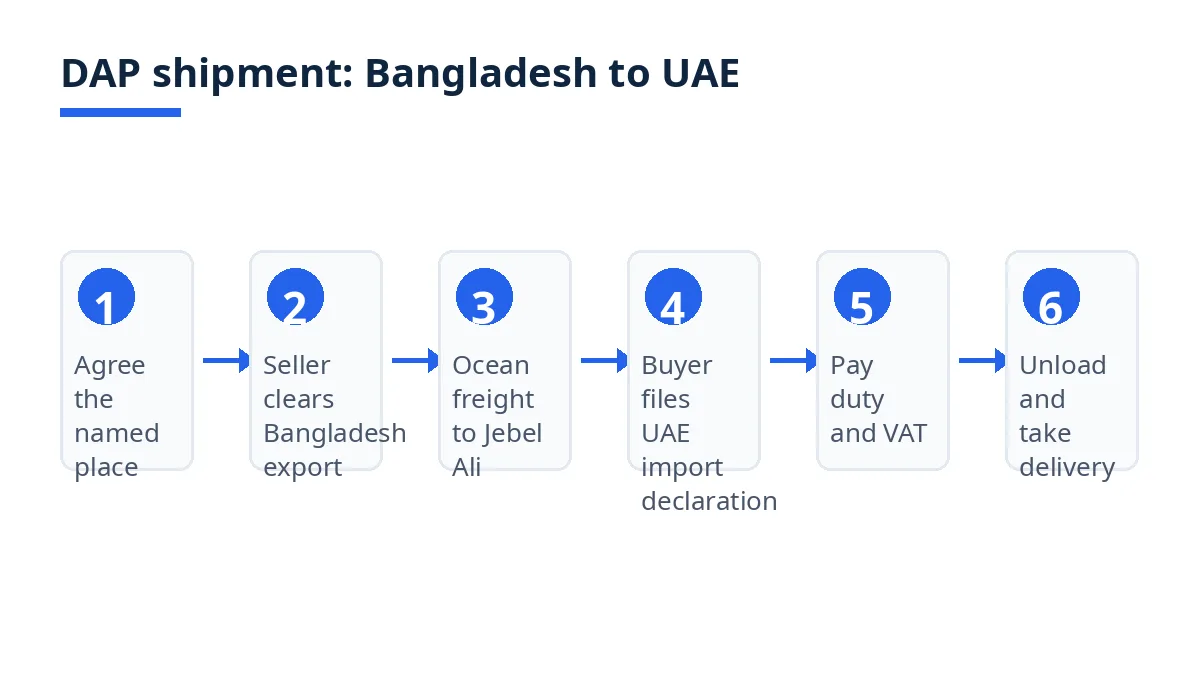
Agree the named place in writing. State the full delivery address, for example a warehouse in Dubai, a Jebel Ali Free Zone facility, or a Khalifa Port area address in Abu Dhabi. The named place decides where the seller's risk ends and your unloading and clearance duties begin. If the goods are meant for a free zone, say so explicitly, because free-zone goods are treated differently from mainland goods.3
Confirm the seller's export set from Bangladesh. Goods may not be loaded unless an export declaration, the Bill of Export or Shipping Bill, is submitted to Customs and approved.4 Enclosed documents include the export contract or purchase order where there is no export letter of credit, the commercial invoice, the packing list, the EXP form certified by an authorized dealer, and a certificate of origin issued by the Export Promotion Bureau (EPB) or a Chamber of Commerce and Industry.4
Book the ocean leg from Chattogram to Jebel Ali. Most Bangladesh-to-UAE container traffic moves through Chattogram port to Jebel Ali, the UAE's main container gateway. Carrier schedules for this port pair show transit of around 10 days on direct services; transshipment services take longer, so ask whether the quoted sailing is direct or via a hub.5
Prepare the UAE import side before arrival. Appoint a UAE customs broker and confirm your importer code is registered with the relevant customs authority. An importer code issued by Dubai Customs is mandatory for importing into Dubai, including shipments entering a free zone or the mainland.6 If you are VAT-registered, link that code to your Tax Registration Number (TRN) so import VAT is handled through your VAT return.7
File the UAE import declaration on arrival. Your broker submits the declaration through the port's customs system — Mirsal 2 for Dubai — with the HS code, value, quantity, origin and importer details.
Pay duty and VAT, or account for VAT on your return. For most goods, customs duty is 5% of the CIF value, and import VAT is 5% of the CIF value plus duty.3 A VAT-registered importer generally accounts for the import VAT in Box 6 of the VAT return, where the value includes customs duties and any excise tax paid, with VAT applied at 5%.7 A non-registered importer normally pays the VAT at the border before release.
Unload and take delivery at the named place. The seller's delivery is complete when the goods arrive ready for unloading. Unloading, and any onward transport from a port to your warehouse, is your cost and risk unless agreed otherwise in writing.
Costs, timelines and documents
What are the typical costs and timelines?
There are no guaranteed freight rates on this lane. The cost lines you must budget are:
Cost line | Who pays under DAP | Notes |
|---|---|---|
Goods and Bangladesh export clearance | Seller | Inside the DAP price |
Ocean freight Chattogram to Jebel Ali | Seller | Inside the DAP price; direct services run around 10 days5 |
UAE customs duty | Buyer | Generally 5% of CIF value for most goods3 |
UAE import VAT | Buyer | |
Broker, declaration and port handling charges | Buyer | Agree who books port handling at the named place |
Unloading and onward transport | Buyer | Unless agreed otherwise in writing |
Cargo insurance | As agreed | DAP does not oblige the seller to insure for the buyer2 |
Example figures, for budgeting only: a shipment with a CIF value of AED 100,000 attracting 5% duty gives duty of AED 5,000, a VAT base of AED 105,000 and VAT of AED 5,250. Your actual bill depends on your HS code, any excise tax, and whether the goods qualify for an exemption or a free-zone treatment.7 3
For timelines, plan on three blocks rather than one delivery week: production and export clearance in Bangladesh, ocean transit of around 10 days on a direct Chattogram to Jebel Ali service (longer via transshipment),5 and UAE clearance and delivery, typically 1 to 2 working days after vessel arrival when documents are correct.6 Inspection, a wrong HS code, or an unpaid duty or VAT bill extends the last block and can add storage and demurrage charges.
Which documents are needed?
The Bangladesh export set is the Bill of Export, commercial invoice, packing list, EXP form certified by an authorized dealer, certificate of origin, and, where applicable, product-specific certificates such as a phytosanitary certificate for agricultural goods.4 The UAE import set is the bill of lading or airway bill, commercial invoice, packing list, certificate of origin, delivery order, and your importer code, plus permits for regulated goods such as food or pharmaceuticals. Keep names, values and HS codes identical across the two sets: a mismatch between invoice and declaration is the most common reason a straightforward clearance stalls.
Bangladesh-specific rules and tips
Keep one legal name across every paper. The export declaration names the exporter and the foreign buyer,4 so the name on the trade licence, quotation, proforma invoice, bill of lading and UAE import declaration should match. A spelling difference between the Bangladesh export papers and the UAE import papers gives customs a reason to hold the shipment for verification.
Confirm which port and sailing the price assumes. Bangladesh export cargo normally loads at Chattogram, but a DAP price that assumes a transshipment service carries a different transit time from one that assumes a direct Jebel Ali sailing.5 Ask for the load port, the transshipment port if any, and the free days at destination in writing.
Ask about product-specific certificates early. Bangladesh Customs notes that product-wise additional certification is necessary for some categories, including the Export Registration Certificate (ERC) for jute, jute goods and tea, and phytosanitary certificates for agricultural goods.4 Confirm who obtains any certificate your product needs, and how long it takes, before production finishes.
Mistakes and red flags
What are the most common mistakes?
Budgeting as though DAP meant DDP. The most expensive mistake on this lane is treating the DAP price as duty-paid. Under DAP the buyer carries out import formalities and pays duty and import VAT.2 Price the UAE bill separately, every time.
Naming a city instead of a place. "DAP Dubai" does not say whether delivery is at Jebel Ali port, a free-zone warehouse or your premises, and each answer changes who pays for port handling and onward transport. Name the full address.
Assuming the seller insures the goods. Under DAP the seller has no obligation to insure for the buyer's risk.2 If the container is damaged on the ocean leg, the question of who bears the loss depends on the risk transfer at the named place and on any insurance you agreed, so settle insurance in writing.
Leaving the importer code and TRN link until arrival. If your importer code is not linked to your TRN, import VAT cannot flow through your VAT return as expected.7 Sort the link before the vessel sails, not while the container sits at Jebel Ali.
Sending goods into a free zone without saying so. Goods imported into a free zone are exempt from UAE customs duty as long as they remain within the free zone or are re-exported, with duty applying only when goods enter the mainland.6 If your plan is mainland delivery, do not let a free-zone routing assumption understate your duty bill.
Accepting a verbal change to the named place or the term. Record any change to the named place, the delivery term or the insurance arrangement on the quotation and purchase order.
Checklist
Before you confirm, every line should be answered in writing.
Named place stated as a full address: "DAP [full address], UAE, Incoterms® 2020".
Mainland or free-zone destination confirmed, and its duty treatment checked.6
HS code agreed and checked against the duty and VAT treatment.3
DAP price confirmed as excluding UAE duty, import VAT, broker charges, unloading and onward transport.
Cargo insurance agreed in writing, or consciously declined.2
Bangladesh export set agreed: Bill of Export, invoice, packing list, EXP form, certificate of origin.4
UAE import set ready: bill of lading, invoice, packing list, certificate of origin, delivery order, importer code.
Importer code registered and, if VAT-registered, linked to the TRN.7
Load port, routing and destination free days confirmed.5
UAE broker appointed, with responsibilities in writing.
Duty and VAT estimate recorded: duty on CIF value, VAT at 5% on CIF value plus duty.7 3
How Exportain helps
On Exportain, browse suppliers and post a request for quotation (RFQ) on the RFQ board with your product specification, quantity and named place in the UAE, so suppliers quote against the same delivery term and destination. Ask each reply to state the load port, whether the sailing is direct or via transshipment, and what the DAP price excludes on the UAE side. Before you confirm, read the Incoterms for shipments from Bangladesh guide and the landed cost imports from Bangladesh guide, so UAE duty and VAT are in your comparison from the start.
FAQs
What should I know first about DAP?
DAP means the seller delivers the goods to your named place in the UAE, ready for unloading, and bears cost and risk until that point. You handle unloading, UAE import clearance, duty and import VAT.2 The seller does not unload, and DAP does not oblige the seller to insure the goods for you, so agree insurance separately.1 2
What are the typical costs and timelines?
The DAP price covers the goods, Bangladesh export clearance and freight to the named place. On top of it, budget UAE customs duty — generally 5% of CIF value for most goods — and 5% import VAT on the CIF value plus duty.3 Ocean transit on a direct Chattogram to Jebel Ali service is around 10 days, with UAE clearance typically 1 to 2 working days after arrival when documents are correct.5 6 Freight rates vary by sailing and season, so treat any quoted rate as valid only for its stated period.
Which documents are needed?
The Bangladesh export set is the Bill of Export, commercial invoice, packing list, EXP form certified by an authorized dealer, and certificate of origin, plus product-specific certificates where required.4 The UAE import set is the bill of lading, commercial invoice, packing list, certificate of origin, delivery order and importer code, plus permits for regulated goods. Keep names, values and HS codes identical across both sets.
What are the most common mistakes?
The most common mistakes are budgeting as though DAP meant DDP, naming a city instead of a precise place, assuming the seller insures the goods, and leaving the importer-code and TRN link until the goods arrive.2 7 Record the named place, the term, the insurance arrangement and the UAE cost exclusions in writing before the goods sail.
Next steps on Exportain
Post a free RFQ on Exportain and get quotes from verified Bangladeshi suppliers: state your product, quantity and full UAE delivery address on the RFQ board so every quotation is comparable on the same DAP named place. Before you accept, read the Incoterms for shipments from Bangladesh guide and the landed cost imports from Bangladesh guide, and work your UAE duty and VAT estimate into the comparison.
Sources
- Incoterms® 2020. International Chamber of Commerce (ICC) (accessed )
- Delivered at Place (DAP) – Incoterms® 2020 Rules. Trade Finance Global (accessed )
- Customs Duty & Excise Tax UAE 2026: Compliance Guide. Audit Firms Dubai (accessed )
- Customs Clearance Procedures for Export. Bangladesh Customs, National Board of Revenue (accessed )
- Chittagong to Jebel Ali FCL Shipping Rates | Schedules & Transit Time. Cogoport (accessed )
- FAQs — JAFZA imports, importer code and Jebel Ali cargo release. Sea Prince Logistics (accessed )
- Value Added Tax (VAT) Returns User Guide. Federal Tax Authority (accessed )
About the author
Sourcing from Bangladesh?
Post a request for quotation and suppliers on Exportain can send you their quotes directly.
Post an RFQ