DAP Shipping From Bangladesh to Saudi Arabia: Costs, Steps and Timeline
DAP from Bangladesh to Saudi Arabia: the seller delivers to your named place, but you clear Saudi import, pay duty and 15% VAT, and handle SABER conformity. Costs, timelines and documents explained.
Short answer
Under DAP, your Bangladeshi seller pays for export clearance and carriage to the exact named place in Saudi Arabia and bears the transit risk until the goods are there ready for unloading. You, the buyer, handle Saudi import clearance, pay customs duty and 15% import VAT, and unload. The DAP price is not duty-paid, so budget the border charges separately and confirm SABER conformity before shipment.
On this page
Key takeaways
Under DAP, the Bangladeshi seller bears cost and risk to the named place in Saudi Arabia, while the buyer handles Saudi import clearance, customs duty, 15% import VAT and unloading.
The named place must be a precise address: Jeddah Islamic Port and a Riyadh warehouse are different deliveries, with different inland legs and clearance sequences.
Budget separately for the DAP price, customs duty by HS code, and 15% import VAT charged on the customs value plus duty; the DAP price is not a duty-paid price.
For regulated goods, SABER conformity starts before sailing: a PCoC for the product type, valid up to one year, plus an SCoC for each consignment, applied for before the goods reach port.
Transit is multi-week via feeder and transshipment routing, so confirm the vessel schedule and every date in writing; no transit figure in this guide is a guaranteed delivery time.
A container of garments leaves Chattogram for a warehouse outside Jeddah, and the quotation says DAP. The seller has priced the ocean freight, the buyer has not yet paid a riyal in Saudi duty, and a conformity certificate must exist before the ship berths. That gap — between a delivered price and a cleared, usable delivery — is where most DAP Bangladesh to Saudi Arabia shipments go wrong.
Under DAP, short for Delivered at Place, the Bangladeshi seller arranges and pays for carriage to the named place of destination and bears the cost and risk of the journey until the goods are placed at the buyer's disposal there, ready for unloading. The buyer then takes over the Saudi side: import clearance, customs duty, import VAT and unloading.1 The Incoterms 2020 rules give 11 rules with a clear allocation of cost, risk and obligations,1 and DAP is the one where the seller carries the goods furthest without taking on the import itself.
Why this matters for buyers and sellers
For a Saudi buyer, one supplier price covers the factory gate, export formalities and the sea leg. It also leaves the buyer in control of the part only the buyer can properly control: the Saudi import declaration, the duty and VAT assessment, and the conformity file. Saudi clearance needs a Saudi importer record, a SABER account in the importer's name, and the buyer's own VAT treatment.
For a Bangladeshi seller, DAP is heavier than FOB or CIF: the job ends only when the goods are at the agreed place in Saudi Arabia, ready for unloading. The seller therefore carries transit risk for the whole ocean leg and any inland leg, and must price feeder connections, transshipment and port handling into the quotation. The seller does not take on Saudi import clearance or duty: if the seller is to clear import and pay duty, that is a different rule — DDP — and it should be written as DDP, not smuggled into a DAP price.
Two distinctions prevent the most common arguments. First, DAP is not DPU: under DAP the seller does not unload, so unloading labour, equipment and risk at the named place sit with the buyer.1 Second, DAP places no insurance obligation on either party unless the contract adds one, so cargo cover must be agreed in writing rather than assumed from the freight price. Compare DAP with the other ten rules in the Incoterms guide for shipments from Bangladesh before you fix the term.
Step-by-step: how it works
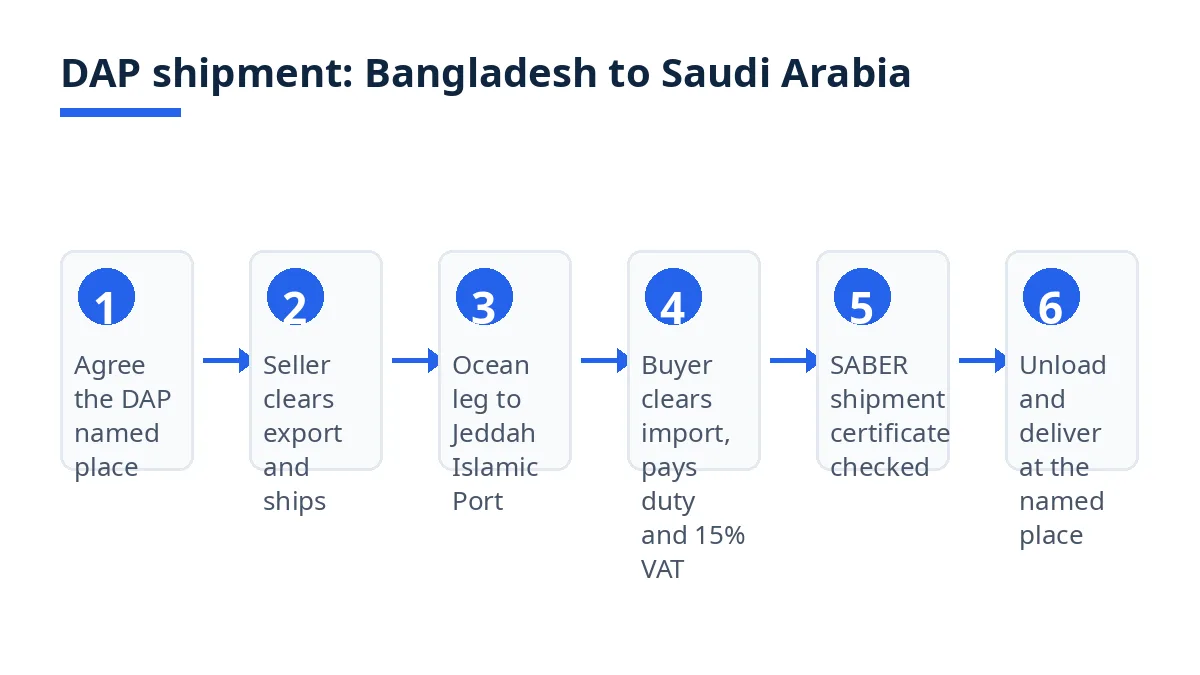
Name the place precisely, in writing. Write "DAP [full address], Incoterms 2020" into the quotation and the purchase order. "DAP Jeddah" is not precise enough: it does not say whether delivery is at Jeddah Islamic Port, at a bonded facility, or at a warehouse in Jeddah or Riyadh. The named place decides how far the seller's carriage and risk extend, and a Riyadh warehouse adds an inland leg after the port that someone must price and schedule.
The seller clears the goods for export in Bangladesh. Goods may not be loaded unless an export declaration, the Bill of Export or Shipping Bill, is submitted to Customs and approved.2 The enclosed export set includes the contract or purchase order, commercial invoice, packing list, EXP form certified by an authorized dealer bank, and certificate of origin from the EPB or a Chamber of Commerce and Industry.2
The buyer opens the SABER file early. For regulated goods, the Saudi importer registers the product on SABER, the conformity platform of the Saudi Standards, Metrology and Quality Organization (SASO), and obtains a Product Certificate of Conformity (PCoC) valid for up to one year.3 A Shipment Certificate of Conformity (SCoC) is then issued per consignment.3 Since January 2025, SCoC applications made after the goods reach port are reported as invalid, so the SCoC belongs in the pre-departure checklist.4
The seller books and pays the carriage. From Chattogram this is normally a feeder-plus-mainline routing: published carrier schedules show Chattogram feeder sailings connecting through Colombo on services that call at Jeddah.5 Ask for the vessel, transshipment port and estimated arrival in writing.
The vessel arrives at Jeddah Islamic Port. Jeddah Islamic Port is the Kingdom's Red Sea gateway for cargo bound for the western region, and its South Container Terminal was expanded under a SAR 3 billion programme that more than doubled capacity from 1.8 million to 4 million TEUs.6 For a Riyadh or Eastern Province warehouse, the Jeddah leg is only the first part of the journey.
The buyer clears import and pays the border charges. The buyer's broker files the import declaration, the SCoC is validated, duty is assessed on the customs value by HS code, and import VAT is charged on the customs value plus duty.7 Only after clearance can the goods move to the named place.
Delivery happens at the named place, ready for unloading. Risk passes when the goods are placed at the buyer's disposal on the arriving vehicle, ready for unloading — not when they are unloaded.1 The buyer arranges unloading and takes the goods into stock. If the named place is inland, agree the sequence in advance: clearance first, then the inland leg, with a named owner for the truck booking and storage if clearance slips.
Costs, timelines and documents
What the seller's DAP price covers
The DAP price covers the goods, export clearance in Bangladesh, and carriage to the named place, including ocean freight and any inland carriage the seller has contracted to that place. It does not cover Saudi import duty, Saudi import VAT, the buyer's broker fees, unloading at destination, or onward transport beyond the named place. Treat any quotation bundling those buyer-side items into a DAP price with suspicion: either the seller is quietly pricing a DDP service, or the buyer will be charged again at the border.
What the buyer pays at the Saudi border
Saudi Arabia applies a standard VAT rate of 15%, and imported goods are charged VAT on the customs value plus any customs duty.7 ZATCA guidance likewise applies 15% as the standard rate.8 The calculation is therefore duty first, then VAT on the duty-inclusive value. As an arithmetic illustration only — not a rate promise — a consignment with a customs value of SAR 100,000 and a hypothetical duty rate of 5% would carry duty of SAR 5,000, a VAT base of SAR 105,000 and import VAT of SAR 15,750. Your actual duty depends on the HS classification of your goods, and some goods attract excise or additional controls on top of VAT, so confirm the rate line by line before committing to a resale price. For the full per-unit picture, work through the landed cost guide for imports from Bangladesh with your own duty and VAT figures inserted.
Timelines to plan around
There are no guaranteed transit times on this lane, only planning ranges to confirm against a dated schedule.
SABER product stage: allow weeks, not days, where testing is needed. A regulated product needing laboratory test reports can take several weeks from registration to PCoC.
SABER shipment stage: a clean SCoC file is typically measured in days, provided the PCoC is active and the invoice and bill of lading match the registered product.3
Ocean leg: plan on a multi-week sea leg. One published forwarder table lists Jeddah to Chattogram at 25 days for less-than-container-load cargo,9 showing the scale of the lane in the reverse direction; the Chattogram-to-Jeddah leg follows the same pattern, so ask your forwarder for the dated vessel schedule.
Clearance and delivery: clearance time depends on document readiness. A file with a matching HS code, active PCoC, pre-issued SCoC and consistent invoice and packing list clears faster than one assembled after arrival; a mismatch can hold the container at Jeddah while storage accrues.
Documents for the two borders
In short, the papers are the Bangladesh export set (Bill of Export, invoice, packing list, EXP form, certificate of origin),2 the Saudi import set (import declaration, bill of lading, invoice, packing list, certificate of origin), and the SABER pair (PCoC and SCoC).3
Bangladesh-specific rules and tips
Keep one legal name and one HS code across every paper. The export declaration names the exporter and the foreign buyer,2 and the SABER registration is keyed to the HS code. If the invoice, SABER file and Saudi declaration disagree, the SCoC or clearance can stall. Agree the HS code before SABER registration.
Start SABER before production finishes. Textiles are among the regulated categories under SABER conformity,4 which matters for Bangladesh's largest export lines. The seller supplies the technical file; the importer holds the SABER account. A seller who waits until the cartons are packed to ask about test reports has already lost the sailing.
Confirm the EXP form and certificate of origin early. The EXP form must be certified by an authorized dealer bank,2 and the certificate of origin comes from the EPB or a Chamber.2 Both are routine, yet both are most often chased at the last minute, and a missing EXP certification can hold the Bill of Export.
Price the inland leg separately when the named place is inland. A DAP price to a Riyadh warehouse is not a DAP price to Jeddah port plus a favour. If the seller will not price the inland leg, name Jeddah Islamic Port as the place and arrange the inland leg yourself, with the cost visible in your landed cost.
Do not let a forwarder re-label the term. Some forwarders quote "DAP" while meaning "delivered to port, buyer clears and collects". That is DAP only if the named place is the port and the buyer understands it. Put the named place, unloading and insurance in the purchase order.
Mistakes and red flags
The mistakes that cost buyers most
Naming a city instead of a place. "DAP Jeddah" leaves the delivery point open to argument: a port, a warehouse address and a free-zone facility are three different deliveries.
Assuming DAP means duty-paid. DAP excludes Saudi duty and 15% import VAT; a buyer who priced resale on the DAP figure alone will be short at the border.
Treating SABER as arrival paperwork. A lapsed PCoC, or an SCoC applied for after arrival, blocks clearance. Since January 2025 the SCoC must be in hand before the goods reach port.4
Changing the specification after registration. A different composition, model or HS code breaks the link between the PCoC, the SCoC and the declaration. Freeze the specification at registration.
Leaving insurance and unloading unagreed. DAP obliges neither party to insure, and unloading is the buyer's cost and risk.1 Agree both before the truck arrives.
Paying for import clearance inside a DAP price. If a seller charges for Saudi clearance and duty while quoting DAP, clarify in writing whether the deal is actually DDP.
Checklist
Before the goods sail, every line below should be answered in writing.
Named place written in full: "DAP [full address], Incoterms 2020".
HS code agreed, identical on invoice, SABER file and declaration.
SABER: PCoC active for the product type, with expiry date noted.3
SABER: SCoC issued for this consignment before arrival.4
Test reports from a recognized laboratory supplied for regulated goods.
Bangladesh export set ready: Bill of Export, invoice, packing list, EXP form, certificate of origin.2
DAP price confirmed as excluding Saudi duty, 15% VAT, broker fees and unloading.
Duty rate checked by HS code; VAT base understood as customs value plus duty.7
Insurance and unloading responsibilities written into the purchase order.
Vessel, transshipment port and Jeddah arrival confirmed in writing.
Clearance sequence agreed for inland named places: clearance first, then the inland leg.
Broker appointed on the Saudi side, with the SCoC and invoice set shared before sailing.
How Exportain helps
On Exportain, post a request for quotation on the RFQ board stating the full DAP named place, the HS code and whether the SABER product file already exists, so suppliers quote against the same delivery point and conformity position. Ask each reply to confirm, separately, the DAP price, vessel routing and insurance position, so quotations compare line by line rather than on a single headline figure. Read supplier badges for what they record: Exportain verification is a document and photo review, not a factory inspection, and a badge is not a guarantee of capacity, quality or delivery. Sample approval, inspection and the SABER technical file stay with you and your supplier.
FAQs
What should I know first about DAP?
DAP means the seller delivers the goods to your named place in Saudi Arabia, ready for unloading, bearing the cost and risk of carriage to that point, while you handle Saudi import clearance, duty, 15% import VAT and unloading.1 It is not DDP: under DDP the seller would also clear import and pay duty.
What are the typical costs and timelines?
The seller's DAP price covers export clearance and carriage to the named place. The buyer separately pays duty by HS code, 15% import VAT on the customs value plus duty,7 broker fees, unloading and onward transport. Timelines are planning ranges only: SABER product certification can take weeks where testing is needed, the SCoC is a per-shipment step measured in days on a clean file,3 and the ocean leg is multi-week via feeder and transshipment routing, so confirm every date against a dated vessel schedule.
Which documents are needed?
The Bangladesh export set is the Bill of Export, commercial invoice, packing list, EXP form certified by an authorized dealer bank, and certificate of origin from the EPB or a Chamber of Commerce and Industry.2 The Saudi side adds the SABER pair — a PCoC for the product type and an SCoC for the consignment3 — plus the import declaration, bill of lading, invoice, packing list and certificate of origin. The purchase order itself is a document too: it must state the full named place, the Incoterms 2020 wording, and who insures and who unloads.
What are the most common mistakes?
Naming a city instead of a precise place, assuming the DAP price is duty-paid, leaving SABER until after sailing, changing the specification after registration, and leaving insurance and unloading unagreed. Each is avoidable before shipment and expensive after it: a container held at Jeddah for a missing certificate accrues storage.
Next steps on Exportain
Post your full DAP named place, HS code and SABER position on the RFQ board so suppliers quote the same delivery point. Before you accept a quotation, compare the delivery terms in the Incoterms guide for shipments from Bangladesh and run your duty and VAT figures through the landed cost guide for imports from Bangladesh. A DAP quotation is only comparable when the named place, the insurance position and the excluded border charges are identical across replies.
Sources
- Incoterms® 2020. International Chamber of Commerce (ICC) (accessed )
- Customs Clearance Procedures for Export. Bangladesh Customs, National Board of Revenue (accessed )
- What Is a SASO Certificate? SABER Certification Guide. Tetra Inspection (accessed )
- Shipping from China to Saudi Arabia: SABER, SASO and Customs. Shianhub (accessed )
- Chittagong to Middle East Express service schedule. CMA CGM (accessed )
- DP World and Mawani inaugurate SAR 3 billion state-of-the-art terminal in Jeddah. Eye of Riyadh (accessed )
- Guide to Import VAT in Saudi Arabia for Foreign Companies. Commenda (accessed )
- SEZ Tax and Customs Procedures. Zakat, Tax and Customs Authority (ZATCA) (accessed )
- Freight Shipping to Bangladesh by Air & Ocean. Shipa Freight (accessed )
About the author
Sourcing from Bangladesh?
Post a request for quotation and suppliers on Exportain can send you their quotes directly.
Post an RFQ