

DAP Shipping From Bangladesh to Netherlands: Costs, Steps and Timeline
Under DAP, the Bangladeshi seller delivers to your named Dutch place, and you handle Dutch import clearance, duty and VAT. This buyer-side guide covers your EORI and declaration steps, Rotterdam routing, indicative costs and timelines, and the documents to agree before loading.
Short answer
Under DAP, the Bangladeshi seller delivers your goods to your named Dutch place, ready for unloading, and you handle Dutch import clearance, duty and import VAT. Before loading, confirm your EORI number, your customs representative if you are not established in the EU, and your VAT route, whether border payment with later recovery or Article 23 deferral through a valid permit. Name an exact delivery address, agree unloading and insurance in writing, and price the buyer-side lines separately.
On this page
Key takeaways
Under DAP, the seller delivers to your named Dutch place, ready for unloading. You handle import clearance, duty, import VAT and unloading.
Set up your Dutch import side before loading: EORI number, customs representative where needed, and VAT route.
Price the buyer-side lines separately: clearance charges, duty, import VAT, unloading and waiting or storage charges.
A zero-duty assumption needs origin evidence for the preference claimed, checked for your commodity code on the entry date.
Name an exact delivery address, not a city or port, and agree insurance, unloading and document timing in writing.
A DAP quotation from Bangladesh to the Netherlands can look like a single delivered price to your Dutch address. The part that decides whether that price holds is the work the term leaves with you. Under DAP, the seller arranges and pays for carriage to the named place and bears the transport risk until the goods are placed at your disposal on the arriving vehicle, ready for unloading. The buyer handles import clearance, duties and taxes, and takes the unloading risk.1 The Incoterms 2020 rules set out 11 rules with a clear allocation of cost, risk and obligations,2 and delivery under DAP happens before unloading, the sole difference from DPU.2
This guide is written from the buyer side: what to set up before loading, how the Rotterdam entry works, the cost lines, and the documents to agree in writing. If you want the seller to handle Dutch import instead, that is DDP: the seller takes the import responsibility, including clearance, duties and taxes.1 See the DDP shipping to Netherlands guide and the Incoterms for shipments from Bangladesh guide.
Why this matters for buyers and sellers
For the buyer, DAP buys control of the Dutch side: you choose the representative, hold the import record, and decide how duty and VAT are handled. That control comes with cash exposure. In principle, duties and import VAT are due immediately on imports to the Netherlands from a non-EU country, and you submit an import declaration to Dutch Customs.3 Goods imported from outside the EU must be declared, and you must pay the VAT on them to Customs, with later deduction or refund as input tax where the goods are destined for you under the declaration.4
For the seller, DAP avoids building a Dutch import setup, but not the delivery duty: the seller must organize carriage to the destination and complete export and transit formalities.1 DAP becomes fragile when the buyer cannot clear the goods, lacks the registrations, or receives information too late.1 Separate predictable transport costs from items that depend on commodity, origin, classification, valuation and timing.1
Step-by-step: how it works
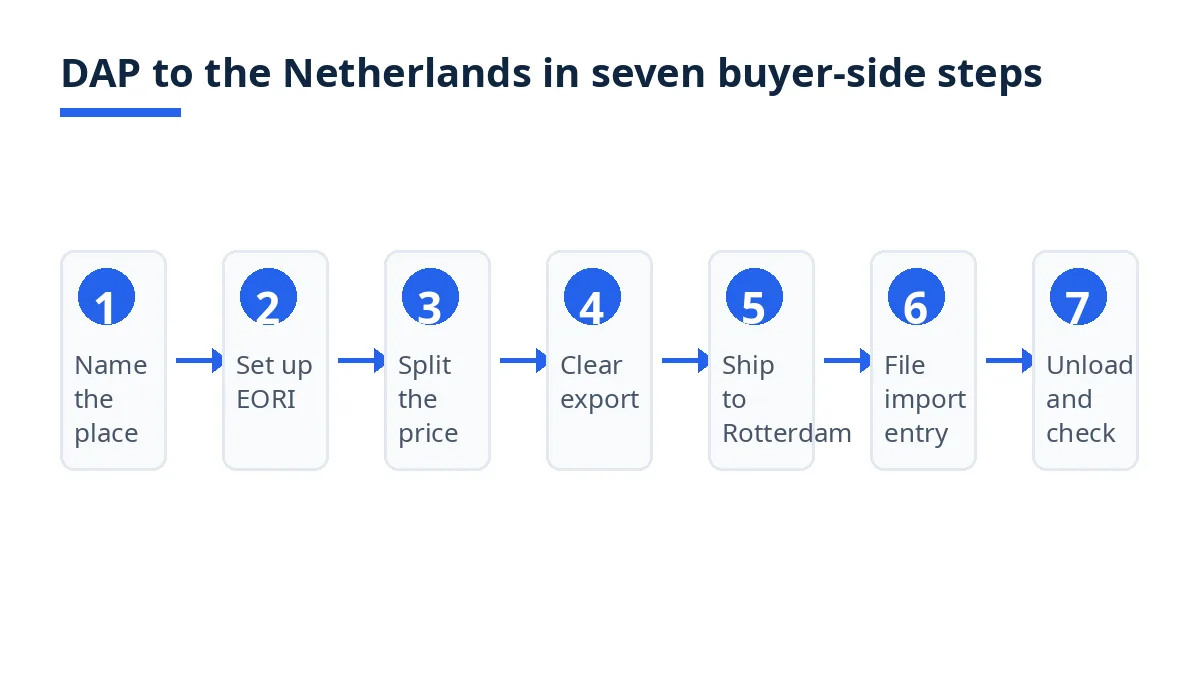
Name the exact Dutch delivery place and write the term in full. State the street address of the warehouse or site, not "Rotterdam" or "Netherlands." Write the term as DAP followed by that address and Incoterms 2020.1 Agree unloading, equipment, labor and waiting terms.
Set up your Dutch import side before the first shipment. You will need an EORI number, used in all communications with Customs in the EU; apply for it before you import.3 If your company is not established in the EU, you cannot act as declarant yourself: appoint an indirect customs representative, who submits under their own name and shares the customs debt with your company.3 Confirm your VAT route at the same time: border payment with later recovery, or Article 23 deferral.
Agree the price in separate buyer and seller lines. The seller lines are the product price, export costs, main carriage to the named place and export and transit formalities.1 The buyer lines are representation and clearance charges, duty, import VAT, unloading, and waiting or storage charges if clearance or unloading slips.
Clear export in Bangladesh. Goods may not be loaded unless an export declaration, the Bill of Export or Shipping Bill, is submitted to Customs and approved.5 The export set includes the export letter of credit, or the contract or purchase order where there is none, the commercial invoice, packing list, EXP form certified by an authorized dealer, and certificate of origin issued by the EPB or a Chamber of Commerce and Industry.5
Ship from Chattogram to Rotterdam. Chattogram port accounts for 92 percent of Bangladesh's external trade and 98 percent of its container shipments.6 Ships from Chattogram have historically gone via transshipment ports such as Singapore, Colombo or Malaysia's Tanjung Pelepas or Klang to European base ports such as Rotterdam, taking around 40 days, while direct shipping to the Netherlands has cut that time to about 20 days.6 Confirm the routing and schedule: treat transit figures as indicative.
File the Dutch import declaration and settle duty and VAT. The declaration process involves the Single Administrative Document, outlining duties, VAT and other taxes, and the Entry Summary Declaration, submitted before goods arrive in the EU.7 You will always need an EORI number when dealing with Dutch customs.7 The customs value for VAT is the goods value plus transport, insurance and similar costs up to the EU border.4 Pay the duty and import VAT shown on the assessment, or use a valid deferral route, and keep the assessment notice: a customs debt is levied via a customs assessment (uitnodiging tot betaling, or UTB), needed to recover VAT.3
Unload, check and close the file. Unloading is the buyer's task and risk under DAP unless a separate transport agreement changes a cost element.1 Count and inspect against the packing list and invoice at delivery, record damage or shortage in writing at the time, and file the declaration, UTB, VAT proof and delivery record together.
Costs, timelines and documents
What are the typical costs and timelines?
There is no typical DAP price for a Bangladesh to Netherlands shipment: the buyer-side lines move with the product, commodity code, origin evidence, customs value and VAT route. The lines are stable even when the figures are not:
Cost line | Paid by | Notes |
|---|---|---|
Product price, export costs, main carriage to the named place | Seller, via the DAP price | Carriage and export formalities sit with the seller.1 |
Insurance | As agreed in writing | DAP alone does not settle insurance.1 |
Dutch representation and clearance charges | Buyer | Confirm direct or indirect representation.3 |
Import duty | Buyer | Depends on commodity code and preference claimed; confirm on the entry date.7 |
Import VAT | Buyer | Standard 21 percent; reduced 9 percent for items such as food and medicines.7 |
Unloading, waiting and storage | Buyer | Unloading risk sits with the buyer.1 |
Arithmetic example only, not a market quote: on a customs value of EUR 12,500, duty-free entry gives duty of EUR 0 and import VAT at 21 percent of EUR 2,625. With an illustrative 10 percent duty line, duty would be EUR 1,250, the VAT base would rise to EUR 13,750, and import VAT at 21 percent would be EUR 2,887.50. The example shows how a duty change moves the VAT base; confirm the duty line for your commodity code on the entry date. See the landed cost imports from Bangladesh guide.
For timelines, work in stages: import setup, export clearance, main carriage, Dutch clearance, and unloading. Transit is indicative only: 2022 reporting put transshipment routings at around 40 days and direct Chattogram to Netherlands sailings at about 20 days.6 Ask for a date range per stage. On VAT cash flow, weeks or even months can pass between payment and recovery, so you effectively prefinance it unless a deferral route applies.3
Which documents are needed?
The Bangladesh export set is the Bill of Export, commercial invoice, packing list, EXP form certified by an authorized dealer, and certificate of origin, with the contract or purchase order where there is no export letter of credit.5 The Dutch import set adds the transport document, commodity code per line, origin evidence for any preference claimed, your EORI number, and the import declaration filed by you or your representative.7 3 A certificate of origin may reduce or eliminate duties, and matters for whether you may import the product at all.3 Keep description, quantity, value and origin identical across every document: an invoice-declaration mismatch holds a Rotterdam entry.
Bangladesh-specific rules and tips
Keep one legal name and one product description across the whole file. The Bangladesh export declaration names the exporter, the foreign buyer or importer, and the transport operator.5 The Dutch entry must be reconcilable with it, so the name on the trade license, invoice, packing list and Dutch entry should match, with the same product wording.
Claim a preference only with origin evidence that survives a check. As a least developed country, Bangladesh currently benefits from the Everything But Arms arrangement: duty-free and quota-free access to the EU market for all products except arms and ammunition. After a three-year transition following LDC graduation, Bangladesh will lose that access around the end of 2029 unless the transition is extended.8 The new GSP regulation applies from January 1, 2027 for 10 years, and after graduation apparel will face double transformation instead of the single-transformation rule under EBA.8 Check the preference, origin evidence and fallback duty figure for your product on the entry date, and write the fallback into the quotation: if the preference fails, the duty line falls on the buyer under DAP.
Mistakes and red flags
What are the most common mistakes?
Assuming DAP includes Dutch import clearance. This is the defining DAP error: under DAP the buyer is responsible for import clearance, duties and taxes.1 A delivered-price quotation with no buyer-side lines has not removed the import bill; it has only left it unpriced.
Naming a port or a city instead of a delivery place. DAP to Rotterdam is not DAP to your warehouse: naming only Rotterdam leaves the final leg, its cost and its risk undefined.1
Loading before the buyer import setup exists. A shipment that sails while the EORI number, representative appointment or VAT route is unconfirmed arrives at Rotterdam with no one able to file the entry. Apply for the EORI number before you import,3 and confirm the representation basis in writing.3
Treating Article 23 deferral as zero VAT, or as available without a permit. Under the Article 23 license, Dutch import VAT is no longer due on import; you report it in your next Dutch VAT return, and if entitled to recover it, you reclaim it in the same return, so none must be prefinanced.3 Companies based in the Netherlands can apply for the permit themselves; companies based outside it can only use it through a general fiscal representative.3 A foreign entrepreneur cannot apply the reverse-charge mechanism directly, but can use a tax representative who applies it on their behalf.4 Never reference a deferral without the license.
Accepting a single-total quote, and leaving unloading and insurance unagreed. A single-total quotation hides the lines most likely to move: duty, VAT handling and clearance charges.1 The Incoterms rules do not by themselves settle ownership, payment or insurance,1 so put those in their own clauses. Under DAP the goods arrive ready for unloading, not unloaded,2 so a site with no dock, equipment or labor booked leaves the vehicle waiting at your cost.
Checklist
Before a DAP shipment to the Netherlands is loaded, every line should be answered in writing.
Named Dutch delivery place agreed, with street address and Incoterms 2020 stated.1
Unloading, equipment, labor and waiting terms agreed.1
Buyer EORI number confirmed for Dutch customs use.3
Customs representative appointed; direct or indirect representation stated.3
VAT route confirmed: border payment with later recovery, or Article 23 deferral via a valid permit.4 3
Price split in writing: seller lines to the named place, buyer lines for clearance, duty, VAT and unloading.1
Insurance agreed in its own clause, separate from the DAP term.1
Commodity code confirmed for every product line.7
Origin evidence held for any preference claimed, with the fallback duty figure stated.8
Bangladesh export set agreed: Bill of Export, invoice, packing list, EXP form, origin certificate.5
Product compliance owner named, separate from the customs filer.7
How Exportain helps
On Exportain, browse suppliers and post a request for quotation (RFQ) on the RFQ board stating that the quotation must be DAP to your named Dutch place, with seller lines to that place and buyer-side lines shown separately. Ask each reply for the Rotterdam routing, sailing schedule, and full export document set it will send before loading. When you accept a quotation, Exportain creates one order and issues one proforma invoice from the accepted terms.
Read the badges for what they record. Exportain Verified means Exportain has checked identity, phone, email and business registration, and Export Verified means it has checked the Export Registration Certificate (ERC). Verification is a document review by staff, free, and never granted by membership plans. It is not a factory inspection, nor Dutch customs, EORI or VAT registration.
FAQs
What should I know first about DAP?
Know first that DAP splits the journey at your named Dutch place: the seller bears transport risk until the goods are placed at your disposal on the arriving vehicle, ready for unloading, and you handle import clearance, duties, taxes and unloading.1 Delivery under DAP happens before unloading, the sole difference from DPU.2
What are the typical costs and timelines?
There are no typical DAP figures: the price is the sum of seller lines to the named place plus buyer lines for Dutch clearance, duty, import VAT and unloading. The worked example in the costs section shows how a duty change moves the VAT base; it is not a market quote.
Which documents are needed?
The Bangladesh export set is the Bill of Export, commercial invoice, packing list, EXP form certified by an authorized dealer, and certificate of origin, with the contract or purchase order where there is no export letter of credit.5 The Dutch import set adds the transport document, commodity code per line, origin evidence for any preference claimed, your EORI number, and the import declaration, plus the customs assessment notice (UTB) needed to recover VAT.3
What are the most common mistakes?
The most common mistakes are assuming DAP includes Dutch import clearance,1 naming a port or city instead of an exact address, loading before the EORI number and representative are in place,3 treating Article 23 deferral as zero VAT without a permit,4 and leaving unloading and insurance unagreed. A quotation with no buyer-side lines has not removed the import bill; it has only left it unpriced.
Next steps on Exportain
Browse suppliers, then post your named Dutch delivery place, routing requirement and document set on the RFQ board so suppliers quote DAP against the same place and terms. Before you confirm, read the Incoterms for shipments from Bangladesh guide to compare DAP with the other terms.
Sources
- DAP vs DDP – How to Choose the Right Setup for International Transport. International Forwarding Association (accessed )
- Incoterms® 2020. International Chamber of Commerce (ICC) (accessed )
- Importing goods into the Netherlands: main rules for non-EU businesses. Baker Tilly Netherlands (accessed )
- Import from non-EU countries to the Netherlands. Dutch Tax and Customs Administration (accessed )
- Customs Clearance Procedures for Export. Bangladesh Customs, National Board of Revenue (accessed )
- Direct shipping now to Netherlands. The Business Standard (accessed )
- Importing to Netherlands. TecEx (accessed )
- EU GSP rules and Bangladesh's RMG. The Daily Star, (accessed )
About the author
Sourcing from Bangladesh?
Post a request for quotation and suppliers on Exportain can send you their quotes directly.
Post an RFQ


