

DDP Shipping From Bangladesh to Netherlands: Costs, Steps and Timeline
DDP to the Netherlands puts Dutch customs and VAT on the seller: EORI, Rotterdam clearance, and Article 23 VAT deferral through a fiscal representative, plus costs, documents, and checks.
Short answer
Under DDP, a Bangladeshi seller delivers goods to a named place in the Netherlands, cleared for import, with Dutch duty and import VAT already handled by the seller. That makes the seller, not the Dutch buyer, the party that must arrange a Dutch EORI number, Rotterdam import clearance, and a fiscal representative for Article 23 VAT deferral. This guide explains each step, the cost structure, and the documents both sides must agree in writing before shipment.
On this page
Key takeaways
Under DDP the Bangladeshi seller, not the Dutch buyer, must arrange the Dutch import entry, including an EORI number, a customs representative, and a VAT route.
A foreign entrepreneur cannot apply for an Article 23 permit directly: a tax representative applies for it, declares the import VAT, and deducts it on the same return.
Dutch import VAT timing changes under Article 23, but the VAT does not disappear, and the permit must be in place before the price assumes no border VAT payment.
A zero-duty DDP price is only sound with origin evidence for the Everything But Arms preference and a stated fallback if that preference fails.
Name an exact Dutch delivery place, not a city, and agree the price build-up, duty assumption, and document set in writing before loading.
Under DDP, a Bangladeshi seller delivers goods to a named place in the Netherlands, cleared for import, with Dutch duty and import VAT already handled by the seller. That makes the seller, not the Dutch buyer, the party that must arrange a Dutch EORI number, Rotterdam import clearance, and a fiscal representative for Article 23 VAT deferral. This guide explains each step, the cost structure, and the documents both sides must agree in writing before shipment.
Why this matters for buyers and sellers
DDP changes who carries the Dutch side of the deal. The Incoterms 2020 rules set out 11 rules with a clear allocation of cost, risk and obligations, and DDP is the rule under which the seller takes the widest set of obligations, including import clearance in the destination country.1 For a Netherlands delivery, that means the seller cannot treat Dutch customs and Dutch VAT as the buyer problem. The seller must be able to file, or have filed on its behalf, a Dutch import declaration, pay any duty that applies, and settle the import VAT position before the goods are released for final delivery.
For the buyer, the attraction is a single DDP price and one party to hold to account for delivery to the named place. For the seller, the attraction is control of the full route and a price that reflects the whole service. The risk sits with the seller in a different way than under other terms. If the Dutch entry is wrong, the duty is higher than expected, or the VAT arrangement is not in place, the cost lands on the seller, and a delay at Rotterdam delays a delivery the seller has already promised.
The seller-as-importer question is the first decision, not a detail to sort out at the port. When goods arrive from a non-EU country, an import declaration must be filed with Dutch customs, and an EORI number is always needed when dealing with Dutch customs.2 Rotterdam remains one of the two largest container ports in Europe, handling 13.82 million TEU in 2024,3 but choosing Rotterdam as the entry port does not settle the delivery point. The contract must still name the final place, such as a warehouse in Eindhoven or a distribution centre near Utrecht, because DDP delivery is complete only at that named place, ready for unloading, not at the port gate.
Step-by-step: how it works
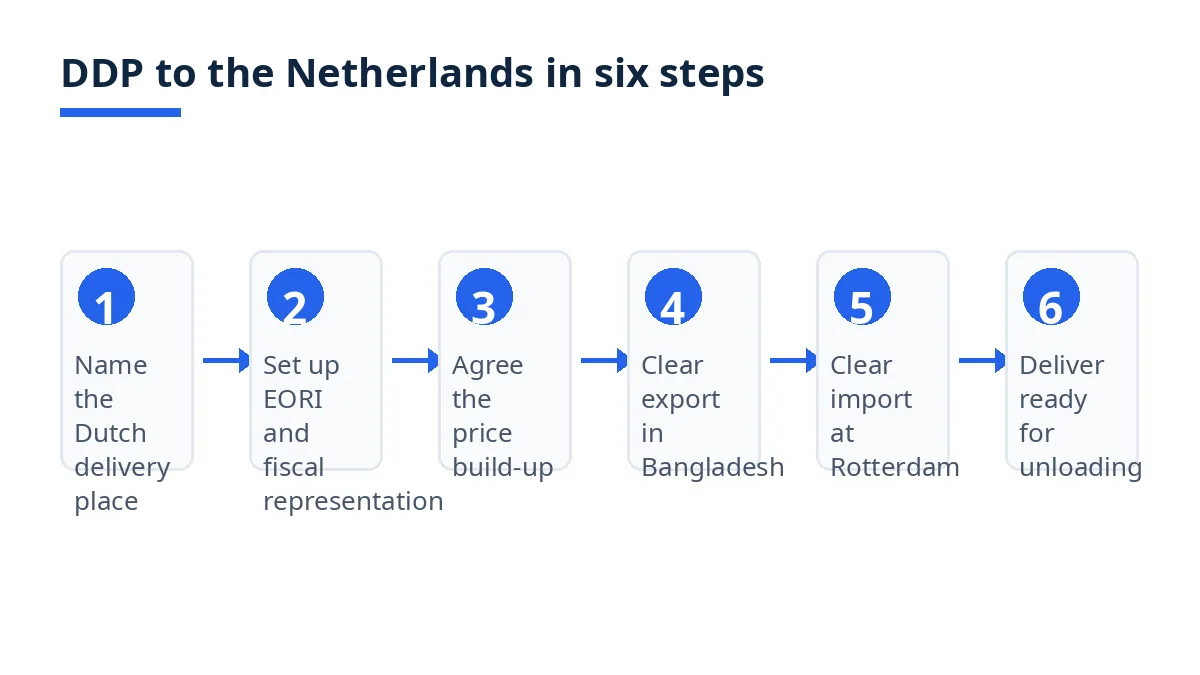
Name the exact Dutch delivery place and write the DDP term in full. State the street address, not only a city, and write the term as DDP followed by that address and Incoterms 2020. Agree who unloads and who pays for waiting time.
Set up the seller side in the Netherlands before the first shipment. The seller needs an EORI number valid in the EU, a Dutch customs representative for the import declaration, and a VAT route for the import. Those three items are arranged through a Dutch customs broker and, for VAT, a fiscal representative. Do not load a DDP shipment while any of the three is still unconfirmed.
Agree the price build-up and the duty and VAT treatment in writing. List the ex-works price, export costs, main carriage, insurance, Rotterdam clearance charges, duty, import VAT handling, and final delivery as separate lines that add up to the single DDP price the buyer pays. State whether the duty figure assumes a tariff preference, and what happens if that preference is lost.
Clear export in Bangladesh. Goods may not be loaded unless an export declaration, the Bill of Export or Shipping Bill, is submitted to Customs and approved, with the exporter, the foreign buyer, and the transport operator named in the declaration.4 The export set includes the export contract or purchase order where there is no export letter of credit, the commercial invoice, the packing list, the EXP form certified by an authorized dealer, and a certificate of origin issued by the EPB or a Chamber of Commerce and Industry.4
Ship, file the Dutch import declaration, and clear at Rotterdam. The seller, through its Dutch representative, files the import declaration, pays or defers the import VAT under the arrangement in place, and pays any duty due. Import duties, where they apply, are charged on the customs value, which is the purchase price plus transport and insurance costs up to the EU border or port of entry.2
Deliver to the named place and close the file. The seller arranges onward carriage from Rotterdam to the named place and places the goods at the buyer disposal, ready for unloading. Both sides then reconcile the delivered quantity against the packing list and the invoice, and record any damage or shortage at delivery, not days later.
See the Incoterms for shipments from Bangladesh guide for how DDP compares with other terms.
Costs, timelines and documents
What are the typical costs and timelines?
There is no typical DDP price for a Bangladesh to Netherlands shipment, because the price is the sum of lines that change with the product, the route, and the Dutch entry position. The lines are stable even when the figures are not: product price, Bangladesh export costs, main carriage to Rotterdam, insurance, Dutch customs representation and clearance charges, duty, import VAT handling, and final delivery to the named place. A quotation that shows only one total hides the line most likely to move, which is usually duty or VAT handling.
Example figures: take a shipment with a customs value of EUR 18,000. If the goods qualify for duty-free entry under the Everything But Arms arrangement described below, duty is EUR 0. At the standard Dutch VAT rate of 21 percent, import VAT on that value is EUR 3,780 if paid at the border. If the same goods lose the preference and duty of EUR 1,800 applies instead, the VAT base rises to EUR 19,800 and import VAT rises to EUR 4,158. These are arithmetic examples only, and the duty line must be confirmed for the exact commodity code on the entry date.
The Article 23 route changes the cash timing, not the VAT rate. Under the reverse-charge mechanism on import, the importer is not required to pay VAT on import immediately, and the VAT can instead be paid when filing the VAT return, provided an Article 23 permit is held.5 A foreign entrepreneur cannot apply for an Article 23 permit directly, but can engage a tax representative who applies for the permit on its behalf, declares the VAT on its return for the period, and deducts it as input tax on the same return, so no VAT is paid in advance on import.5
For timelines, work in stages, not in a single transit figure: seller setup in the Netherlands, Bangladesh export clearance, main carriage to Rotterdam, Dutch import clearance, and final delivery. Ask for a date or date range per stage, and agree what happens to storage and waiting charges if a stage slips.
Which documents are needed?
The Bangladesh export set is the Bill of Export, the commercial invoice, the packing list, the EXP form certified by an authorized dealer, and the certificate of origin, with the export contract or purchase order where there is no export letter of credit.4 The Dutch import set is built around the same commercial facts, plus the transport document, the commodity code for each product line, the origin evidence for any tariff preference claimed, and the import declaration filed by the seller representative. Keep the product description, quantity, value, and origin identical across every document, since a mismatch between the invoice description and the declaration line is the most common reason a Rotterdam entry is held for questions.
Bangladesh-specific rules and tips
Claim the preference only with origin evidence that survives a check. As a least developed country, Bangladesh benefits from the Everything But Arms arrangement, which grants duty-free, quota-free access to the EU for exports of all products except arms and ammunition.6 That preference is not automatic on the strength of a Bangladesh origin label. The seller must hold the origin evidence the Dutch declaration relies on, and the buyer should ask what that evidence is before accepting a DDP price built on zero duty. If the evidence fails, the duty line appears after the price was agreed, and under DDP it is the seller who must absorb or renegotiate it.
Keep one legal name and one product description across the whole file. The Bangladesh export declaration names the exporter and the foreign buyer,4 and the Dutch import declaration must be reconcilable with it. The name on the trade license, the invoice, the packing list, and the Dutch entry should match, and the product description should use the same wording on both sides.
Treat product compliance as a separate duty from customs clearance. Clearing goods at Rotterdam does not settle whether the goods may be sold in the Netherlands. The General Product Safety Regulation protects consumers from unsafe products, and it must be clear where products come from, with a quality system behind the products sold.2 The seller should confirm which product rules apply to its exact product before quoting DDP, and name the EU party responsible for product compliance where the regime requires one.
Build the Dutch VAT record from the first shipment. Whether VAT is paid at the border or deferred under Article 23, the seller needs a clean record: the import declaration, the VAT return entries, and the proof of onward delivery to the named place. A foreign entrepreneur using a tax representative does not need to register separately where the representative declares and deducts the VAT,5 but that only works if the representative holds the permit and receives the entry data on time. Send the representative the invoice, packing list, and commodity codes before the vessel reaches Rotterdam, not after.
Mistakes and red flags
What are the most common mistakes?
Quoting DDP before the Dutch setup exists. A DDP price quoted without an EORI number, a customs representative, and a VAT route is a price for a service the seller cannot yet deliver. The buyer discovers the gap at Rotterdam, when the goods need an importer and the seller has none.
Pricing duty on an assumed preference. A zero-duty DDP price that never names the preference, the origin evidence, or the fallback if the preference fails leaves the seller exposed to the full duty line.
Naming a city instead of a delivery place. DDP to Rotterdam is not DDP to the buyer warehouse. If the contract names only Rotterdam, the final delivery leg, its cost, and its risk are undefined.
Treating the customs broker as the importer. A broker files the declaration, but the importer of record carries the duty and VAT position. Agree in writing whether the broker acts in the seller name or in its own name, because that choice changes who Dutch customs holds liable.
Assuming Article 23 removes VAT. Article 23 defers import VAT to the VAT return, where it is declared and deducted in the same return for a fully deductible importer.5 It does not remove VAT, it does not apply without a permit, and a foreign entrepreneur cannot obtain that permit without a tax representative.5 A quotation that treats deferred VAT as zero VAT misstates the position.
Checklist
Before a DDP shipment is loaded, every line should be answered in writing.
Named Dutch delivery place agreed, with unloading and waiting terms stated.
DDP term written as DDP plus the named place plus Incoterms 2020.1
Seller EORI number confirmed for Dutch customs use.2
Dutch customs representative appointed, with the representation basis stated.
VAT route confirmed: border payment or Article 23 deferral through a tax representative.5
Price build-up itemized, with the duty assumption and fallback stated.
Commodity code confirmed for every product line.2
Origin evidence held for any tariff preference claimed.6
Bangladesh export set agreed: Bill of Export, invoice, packing list, EXP form, origin certificate.4
Product compliance owner named, separate from the customs filer.2
Damage and shortage reporting agreed for the named place.
How Exportain helps
On Exportain, browse suppliers and post a request for quotation (RFQ) on the RFQ board stating that the quotation must be DDP to a named Dutch place, with the price build-up, the duty assumption, and the seller Dutch setup shown as separate lines. Ask each reply whether the seller already holds an EU EORI number and a Dutch fiscal arrangement. When you accept a quotation, Exportain creates one order and issues one proforma invoice.7
Read the badges for what they record. Exportain Verified and Export Verified are document checks,7 and verification is a document review by staff, free, and never granted by membership plans.8 It is not a factory inspection,7 8 and it is not Dutch customs or VAT registration.
FAQs
What should I know first about DDP?
Know first that DDP puts the Dutch side on the seller. The seller must deliver to the named Dutch place, cleared for import, with duty and import VAT handled.1 That requires an EORI number,2 a Dutch customs representative, and a VAT route, which for a foreign entrepreneur means a tax representative holding an Article 23 permit if VAT is to be deferred.5
What are the typical costs and timelines?
There are no typical DDP figures, because the price is the sum of product, export, carriage, insurance, Rotterdam clearance, duty, import VAT handling, and final delivery lines. Example figures in this guide use a EUR 18,000 customs value to show how a duty change moves the VAT base, not to state a market price. Timelines should be agreed stage by stage, from Dutch setup and Bangladesh export clearance through Rotterdam clearance to final delivery, with no single transit figure promised.
Which documents are needed?
The Bangladesh export set is the Bill of Export, invoice, packing list, EXP form, and certificate of origin, with the export contract or purchase order where there is no export letter of credit.4 The Dutch import set adds the transport document, a 10-digit commodity code per line,2 origin evidence for any preference claimed,6 and the import declaration filed through the seller representative.
What are the most common mistakes?
The most common mistakes are quoting DDP before the Dutch EORI, representative, and VAT setup exist, pricing duty on an unproven preference, naming a city instead of an exact delivery place, treating the broker as the importer, and treating Article 23 deferral as if VAT disappears.5 Each mistake surfaces at Rotterdam.
Next steps on Exportain
Browse suppliers, then post your named Dutch delivery place and DDP requirements on the RFQ board so sellers quote the full price build-up with their Dutch setup shown. Before you confirm, read the landed cost imports from Bangladesh guide to check each DDP line.
Sources
- Incoterms® 2020. International Chamber of Commerce (ICC) (accessed )
- Importing home accessories. Netherlands Chamber of Commerce (KVK) (accessed )
- Container throughput at Rotterdam and Antwerp-Bruges: A growing rivalry. PortEconomics (accessed )
- Customs Clearance Procedures for Export. Bangladesh Customs, National Board of Revenue (accessed )
- Reverse-charge mechanism on import: Article 23. Belastingdienst (accessed )
- EU trade relations with Bangladesh. European Commission, (accessed )
- Trust & Safety Center. Exportain (accessed )
- Supplier verification: Earn trust badges buyers can see. Exportain (accessed )
About the author
Sourcing from Bangladesh?
Post a request for quotation and suppliers on Exportain can send you their quotes directly.
Post an RFQ


