

DAP Shipping From Bangladesh to Germany: Costs, Steps and Timeline
DAP shipping from Bangladesh to Germany: the seller delivers to your named place, while you clear German customs, pay duty and 19% import VAT, and unload. Includes the Bangladesh export set, Hamburg routing and a buyer checklist.
Short answer
Under DAP, a Bangladeshi seller delivers goods to a named place in Germany, ready for unloading, and bears cost and risk to that point. The German buyer clears import customs, pays duty and import VAT, and unloads the goods. Before ordering, agree the full named place address, appoint a German customs broker, confirm your EORI number, and get a duty and import VAT estimate beside the DAP price, so the border bill never comes as a surprise.
On this page
Key takeaways
Under DAP, the seller bears cost and risk to the named place in Germany, ready for unloading; the buyer clears German import customs, pays duty and import VAT, and unloads.
Name a full delivery address, not a city: the named place is where the seller's obligation ends and your unloading, clearance and storage responsibilities begin.
German import VAT is 19%, or 7% for selected goods, assessed on the customs value plus duty; plan the release-day cash flow and confirm recovery with a tax adviser.
A preference claim needs written proof of origin, and Bangladesh's preference position must be re-checked for every order as the post-graduation framework changes.
Under Delivered at Place (DAP), a Bangladeshi seller arranges carriage and delivers your goods to a named place in Germany, ready for unloading. You, the buyer, then clear German import customs, pay any duty and import VAT, and unload the goods. That split is the whole point of a DAP shipment from Bangladesh to Germany, and it is also where most first orders on this lane go wrong: a DAP price is a delivered-to-the-named-place price, not a landed, duty-paid price.
The Incoterms 2020 rules set out 11 rules with a clear allocation of cost, risk and obligations.1 Under DAP the seller does not unload the goods, a point the rules draw out by contrast with Delivered at Place Unloaded (DPU), where the seller does unload.1 Delivered Duty Paid (DDP) is the rule that puts import clearance and duty payment on the seller. If your quotation says DAP and you budgeted as though it said DDP, the duty and import VAT bill at the German border will come as a surprise. Write the rule, the named place and the edition together, for example "DAP Musterstraße 10, 20097 Hamburg, Germany, Incoterms® 2020", so the delivery point is a real address, not a city name.
Why this matters for buyers and sellers
For the buyer, DAP keeps control of the German side. You choose your own customs broker, hold your own EORI number, and see the duty and import VAT assessment on your own import declaration rather than inside a seller-priced lump sum. That control matters when a duty rate or a preference position changes the landed cost, or when your product needs a certificate your seller cannot assess for you.
For the seller, DAP stops at a defined point. The seller quotes carriage to the named place and does not take on a German customs entry, German duty payment or German import VAT. That boundary lets the seller price carriage without guessing your duty rate. A seller quoting DAP and DDP side by side is pricing two different obligations, so the two prices should never be compared as though one were the other with a margin added.
The boundary also decides who fixes a problem. If the goods do not reach the named place, the problem sits on the seller side. If the goods arrive but the German entry is not ready, the delay and any storage that follows sit on the buyer side. Agreeing the named place, the broker and the unloading plan before the goods sail is what keeps that boundary clean.
Step-by-step: how it works
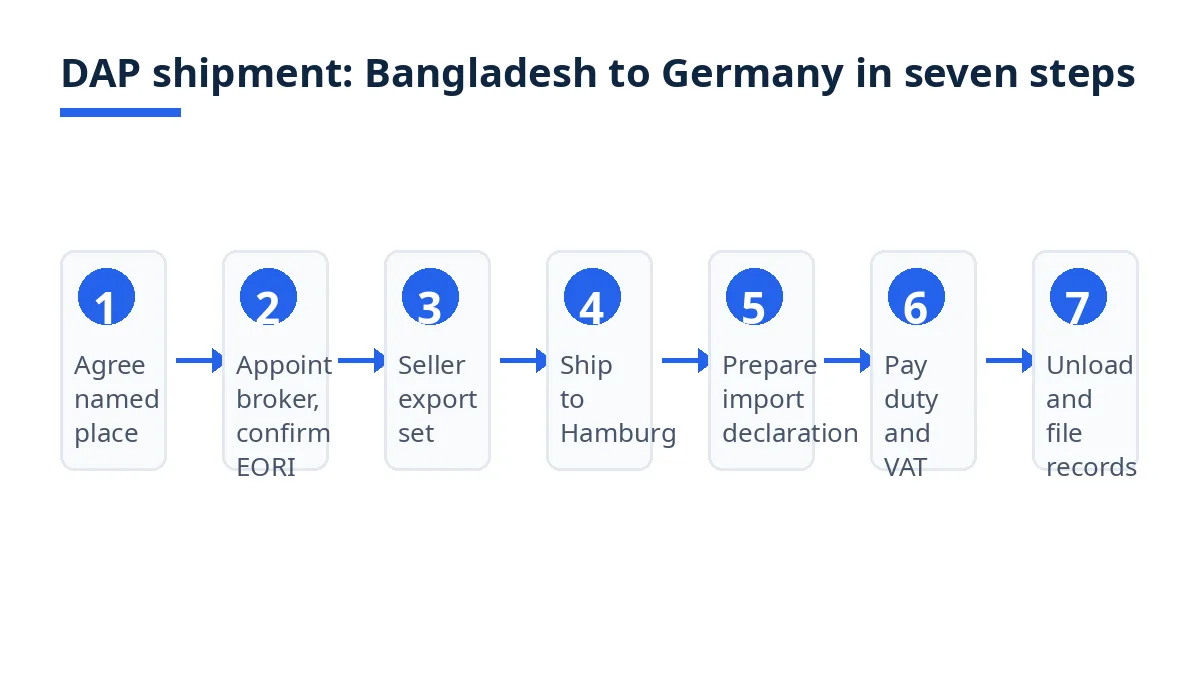
Agree the DAP named place in writing. State the full delivery address, the unloading responsibility and the delivery hours and vehicle access at that address. DAP delivery happens before unloading, so unloading labour and equipment are buyer-side items unless you agree otherwise in writing. A named place that is a warehouse dock with a booked unloading slot behaves very differently from a street address with no forklift.
Appoint your German customs broker and confirm your EORI number. The EORI number is a unique number issued by the competent authorities in the European Union that allows customs to identify economic operators, and there is an obligation to quote an EORI number on customs declarations.2 Give the broker the product description, the expected HS code and the origin documents early, so classification and any preference position are checked before sailing, not at the border.
Let the seller complete the Bangladesh export set. Goods may not be loaded unless an export declaration, the Bill of Export or Shipping Bill, is submitted to Customs and approved.3 Enclosed documents include the export contract or purchase order where there is no export letter of credit, the commercial invoice, the packing list, the EXP form certified by an authorized dealer, and a certificate of origin issued by the Export Promotion Bureau (EPB) or a Chamber of Commerce and Industry.3 The seller then books carriage from Chattogram toward the agreed German gateway.
Ship through the transshipment route and confirm the sailing schedule. Container transshipment from Chattogram runs by feeder vessel to Colombo, Singapore or Malaysia, and from there by mother vessel to main European ports including Hamburg, a process reported at about 40 days.4 Get the feeder port, the mother vessel routing and the estimated arrival in writing, and plan your warehouse and broker capacity around that window rather than a single promised week.
Prepare the German import declaration while the goods sail. Your broker lodges the entry for release for free circulation, using the commercial invoice, packing list, bill of lading and origin proof. Where a tariff preference is claimed, the origin of the goods must be substantiated by presenting written proof of preferential status.5
Pay duty and import VAT on release. The import VAT rate is currently set at 19 percent, with a reduced rate of 7 percent for selected goods such as food products and books.5 The basis for assessment of import VAT is the goods' customs value plus customs duty, plus any applicable excise duties.5 Ask your tax adviser before ordering whether you recover the import VAT as input tax, because the cash-flow effect at release is very different from the final cost.
Unload, inspect and file the records together. Check the goods against the packing list and commercial invoice on arrival, note any shortage or damage in writing at once, and keep the import declaration, duty and VAT payment records and delivery note with the order file. Those records are what a later duty query or VAT reclaim will ask for.
Costs, timelines and documents
What are the typical costs and timelines?
There are no typical DAP costs a guide can state as fact, because carriage, duty and the onward leg each move with the product, the gateway and the season. The split below shows who pays what, which is the part that does not change.
Cost line | Seller pays | Buyer pays |
|---|---|---|
Bangladesh export clearance and export documents | Yes | No |
Origin handling and main carriage to the named place | Yes | No |
Transit risk to the named place | Yes | No |
German import declaration and broker fee | No | Yes |
German customs duty | No | Yes |
German import VAT at 19% or 7% | No | Yes |
Unloading at the named place | No | Yes |
Storage or detention if clearance is delayed | No | Yes |
Onward delivery beyond the named place, if any | No | Yes |
For timelines, count production, Bangladesh export clearance, the sea transit, German clearance and the onward leg as separate lines. The sea leg is measured in weeks on this lane, with transshipment routing reported at about 40 days to European ports.4 Ask for sampling, cargo-ready, sailing, arrival and clearance dates as separate lines, not a single delivery week.
Example figures: a DAP price of USD 20,000 covers carriage to the named place in Hamburg. If the duty assessed is USD 0 under a preference and the customs value is USD 20,000, import VAT at 19% is USD 3,800 on that base, before the broker fee and unloading costs. The example shows the method only, not a typical price, duty rate or VAT outcome for any product.
Which documents are needed?
The seller's export set is the Bill of Export, commercial invoice, packing list, EXP form certified by an authorized dealer, and certificate of origin issued by the EPB or a Chamber of Commerce and Industry, with the export contract or purchase order where there is no export letter of credit.3 Your German import set is the commercial invoice, packing list, bill of lading, origin proof for any preference claim, your EORI number and the broker's authority to act. Product-specific certificates, where your product needs them, are confirmed by your broker before sailing, not discovered at the border.
Bangladesh-specific rules and tips
Keep one legal name across every paper. The export declaration specifies the description of goods, value, name of exporters, name of foreign buyers or importers, and name of transport operators.3 The name on the trade licence, quotation, proforma invoice and payment account should match, or the export set and the import entry will disagree.
Confirm the EXP form route with the seller's bank early. The EXP form certified by an authorized dealer exists to ensure the realization of export proceeds.3 A seller whose bank arrangement is not settled before sailing can hold up the export set, so ask who the authorized dealer is and that the form is in hand before the cargo-ready date.
Treat the preference position as a per-order check. The Everything But Arms initiative provides least developed countries with duty-free and quota-free access to the EU market for all products except arms and ammunition, and Bangladesh currently enjoys that access as a least developed country.6 A new Generalised Scheme of Preferences framework is scheduled to take effect on 1 January 2027,6 and Bangladesh is preparing for its post-graduation transition, so re-check the preference position and the origin proof for every order rather than copying last year's duty line.
Allow time for stuffing checks. Where goods are loaded into containers at private inland container depots or exporters' premises, a gate division officer may check the goods before they proceed to the port area.3 Build that check into the cargo-ready date.
Mistakes and red flags
What are the most common mistakes?
Treating DAP as duty-paid. DAP leaves German import clearance, duty and import VAT with the buyer. Budgeting a DAP price as a landed price guarantees a shortfall at release.
Naming a city instead of a place. "DAP Hamburg" names no dock, no unloading crew and no delivery hours. The named place must be an address where a truck can arrive and unload.
Accepting the seller's duty guess. The seller does not pay your duty and may not know your HS code or preference position. Get the broker's duty and VAT estimate beside the DAP price before you confirm.
Claiming a preference without origin proof. Where a preference takes the form of an exemption from customs duty, only import VAT and any applicable excise duty must be paid, but that treatment is subject to the origin being substantiated by written proof of preferential status.5 No proof, no preference.
Forgetting the import VAT cash flow. Import VAT at 19% on the customs value plus duty is payable at release even where it is later recoverable.5 A buyer who prices without that line can be short of cash on arrival day.
Having nobody ready to unload. DAP delivery happens before unloading. A named place with no crew, no equipment and no booked slot turns a delivered truck into storage and detention charges.
Comparing a DAP price with an FOB or CIF price directly. They contain different journeys. Price every quote to the same finish line, your warehouse floor, before you compare suppliers.
Checklist
Before you confirm, every line should be answered in writing.
Named place agreed as a full address, with unloading responsibility and delivery hours stated.
Incoterm written as DAP plus the named place plus Incoterms® 2020 on the quotation and purchase order.
German customs broker appointed and EORI number confirmed.2
HS code and preference position checked by the broker, with origin proof identified.
Bangladesh export set confirmed: Bill of Export, invoice, packing list, EXP form, certificate of origin.3
Sailing schedule confirmed, including feeder port, transshipment routing and estimated Hamburg arrival.
Duty and import VAT estimate beside the DAP price, with the VAT base understood.5
Import VAT cash flow planned for release day, with tax advice on recovery.
Unloading crew, equipment and slot booked at the named place.
Inspection plan agreed: check against packing list and invoice on arrival, shortages noted in writing.
Order file ready for the declaration, payment records and delivery note.
How Exportain helps
On Exportain, browse suppliers and post a request for quotation (RFQ) on the RFQ board with your product specification, quantity and DAP named place, so suppliers quote against the same delivery point. Ask each reply to state the named place, what the DAP price excludes, and the sailing route offered. Read badges for what they record: verification is a document and photo review, not a factory inspection, and membership plans never grant a trust badge.7 That review is a starting point for enquiries, not a substitute for your broker check, sample approval or inspection.
FAQs
What should I know first about DAP?
DAP means the seller delivers the goods to your named place in Germany, ready for unloading, and bears cost and risk to that point. You unload, clear German import customs and pay duty and import VAT. DAP is not duty-paid delivery: that is DDP. Name the full address and the Incoterms® 2020 edition in writing, because the named place is where the seller's obligation ends.1
What are the typical costs and timelines?
There are no typical figures a guide can state as fact, because carriage, duty and the onward leg move with the product, gateway and season. The seller pays export clearance and carriage to the named place; you pay the German declaration, duty, import VAT, unloading and any storage from delayed clearance. The sea leg is measured in weeks, with transshipment routing to European ports including Hamburg reported at about 40 days.4
Which documents are needed?
The export set is the Bill of Export, commercial invoice, packing list, EXP form certified by an authorized dealer, and certificate of origin issued by the EPB or a Chamber of Commerce and Industry.3 The import set is the commercial invoice, packing list, bill of lading, origin proof for any preference claim, your EORI number and your broker's authority. Product-specific certificates are confirmed by your broker before sailing.
What are the most common mistakes?
The most common mistakes are treating DAP as duty-paid, naming a city instead of a delivery address, accepting the seller's duty guess without a broker check, claiming a preference without origin proof,5 forgetting the import VAT cash flow at release,5 and having nobody ready to unload. Fix each in writing before the goods sail: restate the rule and named place, agree broker and EORI roles, and get the duty and VAT estimate beside the DAP price.
Next steps on Exportain
Browse suppliers, then post your product specification, quantity and DAP named place on the RFQ board so suppliers quote against the same delivery point. Before you confirm, read the Incoterms for shipments from Bangladesh guide and the landed cost for imports from Bangladesh guide to compare the DAP price against your landed cost.
Sources
- Incoterms® 2020. International Chamber of Commerce (ICC) (accessed )
- Using the EORI number. German Customs (Zoll) (accessed )
- Customs Clearance Procedures for Export. Bangladesh Customs, National Board of Revenue (accessed )
- Direct routes from Ctg to major ports halve shipment time and cost. The Business Standard (accessed )
- Assessment of taxes and duties. German Customs (Zoll) (accessed )
- EU invites Bangladesh to share success story in preferential market access. The Financial Express (accessed )
- Supplier verification: Earn trust badges buyers can see. Exportain (accessed )
About the author
Sourcing from Bangladesh?
Post a request for quotation and suppliers on Exportain can send you their quotes directly.
Post an RFQ


