

Custom Women's Blouses Manufacturer in Bangladesh: OEM Process From Tech Pack to Bulk
No single blouse specification fits every buyer: neckline, sleeve, embellishment and grading set the price and the risk. This guide follows a custom women's blouse order from tech pack to bulk inspection.
Short answer
A custom women's blouse order in Bangladesh starts with a detailed tech pack covering neckline, sleeve, darts, placket, fabric and the split per style, colour and size. The factory then makes a proto sample, trials embroidery or embellishment separately, and proves fit and grading in the smallest, middle and largest sizes. A pre-production sample in bulk materials, washed and pressed, is approved in writing before bulk cutting, sewing and AQL-based inspection begin.
On this page
Key takeaways
A blouse order is decided at the neckline, sleeve and armhole: specify each with a measured sketch, not words alone, and test them on a proto sample before bulk.
Approve embroidery and embellishment on a washed trial panel first, because it can pucker fabric, change drape or pull a neckline down.
Approve fit and grading in the smallest, middle and largest sizes, since bust, waist, shoulder and armhole do not grow at the same rate.
Approve a pre-production sample in bulk materials, washed and pressed, in writing before bulk cutting starts, and inspect bulk against that reference.
There are no typical blouse prices or lead times: each factory prices your fabric, construction, embellishment, size range, colour split and delivery term.
A blouse order is usually decided at the neckline, the sleeve and the armhole, not at the fabric table. A woven blouse can use the right cloth and still fail when a collar rolls after washing, a puff sleeve sits at the wrong height, a dart pulls across the bust, or a button placket gaps between buttons. Those pattern and construction problems appear only when the garment is worn, washed and pressed. This guide follows a custom women's blouse order in Bangladesh through the stages where they are caught: the tech pack, the proto sample, the embellishment trial, the fit and grading approval, the pre-production sample, and bulk inspection.
Blouses sit in the woven sector. The Bangladesh Garment Manufacturers and Exporters Association (BGMEA), which represents the woven, knitwear and sweater sub-sectors, reports around 4,500 member factories, of which about 60 percent are woven garment manufacturers, and states that its member factories account for 100 percent of woven garment exports.1 In the July to September 2026 quarter, woven exports reached $4,614.80 million, up 5.11 percent year on year, within ready-made garment exports of $10,578.56 million, according to data released by the Export Promotion Bureau (EPB).2
Why this matters for buyers and sellers
For the buyer, a blouse range lives or dies on fit across sizes and on repeatability of the details that sell it: the neckline shape, the sleeve fullness, the embroidery placement, and the drape after washing. A buyer who approves a single middle size and a single colour has approved only part of the order. The smallest and largest sizes, the lightest colour, and the most decorated variant each carry their own risk.
For the seller, a blouse order is a sequence of precise operations: cutting shaped pieces, setting a sleeve into a curved armhole, sewing darts, finishing a collar or tie neck, attaching buttons, and pressing a garment that must hold its shape on a hanger. Each operation is set once and repeated thousands of times, so an error approved at sample stage is repeated across the whole bulk run. Written approvals at each stage fix the standard before cutting starts.
Use one delivery term for every quotation: the Incoterms 2020 rules set out 11 rules with a clear allocation of cost, risk and obligations.3 Compare quotes only on the same term and named place.
Step-by-step: how it works
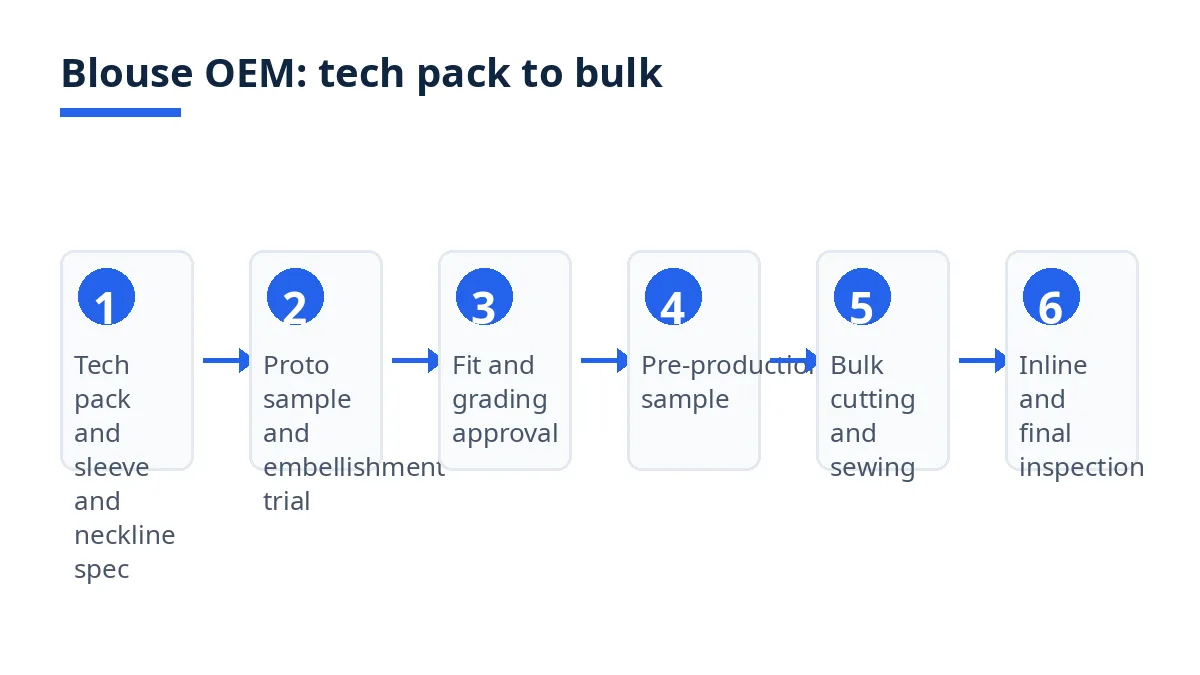
1. Write a blouse tech pack, not a general garment brief
A blouse tech pack must describe the parts that make this garment different from any other woven top: a flat sketch of front and back, the neckline shape and depth, the collar or tie-neck construction, the sleeve type and length, the sleeve cap height and fullness, the armhole depth, dart positions, the button placket width and button spacing, and the hem shape. Add a measurement chart covering bust, waist, hip, shoulder, neckline depth, armhole, sleeve length, sleeve opening, and body length. State the fabric composition, construction, weight and width, the lining fabric if any, and the care label content. State the split in the same document: quantity per style, per colour, per size, and the size ratio for each colour.
2. Make a proto sample and test the shape
The proto sample is made in a substitute fabric to test pattern and construction. Check the neckline first: does it sit flat, does a collar stand or roll as drawn, and does a tie neck tie without twisting. Then check the sleeve: does the cap ease into the armhole without puckering, does the sleeve hang at the intended angle, and does the cuff or elastic opening close as specified. Check dart placement on a form or a fit model, and check that the placket closes without gapping between buttons. List every correction in writing with a revised measurement, not a general comment such as "fix the sleeve".
3. Run the embroidery and embellishment trial separately
Blouses often carry embroidery, lace, sequins, smocking or beadwork, and each changes the garment. Embroidery can pucker a light woven fabric, lace can stretch differently from the body cloth, and beadwork adds weight that pulls a neckline down. Approve embellishment on its own trial panel before it is sewn into a full sample: check design size and placement, thread colours against the actual fabric colour, stitch density, and the backing used. Wash the trial panel and check whether the embellishment puckers, fades or loosens. Record the approved thread colours, design reference and placement measurements for repeat orders.
4. Approve fit and grading across the size range
Grading is where a blouse most often fails quietly. A pattern graded only from the middle size can give a neckline that is too tight at the smallest size and a sleeve that is too wide at the largest size, because bust, waist, shoulder and armhole do not grow at the same rate. Ask for graded measurements for every size, and approve a fit sample in at least the smallest, middle and largest sizes. Measure each sample against the graded chart, check sleeve and armhole on each size, and confirm that dart positions move correctly with the grade.
5. Approve a pre-production sample in bulk materials
The pre-production sample is made in the actual fabric, colour, trims, embellishment and labels, using the bulk methods. Wash it using the care instructions that will go on the label, measure it again after washing, and check shrinkage, neckline shape, sleeve length and button security. Press it as the bulk goods will be pressed, and check the finished appearance on a hanger. Approve it in writing, or list corrections and repeat the sample.
6. Cut, sew, press and inspect in bulk
Bulk production follows the approved sample: fabric is cut by size and colour, pieces are sewn in sequence, embellishment is applied at the agreed stage, buttons and labels are attached, and garments are pressed and packed. Inspection should run during production, not only at the end, because a sleeve fault found in the first hundred pieces can still be corrected, while the same fault in finished cartons cannot. Agree the inspection plan before production starts. ISO 2859-1 defines a system of acceptance sampling plans for inspection by attributes, indexed by acceptance quality limit (AQL) for lot-by-lot inspection, and AQL is the maximum average percentage of defective items considered acceptable during random sampling.4 Write the inspection level and AQL values into the purchase order, and list blouse defect points: neckline roll, sleeve puckering, dart position, button alignment, embellishment loosening, and shade variation between panels.
Stage | What is approved | Approval in writing |
|---|---|---|
Tech pack | Neckline, sleeve, darts, placket, fabric, split | Signed pack with measurements |
Proto sample | Pattern shape and construction | Correction list with revised measures |
Embellishment trial | Design, placement, wash behaviour | Thread colours and placement |
Fit and grading | Smallest, middle and largest sizes | Graded chart sign-off |
Pre-production sample | Bulk fabric, wash, press, finish | Sealed reference sample |
Bulk inspection | Inline and final checks against the reference | Inspection report per lot |
Costs, timelines and documents
What are the typical costs and timelines?
There are no typical blouse costs or timelines that a guide can state as fact, because each factory prices your fabric, neckline and sleeve construction, embellishment method, trim and label runs, finishing and packing, and the delivery term you choose.3 Ask for the price broken down by fabric, trims, embellishment set-up, sewing, finishing and packing, so you can see which detail drives the quote.
For timelines, sampling depends on fabric availability, embellishment digitising and correction rounds, and bulk production depends on fabric and trim delivery, line capacity and the number of sizes and colours. Ask for sampling, fabric ready, embellishment ready, production and inspection dates as separate lines, not a single delivery week.
Example figures: a buyer orders 2,400 blouses in four colours at 600 per colour. If one colour is cut to 300 pieces and the other three rise to 700 each, the total stays at 2,400, but the small colour now carries its own dye, trim and cutting set-up at half the quantity. The example shows structure only, not a typical price, quantity or lead time.
Which documents are needed?
The order documents are the tech pack, the itemized quotation, the purchase order with the split per style, colour and size, the graded measurement chart, the approved sample record, and the inspection plan with AQL values.4 For export clearance, see the Bangladesh Customs export clearance procedure for the governing document set.5
Bangladesh-specific rules and tips
Confirm association claims at the source. If a supplier claims BGMEA membership, confirm it with the association itself. BGMEA reports around 4,500 member factories, with about 60 percent in woven garments, and states that its members account for 100 percent of woven garment exports.1 Membership signals an active woven business, not capacity for your neckline, sleeve or embellishment.
Use the HS heading in the commercial documents. In the Harmonized System, heading 6206 covers blouses, shirts and shirt-blouses, women's or girls', not knitted or crocheted.6 Confirm the subheading by fibre, because a silk, cotton and man-made fibre blouse fall under different subheadings, and the subheading should match the fabric on the tech pack and invoice.
Put fibre content on the label at sample stage: relabelling finished garments after sewing is the expensive fix. For the European Union, Regulation (EU) No 1007/2011 requires a textile product to be labelled or marked with the name and percentage by weight of all constituent fibres in descending order.7
Ask where the fabric and embellishment inputs come from. Woven blouse fabrics, lace, embroidery thread and buttons may be sourced locally or imported for your specification, and an imported lace or a special button can set both the minimum quantity and the earliest production date. Confirm that the pre-production sample uses the same inputs as bulk.
Mistakes and red flags
What are the most common mistakes?
Approving a single size and a single colour. A blouse that fits the middle size can fail at the smallest and largest sizes, and embroidery that looks clean on a dark fabric can pucker on a light colour. Approve fit in three sizes and embellishment on each fabric colour.
Describing the sleeve and neckline in words only. "Puff sleeve" and "V neck" each cover several shapes. A sleeve differs by cap height, fullness and opening, and a neckline differs by depth and width. Give a sketch with measurements for both, or the factory will choose a shape and you will discover the difference at sample stage.
Letting embellishment join the order late. Embroidery or lace added after the pattern is approved can change the drape, weight and wash behaviour of the blouse. Approve the embellishment trial before the pre-production sample, not alongside bulk cutting.
A cheaper quote is not a cheaper blouse if the specification moved. A plain neckline, an unlined body, a stock button or a different delivery term each change the offer, so compare replies only when they answer the same tech pack on the same Incoterm.
Treating a profile or a badge as proof of blouse capability. A profile is a starting point for enquiries. It does not show whether a factory can set your sleeve, match your embroidery or grade your size range, and a badge is not a guarantee of capacity, quality or delivery.8
Skipping the wash test on the pre-production sample. A blouse that measures correctly before washing and shrinks unevenly after washing is a different garment. Wash, measure and press the pre-production sample before approving bulk.
Checklist
Before you confirm, every line should be answered in writing.
Tech pack sent: neckline, sleeve, darts, placket, fabric, lining, labels, packing.
Split stated per style, colour and size, with one size ratio per colour.
Proto sample corrected in writing, with revised neckline and sleeve measurements.
Embellishment trial washed and approved, with colours and placement recorded.
Fit approved in smallest, middle and largest sizes against the graded chart.
Pre-production sample in bulk materials washed, measured, pressed and approved.
Inspection level and AQL values in the purchase order.4
Quotations compared on the same tech pack and Incoterm.3
Fibre content and care label agreed for the destination market.7
Export document set confirmed against the Bangladesh Customs procedure.5
How Exportain helps
On Exportain, browse suppliers and post a request for quotation (RFQ) on the RFQ board with your blouse tech pack summary, neckline and sleeve specification, embellishment method and split per colour and size, so suppliers quote against the same specification. Read the MOQ definition guide before you set your quantity, and ask each reply for its minimum per style and per colour. Verification on Exportain is a document and photo review, not a factory inspection, and a badge is not a guarantee, so sample approval and inspection stay with you.8 9 See how supplier verification works on Exportain.
FAQs
What should I know first about women's blouses?
A custom blouse order turns on the neckline, the sleeve and the armhole, and on how those parts behave after washing. Woven women's blouses fall under HS heading 6206, which covers blouses, shirts and shirt-blouses, women's or girls', not knitted or crocheted.6 Specify the neckline shape and depth, the sleeve type and cap, the dart positions and the embellishment method in the tech pack, and approve fit in three sizes before bulk cutting.
What are the typical costs and timelines?
There are no typical figures a buyer can rely on, because each factory sets its price and lead time for your fabric, neckline and sleeve construction, embellishment, size range, colour split and delivery term.3 Sampling depends on fabric and embellishment work, and bulk time on trim delivery and line capacity.
Which documents are needed?
The order documents are the tech pack, itemized quotation, purchase order with the split, graded measurement chart, approved sample record and inspection plan.4 For export clearance, see the Bangladesh Customs export clearance procedure for the governing document set.5
What are the most common mistakes?
The most common mistakes are approving one size and one colour only, describing the sleeve and neckline in words without a measured sketch, adding embellishment after the pattern is approved, comparing quotes on different specifications or terms,3 and skipping the wash test on the pre-production sample. Each is fixed by a written approval at the stage where the detail is set.
Next steps on Exportain
Browse suppliers, then post your blouse tech pack summary, neckline and sleeve specification and split per colour and size on the RFQ board so suppliers quote on the same basis. Before you confirm, read women's blouses manufacturers in Bangladesh and wholesale women's blouses in Bangladesh.
Sources
- BGMEA at a glance. Bangladesh Garment Manufacturers and Exporters Association (BGMEA) (accessed )
- RMG exports rise 6.10% to $10.58b in July-Sept of FY27. tob.news, (accessed )
- Incoterms® 2020. International Chamber of Commerce (ICC) (accessed )
- ISO 2859-1:2026 - Sampling procedures for inspection by attributes — Part 1: Sampling schemes indexed by acceptance quality limit (AQL) for lot-by-lot inspection. ISO (accessed )
- Customs Clearance Procedures for Export. Bangladesh Customs, National Board of Revenue (accessed )
- Classification Detail — HS Code 620610. United Nations Statistics Division (accessed )
- Regulation (EU) No 1007/2011 on textile fibre names and related labelling and marking of the fibre composition of textile products. European Union, (accessed )
- Trust & Safety Center. Exportain (accessed )
- Supplier verification: Earn trust badges buyers can see. Exportain (accessed )
About the author
Sourcing from Bangladesh?
Post a request for quotation and suppliers on Exportain can send you their quotes directly.
Post an RFQ


