Wholesale Women's Blouses From Bangladesh: Prices, MOQ and Reliable Suppliers
No single wholesale blouse price or MOQ in Bangladesh: what sets the minimum per style, colour and embellishment, and how to specify a blouse range so quotations can be compared.
Short answer
There is no single wholesale price or minimum order quantity for women's blouses from Bangladesh. Each factory sets its price and minimum per style, per colour and per embellishment placement for your specification, driven by cloth and drape, neckline and sleeve construction, embellishment set-up, trim lots and the size assortment. Ask for each minimum in writing, with set-up costs itemised apart from the unit price.
On this page
Key takeaways
There is no single wholesale blouse price or MOQ in Bangladesh, because each factory sets its minimum per style, per colour and per embellishment placement for your specification.
Cloth and drape, neckline and sleeve construction, embellishment set-up, trim lots and the size assortment are the drivers that set the price and the floor.
Approve the silhouette worn, not flat: check neckline, sleeve and hem on a form or a wearer, and check graded measurements at the smallest and largest sizes.
Ask for every minimum and set-up cost in writing on the quotation and purchase order, with the style, colour and size split it applies to.
Badges record document and photo reviews, not factory inspections, and a badge is not a guarantee of capacity, quality or delivery.
A wholesale blouse range is judged from the shoulder down. A buyer opening a carton checks the neckline first, then the sleeve, then the way the fabric hangs from the bust to the hem. If any of those three is wrong, the blouse does not become a lower-priced blouse. It becomes stock that a shop cannot put on a rail with confidence, and the price agreed for it stops mattering.
That is why a wholesale enquiry for women's blouses from Bangladesh needs more detail than a style name and a total quantity. The factory prices the cloth, the neckline and collar work, the sleeve shape, the embellishment, the button and trim set, and the size assortment as separate pieces of work. Each piece can carry its own minimum, and the smallest of those minimums, not the order total, decides whether the range can run.
Bangladesh has a wide woven base for this kind of work. The Bangladesh Garment Manufacturers and Exporters Association (BGMEA) states that around 60 percent of its member factories are woven garment manufacturers, and that its member factories account for 100 percent of woven garment exports.1 Woven garment exports reached $4.614 billion in July to September 2026, up 5.11 percent year on year, within ready-made garment exports of $10.578 billion, according to data released by the Export Promotion Bureau (EPB).2 That base gives a buyer many factories able to quote, but it creates no shared price, minimum or lead time for a blouse.
In the Harmonized System, heading 6206 covers blouses, shirts and shirt-blouses for women or girls, not knitted or crocheted, with subheadings by fibre: silk, wool, cotton, man-made fibres and other textile materials.3 A knitted blouse sits elsewhere, so state the construction in the enquiry. A woven blouse and a knitted blouse are different cutting, sewing and finishing jobs even when they look alike on a hanger.
Why this matters for buyers and sellers
For the buyer, the risk in a blouse order sits at the fit points that a flat measurement sheet hides. A neckline that gapes when worn, a sleeve that pulls across the upper arm, or a hem that kicks out at the side seam will show in a shop fitting room, not on a factory table. Blouses are also bought in assortments, not in single sizes. A range that sells through in the middle sizes and stalls at the ends ties up the same cash as a range that sells evenly, but returns less of it.
For the seller, a blouse range multiplies set-up work. Each neckline shape needs its own collar or facing pattern, each sleeve shape needs its own pattern and finishing, and each embellished style needs its own embroidery or handwork set-up. Cloth cut for one neckline and sleeve combination cannot be reused for another, and buttons, beads or lace bought for one colourway cannot be sold on to another buyer. A short run still uses the pattern, marker and set-up time, so the cost per piece rises as the quantity per style, colour and size falls.
Three decisions therefore come before price. First, the silhouette: neckline, sleeve and length, with the fit points measured on a worn sample, not only flat. Second, the cloth and drape: fibre, weave, weight and hand, and whether the cloth is stocked or woven and dyed to order. Third, the assortment: the size run, the ratio between sizes, and the quantity per colour. Settle those three in writing and the quotations that follow can be compared. Leave any of them open and two factories will quote two different garments under the same style name.
Step-by-step: how it works
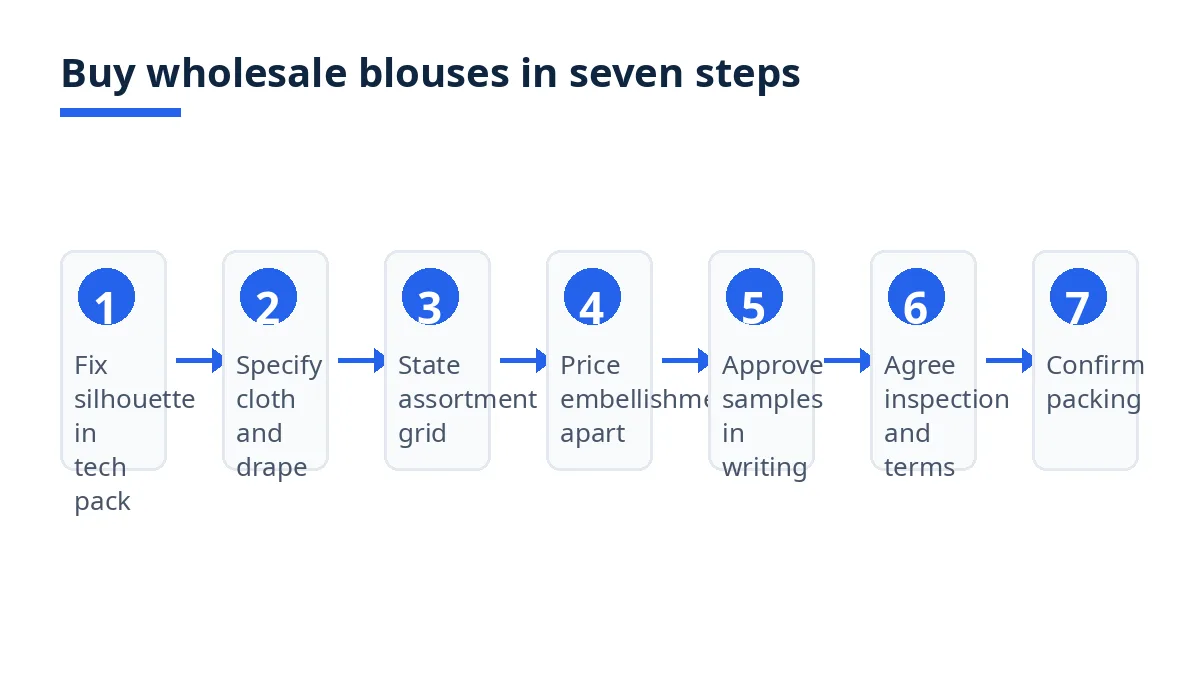
Fix the silhouette in a tech pack. State the neckline shape and depth, collar or facing construction, sleeve shape and length, body length, hem finish, button or closure type and placement, and the fit points to be measured on the sample. Include a size chart with bust, waist, shoulder and sleeve measurements, and the tolerance allowed at each point.
Specify cloth and drape, not only fibre. Give the fibre, weave, weight, colour, and whether the cloth is stocked or dyed to order. Ask for a drape sample in the actual cloth, because a blouse that measures correctly flat can still hang badly at the hem or pull at the bust.
State the assortment as a grid. Give the quantity per style, per colour and per size, with one size ratio per colour. A total without that grid cannot be answered with a usable price or minimum.
Price embellishment apart from the garment. State the embroidery, bead, sequin or lace work by placement, size and stitch or piece count, and ask for its set-up cost and minimum as separate lines. Embellishment minimums often bind before the garment minimum does.
Approve samples in stages, in writing. Order a proto sample for silhouette and fit, then a pre-production sample in the actual cloth, colour, neckline, sleeve, embellishment and buttons. Check the neckline on a form or a wearer, check the sleeve at the armhole and cuff, wash the sample, then approve it or list corrections in writing.
Agree inspection and delivery terms before confirming. Write the inspection criteria, sample size and acceptance limits into the purchase order, and state one delivery term with a named place for every quotation. The Incoterms 2020 rules set out 11 rules with a clear allocation of cost, risk and obligations.4 Compare quotations only on the same term.
Confirm packing by size and colour. State how blouses are folded or hung, how many pieces go in a carton, and whether cartons are packed by size, by colour or assorted. A carton packed the wrong way costs resorting time at the destination.
Costs, timelines and documents
What are the typical costs and timelines?
There is no typical wholesale blouse price or lead time a guide can state as fact, because each factory prices your cloth, neckline and sleeve construction, embellishment, trim set, size assortment and delivery term. The table below shows what drives the price, so a buyer can read a quotation line by line instead of comparing totals.
Cost driver | What moves the price | State in your enquiry |
|---|---|---|
Cloth and drape | Fibre, weave, weight, dyeing, stock or dyed to order | Fibre, weave, weight, colour, stock status |
Neckline and collar | Pattern, facing, collar construction, finishing time | Shape, depth, collar or facing, edge finish |
Sleeve | Pattern, shape, cuff or hem, setting time | Shape, length, cuff or hem finish |
Embellishment | Set-up per placement, stitch or piece count, handwork time | Method, placement, size, count, set-up price |
Buttons and trims | Button type, lace, labels, cartons, separate lots | Button spec, trim list, label and carton spec |
Size assortment | Marker efficiency, small-size and large-size cutting waste | Size run, ratio per colour, quantity per size |
For timelines, sampling depends on cloth availability and correction rounds, and bulk production depends on dyeing, embellishment capacity, trim delivery and line capacity. Ask for sampling, cloth ready, production and inspection dates as separate lines, not a single delivery week.
Example figures: a buyer orders 900 blouses in a size ratio of 1-2-3-2-1 across five sizes. The ratio has 9 parts, so 900 divided by 9 gives 100 pieces per part, and the size quantities are 100, 200, 300, 200 and 100, which add back to 900. The example shows assortment arithmetic only, not a typical quantity, price or lead time.
Which documents are needed?
The order documents are the tech pack, the itemised quotation and the purchase order, with the price, minimum and size split per style and colour on both the quotation and the order. For the export-clearance set, follow the Bangladesh Customs export procedure rather than assembling papers from memory.5
Bangladesh-specific rules and tips
Confirm association claims at the source. If a supplier claims BGMEA membership, confirm it with the association itself. BGMEA states that around 60 percent of its member factories are woven garment manufacturers, and that its member factories account for 100 percent of woven garment exports.1 Membership signals an active woven business, not a price, a minimum or capacity for your blouse range.
Put one legal name on every document in the file. Customs and the bank compare the declaration against the trade licence, quotation, proforma invoice and payment account, so reconcile every name before the goods are ready, not at the port.
Check the cloth route before the price route. Some blouse cloths are woven locally and some are imported for the order, and an imported cloth or lace can set both the minimum and the earliest production date. Ask which inputs are imported, and whether the cloth is already stocked in your colour.
Settle labelling for the destination market early. If you sell into the European Union, Regulation (EU) No 1007/2011 covers textile fibre names and related labelling and marking of the fibre composition of textile products.6 Agree the fibre composition wording and the care label content before production, because a label correction after packing means opening cartons.
Grade the blouse, do not only size it. A blouse graded from a middle size outward can change shape at the ends of the range, especially at the bust, shoulder and sleeve. Ask for graded measurements at the smallest and largest sizes, and check those sizes on the pre-production sample, not only the sample size.
Mistakes and red flags
What are the most common mistakes?
Approving a blouse flat, not worn. A neckline, sleeve and hem can measure correctly on a table and fail on a body. Check the sample on a form or a wearer, and check the sleeve with the arm raised and lowered.
Ordering embellishment without its own minimum. An embroidered or beaded blouse can meet the garment minimum and still fall below the embellishment run. Ask for the embellishment minimum per placement and per colour before confirming the range.
Splitting a small range across too many necklines. Each neckline needs its own pattern and finishing. Three necklines at a small total mean three small runs, each carrying its own set-up, instead of one run that clears its minimum.
Comparing blouses on different silhouettes. A lower price on a plain cap sleeve, a stock cloth and stock buttons is a different offer from a higher price on a collar blouse with embroidery and dyed-to-order cloth. Compare only replies to the same tech pack on the same delivery term.4
An agreed concession that stays spoken-only has no standing. When a supplier accepts a lower minimum, a shared cloth lot or a waived set-up, have that concession added in writing to the order documents, naming the style, colour and size split it applies to — otherwise the concession cannot be enforced later.
Treating a profile or a badge as a fit check. A profile is a starting point for enquiries. It does not test whether a factory can cut your neckline, set your sleeve or run your embellishment, and a badge is not a guarantee of capacity, quality or delivery.7
Checklist
Before you confirm, every line should be answered in writing.
Tech pack sent: neckline, collar or facing, sleeve, length, hem, buttons, embellishment, cloth, sizes, packing.
Assortment stated per style, colour and size, with one size ratio per colour.
Price and minimum confirmed per style and colour, with the binding line named.
Cloth status per colour recorded: stocked, woven to order or dyed to order.
Embellishment set-up and minimum priced apart from the garment price.
Button, lace, label, tag and carton minimums confirmed apart from the garment minimum.
Proto sample checked for silhouette and fit, on a form or a wearer.
Pre-production sample in actual cloth, colour, sleeve and embellishment measured, washed and approved in writing.
Graded measurements checked at the smallest and largest sizes.
Fibre and care label wording agreed for the destination market.6
Inspection criteria and delivery term in the purchase order.4
Export-clearance papers confirmed against the customs procedure.5
Quotations compared on the same specification, assortment and delivery term.
How Exportain helps
On Exportain, browse suppliers and post a request for quotation (RFQ) on the RFQ board with your tech pack summary, neckline and sleeve specification, embellishment detail, size grid per colour and delivery term, so suppliers quote against the same blouse. Ask each reply for its minimum per style, per colour and per embellishment placement. Read any badges for what the trust page says they record, and treat them as document and photo reviews, not factory inspections.7 8 When you accept a quotation, Exportain creates one order and issues one proforma invoice from the accepted terms.7 See how supplier verification works on Exportain and the MOQ guide.
FAQs
What should I know first about women's blouses?
Know the silhouette before the price. The neckline, collar or facing, sleeve shape and length, and hem finish decide the pattern and finishing work, and the cloth and drape decide how the blouse hangs. Woven blouses for women or girls sit under HS heading 6206, which covers blouses, shirts and shirt-blouses, not knitted or crocheted, by fibre.3 State construction, cloth and the size grid in the first enquiry, because factories price and set minimums from those details, not from a style name alone.
What are the typical costs and timelines?
There are no typical figures a buyer can rely on, because each factory sets its price, minimum and lead time for your specification. Cloth, neckline and sleeve construction, embellishment set-up, trim lots, the size assortment and the delivery term drive the price,4 and cloth availability, dyeing, embellishment capacity and line capacity drive the timeline. Ask for sampling, cloth ready, production and inspection dates as separate lines.
Which documents are needed?
The order documents are the tech pack, itemised quotation and purchase order, with the price, minimum and size split per style and colour on both. For the export-clearance set, follow the Bangladesh Customs export procedure rather than assembling papers from memory.5
What are the most common mistakes?
The most common mistakes are approving a blouse flat instead of worn, ordering embellishment without its own minimum, splitting a small range across too many necklines, comparing blouses on different silhouettes or delivery terms,4 accepting a lower minimum verbally, and reading a badge as a guarantee. A badge is not a guarantee of capacity, quality or delivery.7
Next steps on Exportain
Browse suppliers, then post your tech pack summary, neckline and sleeve specification and size grid per colour on the RFQ board so suppliers state their minimum per style, per colour and per embellishment placement. Before you confirm, read how supplier verification works on Exportain and the MOQ guide.
Sources
- BGMEA at a Glance. BGMEA (accessed )
- RMG exports rise 6.10pc to US$10.58b in July-Sept of FY27. The Financial Express, (accessed )
- UNSD Classification Detail: HS Code 6206. United Nations Statistics Division (accessed )
- Incoterms® 2020. International Chamber of Commerce (ICC) (accessed )
- Customs Clearance Procedures for Export. Bangladesh Customs, National Board of Revenue (accessed )
- Regulation (EU) No 1007/2011 on textile fibre names and related labelling and marking of the fibre composition of textile products. European Union, (accessed )
- Trust & Safety Center. Exportain (accessed )
- Supplier verification: Earn trust badges buyers can see. Exportain (accessed )
About the author
Sourcing from Bangladesh?
Post a request for quotation and suppliers on Exportain can send you their quotes directly.
Post an RFQ