Top Women's Blouses Manufacturers in Bangladesh: How to Find and Verify Them
Bangladeshi women's blouse supply is organized by capability, not by ranking: seven types, what each controls, and the neckline, sleeve, drape, embroidery and grading checks that decide an order.
Short answer
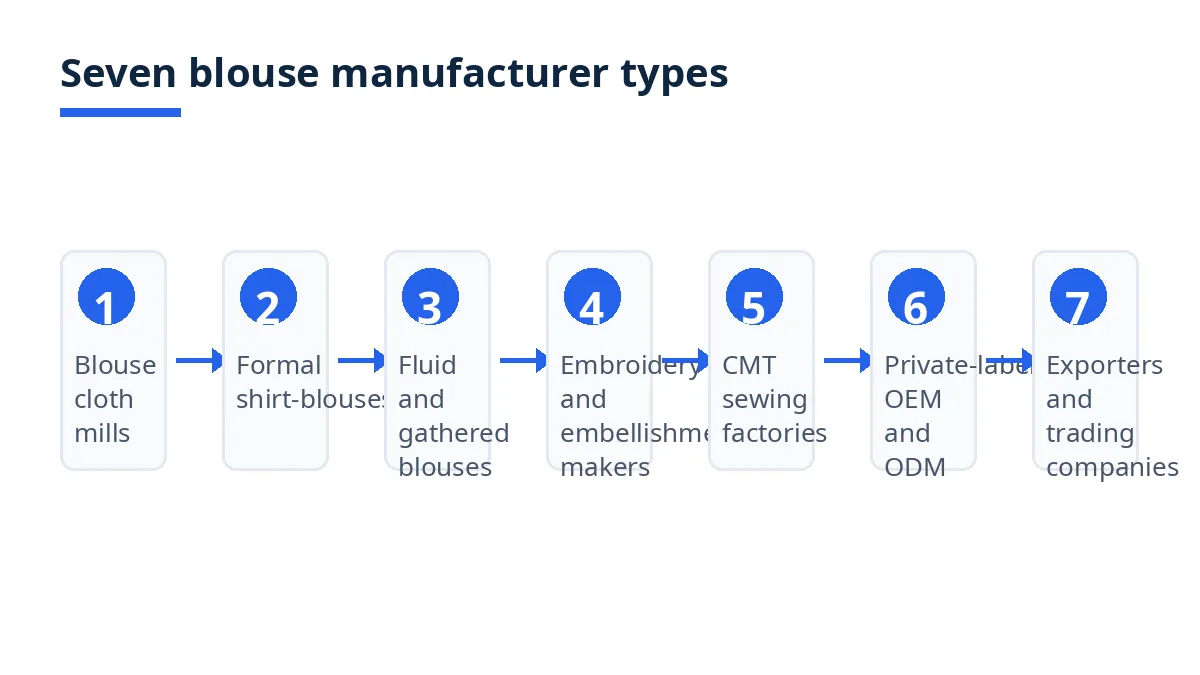
Women's blouses manufacturers in Bangladesh fall into seven types: blouse cloth mills, formal shirt-blouse specialists, fluid and gathered blouse makers, embroidery and embellishment-led makers, CMT sewing factories, private-label OEM and ODM suppliers, and exporters and trading companies. Match the type to your fabric drape, neckline and sleeve construction, embellishment and grading needs, then test a washed, graded sample and agree inspection terms before paying.
On this page
Key takeaways
Blouses are woven garments in the main, and tariff notes define a blouse as a loose-fitting upper-body garment that may be sleeveless, with or without a neckline opening, and sometimes with a collar.
Woven garment exports earned US$4.614 billion in the first quarter of fiscal 2026-27, up 5.11 per cent year on year, within ready-made garment exports of US$10.578 billion, according to EPB data.
Blouse quality is decided at the neckline, sleeve, drape and embellishment points: collar symmetry, sleeve pairing, washed drape, embroidery tension and bead security are the checks that matter.
Women's grading is non-linear: bust, waist and hip increments grow from about 1 inch at smaller sizes to 2 inches at larger sizes, so approve a graded sample set, not only the base size.
Verification is a sequence the buyer runs: BGMEA member search, document review, a washed and graded sample in production cloth, and an agreed AQL inspection before payment.
A blouse is judged in wear, not on a hanger. In wear it reveals faults a flat sample hides: a neckline that pulls open when the wearer moves, a sleeve cap that creases at the armhole, a bust dart that ends a centimetre above or below the bust point, a gathered bodice that loses its softness after laundering, or beadwork that loosens along a seam. A buyer who sorts factories only by unit price will miss all five, because none of them is priced into a quotation.
Bangladesh exports woven garments at a scale that covers many blouse styles at once, and that breadth is part of the difficulty. Woven garment exports earned US$4.614 billion in the first quarter of fiscal 2026-27, up 5.11 per cent year on year, within ready-made garment exports of US$10.578 billion, according to Export Promotion Bureau (EPB) data.1 A buyer can check whether a company belongs to the sector trade body through the member search on the Bangladesh Garment Manufacturers and Exporters Association (BGMEA) site.2 The product itself is broadly defined in tariff terms: heading 6206 covers women's blouses, and the chapter notes describe a blouse as a loose-fitting garment covering the upper part of the body that may be sleeveless, with or without an opening at the neckline, and sometimes with a collar.3 That definition spans a stiff collared office blouse and a sleeveless gathered georgette top, so a shortlist built on the word blouse alone will mix factories whose skills barely overlap.
The entries below sort suppliers by capability, and they are types rather than named or ranked companies. A single factory may work in more than one type, and may bring in an outside unit for one stage of an order.
The list
1. Collared shirt-blouse workshops
These workshops live on structure: pointed or rounded collars, button plackets, yokes, cuffs and button stands, cut mainly from poplin, oxford and fine cotton blends. Their daily routine is interlining choice, fusing temperature and pressing sequence, all aimed at a collar that keeps its line through a working day and through laundering. A factory that sews many garment kinds can produce a shirt-blouse, yet it rarely holds the same collar standard across a full delivery, because collar work is only an occasional job on its lines.
Office, uniform and occasion shirt-blouses belong with this type, above all where every collar in a delivery must read as one standard. Judge the workshop on a laundered sample rather than a fresh one: wash it, press it, wash it again, then look for a collar point that has curled, a placket edge that has started to wave, or bubbling beneath the interlining. Published inspection criteria for blouses treat unmatched collar halves and sleeves that twist or fail to pair as major defects.4 Check the neckline at the ends of the size range as well as the middle, since a collar that sits cleanly at a medium size can gape or bind at the smallest and largest sizes.
2. Fluid, gathered and bias-cut blouse makers
This type works with cloth chosen for movement: georgette, crepe, chiffon, viscose and soft rayon blends, cut on the bias or gathered into shape. Its vocabulary is softness rather than structure, with gathered necklines, tiered bodies, peplum hems, smocked bodices and full sleeves in bishop, balloon and flutter forms.
Relaxed, resort and occasion blouses fit here, especially where the fall of the fabric after laundering is part of what the customer buys. Approval must therefore happen after washing, not before: launder the sample, measure it, and hang it to see whether the drape has thinned or stiffened. Look for gathers that bunch on one side, tier joins that sit at different heights, and a peplum hem that dips or rises around the body. Size grading deserves the same attention, because women's grading is non-linear: published wholesale grading guidance puts bust, waist and hip circumference increments at about 1 inch between smaller sizes, 1.5 inches in the mid-range and 2 inches at the larger end, with vertical length increments stopping entirely after size 14.5 Ask for the grade rule table with the tech pack and approve samples across the range, not only at the base size.
3. Embroidery, lace and embellishment workshops
Here the decoration bench is the factory: thread embroidery, sequin and bead work, lace insertion and edging, applique and smocking, applied to blouses the workshop sews or buys in. Its equipment and skill sit in digitised embroidery files, sequin and bead fixing, lace handling, and the wash testing that decorated cloth demands.
Festive, occasion and boutique blouses belong with this type, above all where the decoration is the reason the customer chooses the garment. Approve a struck-off sample of the artwork stitched on the production cloth, not on a substitute fabric, and wash that decorated sample before signing it off. Check embroidery tension, bead and sequin security, and lace joins after washing, since published blouse inspection criteria list broken beads and sequins and incorrect embroidery stitch tension as major defects.4 Settle who owns the embroidery files and lace patterns if the buyer later moves to another supplier, and agree a tolerance for where each motif sits on the garment.
4. Blouse cloth mills and drape-led suppliers
A mill in this type weaves or sources the blouse cloth itself: cotton voile and lawn, georgette and crepe, satin, chiffon and poplin, in solids, yarn-dyed checks and printed designs. Some mills sell cloth only and leave sewing to the buyer. Others sew through partner factories and quote a finished blouse, with the cloth and its drape as the main selling point. In either case the decisive stage is the cloth: weight, opacity, hand feel and wash behaviour are set here, and no sewing stage restores drape the cloth never had.
This type suits a buyer building a range around one fabric story, or needing the same voile or georgette to read consistently across several blouse styles. Put fibre content, weave, weight, width, dye method and finish in figures on the order, ask for a lab dip against the buyer's shade reference, and wash-test the bulk cloth sample for shrinkage and for change in drape. Where a mill sews through a partner, name that sewing factory in the order and judge its neckline and sleeve work from its own samples, since strong cloth says nothing about how a sleeve cap is set.
5. Cut, make and trim (CMT) blouse factories
A CMT factory cuts and sews blouses from cloth the buyer supplies, or buys cloth to the buyer's specification, and carries no weaving or dyeing operation of its own. Its strength is pattern work, cutting, sewing and pressing, and it is judged on how it handles bias pieces, gathers and delicate fabrics without stretching them out of shape.
Smaller or mixed blouse programs suit this type, as do buyers who already hold cloth stock and buyers testing a new style before larger volumes. Because cloth quality stays the buyer's responsibility, inspect each lot before cutting and record shade, width, weight and weaving faults lot by lot, so a fault found after cutting can be traced to one lot rather than debated in general terms. Settle in advance who bears the cost if a lot fails once cutting has begun, and approve a pre-production sample from the bulk cloth, washed as the shipment will be.
6. Private-label OEM and ODM blouse suppliers
Private-label supply comes in two different deals, and confusing them causes most ownership disputes. In a buyer-designed deal, the factory sews a blouse the buyer has already patterned, graded and specified, so the buyer carries the development work and keeps the pattern. In a supplier-designed deal, the factory presents blouses it has already developed, and the buyer selects styles to carry under its own name, which cuts development time but leaves pattern rights to be settled in writing. The choice shapes who corrects a faulty dart or sleeve, and who may reuse the pattern afterwards.
Own-label buyers should test the deal on its weakest point. For buyer-designed work, the counter-sample must be measured against the tech pack point by point, with dart position, sleeve cap ease and neckline depth checked at more than one size. For supplier-designed work, ask whether the patterns on offer were developed by that factory, and put graded-pattern ownership in writing before the first bulk order. Approve samples at the smallest and largest sizes in both deals, and use a jump set, alternating sizes through the run, to catch grading slips without sampling every size.5
7. Exporters and trading companies
A trading house holds no sewing lines of its own. It buys blouses from partner factories, bundles styles that no single factory would take together, and manages the export paperwork on the buyer's behalf. That bundling is the whole offer: one agreement can cover a collared shirt-blouse, a gathered georgette style and an embellished occasion blouse, where three separate factory contracts would be slower to arrange.
Buyers ordering several blouse types at once, buyers whose quantities are too small or too mixed for one factory, and buyers who want a single point of contact across a range fit this type. The safeguard is written and specific: put the name of the factory sewing each style in the order document before any deposit is paid, and run the neckline, sleeve, drape and embellishment checks on that factory's work, not on the trading company's sales material.
A blouse quotation is built from its construction, not from its category. Cloth, cutting, sewing, decoration, trims, packing and testing each carry their own cost, so compare quotations part by part on an identical specification. Example figures: a second embroidery placement can add a separate digitising and stitching charge, while splitting one cloth across several colours can add a dye-lot charge per colour, and neither illustration means anything unless the cloth, the construction and the packing are the same. On Exportain, versioned quotations state unit price, MOQ, lead time, Incoterm, payment terms and validity, so factories can be compared on the same fields.6 For how minimum order quantity works across a range, read MOQ in the supply chain.
Summary table
Type | Suits | Decisive check |
|---|---|---|
Collared shirt-blouse workshop | Office, uniform and occasion shirt-blouses | Twice-laundered collar and placket sample, necklines graded |
Fluid and gathered maker | Relaxed, resort and occasion blouses | Washed drape, even gathers, non-linear grade table |
Embroidery and embellishment workshop | Festive, occasion and boutique blouses | Decorated wash test, bead security, motif placement |
Blouse cloth mill | Fabric-led ranges, matched drape across styles | Numbered cloth specification, lab dip and washed drape test |
CMT blouse factory | Smaller runs, buyer-supplied cloth | Cloth lot inspection before cutting |
Private-label OEM / ODM | Own-label brands and retailers | Tech pack match, graded sample set, pattern ownership |
Exporter / trading company | Mixed orders, one contract | Producing factory named in writing |
How Exportain helps
Exportain is a B2B marketplace for sourcing from Bangladesh, where buyers can search supplier listings, filter by badge, MOQ and OEM or ODM capability, and send one blouse specification to several suppliers as a request for quotation.6 Treat any badge as an opening filter only: verification on Exportain is a document and photo review by the Exportain team, not a factory inspection, and membership alone never grants a badge.7
FAQs
What is the biggest mistake?
Choosing a supplier by the quoted price before checking which blouse capability the quote buys. A CMT factory quoted on buyer-supplied cloth, a trading company quoting another factory's capacity, and an embellishment workshop quoting its own embroidery bench are three different offers, and a fluid georgette blouse sent to a factory that only sews structured poplin will fail on drape no matter how low the quote is. Compare the same specification from the same type of supplier, then verify the one chosen.
How can I avoid it?
Write one specification covering cloth and drape, neckline and sleeve construction, embroidery or embellishment, dart placement, the grade rule table and packing, and send the identical document to every supplier quoted. Name the producing factory in the order terms, approve a washed and graded pre-production sample set, and set the inspection standard in writing before production starts. ISO 2859-1 specifies sampling schemes indexed by AQL for lot-by-lot inspection, so an inspector can accept or reject a shipment against a published rule instead of an opinion.8
Who is responsible?
The split follows the paperwork. A factory answers for sewing to the specification and the sealed sample it approved. A buyer answers for writing a specification that can actually be checked, and for inspecting the shipment against it before it leaves. If the two sides disagree later, the written specification, the sealed samples and the inspection report decide the argument, not recollection of a phone call.
Where can I get help?
Start with the records that exist: the BGMEA member search for registration,2 the certificate issuer for any audit or fibre claim, and an inspection provider for the pre-shipment check. On Exportain, read what each profile badge covers before relying on it, since verification is a document and photo review rather than a factory inspection.7 The women's blouses quality control checklist turns the checks in this guide into garment-level items.
Next steps on Exportain
Start from the specification in this guide and post a free RFQ stating blouse style, quantity, destination and Incoterm, then weigh the versioned quotations side by side. Before committing, read how supplier verification works on Exportain to see what each badge does and does not cover, and browse Bangladeshi suppliers filtered by badge, MOQ and OEM or ODM capability. For order sizes, see MOQ in the supply chain.
Sources
- Merchandise exports rise 6.34pc to $13.09b in Q1 FY27: EPB. The Financial Express, (accessed )
- BGMEA | Home. Bangladesh Garment Manufacturers and Exporters Association (BGMEA) (accessed )
- Commodity code 6210500000: Other women's or girls' garments - UK Integrated Online Tariff. GOV.UK (accessed )
- Statistical Inspection - Inspection Criteria for General Merchandise. Clothing Technology Digest (accessed )
- Women's Clothing Size Grading for Wholesale Collections: From Sample to Production. Limay Fashion (accessed )
- How to source and buy from Bangladesh. Exportain (accessed )
- Supplier verification: Earn trust badges buyers can see. Exportain (accessed )
- ISO 2859-1:2026 — Sampling for Inspection by AQL. American National Standards Institute (ANSI) (accessed )
About the author
Sourcing from Bangladesh?
Post a request for quotation and suppliers on Exportain can send you their quotes directly.
Post an RFQ