Custom Tank Tops Manufacturer in Bangladesh: OEM Process From Tech Pack to Bulk
A cut-and-fit OEM guide to custom tank tops from Bangladesh: fit blocks, rib, jersey and slub fabric choice, dye and print development, cut and pre-production approval, bulk production, inspection and shipment.
Short answer
Custom tank top manufacturing in Bangladesh under an OEM arrangement runs from a tech pack that fixes the fit block, armhole and neckline, through washed fabric choice, dye and print development on the bulk fabric, cut and pre-production sample approvals, bulk cutting and sewing, and inspection against a sealed sample before shipment. Each stage ends with a written approval, so a fault in an opening, a colour or a print is found while it can still be corrected.

On this page
Key takeaways
A custom tank top OEM order is a cut-and-fit order first: the fit block, armhole depth and neckline shape are fixed in the tech pack and tested across the full size range before bulk cutting.
Fabric is chosen on washed samples, with rib for stretch and recovery at openings, plain jersey for a clean print surface, and slub only after its texture and dye variation are approved on a larger cut piece.
Dye lab dips and print strike-offs are approved on the actual bulk fabric, because a colour or print approved on a swatch can shift on rib, jersey or slub.
The pre-production sample in bulk fabric, colour, binding, print and labels is the reference bulk is judged against, so no bulk cutting starts before it is approved in writing.
Exportain verification is a document and photo review, not a factory inspection, so cut approval, print approval and inspection stay with the buyer.
A single line on a purchase order that reads "tank top" usually hides two different garments. One is cut close to the body, with a high armhole and a narrow strap, for training or sport. The other hangs looser, with a lower armhole and an easier drape, for everyday wear. Pattern, marker, grading and often cloth change between those two versions, even when colour and print stay the same. Treating them as one order, with one pattern and one approval, is where most tank-top problems begin. This guide therefore starts by splitting the range, then works through cloth, colour, print, cut and inspection in sign-off order.
Bangladesh is a practical place to place that split order, because the knitwear base is deep. BKMEA, the knitwear trade association founded in 1996, lists about 2,540 member factories.1 Ready-made garment exports reached $10,578.56 million in July to September 2026, with knitwear accounting for $5,963.76 million, up 6.88 percent year on year, according to Export Promotion Bureau data reported in the press.2 Several factories can quote the same tech pack, and the buyer still has to find which one holds an armhole shape, a neckline rib and a print result across a full size range after washing.
Bangladesh-specific rules and tips
Settle classification and labelling before any cloth is ordered, because both follow the finished garment's fibre mix. Heading 6109 covers T-shirts, singlets and other vests, knitted or crocheted, with cotton under 610910 and other textile materials under 610990.3 A blend change between sample cloth and bulk cloth can move the line and the label together. For EU sales, Regulation (EU) No 1007/2011 requires the name and percentage by weight of all constituent fibres, in descending order.4 Ask for the fibre split on the bulk cloth, in writing, not the split on an early sample.
Treat an association claim as a starting point for a check, not as evidence about cutting. If a candidate says it belongs to BKMEA, confirm that claim with the association itself, then judge the factory on its own cut trial, dye route and print result.1 Membership describes a business in the knitwear sector, not whether its armhole curve suits a close athletic block or a relaxed casual block.
Ask, early, where dyeing and printing actually happen. A factory with its own dye and print lines can usually give firmer dates for lab dips and strike-offs and repeat a shade or print run without waiting on another workshop. A factory that sends cloth out depends on that workshop's queue, so a delay there delays the whole order even when cutting is on schedule.
Keep one legal name on every paper from the first quotation to the last shipment document. The export declaration names the exporter and the foreign buyer,5 and a mismatch between trade licence, quotation, proforma invoice and payment account creates a problem when goods are ready to load. Align the names before bulk production starts.
Why this matters for buyers and sellers
For a buyer, a tank top is unforgiving because the parts most likely to fail are the parts the wearer feels first: a neckline rib that loses recovery after washing will gape, an armhole binding that rolls will rub, and a strap that twists in the wash will sit unevenly no matter how accurate the body length is. None of those faults shows clearly in a flat photograph, and none is fixed by a lower unit price. Each point therefore has to be tested on a real garment, in bulk cloth, after washing, before the bulk run is cut.
For a seller, the same discipline protects the cutting plan. Tank panels are small and the marker is tight, so a late change to strap width, armhole depth or the size ratio forces marker, binding length and trim quantities to be reworked together. A factory receiving signed decisions in sequence can schedule knitting, dyeing, printing and sewing around fixed quantities. A factory receiving changes mid-bulk must choose between stopping the run and carrying a fault into finished stock.
Step-by-step: how it works
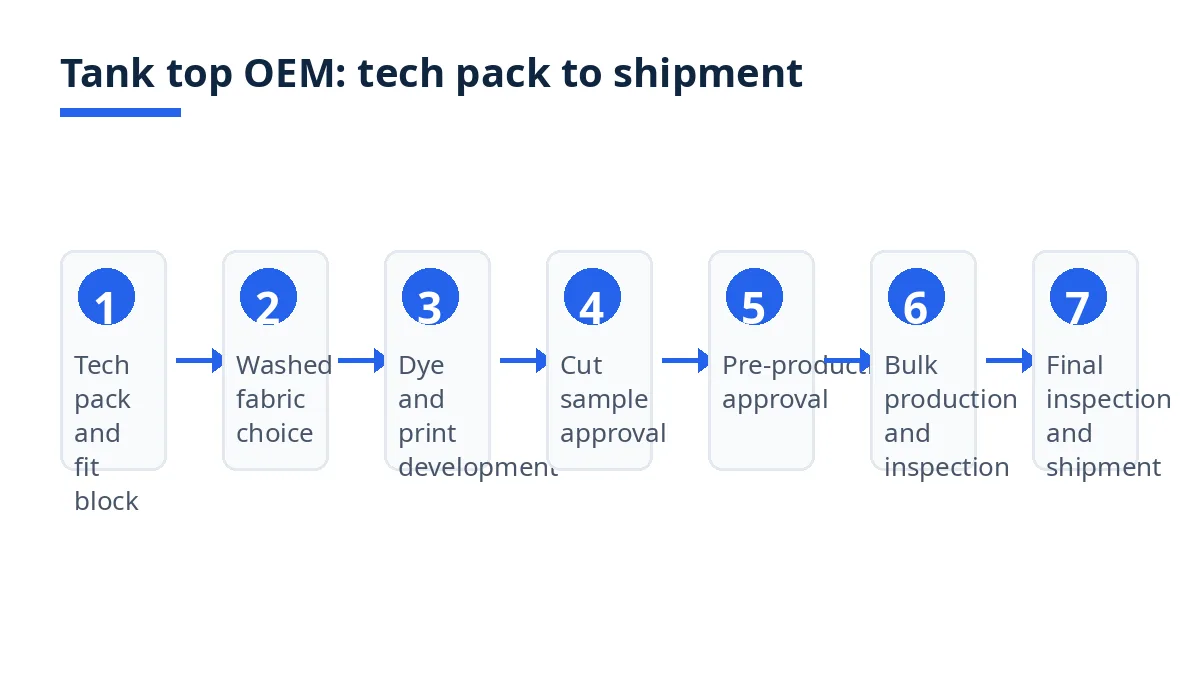
Split the range into fit blocks before writing the pack. Name each block, athletic or casual, and give it its own size chart, grading, armhole depth and shape, neckline shape and depth, strap width, body length per size, hem finish and binding method. Two blocks mean two patterns and two markers, even where cloth and colour match. One combined pack produces quotations that cannot be compared.
Trial the cloth washed, and record the result per block. Ask for washed pieces of each candidate cloth and test them as worn: stretch the neckline rib and watch it recover, pull the armhole binding and check it lies flat, and wash the piece before judging feel or shade. Rib suits openings that must stretch and spring back, which fits a closer athletic block. Plain jersey gives a flat ground for print and suits a casual block. Slub texture breaks up print and takes dye unevenly, so judge a slub colour on a larger cut piece, and record composition, construction and weight for the cloth chosen.
Develop colour and print on the bulk cloth itself. A shade or artwork approved on one cloth does not carry across to another, because rib, jersey and slub absorb dye and hold ink differently. Ask for a lab dip for every dyed colour and a strike-off for every print, each on the actual bulk cloth, signed off in writing. Watch print under stretch: a design clean flat on jersey can crack across rib when pulled on, and fragment across slub texture.
Run a graded cut trial, not a single-size sample. The factory cuts a trial from the pattern to test openings, strap and body length. Try it on, measure armhole and neckline against the size chart, wash it, and return corrections with measurements. Check smallest and largest sizes as well as middle sizes, because an armhole that sits well in a medium can gape in the largest size and bind in the smallest. A cut sign-off here covers pattern and openings only, nothing yet about bulk cloth, shade, print or labels.
Hold bulk cutting until a sealed reference garment exists. The pre-production sample is made in bulk cloth, approved colour, binding or rib trim, print and labels. Wash it, wear it, measure the openings again, and check print and label wording against the agreed text. Keep one sample sealed as the inspection reference and attach the written sign-off, with photographs, to the purchase order.
Track bulk in stages, and inspect mid-run. Bulk moves through knitting, dyeing and printing where applicable, cutting by marker, sewing, binding or rib work at neckline and armholes, finishing and packing. Ask for reports at cloth-ready, cutting-complete and sewing-complete points, with quantities per colour, and agree a mid-sewing inspection while an opening fault can still be corrected on pieces not yet sewn. Write the inspection plan, sample size and acceptance and rejection thresholds into the purchase order before production starts, with defect classes for armhole, neckline, strap, print, measurements and labels.
Release only a lot that passes final inspection. Final inspection compares the finished, packed lot with the sealed sample, the size chart and the agreed plan. A lot that fails stays held, even if the shipping date is close, because an opening or print fault found at this point is already sewn into every piece in the lot.
Costs, timelines and documents
No guide can state a typical tank-top cost or lead time as a fact, because the price follows the buyer's choices: fit block, cloth, dye lots, print set-up, binding and label runs, packing and delivery term. Development and set-up lines should appear apart from the unit price, the split shown per style, colour and size, and quotations compared only on the same delivery term and named place. The Incoterms 2020 rules set out 11 rules with a clear allocation of cost, risk and obligations,6 so a cheaper quotation on a different term is a different offer, not a saving.
Line | What it covers | How to ask for it |
|---|---|---|
Pattern and cut development | Fit blocks, grading, cut trial, corrections | One line per fit block |
Dye development | Lab dips per dyed colour on bulk cloth | One line per colour, cloth named |
Print set-up | Screens and strike-offs per artwork | One line per artwork, cloth named |
Pre-production sample | Reference garment in bulk cloth, colour, print, labels | One line, sealed sample kept |
Unit price | Cloth, cutting, sewing, binding, finishing, packing | Split per style, colour, size |
Delivery term | Cost and risk up to the named place | Same Incoterms 2020 rule, named place, every quote |
Ask for dates as separate lines rather than a single delivery week: tech-pack confirmation, washed trials, lab dips, strike-offs, cut trial, pre-production sample, cloth ready, bulk production, inspections and shipment. Example figures: washed trials of 7 days, lab dips of 5 days, strike-offs of 7 days, a graded cut trial of 9 days and a pre-production round of 11 days add to 39 days (7 + 5 + 7 + 9 + 11 = 39) before bulk cutting. Example figures: set-up lines of 150 dollars for pattern and cut work and 160 dollars for print screens add to 310 dollars (150 + 160 = 310). Spread over 4,000 pieces, the example figures give 0.0775 dollars per piece (310 divided by 4,000 = 0.0775). Example figures only, not a market price; set-up lines already paid for should not recur on a repeat order unless fit block, cloth or artwork changed.
File together the pack, the quote, the purchase order, and, for every stage, the signed note with its photo and the inspection paperwork. For shipment, the export set accompanies the Bill of Export and includes the commercial invoice, packing list, EXP form certified by an authorized dealer, and a certificate of origin issued by the EPB or a Chamber of Commerce and Industry.5
Mistakes and red flags
Signing off one size and assuming the range. An armhole approved only in a medium has not been approved where it is most likely to fail, at the smallest and largest sizes.
Judging colour or print on a swatch. A small swatch hides how dye takes across slub texture and how print ink sits on rib under stretch. Judge both on bulk cloth, at a size large enough to show the fault.
Cutting bulk from the cut trial alone. The cut trial proves the pattern, not bulk cloth, shade, print or labels, and bulk cut without a sealed reference has no standard for inspection.
Accepting a change by voice or message alone. A verbal change leaves no record, and a later dispute turns on who said what rather than on measurements and photographs.
Comparing quotations that describe different garments. A quote on a different fit block, cloth, print method or delivery term is a quote for a different order.
Mistaking a badge for a garment approval. A badge summarises past profile checks; your pattern, print and finished lot still need their own sign-offs.
Checklist
Range split into athletic and casual fit blocks, each with its own size chart, grading, armhole, neckline and strap specification.
Cloth chosen from washed trials, rib, jersey or slub recorded with composition, construction and weight, per block.
Colour and print signed in writing per colour and artwork, both judged on bulk cloth.
Cut tested across the range, smallest to largest, with try-on, wash and written corrections.
Reference garment signed in writing, with photographs: bulk cloth, colour, binding, print and labels, with one kept sealed.
Purchase order carrying the split per style, colour and size, inspection plan, sample size, acceptance and rejection thresholds, and defect classes.
Three reporting moments set in the order: cloth ready, cutting done, sewing done, plus a check halfway through sewing.
Only price replies that state fit block, cloth, artwork and the Incoterms rule with its named place.6
Hold every lot until its final check against the sealed reference passes, and only then release it.
Sort the shipment papers early, and use a single trading name on every document.5
How Exportain helps
On Exportain, browse suppliers and post a request for quotation on the RFQ board with a summary of the tech pack, fit blocks, cloth choice, dye and print requirements, split per colour and delivery term, so replies quote against the same specification. Ask each reply to state its cut development steps, dye and print route, and stage reporting points, and read how supplier verification works on Exportain alongside the MOQ definition guide. Verification on Exportain is a document and photo review by staff, not a factory inspection,7 so cut, print and inspection sign-offs remain the buyer's responsibility.
FAQs
What should I know first about tank tops?
Know that one product name covers two different patterns. An athletic block and a casual block need separate grading, armhole shapes and strap widths, and cloth, dye and print decisions should be made per block, not once for the whole range. Tank tops fall under heading 6109, cotton under 610910 and other materials under 610990,3 and EU labelling requires fibre names and percentages in descending order.4
What are the typical costs and timelines?
There are no reliable typical figures, because each factory prices the buyer's fit block, cloth, dye lots, print set-up, binding and label runs, packing and delivery term. Ask for development lines apart from the unit price, and for each stage date separately, rather than one delivery week.
Which documents are needed?
The order needs the tech pack, itemised quotation and purchase order, written sign-offs for dye, print, cut and pre-production with photographs, and the inspection plan and reports. The shipment papers sit with the Bill of Export and include the invoice, packing list, EXP form and certificate of origin.5
What are the most common mistakes?
The most common mistakes are signing off one size and assuming the range, judging colour or print on a swatch, cutting bulk from the cut trial alone, accepting changes verbally, comparing quotations for different garments or delivery terms,6 and reading a badge as a substitute for sample approval or inspection.7
Next steps on Exportain
Post the pack summary with its two fit blocks and chosen cloth on the RFQ board after browsing suppliers, so every quote answers the same specification. Before confirming an order, read how to import tank tops from Bangladesh.
Sources
- BKMEA at a Glance. BKMEA (accessed )
- RMG exports rise 6.10pc to US$10.58b in July-Sept of FY27. The Financial Express, (accessed )
- Classification Detail — HS Code 6109. United Nations Statistics Division (accessed )
- Regulation (EU) No 1007/2011 on textile fibre names and related labelling and marking of the fibre composition of textile products. European Union, (accessed )
- Customs Clearance Procedures for Export. Bangladesh Customs, National Board of Revenue (accessed )
- Incoterms® 2020. International Chamber of Commerce (ICC) (accessed )
- Supplier verification: Earn trust badges buyers can see. Exportain (accessed )
About the author
Sourcing from Bangladesh?
Post a request for quotation and suppliers on Exportain can send you their quotes directly.
Post an RFQ