Custom Socks Manufacturer in Bangladesh: OEM Process From Tech Pack to Bulk
A stage-by-stage OEM guide to custom socks from Bangladesh: knitting program and gauge setup, heel and toe sampling, toe-linking, boarding, pairing and dozen packing, with the costs, timelines and documents to agree in writing.
Short answer
A custom socks OEM order in Bangladesh runs on circular knitting machines: you send a sock tech pack, the factory programs the knitting pattern and sets the gauge, then knits samples for heel and toe approval, links the toes, boards and pairs the socks, and packs them by the dozen. Each machine stage has its own approval and failure mode, so agree the gauge, toe method, size forms and packing in writing before bulk knitting starts.
On this page
Key takeaways
A custom socks OEM order is a machine program, not a cut-and-sew pattern: the gauge setup, heel shaping, toe-linking method and boarding forms decide fit, and each stage needs its own written approval.
Approve three samples before bulk knitting: the knitting sample for loop structure and colour, the heel and toe samples for shaping, and the pre-production pair in bulk yarn, linked, boarded, washed and paired.
Gauge drift, missed toe links, boarding size mismatch and pairing mismatch are the sock-specific failure modes, so check loop length at the start of bulk knitting and inspect pairs, not single socks.
Costs and timelines are quoted line by line per machine stage, with program set-up, sampling and linking lines apart from the unit price, and quotations compared only on the same gauge, toe method and delivery term.
Exportain verification is a document and photo review, not a factory inspection, so gauge capability, linking route and boarding forms must be confirmed with the supplier directly.
A custom sock order does not start on a cutting table. It starts on a circular knitting machine, where the sock is knitted as a tube with the toe left open, and the yarn is fed into the machine and knitted around the cylinder.1 That shapes the whole OEM process: the specification is a knitting program and gauge setup, not a paper pattern, and the risks sit at toe closure, heel shape and finished size after boarding.
Socks sit inside the knitwear sector. The Bangladesh Knitwear Manufacturers and Exporters Association (BKMEA), established in 1996, is the apex trade body for the knitwear sector, representing approximately 2,540 member factories.2 Knitwear exports reached $5,963.76 million in July to September 2026, up 6.88 percent year on year, within ready-made garment exports of $10,578.56 million, per Export Promotion Bureau (EPB) data.3 Many factories there can knit socks, but only the machine setup for your gauge, yarn and foot size decides whether one can knit yours.
Why this matters for buyers and sellers
For the buyer, sock-order risk sits in fit and feel on the foot. Heel pocket depth decides whether the sock stays put, the toe closure decides whether a ridge can be felt in the shoe, and washed length decides whether the size still matches its boarding form. None of those can be judged from a photograph of an unlinked tube. Each stage below tests one part of that risk while correction is still cheap: the program fixes loop structure, the heel and toe samples test shaping, the linked-toe sample tests closure, and boarding tests finished size.
For the seller, the sequence protects machine planning. A gauge change means resetting the cylinder and the program, a yarn change means re-testing loop length and tension, and toe-linking is a separate workstation from knitting. A late change therefore re-programs the machine, re-knits the sample and re-books the linking line. Written approvals at knitting, heel and toe, and boarding stages give the factory a schedulable program.
Step-by-step: how it works
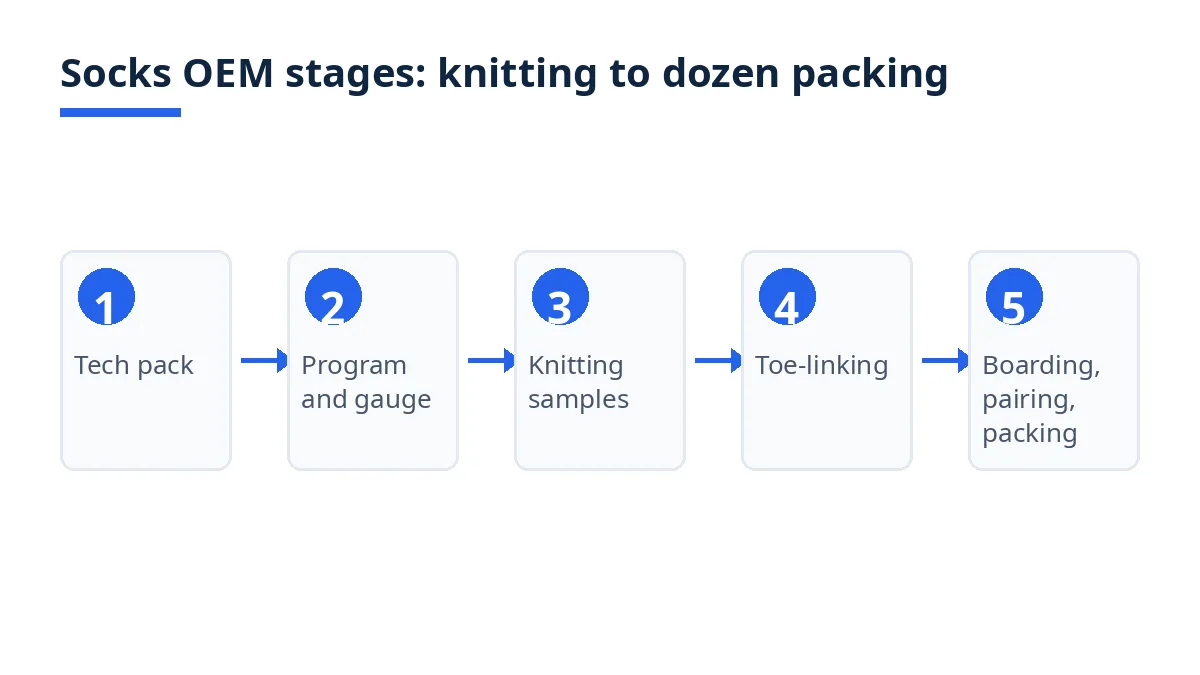
Send one sock tech pack to every candidate. State sock type and length, yarn composition and count, gauge, cuff and elastic, heel and toe construction, foot length per size, colour and pattern repeat, toe closure method, label wording, pairing rule and dozen packing, plus delivery term. One identical pack makes quotations comparable: a quote on a different gauge or toe method is a quote for a different sock.
Agree the knitting program and gauge setup before any sample is knitted. The knitting machine has a cylinder with 84 to 200 knitting needles surrounding it.1 Ask the factory to confirm in writing cylinder and needle count, gauge setting, yarn feed and loop length. Gauge drift is the quiet failure of sock orders: a small loop-length change alters fabric density and finished size after boarding, even when the program name is unchanged.
Approve the knitting sample. The factory knits a first sample from the program to test loop structure, colour and pattern. Coloured socks are either dyed after knitting or knitted with previously dyed yarn, called in-grain yarn.1 Record each colour's route: it decides the dye lot, colour matching method and earliest bulk date.
Approve the heel and toe samples separately. The heel is shaped during knitting; the toe is knitted open and closed afterwards. Measure heel depth, foot length and leg length, and check the toe area before closing. A shallow heel slips in wear, and a toe shape approved only on paper cannot be corrected once linking starts.
Confirm the toe-linking method in writing. After the socks are knitted, the toe seams must be closed, and the sock goes to the seaming area where the toe opening is sealed.1 The common routes are automatic and hand linking. Hand linking joins the toe with a single thread so the closure sits flat, which suits a sock where toe feel matters most. State method, thread and inspector: the toe is the part the wearer notices first.
Run bulk knitting with stage checks, not a single end check. Ask for reports at yarn-ready, knitting-complete and linking-complete points, per colour and size. Check loop length and gauge at the start of the bulk run against the approved sample, because a gauge drift found after linking is already built into every pair.
Board, pair and pack by the dozen. After knitting and seaming, washing and drying remove knitting oils and residue and help with shrinkage and stabilisation.1 They are then pulled onto flat metal foot forms, called boarding, formed to shape and size and steam pressed flat.1 Pairing follows boarding: even socks produced from the same machine, using the same yarn and settings, can vary slightly, so pairing matters for consistency at distribution.1 State pairing rule and dozen and carton counts.
Inspect, then ship. Inspect the boarded, paired and packed lot against the approved pre-production sample, size forms and agreed sampling plan. ISO 2859-1 defines acceptance sampling plans for inspection by attributes, indexed by acceptance quality limit (AQL) for lot-by-lot inspection.4 AQL is the maximum average percentage of defective items considered acceptable during random sampling, and it determines sample sizes and acceptance or rejection thresholds.4 Put the inspection level, AQL values and defect classes for toe closure, heel shape, measurements, pairing and packing in the purchase order before bulk knitting starts.
Stage | What you approve | Failure mode it catches |
|---|---|---|
Program and gauge | Cylinder, needle count, loop length | Gauge drift, size drift |
Knitting sample | Loop structure, colour, pattern | Wrong dye route, pattern error |
Heel and toe samples | Heel depth, foot length, toe shape | Heel slippage, toe faults |
Toe-linking method | Linking route, thread, inspector | Ridges, missed loops, open toes |
Boarding | Foot forms per size, steam press | Size mismatch after washing |
Pairing and packing | Pairing rule, dozen and carton counts | Mismatched pairs, short cartons |
See the socks quality control checklist.
Costs, timelines and documents
What are the typical costs and timelines?
There are no typical costs or timelines a guide can state as fact: each factory prices your yarn, gauge, machine time, linking method, boarding forms, pairing labour, dozen packing and delivery term. The structure is what can be stated: program and gauge setup, sampling and linking set-up sit apart from the unit price, and the split per colour drives dye and yarn cost. The Incoterms 2020 rules set out 11 rules with a clear allocation of cost, risk and obligations,5 so compare quotations only on the same term and named place.
For timelines, ask for separate dates, not one delivery week: tech-pack confirmation, program, knitting sample, heel and toe samples, pre-production sample, yarn ready, bulk knitting, linking, boarding and pairing, inspection and shipment.
Example figures: a knitting sample round of 7 days, a heel and toe correction round of 5 days and a pre-production round of 10 days add to 22 days (7 + 5 + 10 = 22) before bulk knitting. Example figures: set-up lines of 150 dollars for the knitting program and 90 dollars for sample charges add to 240 dollars (150 + 90 = 240). Spread over an order of 6,000 pairs, the example figures give 0.04 dollars per pair (240 divided by 6,000 = 0.04). These are example figures only, not a market price. On a repeat order, set-up lines already paid for should not be charged again unless the program or toe method has changed.
See the MOQ definition guide.
Which documents are needed?
The order documents are the tech pack, itemized quotation, purchase order with the split per style, colour, size and dozen count, written knitting, heel and toe approvals, written pre-production approval with photographs, inspection plan with AQL values4 and inspection reports. Keep every approval on the order thread.
For export clearance in Bangladesh, goods may not be loaded unless an export declaration, the Bill of Export or Shipping Bill, is submitted to and approved by Customs.6 Enclosed documents include the export contract or purchase order where there is no export letter of credit, the commercial invoice, the packing list, the EXP form certified by an authorized dealer, and a certificate of origin from the EPB or a Chamber of Commerce and Industry.6
Bangladesh-specific rules and tips
Settle the classification against the fibre, not the style name. Heading 6115 covers hosiery, including panty hose, tights, stockings, socks and other hosiery, knitted or crocheted.7 The subheading divides by fibre, so confirm the line against the actual yarn composition before printing the label: a blend change between sample and bulk yarn changes both classification and label.
Confirm the fibre label for EU sales. Regulation (EU) No 1007/2011 states that a textile product shall be labelled or marked with the name and percentage by weight of all constituent fibres in descending order.8 Settle fibre percentages at tech-pack stage: a correction after boarding costs a relabelling run.
Verify membership claims directly. A claim of BKMEA membership is a claim, not evidence: ask the association itself whether the factory is a current member.2 What that confirms is that the firm trades as a knitwear business — it says nothing about whether its gauges, linking or lead times fit your sock.
Ask which inputs are made in-house and which are bought in. A factory that runs its own linking and boarding lines controls those dates; a factory that sends socks out for linking or boarding depends on another workshop's schedule. Know which applies: a stage report is only useful for the stage that can actually slip. The export declaration names the exporter and the foreign buyer,6 so keep one legal name across the trade licence, quotation, proforma invoice and payment account.
Mistakes and red flags
What are the most common mistakes?
Approving bulk on the knitting sample alone. The knitting sample tests loop structure and colour, not the linked toe, the boarded size or the paired finish. Bulk knitted before pre-production approval in bulk yarn, with the agreed toe method and boarding forms, has no reference pair to inspect against.
Accepting the toe method verbally. A linked toe and a sewn toe feel different in wear and cost different amounts to run. Record method, thread and inspector on the quotation and purchase order, with the sample it applies to.
Skipping the size-set sample. A sock approved in one size is not approved in every size: boarding forms differ by size, and a gauge that holds in a medium form can drift in the smallest and largest forms. Approve the size set before bulk knitting.
Do not compare unlike quotations. A cheaper quote built on a coarser gauge, a sewn toe where you specified a linked toe, or a different delivery term is not a saving — it is a different product on different terms.5 Hold the tech pack, the delivery term and the named place constant, and only then compare prices.
Treating a profile or a badge as machine capability. A badge records checks already done; it does not prove a cylinder, gauge or linking line can knit your sock.
Skipping the pairing check to save time. Pairing matches two socks from the same machine for size and appearance.1 A lot that passes a single-sock check can still fail as pairs, and pairs are what the customer opens.
Checklist
Before you confirm, every line should be answered in writing.
Tech pack sent as one identical pack: yarn, gauge, heel and toe, cuff, sizes, toe method, dozen packing.
Program and gauge setup confirmed: cylinder, needle count and loop length for your yarn.
Knitting sample approved, with the dye route per colour recorded: dyed after knitting or knitted in-grain.1
Heel and toe samples measured and approved separately, per size.
Toe-linking method, thread and inspector on the quotation and purchase order.
Pre-production sample in bulk yarn, linked toe, boarded, washed and paired, approved in writing with photographs, and one sealed pair kept.
Inspection level and AQL values in the purchase order, with defect classes for toe, heel, measurements, pairing and packing.4
Stage reports agreed at yarn-ready, knitting-complete and linking-complete points.
Boarding forms, pairing rule, and dozen and carton counts confirmed.
Quotations compared on the same gauge, toe method and delivery term.5
Export set agreed: invoice, packing list, EXP form, certificate of origin, Bill of Export.6
One legal name across trade licence, quotation, proforma invoice and payment account.6
How Exportain helps
On Exportain, browse suppliers and post a request for quotation (RFQ) on the RFQ board with your tech pack summary, gauge, toe method, size forms, dozen packing and delivery term, so suppliers quote against the same specification. Ask each reply for cylinder and gauge capability, linking route and boarding forms per size. When you accept a quotation, Exportain creates one order and issues one proforma invoice from the accepted terms.9
Read badges for what they record only: verification is a document and photo review, not a factory inspection, and a badge is not a guarantee of capacity, quality or delivery.9 10 See how supplier verification works on Exportain before treating any badge as a capability check.
FAQs
What should I know first about socks?
A sock is knitted as a tube on a circular machine with the toe left open, then closed in a separate linking step.1 That makes program, gauge setup, heel shape and toe method the four decisions to settle first, before price or timeline. Socks fall under heading 6115, covering hosiery including socks, knitted or crocheted,7 with the subheading set by fibre.
What are the typical costs and timelines?
There are no typical figures a buyer can rely on: each factory sets price and lead time for your yarn, gauge, linking method, boarding forms, packing and delivery term.5 Ask for program set-up, sampling and linking lines apart from the unit price, and for sampling, yarn-ready, knitting, linking, boarding and inspection dates separately.
Which documents are needed?
Keep two bundles on file. The first proves what was agreed: tech pack, itemized quotation, purchase order, written knitting, heel-and-toe and pre-production approvals with photographs, and the inspection plan with its reports. The second proves the shipment: certificate of origin from the EPB or a Chamber of Commerce and Industry, EXP form certified by an authorized dealer, packing list, commercial invoice, and the Bill of Export.6
What are the most common mistakes?
The most common mistakes are approving bulk on the knitting sample alone, accepting the toe method verbally, skipping the size-set sample, comparing quotations on different gauges, toe methods or terms,5 and reading a badge as proof of machine capability.9 A badge is not a guarantee of capacity, quality or delivery.9
Next steps on Exportain
Browse suppliers, then post your tech pack summary, gauge, toe method and dozen packing on the RFQ board so suppliers quote on the same specification. Before you confirm, read how to import socks from Bangladesh.
Sources
- All about socks: From knitting to the finished product. Patra, (accessed )
- BKMEA at a Glance. BKMEA (accessed )
- RMG exports rise 6.10pc to US$10.58b in July-Sept of FY27. The Financial Express, (accessed )
- ISO 2859-1:2026 - Sampling procedures for inspection by attributes — Part 1: Sampling schemes indexed by acceptance quality limit (AQL) for lot-by-lot inspection. ISO (accessed )
- Incoterms® 2020. International Chamber of Commerce (ICC) (accessed )
- Customs Clearance Procedures for Export. Bangladesh Customs, National Board of Revenue (accessed )
- Classification Detail — HS Code 611522. United Nations Statistics Division (accessed )
- Regulation (EU) No 1007/2011 on textile fibre names and related labelling and marking of the fibre composition of textile products. European Union, (accessed )
- Trust & Safety Center. Exportain (accessed )
- Supplier verification: Earn trust badges buyers can see. Exportain (accessed )
About the author
Sourcing from Bangladesh?
Post a request for quotation and suppliers on Exportain can send you their quotes directly.
Post an RFQ