

Custom Kitchen Towels Manufacturer in Bangladesh: OEM Process From Tech Pack to Bulk
A gate-by-gate OEM guide for custom kitchen towels in Bangladesh: what the tech pack must contain, how proto, sales and pre-production samples differ, which bulk gates release production, and which tolerances to agree before cutting.
Short answer
A custom kitchen towel OEM order runs on written gates, not on a single approval. The buyer sends a full tech pack, approves a proto sample, a sales sample and a pre-production sample in the actual fabric and colour, then releases bulk only after fabric, in-line and final inspection gates pass against agreed tolerances. Each gate needs a written pass, correction or stop decision before the next stage starts.
On this page
Key takeaways
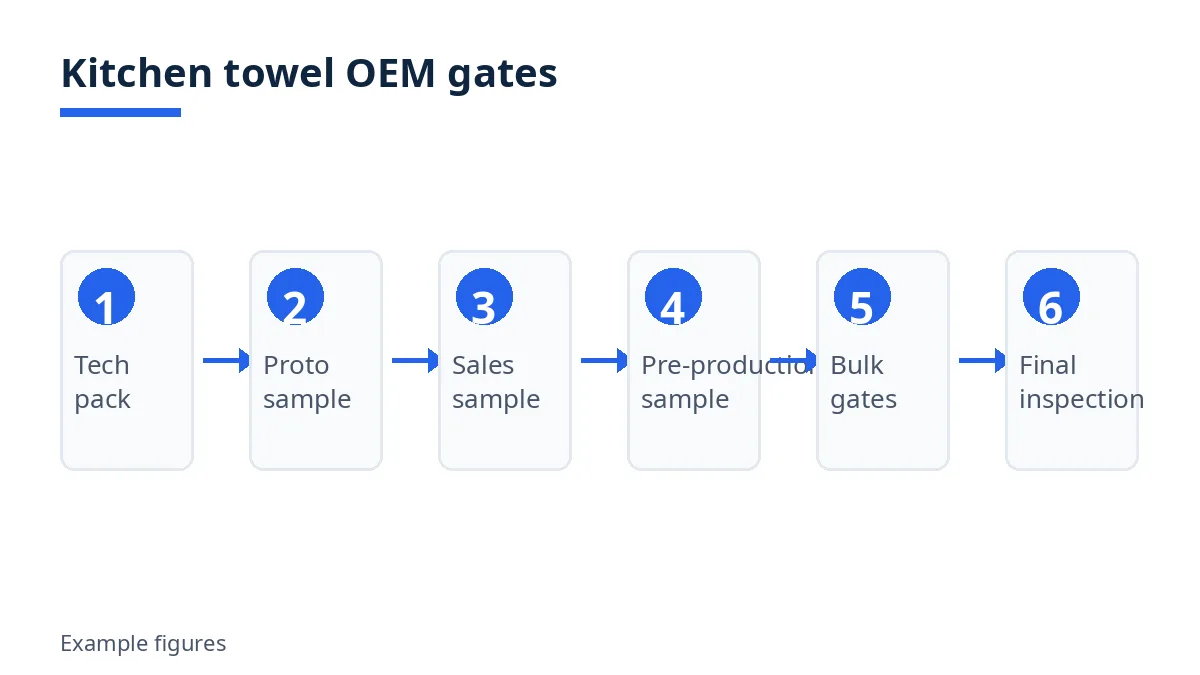
The OEM process is a sequence of written gates: tech pack, proto sample, sales sample, pre-production sample, then five bulk gates, and no stage starts until the previous gate is signed.
A kitchen-towel tech pack must state fabric, weave, weight, colour, print, hem, labels, packing, measurement and inspection, plus the HS 6302 classification for the exact construction.
Proto samples prove construction only; sales samples prove the selling product; only a pre-production sample in bulk fabric, colour, trims, labels and packing approves bulk.
Spec tolerances must be agreed in numbers before cutting, covering size, weight, hem, stitching, print placement, colour, wash change and lint, with a separate table per towel type.
Exportain verification is a document and photo review, not a factory inspection, and a badge is not a guarantee of production capacity, product quality or delivery.
A custom kitchen towel order is decided at gates, not at the first sample. A towel that looks right on a table can still shed lint on glassware, shrink out of size after washing, or bleed colour onto a white worktop. A working OEM process is therefore a sequence of written approvals: a tech pack that leaves no choice open, samples that prove one stage at a time, and bulk gates that stop a bad lot before it is packed.
This guide follows that process only. It does not cover brand building, retail pricing, or wholesale channels. Its question is narrower: what must be signed off before bulk starts.
The tech pack: what a kitchen-towel OEM pack must contain
A tech pack is the manufacturing instruction for one towel, written so that two factories quoting on it price the same product.
Tech pack section | State in writing |
|---|---|
Towel identity and use | Intended use and finished size, for example a drying towel at 45 x 70 cm, hemmed on four sides |
Fabric | Fibre, weave, and weight in grams per square metre, with a fabric swatch attached |
Colour and print | Colour reference, print method, artwork file, placement, and size |
Edge, hem, and labels | Hem width, stitch type, hanging loop, fibre and care labels, and barcode placement |
Packing and measurement | Pieces per pack, carton size and marks, measuring method, and tolerance per point |
Inspection | Sampling plan, defect list, and test methods for washing, colour, and lint |
Classification belongs in the pack from the start, because it decides the export paperwork. Heading 6302 covers bed linen, table linen, toilet linen and kitchen linen, and within it, toilet linen and kitchen linen of terry towelling or similar terry fabrics, of cotton, sits under subheading 6302.60, while other cotton kitchen linen sits under 6302.91.1 A waffle towel, a flat-weave tea towel, and a terry dish towel can therefore fall in different places, so confirm the subheading for the exact construction with the factory and the customs broker before bulk, rather than after the cartons are sealed. See the HS code for kitchen towels guide for the classification detail.
Labels also need a destination rule, not a guess. For the European Union, Regulation (EU) No 1007/2011 covers textile fibre names and the labelling and marking of fibre composition, and it requires the name and percentage by weight of all constituent fibres in descending order on a textile product.2 Put the fibre statement in the tech pack in that order, and require the factory to reproduce it exactly on the sewn-in label.
Why this matters for buyers and sellers
For the buyer, the gate sequence protects the repeat order. A restaurant supplier, a hotel group, or a homeware retailer reorders the same towel, and the second order must match the first in size, colour, hand feel, and wash behaviour.
For the seller, the same gates protect the factory. A factory that cuts bulk from an unapproved proto sample carries the rework when the buyer rejects the result.
Sampling stages: proto, sales, and pre-production
Sampling is three different samples, each answering a different question.
The diagram below shows the gate order. No stage starts until the previous gate has a written decision.
Stage | Made from | Question it answers |
|---|---|---|
Proto sample | Available fabric, close to specification, not necessarily bulk fabric | Can the factory make this construction, hem, and print at all |
Sales sample | Near-final fabric and colour, with final artwork and labels | Is this the product the buyer will sell, photograph, and list |
Pre-production sample | Bulk fabric, bulk colour, bulk trims, bulk labels, bulk packing | Is this exactly what bulk will be, made the bulk way |
The proto sample tests construction. Check the weave, the hem, the loop, and the print method against the tech pack.
The sales sample tests the selling product. Check colour under daylight, print clarity, label wording, and hand feel, and photograph it for the listing only after approval.
The pre-production sample is the bulk gate. It must be made from the bulk fabric lot, dyed to the bulk colour, printed or embroidered with the bulk method, sewn with the bulk hem, and packed in the bulk packing. Measure it, wash it, test it for lint on dark glassware, and check colour fastness against a white cloth.
Bulk approval gates: from fabric to packed cartons
Bulk approval is a second sequence, inside production. A signed pre-production sample does not remove the need for bulk checks, because bulk introduces new variables: a new dye lot, a longer print run, a different sewing line, and a longer packing run.
Fabric gate. Before cutting, check bulk fabric against the approved sample for weave, weight, colour, and width, and record the lot numbers.
Cutting gate. Check the first cut panels for size, shape, and print placement before the full run is cut.
In-line gate. During sewing, check hems, stitch density, loop placement, and label position on pieces taken from the line at intervals.
End-line gate. At the end of the line, check finished, unwashed pieces for measurement, appearance, print quality, and packing readiness.
Final inspection gate. Inspect a sample drawn from the finished lot against the agreed sampling plan and defect list, and test washed pieces for size change, colour fastness, and lint.
The sampling plan for the final gate should be agreed before bulk, not negotiated after a failure. ISO 2859-1 defines a system of acceptance sampling plans for inspection by attributes, indexed by acceptance quality limit (AQL) for lot-by-lot inspection, and AQL is the maximum average percentage of defective items considered acceptable during random sampling, which determines sample sizes and acceptance or rejection thresholds.3
Spec tolerances: agree the numbers before cutting
A tolerance is the amount of variation a buyer accepts around a stated value. Without tolerances, a factory cannot know whether a towel 1 cm short is acceptable, and a buyer cannot prove that it is not. Tolerances belong in the tech pack and the purchase order, in numbers, for every point that will be measured.
Example figures: the table below shows the fields to agree, with illustrative values only. These are not industry standards and not typical values. Replace every value with the figure agreed for the specific towel, in writing, before cutting.
Measurement point | Agree in writing |
|---|---|
Finished length and width | Measuring method, relaxed or stretched, and a stated centimetre tolerance each way |
Fabric weight | A stated grams-per-square-metre range around the target weight, and how it is measured |
Hem and stitching | Hem width and a stated millimetre tolerance, plus stitches per stated length |
Print placement and colour | Placement from each edge with a stated millimetre tolerance, checked under daylight against the approved sample |
Size after washing and lint | Wash method, number of washes, a stated percentage allowance, and a stated wiping test on a dark glass |
Two rules keep tolerances honest. First, a tolerance tighter than the factory can hold will be breached in bulk, so ask the factory to confirm each tolerance against its own cutting, sewing, and dyeing capability before signing. Second, each towel needs its own table: waffle, terry, and flat-weave towels shrink and print differently.
Costs, timelines and documents
What are the typical costs and timelines?
There are no typical costs or timelines for a custom kitchen-towel OEM order that a guide can state as fact. The price depends on the fabric and weave, the weight, the colour and dye method, the print or embroidery set-up, the hem and loop work, the label and packing specification, the quantity per colour, and the delivery term. The timeline depends on fabric availability, dyeing, correction rounds at each sample gate, bulk sewing capacity, and inspection.
Ask for costs and dates as separate lines, not as one total and one week: tech pack review, proto sample, sales sample, pre-production sample, fabric ready date, bulk production dates, inspection dates, and shipment date. For the quantity side, see the kitchen towels MOQ in Bangladesh guide.
One delivery term should apply to every quotation for the same order. The Incoterms 2020 rules set out 11 rules with a clear allocation of cost, risk, and obligations.4
Which documents are needed?
The order documents are the tech pack, the itemized quotation, the purchase order carrying the tolerances and the inspection plan, and the written approval for each sample gate.
For export clearance in Bangladesh, goods may not be loaded unless an export declaration, the Bill of Export or Shipping Bill, is submitted to Customs and approved.5 Enclosed documents include the export contract or purchase order where there is no export letter of credit, the commercial invoice, the packing list, the EXP form certified by an authorized dealer, and a certificate of origin issued by the EPB or a Chamber of Commerce and Industry.5
Bangladesh-specific rules and tips
Confirm the construction before the classification. A terry towel and a flat-weave towel sit in different subheadings under heading 6302, as set out above,1 and the wrong subheading creates a customs problem that no sample approval can fix. See the kitchen towels manufacturers in Bangladesh guide for supplier types.
Confirm label wording against the destination rule before printing labels. The EU fibre-content rule requires the fibre names and percentages in descending order,2 so a label that lists a minor fibre first, or omits a fibre, is wrong even if the towel itself is right.
Keep one legal name across every paper. The export declaration names the exporter and the foreign buyer,5 so the name on the trade licence, the quotation, the proforma invoice, and the payment account should match.
Mistakes and red flags
What are the most common mistakes?
Approving bulk from a proto sample. A proto sample proves construction only.
Approving a sample by photograph. Colour, hand feel, lint, and wash behaviour cannot be approved from a photograph.
Leaving tolerances unwritten. A towel that is "about the right size" cannot be inspected.
Accepting a correction verbally. A correction promised during production, without a new sample, becomes a bulk change that no one can check.
Treating a profile or a badge as a production approval. A supplier profile and a badge record document and photo checks, not the ability to make a specific towel.
Starting bulk before the fabric gate. Cutting from an unchecked fabric lot locks in a colour or weight error across the whole order.
Red flags include refusal to make a bulk-fabric pre-production sample, refusal to state tolerances, and a quotation with no separate set-up lines.
Checklist
Before bulk is released, every line below should be answered in writing and filed with the purchase order.
Tech pack complete: identity, fabric, colour, print, hem, labels, packing, measurement, inspection.
Classification confirmed for the exact construction under heading 6302.1
Proto sample approved or corrected, with its limit recorded; sales sample approved in final colour, artwork, and labels.
Pre-production sample approved in bulk fabric, colour, trims, labels, and packing, and sealed.
Tolerance table agreed for every measurement point, including wash and lint points.
Sampling plan, AQL values, and defect list in the purchase order.3
Five bulk gates scheduled: fabric, cutting, in-line, end-line, and final inspection.
Delivery term stated as one Incoterms 2020 rule with a named place.4
Export set agreed: invoice, packing list, EXP form, certificate of origin, Bill of Export.5
Repeat-order reference filed: sealed pre-production sample, fabric lot, dye lot, and paid set-up lines.
How Exportain helps
On Exportain, browse suppliers and post a request for quotation (RFQ) on the RFQ board with the tech pack summary, the sample-gate sequence, and the delivery term, so suppliers quote against the same specification and the same gates. Ask each reply to confirm, in writing, that it will supply a proto sample, a sales sample, and a pre-production sample in bulk fabric and colour before bulk starts.
Read the badges for what they record. Exportain Verified means Exportain has checked identity, phone, email and business registration, and Export Verified means it has checked the Export Registration Certificate (ERC).6 Factory Verified means it has reviewed photos of the manufacturer factory, while Trading Company Verified means it has reviewed photos of the trading company office or warehouse.6 Verification is a document review by staff, free, and never granted by membership plans, and it is not a factory inspection.7 A badge is not a guarantee of production capacity, product quality or delivery,6 so the sample gates and the bulk gates in this guide stay with the buyer.
When a quotation is accepted, Exportain creates one order and issues one proforma invoice from the accepted terms.6
FAQs
What should I know first about kitchen towels?
Know the towel by its use, its construction, and its gates before talking about price. A drying towel, a glass-polishing towel, and a flat-weave tea towel differ in weave, weight, lint behaviour, and print method. Heading 6302 covers bed linen, table linen, toilet linen and kitchen linen, with terry cotton kitchen linen under 6302.60 and other cotton kitchen linen under 6302.91,1 so confirm the classification for the exact towel at the start.
What are the typical costs and timelines?
There are no typical figures a buyer can rely on, because each factory prices the fabric, weave, weight, colour, print or embroidery set-up, hem, labels, and packing for the specification, and each timeline depends on fabric availability, dyeing, sample correction rounds, and line capacity.
Which documents are needed?
The order documents are the tech pack, the itemized quotation, the purchase order with tolerances and the inspection plan, and the written approval for each sample gate, with the sealed pre-production sample kept as the bulk reference. The export set is the Bill of Export, the commercial invoice, the packing list, the EXP form certified by an authorized dealer, and a certificate of origin issued by the EPB or a Chamber of Commerce and Industry.5
What are the most common mistakes?
The most common mistakes are approving bulk from a proto sample, approving a sample by photograph, leaving tolerances unwritten, accepting a correction verbally, and reading a badge as a production approval. A badge is not a guarantee of production capacity, product quality or delivery,6 and verification is a document review, not a factory inspection.7
Next steps on Exportain
Browse suppliers, then post your tech pack summary and sample-gate sequence on the RFQ board. Before you confirm bulk, read the kitchen towels quality control checklist.
Sources
- Bed linen, table linen, toilet linen and kitchen linen - UK Integrated Online Tariff, Heading 6302. GOV.UK (accessed )
- Regulation (EU) No 1007/2011 on textile fibre names and related labelling and marking of the fibre composition of textile products. European Union, (accessed )
- ISO 2859-1:2026 - Sampling procedures for inspection by attributes — Part 1: Sampling schemes indexed by acceptance quality limit (AQL) for lot-by-lot inspection. ISO (accessed )
- Incoterms® 2020. International Chamber of Commerce (ICC) (accessed )
- Customs Clearance Procedures for Export. Bangladesh Customs, National Board of Revenue (accessed )
- Trust & Safety Center. Exportain (accessed )
- Supplier verification: Earn trust badges buyers can see. Exportain (accessed )
About the author
Sourcing from Bangladesh?
Post a request for quotation and suppliers on Exportain can send you their quotes directly.
Post an RFQ


