Custom Finished Leather Manufacturer in Bangladesh: OEM Process From Tech Pack to Bulk
Run a custom finished leather order on a frozen tech pack: fix the hide specification and tolerances, judge samples hide by hide, approve in writing, and control every change through the approval gate.
Short answer
A custom finished leather manufacturer in Bangladesh should be engaged through a frozen, versioned tech pack. The pack fixes the hide specification, thickness and shade tolerances, tests, and packing; costing, samples, and bulk are then judged against that one version. Sample rounds prove understanding, repeatability, and production-route capability in turn, approval is given in writing at a gate, and any later change reopens only the gates it touches, with its cost and time agreed before bulk runs.

On this page
Key takeaways
Freeze the tech pack first: hide specification, tolerances, tests, and packing under one version number, confirmed in writing by both sides.
Judge each sample round for one job only: understanding, dye-lot repeatability, or production-route capability, against sealed sample hides.
A change reopens the gates it touches. Example figures: adding one color to 2 colors at 150 hides per combination moves the smallest order from 300 to 450 hides.
The Leather Working Group audit assesses the tannery, never the product. Require lab evidence for the lot offered, by the named method, separately.
Finished leather has no single HS code: animal, preparation, form, grain, and finish decide the heading, with bovine leather at 4107, verified in the destination tariff.
A buyer looking for a custom finished leather manufacturer in Bangladesh is really looking for one thing before price, capacity, or delivery dates: a manufacturer who will build to a written specification and hold it through bulk. Custom finished leather is leather made to the buyer's own specification, under an original equipment manufacturing (OEM) arrangement, where the buyer supplies the design and specification and the manufacturer produces it. The document that carries that specification is the tech pack. When it is vague, every later stage has to guess.
The tech pack is the order, not the brief
A tech pack is the blueprint a factory builds from: sketches, measurements, material specifications, colors, trims, labels, stitching details, and packaging, in one controlled document.1 For finished leather, adapt that blueprint to material rather than to a sewn garment. It states what the leather is, how it must look and feel, how it is measured, and how it is packed, and who may change it and how a change is recorded. A mood board, a reference hide, and a phone call are inputs, not a substitute: none states tolerances and none can be versioned.
Treat the tech pack as the order itself. The quotation answers it, the sample is judged against it, and bulk is accepted or rejected against it. If a requirement is not in the pack, the manufacturer cannot be held to it later. Write every requirement as a checkable line — a named value, a range, or a named standard, never an adjective alone. "Soft" is not checkable; "softness and hand-feel judged against sealed sample hide A, kept flat and away from light" can be checked. Version and date every pack, and require both parties to confirm each new version in writing.
Build the tech pack: seven pages that prevent rework
A complete tech pack for a garment contains cover and style information, flat sketches, a bill of materials, measurement specifications with tolerances, colorways, construction and stitching details, artwork and branding, and packaging instructions.1 For finished leather supplied as material, use the same structure with the contents changed to the material. Leave no page blank without writing why it does not apply.
Pack page | What it states for finished leather |
|---|---|
Cover and identity | Article code, season or program, animal, tannage, producing tannery site |
Hide specification | Grade terms, form (whole hides or sides), grain, finish type, end use |
Measurements and tolerances | Thickness nominal value with tolerance, reading points, area method and unit |
Bill of materials | Leather, dyes, finishes, coatings, trims, labels, packing materials |
Colorways and shade | Each color with a physical standard, shade bands, agreed light source |
Construction and handling | Roll packing, handling rules, sorting or marking required |
Tests, labels, and packing | Lab tests by named method, label contents, roll and carton packing |
The hide specification page fixes the material identity every other page assumes. Finished leather means leather further prepared after tanning or crusting; a wet-blue hide, or a crust hide dried but not finished, is not finished leather in tariff terms even if a supplier describes it as finished.2 State animal, tannage, form, grain, and finish on one page, and require the quotation to repeat them. Grade terms alone do not carry the specification, so name the finish, coating, and end use beside the grade term.
The measurements page is where tolerances do their work. A measurement table lists every key measurement with tolerances, and the factory measures the sample against it.1 For leather, the measurements are thickness, area, and shade position. Thickness is gauged under a specified load, with readings at agreed points including the spine and the belly.3 Write the nominal thickness, tolerance, reading points, and gauge method into the pack, and judge shade against the approved standard under the agreed light, hides laid side by side, because shade drifts hide to hide and across one hide.3
The OEM sequence: seven gates from tech pack to bulk
Work the OEM process as gates: points where work stops until a named person approves a named version in writing.
Inquiry and feasibility. The buyer sends the tech pack, with quantities per color and finish combination, destination, and delivery term. The manufacturer confirms feasibility and returns missing pages now, not at sampling.
Tech pack review. Both sides walk the pack page by page and freeze version 1.0. Every tolerance, test method, and packing rule is confirmed, or marked to be confirmed at a named gate, with an owner and a date.
Costing. The manufacturer costs version 1.0 only, on one counting basis stated in the quotation. A minimum order quantity is the smallest quantity a supplier will accept on its normal terms, counted per order, per style, or per color, sometimes combined with a minimum order value.4
Proto sample. The manufacturer makes sample hides to the frozen pack. The buyer judges them hide by hide, unrolled and laid flat, against the sealed standard and the pack tolerances, not against a photograph or a different lot.
Lab evidence and pre-production sample. Where the pack requires tests, lab reports name the method and the result for the lot offered. The pre-production sample must come from the production route, not a laboratory bench, and must carry the lot identity it claims.
Approval gate. The buyer approves, approves with named corrections, or rejects, in writing, against a named pack version. Approval of a sample from one lot approves that lot's route, not every lot that follows.
Bulk, inspection, and shipment. Bulk runs under the approved version. Inspection checks the finished, packed lot against the pack, the approved sample, and the lab evidence. Documents state the same specification, quantity, and lot identity as the goods.
The diagram below shows the same sequence in six steps, with approval as the gate between sampling and bulk.
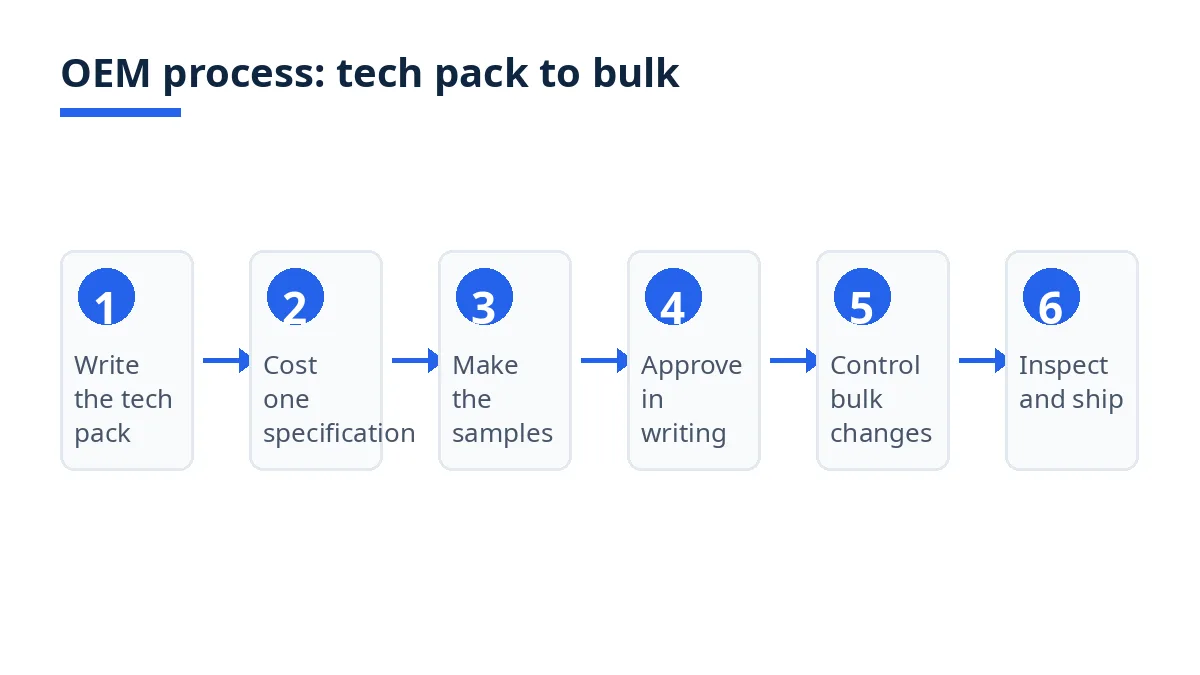
Keep one file per order, with the same article code and version number on every document in it.
Sample iterations: what each round must prove
Name each sample round before it starts, and state what it must prove and what decision it leads to. A proto sample proves the manufacturer understood the pack: grade, finish, shade direction, thickness, and hand-feel. A shade sample proves the color and finish can be repeated on the production dye lot. A pre-production sample proves the production route, not the sample room, can make the leather to the pack. One sample must not carry all three jobs.
Judge every sample the same way. Unroll the hides, lay them flat, and compare them hide by hide against the sealed sample under the agreed light, recording shade, thickness readings, grain, softness, and finish against the pack tolerances.3 Keep sample hides flat, away from light, and apart from other colors.3 Record the decision in writing: approved, approved with corrections listed by pack page, or rejected with the failed lines named. Corrections must name the pack change they require, with a new version number. A correction given as "make it softer," with no tolerance change, will return as a different softness next round.
Agree the rounds in advance: how many the quoted price includes, what each additional round costs, and who pays when a round fails on a line the pack already fixed. No round should start until the last round's corrections are written into a new pack version.
What a change costs: costing and lead-time consequences
A change to the tech pack is never free, even when the manufacturer does not charge for it, because it reopens gates that were closed. Price the change by the gates it reopens, not by the size of the edit. A shade change reopens the dye lot, shade sample, and lab evidence. A thickness change reopens hide selection and usable-area counts. A finish change reopens the finish sample and packing check. A quantity change reopens the lot count and price tier.
Change | Gates reopened | Re-agree in writing |
|---|---|---|
Color or shade | Dye lot, shade sample, lab evidence | New standard, shade bands, dye-lot count |
Thickness or tolerance | Hide selection, thickness readings, usable area | Nominal value, tolerance, reading points |
Finish or coating | Finish sample, flex and colorfastness evidence | Finish type, coating, test methods |
Grade or animal | Hide specification, costing, classification | Grade rules, animal, indicative heading |
Quantity or mix | Lot count, price tier, packing | Count per combination, packing, delivery term |
Packing or labels | Packing sample, carton marks, documents | Roll rule, label contents, carton marks |
Example figures only: take a base order of 2 colors in 1 finish, with a lot minimum of 150 hides per color and finish combination, giving a smallest order of 300 hides. Add one color and the smallest order on the same counting basis becomes 450 hides, because the minimum counts per combination, not per order. The added color also adds a dye lot, a shade sample round, and a lab report. Tiered pricing means the unit price falls in steps as quantity rises, and an order just below a price break can cost more in total than a slightly larger one at the next tier.4 Confirm the tier, the counting basis, and the quotation validity before accepting a change that moves quantity across a break.
Lead time follows the same rule. There is no standard lead time to quote for custom finished leather, and this guide states none. Agree the time per gate in writing: pack freeze, sample rounds, lab turnaround, bulk run, inspection booking, and shipment. A change agreed after the approval gate restarts the clock from the gate it reopens, not from the day it was agreed.
Bulk-production controls and change discipline
Four controls stop a drift before it becomes a lot. First, lot identity: name the lot as one color, one finish, one thickness range, and one tannery run, and keep that identity on the sample record, the lab reports, the inspection record, and the packing list. Second, in-line checking: judge early finished hides against the sealed sample and pack tolerances while correction is still possible.
Third, the change freeze. After the approval gate, no change enters bulk without a written change request naming the pack page, the old value, the new value, the gates reopened, the cost and time consequence, and the approver. Verbal changes and chat messages do not count. If a change is agreed mid-run, the run splits: hides made before the change keep the old version identity, and hides made after it carry the new one. Fourth, the hold rule. Any shade band outside the approved standard, any thickness reading outside tolerance at an agreed point, and any finish fault found in-line is held out of the lot and recorded, not blended into the shipment. Finished leather is graded, not passed as a perfect sheet, and grading turns on position and size, so hold and grade rules must come from the buyer's acceptance specification in the pack, not from the tannery alone.3
Chemical evidence sits beside the physical controls, not instead of them. Where the pack requires a chromium(VI) result, name the method and the limit and require a report for the lot offered. EN ISO 17075-1:2017 specifies a colorimetric method for determining chromium(VI) in leather, suitable for quantifying chromium(VI) down to 3 mg/kg, and applicable to all leather types.5 Separately, the Leather Working Group audit states that for Gold and Silver certification, chromium(VI) levels must be below 3 mg/kg, and any level above that results in automatic failure.6 Those are two different things: a lab method with a limit in the pack, and a tannery audit threshold. Do not accept an audit result as a substitute for a lot lab report.
Classification and documents that follow the specification
The specification decides the paperwork, so write the documents from the frozen pack, not from memory at shipment. For bovine or equine leather further prepared after tanning or crusting, the indicative heading is 4107, with the six-digit line set by whole hides versus sides and by grain.7 2 Sheep or lamb leather falls under 4112 and other animals under 4113, and special finishes such as patent, chamois, or metallized leather fall under 4114, so there is no single code for all finished leather.2 Treat every heading here as indicative: confirm the six-digit line and full national code in the destination tariff, and keep each leather type as a separate invoice line.2 Only the first six digits are shared internationally, so never file one country's national line in another country.2
Check each document against the pack before shipment. The commercial invoice states the leather type, animal, form, grain, finish, quantity, area unit, and price basis. The packing list reconciles hide count, area total, color and finish marks, and roll labels against the order.3 The lab reports name the lot, the method, and the result. The certificate of origin and audit evidence name the tannery site in the pack. If any document names a different animal, finish, site, or version, correct the document or the goods, not the pack after the fact.
Bangladesh notes: tannery site, effluent evidence, and the audit
Name the producing site in the pack, and judge the evidence for that site. Bangladesh tanning is concentrated at the Savar Tannery Industrial Estate, to which tanneries were relocated from Hazaribagh in Dhaka, and the central effluent treatment plant (CETP) there was reported in May 2026 as able to treat between 14,000 and 18,000 cubic meters of waste a day, against about 45,000 cubic meters needed in the peak period after Eid-ul-Azha.8 Ask how the named tannery's effluent is treated and what evidence covers the lot offered; CETP efficiency can affect a tannery's audit scores, with third-party CETP evidence required.6
Read the tannery audit for what it is. The Leather Working Group audit is an assessment of how a tannery measures, controls, and reports the impact of its manufacturing operations, covering 17 sections including water and energy use, environmental management, chemical management, waste management and effluent treatment, and health and safety.6 Companies are rated Gold at 85 percent, Silver at 75 percent, Bronze at 65 percent, and Audited at 50 percent, must reach the rating in every section, and hold certification for 24 months.6 The audit assesses the tannery, never the product: Leather Working Group certification does not guarantee that there will be no restricted-substance failures in a final product.6 Keep audit evidence, lot lab evidence, and sample approvals as three separate records.
On Exportain, read trust badges the same way: verification is a review of documents and photos, not a factory visit, and a badge is not a guarantee of capacity, quality, or delivery.9 A badge shortens the shortlist; the tech pack, samples, lab evidence, and inspection still decide the order.
OEM mistakes that reopen the tech pack
Most OEM failures are pack failures wearing a production disguise.
Quoting from a reference hide instead of a pack. Freeze the pack first, then cost it.
Approving a sample without naming its lot. A bench sample approves a bench process. Record which lot and production route the sample came from, or the approval proves nothing about bulk.
Judging shade from photographs. Screens shift color, and one hide cannot show lot drift. Judge shade hide by hide, side by side, under the agreed light, against the physical standard.
Leaving tolerances to the tannery. Thickness, shade bands, and grade rules belong to the buyer's acceptance specification. A tolerance agreed after bulk starts is a renegotiation, not a specification.
Accepting audit evidence as lot evidence. A tannery audit does not test the lot offered. Require the lab report for the lot, by the named method, beside the audit record.
Changing the pack by conversation. A change never written into a new pack version will be built two ways by two people. Every change is a written request with a new version number.
Counting the minimum on the wrong basis. A minimum counted per color and finish combination is a different order from the same number counted per order. Confirm the basis in the quotation.
Shipping documents written from memory. An invoice or packing list naming a different animal, finish, site, or version from the pack will fail inspection. Write documents from the frozen pack.
Tech-pack sign-off checklist
Use this checklist at the approval gate, before bulk starts. Every line must be answered from a document in the order file, not from memory.
Pack version and date confirmed in writing by both sides, with all seven pages complete or marked not applicable with a reason.
Animal, tannage, form, grain, finish, and end use stated on one page and repeated in the quotation.
Thickness nominal value, tolerance, reading points, and gauge method stated; shade standard, shade bands, and light source stated.
Minimum counting basis confirmed in writing, with quantities per color, finish, and thickness combination.
Sample rounds named with what each must prove; sealed sample hides kept flat, away from light, with lot identity recorded.
Lab tests named by method with limits; reports required for the lot offered, separate from tannery audit evidence.
Change freeze agreed: written change requests only, with gates reopened, cost, and time stated, and a new pack version per change.
Indicative heading recorded with a verify note, one invoice line per leather type, documents written from the frozen pack.
Inspection plan agreed, with hold rules stated.
Tannery site named in the pack, with effluent and audit evidence filed as separate records for that site.
What should a tech pack contain for custom finished leather?
A tech pack for custom finished leather should contain the hide specification, measurements with tolerances, the bill of materials, colorways with a physical shade standard, construction and handling rules, and the tests, labels, and packing instructions, under one version number. It should state the animal, tannage, form, grain, and finish on one page, with thickness, reading points, and the light source for shade.
How do sample rounds and approvals affect cost and timing?
Sample rounds and approvals affect cost and timing through the gates they reopen, not through any standard charge or standard lead time, and this guide states neither. A change agreed after the approval gate restarts the clock from the gate it reopens. Agree in writing how many rounds the quoted price includes, what each additional round costs, and who pays when a round fails on a line the pack already fixed.
Which documents must match the approved tech pack?
The commercial invoice, packing list, lab reports, certificate of origin, and any audit evidence must all match the approved tech pack version: the same leather type, animal, form, grain, finish, quantity, area unit, and tannery site. The indicative heading for bovine or equine leather further prepared after tanning or crusting is 4107, verified in the destination tariff, with each leather type as a separate invoice line.2 If any document names a different specification or version, correct the document or the goods before shipment.
What is the most common OEM mistake with finished leather?
The most common OEM mistake with finished leather is treating a reference hide, a photograph, or a conversation as the specification, and writing the tech pack after the price is agreed. Without a frozen, versioned pack, samples cannot be judged, changes cannot be priced, and bulk cannot be accepted or rejected on a shared record. Freeze the pack first, and allow changes only through written change requests with new version numbers.
Next steps on Exportain
Post an RFQ on Exportain with the tech pack attached: article code, pack version, quantities per color and finish combination, destination, and delivery term, so manufacturers cost one identical specification. Browse Bangladeshi suppliers and read each profile's trust and verification checklist before shortlisting, using the supplier verification guide to read what each badge does and does not show. Check the MOQ guide for the counting basis to confirm in the quotation, the finished leather HS code guide before filing, and the finished leather quality control checklist for the hide-by-hide checks to write into the pack. Exportain is not a party to the goods contract and does not inspect goods, book freight, or clear customs.
Sources
- What Is a Tech Pack? Complete Guide for Clothing Brands. TechSylph, (accessed )
- HS Code for Finished Leather: Classification Guide for Importers. Exportain, (accessed )
- Quality Control Checklist for Finished Leather. Exportain, (accessed )
- MOQ Meaning (Minimum Order Quantity). Exportain (accessed )
- EN ISO 17075-1:2017 - Leather - Chemical determination of chromium(VI) content in leather - Part 1: Colorimetric method. International Organization for Standardization (accessed )
- Certification - Leather Working Group. Leather Working Group (accessed )
- Classification Detail: HS, 2017, Code 4107. United Nations Statistics Division (accessed )
- Govt to fix Savar CETP's deficiencies, back tanneries' own ETPs: Commerce minister. The Daily Star, (accessed )
- How Supplier Verification Works on Exportain. Exportain, (accessed )
About the author
Sourcing from Bangladesh?
Post a request for quotation and suppliers on Exportain can send you their quotes directly.
Post an RFQ