Custom Cotton T-Shirts Manufacturer in Bangladesh: OEM Process From Tech Pack to Bulk
How an OEM cotton T-shirt order runs in Bangladesh, from tech pack to bulk: sampling, price drivers, labelling, AQL inspection and export documents.
Short answer
To use a custom cotton t-shirts manufacturer bangladesh factories offer for an OEM order, send a complete tech pack, compare itemized quotations on one delivery term, approve a pre-production sample in writing, then inspect bulk goods against that sample under an agreed AQL plan before the export filing.
On this page
Key takeaways
A custom order is an OEM order: the tech pack, not a photo, defines the garment that bulk production repeats.
MOQ and price are set by each factory for your specification, so compare itemized quotations on the same tech pack and delivery term.
Approve the pre-production sample in writing in the actual fabric, print and labels, and inspect bulk against that sample.
For the EU, fibre composition labelling follows Regulation (EU) No 1007/2011 by name and percentage by weight in descending order.
Exportain verification is a document and photo review, not a factory inspection, and a badge is not a guarantee.
If you are sourcing a custom cotton t-shirts manufacturer bangladesh factories can supply, the order is made or lost in the paperwork before any sewing starts. A custom order is an OEM order: the factory produces your design, your fabric, your print and your labels, rather than selling a stock style. This guide follows that process from tech pack to bulk shipment, and shows where you set the specification, approve the samples and check the finished goods.
Cotton T-shirts are knitwear. The Bangladesh Knitwear Manufacturers and Exporters Association (BKMEA), established in 1996, is the apex trade body for the knitwear sector and represents approximately 2,540 knitwear member factories.1 The Bangladesh Garment Manufacturers and Exporters Association (BGMEA), which started in 1983, represents the woven garments, knitwear and sweater sub-sectors, and around 40 percent of its member factories are knitwear and sweater manufacturers.2 Knitwear exports reached $5.963 billion in July to September 2026, up 6.88 percent year on year, within ready-made garment exports of $10.578 billion, according to Export Promotion Bureau (EPB) data.3 Scale explains why buyers come to Bangladesh. It does not tell you whether one factory can make your shirt.
Why this matters for buyers and sellers
A custom purchase is judged on a chain of decisions: the tech pack defines the garment, the samples test it, the quotation prices it, and bulk repeats it. An error left in the tech pack is repeated in every unit. An error caught at sampling costs one sample round. Judge the process as well as the price.
What should you know first about cotton T-shirts?
Three points shape every custom order before you contact a factory.
Classification. In the Harmonized System, heading 6109 covers T-shirts, singlets and other vests, knitted or crocheted, and subheading 610910 covers the same garments of cotton, knitted or crocheted.4 Record the indicative code in your file, then confirm the full national code in your destination tariff before you calculate duty and landed cost. The HS code for cotton t-shirts guide sets out the code in detail.
Fibre labelling for the destination. If you sell into the European Union, Regulation (EU) No 1007/2011 requires a textile product to be labelled or marked with the name and percentage by weight of all constituent fibres in descending order.5 The labelling must be durable, easily legible, visible and accessible, and, for a label, securely attached.5 Put the exact wording in the tech pack, because the label is sewn during finishing. Confirm the wording for each market before the pre-production sample is approved.
Who makes the shirt. A manufacturer cuts and sews in its own factory. A trading company places your order with a factory it selects. Both models can deliver, but record in writing which one you have contracted with and whose name appears on the export documents.
Step by step: the OEM process from tech pack to bulk
Keep a dated record of each approval.
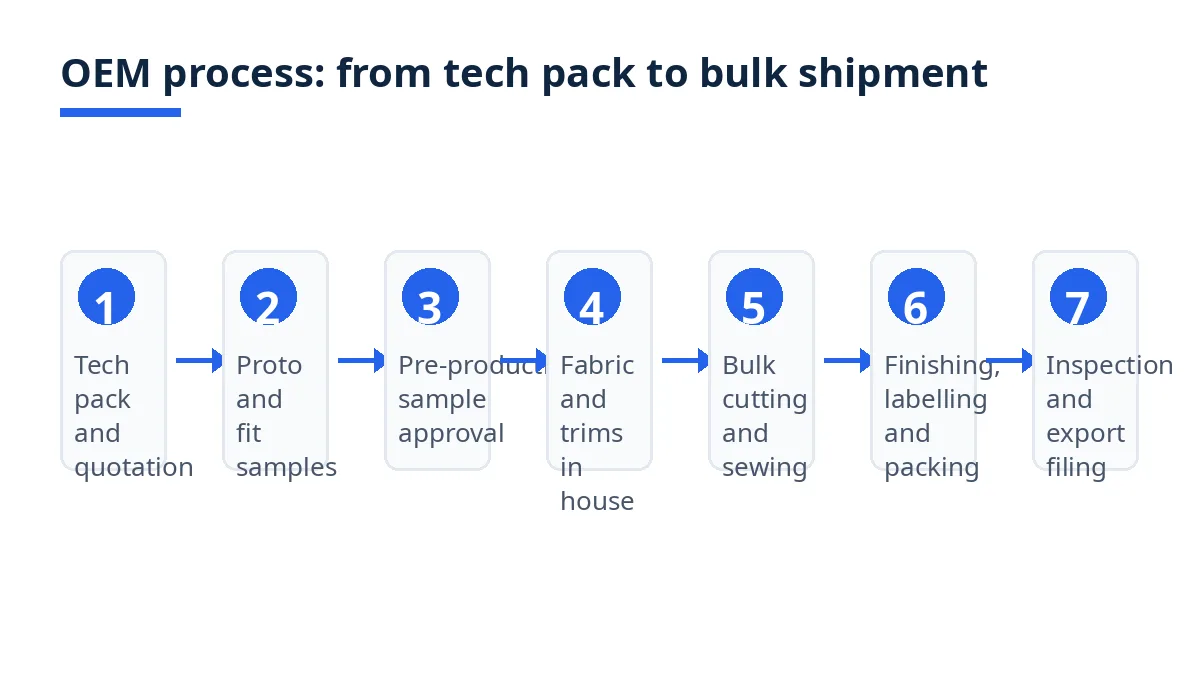
Step 1: Build the tech pack. The tech pack is the factory instruction file. It covers fabric composition and weight, construction and color, a measurement chart for every size, stitch and seam details, print or embroidery artwork with size and placement, neck and hem finish, label artwork and placement, and packing by size and color. Add quantity per size and color, destination, and the delivery term you want quoted. Send the identical file to every candidate, or quotations cannot be compared.
Step 2: Get itemized quotations. Ask each factory to price the same tech pack and state what the unit price includes and excludes. On Exportain, every quotation is versioned and records unit price, minimum order quantity (MOQ), lead time, Incoterm, payment terms and validity.6 Compare on the same specification and delivery term. A lower price on a lighter fabric or without print set-up is not a saving.
Step 3: Order proto and fit samples. The factory makes a first sample, often in an available fabric close to your specification, so you can check style, fit and construction. Measure it against your chart, wash it, and return corrections in writing with marked photos.
Step 4: Approve the pre-production sample. The pre-production sample is made in your actual fabric, color, print and labels, packed as bulk will be packed. Check measurements, fabric weight, stitching, print color and position, label wording and packing against the tech pack, and approve it in writing, or list the corrections in writing. This sample is the standard the bulk inspection is judged against, so keep a sealed reference sample as well.
Step 5: Confirm fabric, trims and the production slot. After approval, the factory books or produces fabric and orders trims such as labels, tags and polybags, made for your order. Confirm in writing that fabric and trims match the approved sample before cutting starts, and agree the inspection window at the same time.
Step 6: Bulk cutting, sewing and finishing. Bulk production repeats the approved sample: cutting, sewing, print or embroidery, finishing, labelling and packing. Ask for updates tied to stages, for example cutting complete, sewing progress, and finishing start. A problem is cheapest to correct while the order is still on the line.
Step 7: Inspect, pack and file for export. Inspect the finished goods against the approved sample, then confirm cartons, packing list and export filing agree with the purchase order.
What drives cost when you order custom T-shirts?
No honest guide can give you a standard custom price or a standard minimum, because both are set by each factory for your specification. What you can do is name the drivers in your enquiry, so the quotation is itemized and comparable.
Fabric: composition, weight and whether the fabric is stocked or knitted and dyed for your order. A dyed-to-order color usually carries a higher minimum than a stocked color.
Quantity split: the total matters less than the split per color and size. Small runs per color raise set-up per unit.
Print or embroidery: method, number of colors, size and placement decide set-up work, a fixed effort spread across the run.
Finishing and packing: private labels, hang tags, folding, polybags, retail packing and carton specification each add a priced step. See the private label cotton t-shirts guide.
Delivery term: the point at which cost and risk pass from seller to buyer changes what the unit price must cover.
Ask each factory to state its own MOQ for your specification and to separate fabric, making, print, trims and packing. The MOQ explained guide covers how minimums are set.
On delivery terms, the International Chamber of Commerce states that the Incoterms 2020 rules set out 11 rules with guidance for selecting the right term, and a clear allocation of cost, risk and obligations.7 State the rule and the named place in the purchase order, the quotation acceptance and the invoice, so all three agree.
Costs, timelines and documents
Sampling depends on fabric availability and correction rounds. Bulk depends on fabric production or dyeing, trim delivery, line capacity, and the inspection and export steps. Build your schedule from the dates each factory gives you, and add a buffer for sample corrections.
The documents fall into three groups.
Group | Documents | What you check |
|---|---|---|
Order documents | Tech pack, versioned quotation, purchase order | Specification, price, MOQ, lead time, Incoterm and payment terms agree across all three |
Production documents | Sample approvals, fabric and trim confirmations, inspection report | Approvals are written and dated, and the report is judged against the approved sample |
Export documents | Commercial invoice, packing list, EXP form, certificate of origin, Bill of Export | Description, quantity and value match the purchase order |
For export clearance in Bangladesh, goods may not be loaded unless an export declaration, the Bill of Export or Shipping Bill, is submitted to Customs and approved.8 Enclosed documents include the export contract or purchase order where there is no export letter of credit, the commercial invoice, the packing list, the EXP form certified by an authorized dealer, and a certificate of origin issued by the EPB or a Chamber of Commerce and Industry.8
For inspection, agree the sampling plan in the purchase order. ISO 2859-1 defines a system of acceptance sampling plans for inspection by attributes, indexed by acceptance quality limit (AQL) for lot-by-lot inspection.9 AQL is the maximum average percentage of defective items considered acceptable during random sampling, and the AQL value determines sample sizes and acceptance or rejection thresholds.9 Write the inspection level and AQL values for critical, major and minor defects into the order, and name who inspects. The cotton t-shirts quality control checklist gives the garment-level checks.
Bangladesh-specific rules and tips
Start with the knitwear associations. BKMEA is the sector association for this product, representing approximately 2,540 knitwear member factories.1 BGMEA covers knitwear alongside woven garments and sweaters.2 If a supplier claims membership, confirm it with the association itself. Membership shows an active garment business. It does not certify that the company can produce your order.
Separate the factory from the trading company on paper. On Exportain, the distinction is recorded in the badges: Factory Verified means Exportain has reviewed photos of the manufacturer factory, while Trading Company Verified means it has reviewed photos of the trading company office or warehouse.10
Match names across documents. The name on the trade licence, quotation, proforma invoice and bank account should be the same legal name. The export filing also names the exporter and the foreign buyer, so a mismatch delays the shipment.8
Plan around fabric, not around sewing. The long stage is usually fabric and custom trims, made or dyed for your specification. Ask for fabric and trim dates separately from sewing dates.
Mistakes and red flags
Sending a picture instead of a tech pack. A photo shows a style, not a specification. Without fabric weight, measurements and print placement in writing, each factory quotes a different garment.
Approving the sample verbally. If the approval, or the corrections, are not in writing, there is no standard to inspect bulk against. Every later dispute becomes a memory dispute.
Changing fabric, color or print after pre-production approval. After approval, fabric and trims are ordered for your specification. A change at that point restarts sampling and can restart the fabric order, so the delivery date moves with it.
Comparing prices quoted on different terms. A price quoted ex works and a price quoted free on board cover different costs. Re-quote every candidate on the identical tech pack and the identical delivery term before you compare.
Reading a badge as a guarantee. Exportain states the limit in plain terms: a badge is not a guarantee of production capacity, product quality or delivery.10 Samples and inspection remain your controls, whoever you buy from.
Paying before identity checks agree. If the licence name, the export registration holder and the payment account name do not match, pause and get the explanation in writing.
Checklist
Tech pack complete: fabric, measurements, print, labels, packing, quantities and delivery term.
Indicative HS subheading 610910 recorded, with the full destination code confirmed in the destination tariff.4
Fibre composition label wording set for each destination, with EU wording following Regulation (EU) No 1007/2011 where the EU is the destination.5
Itemized quotations compared on the same tech pack and the same Incoterm.7 6
Factory or trading company status stated in writing, and any BKMEA or BGMEA membership claim confirmed with the association.1 2
Proto sample corrected in writing, then pre-production sample approved in writing.
Fabric and trim confirmation received before cutting, with the inspection window agreed.
Inspection level and AQL values written into the purchase order, with the inspector named.9
Export document set checked against the purchase order before loading.8
How Exportain helps
On Exportain, search the catalogue by keyword and category, filter to suppliers holding the Exportain Verified badge, sample availability and OEM or ODM capability, and sort by MOQ or lead time.6 Each profile shows the verification level, location, main products and declared certifications.6 Post a request for quotation (RFQ) stating quantity and unit, target price, destination, Incoterm, required certifications and deadline, with your tech pack summary attached, so quotations arrive against the same specification.6
Read the badges for what they record. Exportain Verified means Exportain has checked identity, phone, email and business registration, and Export Verified means it has checked the Export Registration Certificate (ERC).10 Verification is a document review by Exportain staff, and every submission is reviewed before a badge is approved.11 Verification is free, and membership plans never grant a trust badge.11 It is a document and photo review, not a factory inspection,10 11 so sample approvals and bulk inspection stay with you. The guide to how supplier verification works on Exportain sets out each check. After you accept a quotation, payment is settled on those terms with inspection and shipment conditions agreed in writing first.6
FAQs
What should I know first about cotton t-shirts?
Cotton T-shirts fall under HS heading 6109, with subheading 610910 for cotton garments, knitted or crocheted.4 For the EU, fibre composition must be labelled by name and percentage by weight in descending order under Regulation (EU) No 1007/2011.5 Confirm whether your counterparty is the factory that will cut and sew the order or a trading company, and record the answer in writing.
What are the typical costs and timelines?
There is no typical figure, because cost and time are set by fabric, quantity split, print, trims, packing and delivery term for your order. Ask each factory for an itemized quotation and a stage-by-stage schedule against your tech pack, compare quotations on the same Incoterm, and hold the factory to the dates it gave you.7 6
Which documents are needed?
You need three sets. The order set is the tech pack, the versioned quotation and the purchase order. The production set is the written sample approvals, fabric and trim confirmations and the inspection report. The export set filed with the Bill of Export includes the commercial invoice, the packing list, the EXP form certified by an authorized dealer, and a certificate of origin issued by the EPB or a Chamber of Commerce and Industry.8
What are the most common mistakes?
The most common mistakes are sending a photo instead of a tech pack, approving samples verbally, changing the specification after pre-production approval, comparing prices on different delivery terms, and treating a badge as a guarantee of capacity, quality or delivery.10 Keep every approval written and dated, so the bulk inspection has a standard to judge against.
Next steps on Exportain
Browse suppliers in the knitwear and T-shirt categories and filter for OEM capability and sample availability, then post your tech pack summary on the RFQ board so factories quote against the same specification. Before your first bulk order ships, read how to import cotton t-shirts from Bangladesh for the ordering, shipping and duty steps that follow approval and inspection.
Sources
- BKMEA at a Glance. BKMEA (accessed )
- BGMEA at a glance. Bangladesh Garment Manufacturers and Exporters Association (BGMEA) (accessed )
- Merchandise exports rise 6.34pc to $13.09b in Q1 FY27: EPB. The Financial Express, (accessed )
- Classification Detail — HS Code 6109. United Nations Statistics Division (accessed )
- Regulation (EU) No 1007/2011 on textile fibre names and related labelling and marking of the fibre composition of textile products. European Union, (accessed )
- How to source and buy from Bangladesh. Exportain (accessed )
- Incoterms® 2020. International Chamber of Commerce (ICC) (accessed )
- Customs Clearance Procedures for Export. Bangladesh Customs, National Board of Revenue (accessed )
- ISO 2859-1:2026 - Sampling procedures for inspection by attributes — Part 1: Sampling schemes indexed by acceptance quality limit (AQL) for lot-by-lot inspection. ISO (accessed )
- Trust & Safety Center. Exportain (accessed )
- Supplier verification: Earn trust badges buyers can see. Exportain (accessed )
About the author
Sourcing from Bangladesh?
Post a request for quotation and suppliers on Exportain can send you their quotes directly.
Post an RFQ