

Cushion Covers Lead Time From Bangladesh: Production and Shipping Timeline
Cushion covers lead time from Bangladesh, planned backwards from your drop date: cover and insert approvals, material readiness, bulk, inspection, set packing, documents and transit.
Short answer
Cushion covers lead time from Bangladesh has no single figure. Plan backwards from the date the collection must be on sale, through transit, documents and loading, inspection and packing, bulk production, insert approval on the filled track, cover sampling, and material readiness. Fix cover-only or filled per design first, because an empty cover sits in heading 6304 while a filled cushion sits in heading 9404. Replace every planning window with dated lines from the written quote and forwarder estimate.
On this page
Key takeaways
Plan backwards from the date the collection must be on sale, not forwards from the enquiry date.
Fix cover-only or filled per design first: an empty cover sits in heading 6304, a filled cushion in heading 9404.
The insert is its own approval on the filled track, on fill material, fill weight, loft, recovery and casing.
Every duration in this guide is an example planning window only; the drop date must come from the dated lines in the written quote and the dated forwarder estimate.
Exportain verification is a document and photo review, not a factory inspection, and a badge is not a guarantee of capacity, quality or delivery.
A cushion cover order from Bangladesh is decided by one date: the day the collection must be on sale. Work backwards from that date, stage by stage, and the timeline becomes a plan with owners and approvals. Start from the enquiry date and work forwards, and the drop date becomes a hope.
The fork that shapes the whole schedule comes early. An empty, finished cushion cover sits in heading 6304, while a cushion shipped stuffed or internally fitted with any material belongs in heading 9404, not 6304.1 That choice changes the specification, the packing, the invoice lines and the inspection points, so it must be fixed before sampling, not during bulk production.
Why this matters for buyers and sellers
For the buyer, the timeline decides whether a seasonal collection lands complete. Cushion covers sell as a coordinated drop: several designs, several colours, and often matching sizes that a customer buys together. A drop that arrives with three designs out of four, or with covers but no inserts, cannot be merchandised as planned.
For the seller, the order is three supply lines running at once: cover fabric and decoration, closures and trims, and, on the filled track, insert filling and casing. Each line has its own readiness date, and bulk sewing cannot start until all three are ready for the same design. The discipline that protects both sides is to treat the drop date as fixed and the stages as movable only backwards: every stage ends with a written approval, and the next stage starts from that approval.
Step-by-step: how it works
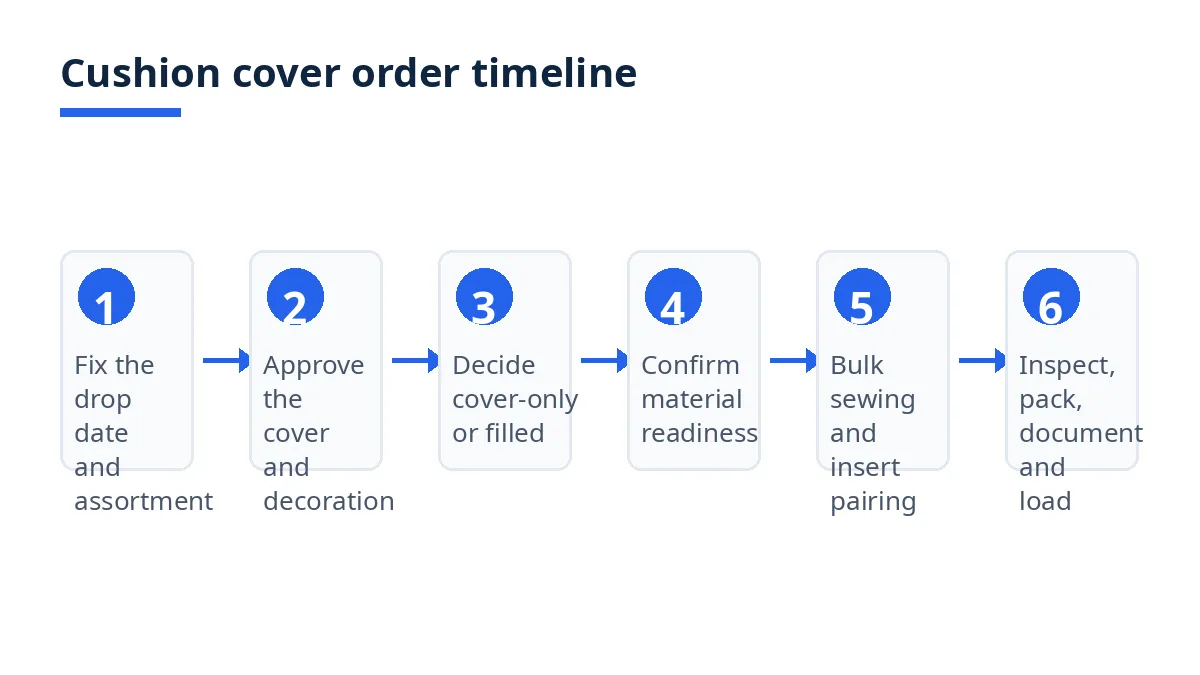
Fix the drop date and the assortment first. List every design, colour, size and quantity in the drop, and state whether each line ships cover-only or filled. Record the date the goods must be in your warehouse, then subtract transit, documents and loading, inspection and packing, bulk production, sampling and material readiness to find the latest date each stage can start. A drop with four designs is four schedules, not one.
Approve the cover before you approve the collection. Ask for the sample in the actual cover fabric, with the actual print, embroidery or applique, piping, closure and label. Check the closure the way a customer will use it: run the zip or envelope opening repeatedly, and check shade under shop lighting as well as daylight. A print or embroidery correction after bulk starts restarts that design alone, but the drop still waits for it.
Decide cover-only or filled, in writing, per design. On the filled track, specify the insert separately: fill material, fill weight, loft and recovery after compression, casing fabric, and whether the insert ships inside the cover or beside it. Heading 6304 covers other furnishing articles, excluding those of heading 9404, so a cover shipped with its insert fitted inside it is a different article at the border from an empty cover.1 Keep cover-only and filled lines on separate invoice lines, and confirm the code per style before shipping.
Confirm material readiness line by line. Ask which cover fabrics are stocked and which must be woven, dyed or printed for the order, and whether zips, piping cord, labels and insert filling are on hand or bought in. An imported zip or a custom-dyed ground can set both the earliest bulk date and the minimum quantity, so record a ready date for each line rather than a single production start date.
Run bulk by design, with the insert track alongside. Cutting, sewing, closure fitting and decoration proceed design by design, and on the filled track the inserts are filled, cased and paired with their covers before packing. Check shade across the bulk run against the approved sample, not only at the start, because dye lots drift across a long run. Check that every insert fits its cover without strain at the closure.
Inspect, pack by set, document and load. Agree the inspection level and acceptance quality limit (AQL) before production. ISO 2859-1 defines a system of acceptance sampling plans for inspection by attributes, indexed by AQL for lot-by-lot inspection, and AQL is the maximum average percentage of defective items considered acceptable during random sampling, which determines sample sizes and acceptance or rejection thresholds.2 Pack by design and assortment, so a retailer can put a set on the shelf without sorting cartons. Then prepare the export set, load, and ship on the forwarder estimate, not on a guessed transit time.
Costs, timelines and documents
What should I know first about cushion covers?
Know the form first: an empty finished cover or a filled cushion. An empty, finished cover sits in heading 6304, at 6304.91 if knitted or crocheted, 6304.92 if not knitted or crocheted and of cotton, 6304.93 if of synthetic fibres, and 6304.99 if of other textile materials, while a cushion shipped filled sits in heading 9404.1 Then know the closure, the decoration method and the assortment, because those four facts drive every later date and cost.
What are the typical costs and timelines?
There is no typical cost or timeline a guide can state as fact for cushion covers. Price follows the cover fabric, the decoration, the closure, the insert on the filled track, the packing volume and the delivery term, and the timeline follows material readiness, sample correction rounds, bulk capacity and the shipping route. Ask for both as dated lines in the written quote.
Stage | Example figures: planning window | What closes the stage |
|---|---|---|
Drop date and assortment lock | 1 week | Signed assortment list, cover-only or filled per design |
Cover sample and decoration approval | 2 to 3 weeks | Written approval of the sample in actual fabric and decoration |
Insert and fill approval (filled track) | 1 to 2 weeks, alongside cover approval | Written insert spec: fill, weight, loft, casing |
Material readiness: fabric, trims, filling | 2 to 4 weeks | Ready dates per line, not one start date |
Bulk sewing, closure and insert pairing | 3 to 5 weeks | Bulk complete by design, inserts paired |
Inspection and set packing | 1 week | Signed inspection report, cartons packed by set |
Documents and loading | 1 week | Approved export set and loaded cartons |
Transit to destination | Per forwarder estimate | Dated forwarder estimate, not a guess |
Example figures: a buyer plans an autumn drop of four designs in three colours, 600 covers per design, half of them filled. If the insert fill approval slips by two weeks, the filled half of the drop slips by two weeks, while the cover-only half stays on plan. Shipping the drop split, or holding the whole drop for the filled half, is a commercial decision to take at the slip, not at the port.
Two cost points belong in the same quote. The first is the delivery term: the Incoterms 2020 rules number 11, with a clear allocation of cost, risk and obligations, and for containers handed over at a terminal in Bangladesh, FCA, CPT or CIP usually match the handover better than FOB, CFR or CIF.3 Compare quotations only on the same rule and named place. The second is the cost of a failed stage: a remake, a split shipment or an air-freight rescue costs more than the weeks saved by skipping the insert approval.
Which documents are needed?
For export clearance in Bangladesh, goods may not be loaded unless an export declaration, the Bill of Export or Shipping Bill, is submitted to Customs and approved.4 Enclosed documents include the export contract or purchase order where there is no export letter of credit, the commercial invoice, the packing list, the EXP form certified by an authorized dealer, and a certificate of origin issued by the EPB or a Chamber of Commerce and Industry.4 Keep cover-only and filled lines separate on the invoice, with the confirmed code per style, so the entry matches the goods as shipped.1
Bangladesh-specific rules and tips
State the fibre composition per style, and check the packed label against it. Regulation (EU) No 1007/2011 lays down harmonised provisions on fibre names and the labelling and marking of fibre composition of textile products.5 A cushion cover range that mixes cotton, linen and polyester across designs needs the composition per design, not per range, and the label on the packed goods must match the specification it was approved against.
Confirm the code per style, not per range. Heading 6304 excludes articles of heading 9404, and the same design shipped empty and shipped filled takes two different headings.1 A range with a knitted cover, a cotton cover and a synthetic-fibre cover also takes three different six-digit lines within 6304. Give your broker the description and confirmed code for each style, and keep the classification file with the shipment documents.
Ask what is imported for your order. Invisible zips, piping cord, embroidery thread and insert filling may be bought in for your specification, and an imported trim can set both the minimum quantity and the earliest bulk date. Agree the colour and size ratio per design before bulk starts.
Approve the insert on loft and recovery, not on first feel. An insert that looks full on the sample table can flatten in the carton. Ask for the fill weight per insert size, check the insert in its cover after compression and recovery, and record the fill weight on the approved sample.
Keep one legal name across every paper. The export declaration names the exporter and the foreign buyer,4 so the name on the trade licence, quotation, proforma invoice and payment account should match.
Mistakes and red flags
What are the most common mistakes?
Setting the drop date from the enquiry date. A drop date needs the dated stage lines behind it: sample approval, material readiness, bulk, inspection, documents and transit. A date set from the enquiry date alone has no stage behind it, and the first slip has nowhere to be absorbed.
Approving the cover without approving the insert. A drop sold as filled cushions is not approved when only the cover is approved. The insert needs its own approval, on fill, weight, loft and casing, before bulk pairing starts.
Mixing cover-only and filled goods on one invoice line. The two forms take different headings,1 and a mixed line invites a wrong entry, a wrong duty line and a delay at destination. Separate the lines, and separate the cartons where the buyer needs them separated.
Comparing quotations on different terms or different forms. A lower price on a cover-only quote, a lighter fabric, a different closure or a different delivery term is a different offer. Compare only replies to the same assortment, on the same form per design and the same Incoterm and named place.3
Checklist
Before you confirm, every line should be answered in writing.
Drop date fixed, with the assortment list signed: design, colour, size, quantity, cover-only or filled per design.
Cover sample approved in actual fabric, decoration, piping, closure and label.
Insert approved on the filled track: fill material, fill weight, loft, recovery and casing.
Material-ready dates recorded per line: fabric, zip, piping, labels, filling.
Bulk dates, inspection date and packing by set agreed.
Inspection level and AQL values in the purchase order.2
Quotations compared on the same assortment, form and Incoterm.3
Export set agreed: invoice, packing list, EXP form, certificate of origin, Bill of Export.4
Transit covered by a dated forwarder estimate, and the drop date set from it.
How Exportain helps
On Exportain, browse suppliers and post a request for quotation (RFQ) on the RFQ board with the drop date, the assortment list, the cover-only or filled form per design, and the delivery term, so suppliers quote against the same schedule. Ask each reply for its material-ready dates, its insert approval plan on the filled track, and its inspection plan, with dated stage lines rather than a single delivery week.
Read the badges for what they record. Exportain Verified means Exportain has checked identity, phone, email and business registration, and Export Verified means it has checked the Export Registration Certificate (ERC).6 Factory Verified means it has reviewed photos of the manufacturer factory, while Trading Company Verified means it has reviewed photos of the trading company office or warehouse.6 Verification is a document and photo review by staff, free, and never granted by membership plans.6 7 It is not a factory inspection,6 7 so sample approval and inspection stay with you. See the Incoterms guide before you compare quotations on different terms.
FAQs
What should I know first about cushion covers?
Know the form first: an empty finished cover or a filled cushion. An empty, finished cover sits in heading 6304, while a cushion shipped stuffed or internally fitted with any material belongs in heading 9404.1 Then know the closure, the decoration method and the assortment, because those facts drive every later date. See the how to import cushion covers guide for the ordering process and the cushion covers quality control checklist for inspection points.
What are the typical costs and timelines?
There are no typical figures a buyer can rely on, because each supplier prices the cover fabric, decoration, closure, insert, packing volume and delivery term for the assortment,3 and each timeline follows material readiness, sample corrections, bulk capacity and the shipping route. Use the example planning windows in this guide only as a framework, and replace them with the dated lines in the written quote and the dated forwarder estimate.
Which documents are needed?
The order documents are the assortment list, the itemized quotation and purchase order, with the cover-only or filled form per design on both. The export set is the Bill of Export, commercial invoice, packing list, EXP form certified by an authorized dealer, and a certificate of origin issued by the EPB or a Chamber of Commerce and Industry.4 See the cushion covers price guide for how to read the quote lines behind those documents.
What are the most common mistakes?
The most common mistakes are setting the drop date from the enquiry date, approving the cover without approving the insert, mixing cover-only and filled goods on one invoice line,1 comparing quotations on different terms,3 and reading a badge as a guarantee. A badge is not a guarantee of capacity, quality or delivery.6
Next steps on Exportain
Browse suppliers, then post your drop date, assortment list and cover-only or filled form per design on the RFQ board so suppliers state their material-ready dates and inspection plan. Before you confirm, read the Incoterms guide and the how to import cushion covers guide.
Sources
- HS Code for Cushion Covers: Classification Guide for Importers. Exportain (accessed )
- ISO 2859-1:2026 - Sampling procedures for inspection by attributes — Part 1: Sampling schemes indexed by acceptance quality limit (AQL) for lot-by-lot inspection. ISO (accessed )
- Incoterms® 2020. International Chamber of Commerce (ICC) (accessed )
- Customs Clearance Procedures for Export. Bangladesh Customs, National Board of Revenue (accessed )
- Regulation (EU) No 1007/2011 on textile fibre names and related labelling and marking of the fibre composition of textile products. European Union, (accessed )
- Trust & Safety Center. Exportain (accessed )
- Supplier verification: Earn trust badges buyers can see. Exportain (accessed )
About the author
Sourcing from Bangladesh?
Post a request for quotation and suppliers on Exportain can send you their quotes directly.
Post an RFQ


