

Cushion Covers Price in Bangladesh: FOB Cost Breakdown for Buyers
Cushion covers price in Bangladesh, read as an FOB quote audit: split cover, insert, trims, design and packing line by line, and compare suppliers on the same specification.
Short answer
A cushion-cover FOB price is the sum of its specification up to loading on board at the named port: cover fabric, insert if included, sewing, closure and trims, design, labels and packing, inspection, inland transport with export documents and port handling, plus margin. Compare quotes only after splitting them by component, because cover-only and cover-plus-insert totals describe different orders.

On this page
Key takeaways
An FOB price ends at loading on board at the named port; ocean freight, insurance and import clearance sit outside it.
The first question on any cushion-cover quote is whether an insert is included, because cover-only and cover-plus-insert quotes are not comparable totals.
Fabric weight, closure type, edge finish, design method and packing format most often explain a price gap between two quotes.
Ask for the price split by component and by variant, not one blended total for a mixed order.
A low total on an unchanged specification usually means a line was cut; find it before accepting.
Two quotations can carry the same FOB total and describe two different products. One may quote a cover only, in a lighter fabric, with a plain zip and flat packing. The other may quote a cover plus insert, in a heavier fabric, with piping, an embroidered motif and compressed packing. The totals match; the orders do not. This guide, for buyers in the United States, the United Kingdom, the European Union and the United Arab Emirates, shows how to read a cushion-cover quotation line by line.
Why this matters for buyers and sellers
For a buyer, the FOB total is the last price the seller fully controls. Everything after loading — ocean freight, marine insurance, import clearance and onward delivery — is arranged and paid for separately, so a low FOB figure paired with a bulky, uncompressed shipment is not automatically a low landed cost. A cover arriving with a weaker zip, thinner fabric or missing insert is a different order, not a bargain.
For a seller, the FOB price must absorb every cost incurred before loading, including costs that appear only with a particular specification: a hidden zip over an envelope closure, a piped edge over a plain one, an embroidered motif over a printed one. The cushion-cover trap is scope: a towel is one piece, while a cushion-cover order may or may not include the pad that fills it. Split first, compare second.
Step-by-step: how it works
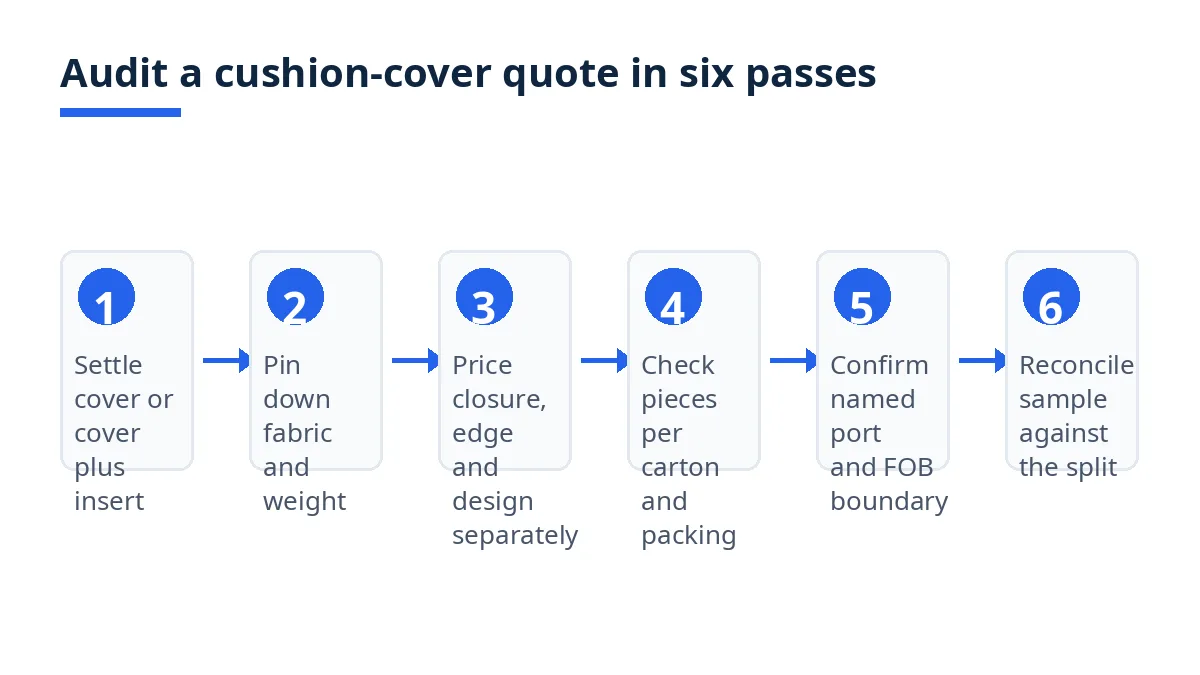
Audit a cushion-cover quotation in six passes. Incoterms 2020, the International Chamber of Commerce set of 11 trade rules, allocates cost, risk and obligations between seller and buyer.1 A quote that cannot answer a pass is not ready to accept.
Pass 1: settle what is being sold. Confirm cover only or cover plus insert, and if an insert is included, its fill and weight. Confirm size in centimetres, finished size tolerance, and whether size is measured flat or filled.
Pass 2: pin down the fabric. Record fibre content, construction, weight, colour list and any finish. "Cotton cover" alone does not specify the fabric.
Pass 3: price the details separately. Ask for separate lines for closure, edge finish, design application and labels. Each carries its own cost, and bundling them hides the one that moved.
Pass 4: check the packing line. Confirm pieces per polybag, pieces per carton, carton type, flat or compressed packing, and carton dimensions and weight. Carton count is what the buyer later pays freight on.
Pass 5: confirm the FOB boundary. Confirm the named port of shipment, that the price is written as FOB with the Incoterms year, and that export clearance, inland transport to the port, origin terminal handling and loading are inside the price. Under FOB, the seller delivers the goods on board the vessel nominated by the buyer at the named port of shipment, cleared for export, and risk transfers to the buyer once the goods are on board.2 The seller pays export packaging, export clearance, inland transport to the origin port, terminal handling at origin and loading, while the buyer pays ocean freight, marine insurance, import clearance and destination transport.2
Pass 6: reconcile the sample against the split. Approve a sample made to the quoted specification — same fabric, closure, edge and design method — and check its size, weight and finish against the component lines. Any changed line should appear as a priced change.
One caution: cushion covers usually ship containerised, and FOB is a sea and inland waterway rule with risk transferring on board the vessel.2 Where a container is stuffed at the seller's factory and the buyer's forwarder controls it from the factory gate, the ICC recommends FCA instead, because FCA transfers risk at handover to the carrier rather than at the vessel.2 Ask your forwarder whether FCA fits the movement better, and record whichever term you choose in writing with its year.
Costs, timelines and documents
The FOB cost stack, component by component
Cover fabric. This line moves with fibre, construction, weight and colour. A heavier fabric uses more material per piece, and jacquard adds loom complexity.
Insert, when included. An insert is a second product inside the price. Its line moves with fill type, fill weight, insert size relative to the cover, and whether it is sewn shut or has its own closure. Without stated fill and weight, two such quotes cannot be compared.
Cutting and sewing. This line moves with size, seam construction, closure insertion, piping or flange work, and cutting waste. Piped and flanged edges are slower than plain sewn edges.
Closure and trims. Zips, buttons, envelope overlaps, piping cord and thread each carry a cost, and a hidden zip is a different line from a visible one. Trims carry their own supplier minimums, so a special zip can add a surcharge.
Design application. Print, embroidery and jacquard are three different cost structures and should never be blended into one "design" line. Printing carries setup costs per colour, embroidery carries digitising and stitch count, and jacquard carries the woven construction itself. Price each method and colourway separately.
Labels, tags and packing. Woven labels, printed care labels, hang tags, polybags and export cartons each carry a cost. For cushion covers, packing deserves special attention: flat and compressed packing produce different carton counts for the same order quantity, and carton count is what later drives freight. Agree compression in writing.
Inspection and testing. These sit inside the FOB price when the seller arranges them before shipment, and they deserve their own line. Agree the inspection basis, sample size and acceptance standard before production.
Inland transport, export documentation and port handling. The final FOB lines carry packed cartons from factory to vessel. The seller pays inland transport to the origin port, origin terminal handling and loading on board.2 Under Bangladesh Customs procedure, goods shall not be allowed to load or ship for export unless an export declaration, the Bill of Export or Shipping Bill, is submitted to Customs and approved, with the commercial invoice, packing list, AD-certified EXP form, certificate of origin, VAT registration certificate and TIN enclosed.3
Margin. Margin is the seller's return on the order. Squeezing the total while keeping the specification unchanged usually means another line was cut.
FOB component | What moves it | Check on the quotation |
|---|---|---|
Cover fabric | Fibre, construction, weight, colour | Fabric and weight stated, not just "cotton cover" |
Insert (if included) | Fill type, fill weight, insert size | Fill, weight and closure of the insert named |
Cutting and sewing | Size, seam, piping or flange, cutting waste | Size and edge finish on the quotation |
Closure and trims | Zip type, buttons, cord, trim minimums | Each trim priced, not bundled |
Design application | Print, embroidery or jacquard; colourways | Price per design method and per colourway |
Labels and packing | Label types, flat or compressed packing | Pieces per carton and carton size stated |
Inspection and testing | Inspection basis, sample size, test scope | Inspection plan agreed before production |
To port and loading | Distance to port, terminal handling, export papers | Named port and FOB inclusions in writing |
Margin | Order size, repeat potential, payment terms | Margin shown apart from production costs |
Example figures: a single 45 x 45 cm cotton cover plus polyester insert, with a hidden zip and a plain edge, packed flat in a polybag in an export carton, might be quoted FOB at USD 2.75 per set, built as cover fabric USD 0.98, insert USD 0.52, cutting and sewing USD 0.38, closure and trims USD 0.18, labels and packing USD 0.22, inspection and testing USD 0.08, inland transport, export documentation and port handling USD 0.19, and margin USD 0.20. These are example figures only, shown to illustrate the shape of the stack, not market rates. The same cover without the insert, on the same example figures, would be USD 2.23, and adding an embroidered motif on the same example figures might add USD 0.35 per cover. Change one specification, and only the lines that specification touches should move.
Bangladesh-specific rules and tips
The export declaration set above is the seller's obligation to assemble. Ask early, while the price is still negotiable.
Labelling is the second point that reaches into the FOB price, because labels are a priced line and a market-entry requirement at once. In the European Union, Regulation (EU) No 1007/2011 lays down rules on textile fibre names and the labelling and marking of fibre composition of textile products, and it applies to products containing at least 80% by weight of textile fibres.4 In the United States, federal law requires most textile and wool products to list fibre content, country of origin and the responsible business, with care instructions under the Care Labeling Rule.5 Specify the label artwork with the same care as the cover design.
Agree the insert question in the first message: state "cover only" or "cover plus insert" in the subject of your enquiry, with fill and weight if you want one. An enquiry that leaves the insert open will return quotes that cannot be compared. The same applies to size: state finished size and whether it is measured flat or filled.
Mistakes and red flags
Comparing a cover-only quote with a cover-plus-insert quote. The cheapest total in the pile is often the one that left the insert out. Split first, compare second.
Accepting "cotton cover" as a fabric specification. Without fibre content, construction, weight and colour, the fabric line cannot be held to at inspection.
Letting design costs hide in one bundled line. A blended "design" figure hides the method that moved.
Ignoring the packing line. Flat versus compressed packing changes carton count, and therefore the freight bill.
Treating FOB as a delivered price. FOB ends at loading on board; ocean freight, marine insurance, import clearance and destination transport are the buyer's costs.2
Using FOB for a factory-stuffed container without asking about FCA. Raise the factory-gate risk gap with your forwarder before signing.2
Approving a sample that does not match the quote. Check the sample against the component split, line by line.
Leaving the label artwork to the end. A label corrected after production is a cost the FOB price never carried.4 5
Checklist
[ ] Scope in writing: cover only, or cover plus insert with fill type and weight.
[ ] Size in centimetres, with tolerance, flat or filled.
[ ] Fabric: fibre content, construction, weight, colour list.
[ ] Closure and edge finish named (zip type, plain, piped, flanged).
[ ] Design priced per method and per colourway.
[ ] Labels and packing: artwork, pieces per polybag and carton, flat or compressed, carton size and weight.
[ ] Price split by component, size, colour and design — not one blended total.
[ ] FOB term with named port and Incoterms year; clearance, transport, handling and loading confirmed inside the price.
[ ] Inspection basis, sample size and acceptance standard agreed before production.
[ ] Sample approved and final invoice reconciled against the same split.
[ ] Export document set named: Bill of Export, invoice, packing list, EXP form, certificate of origin, VAT certificate, TIN.3
How Exportain helps
Exportain lets buyers browse Bangladeshi suppliers, compare listings and post a request for quotation carrying the specification this guide asks for: scope, size, fabric, closure, edge, design method and packing format. A quotation received through the platform states unit price, quantity, Incoterm and terms, so the component split can be requested and recorded in the same thread. Supplier profiles also show trust badges, each naming the check behind it — identity, phone and email, business registration, export registration or facility photos — while verification itself is a document and photo review by Exportain staff, not a factory inspection and not a guarantee of production capacity, product quality or delivery.6 Still run the sample, inspection and document checks in this guide, because those checks protect the specific order, not the listing.
FAQs
What should I know first about cushion covers?
Know the scope before you know the price: cover only or cover plus insert, with different totals, packing and inspection points. Settle scope, size, fabric, closure and edge finish first, then ask for the price split.
What are the typical costs and timelines?
The typical cost is the sum of the specification: fabric, insert if included, sewing, trims, design, packing, inspection, transport with documents and port handling, and margin. There is no standard figure, because each line moves with the choices in your specification. Timelines follow the same rule, so ask for lead time against the exact quoted specification, in writing.
Which documents are needed?
The Bangladesh export set includes the Bill of Export or Shipping Bill, the commercial invoice, the packing list, the AD-certified EXP form, the certificate of origin, the VAT registration certificate and the TIN.3 For the buyer, the invoice and packing list are the reconciliation documents: quantity, size and colour mix, scope and named port should match the quotation. The bill of lading evidences loading.
What are the most common mistakes?
Comparing quotes of different scopes, accepting an unspecified fabric, letting design costs hide in a bundled line, ignoring the packing line, treating FOB as a delivered price, and approving a sample that does not match the quotation. Avoid each with the six-pass audit.
Next steps on Exportain
Browse Bangladeshi suppliers, read how supplier verification works on Exportain before shortlisting, and post your specification as a request for quotation. For quantity questions, the MOQ guide explains how minimums are counted per order, per style and per colour.
Sources
- Incoterms® 2020. International Chamber of Commerce (ICC) (accessed )
- FOB Incoterms Explained: A Complete Guide for Importers and Freight Forwarders 2026. GoFreight (accessed )
- Customs Clearance Procedures for Export. Bangladesh Customs, National Board of Revenue (accessed )
- Regulation (EU) No 1007/2011 on textile fibre names and related labelling and marking of the fibre composition of textile products. European Union, (accessed )
- Textile, Wool, Fur, Apparel and Leather Matters. Federal Trade Commission (accessed )
- How Supplier Verification Works on Exportain. Exportain, (accessed )
- supplier verification
- pre-shipment inspection
- quality control
- buyer guide
- Bangladesh sourcing
- home textiles
About the author
Sourcing from Bangladesh?
Post a request for quotation and suppliers on Exportain can send you their quotes directly.
Post an RFQ


