

Shipping CPT From Bangladesh: How It Works, Costs and Pitfalls
How CPT works for shipments from Chattogram, Mongla, or Dhaka airport: the factory-to-destination steps, an example cost breakdown in example figures, the gateway rules, and the mistakes that hold a booking.
Short answer
Under CPT, a shipment from Bangladesh works the same at every gateway: the seller hands the goods to the first carrier, pays carriage to the named destination, and completes export formalities, while risk passes to the buyer at that handover. The gateway decides the mode, the transport document, and the freight price, not the rule. The buyer arranges cargo insurance from the handover date and handles import clearance, duty, and transport after the destination.
On this page
Key takeaways
CPT works at every Bangladesh gateway, by sea from Chattogram or Mongla and by air from Dhaka airport, with delivery at handover to the first carrier in each case.
The seller pays carriage to the named destination and completes export formalities. The buyer bears the risk from handover and arranges cargo insurance from that date.
Export clearance requires an approved Bill of Export before loading, with the AD-certified EXP form and the other documents Customs lists enclosed.
Name the delivery point, the gateway, and the modes in the contract, and compare quotations only on the same term, destination, and gateway.
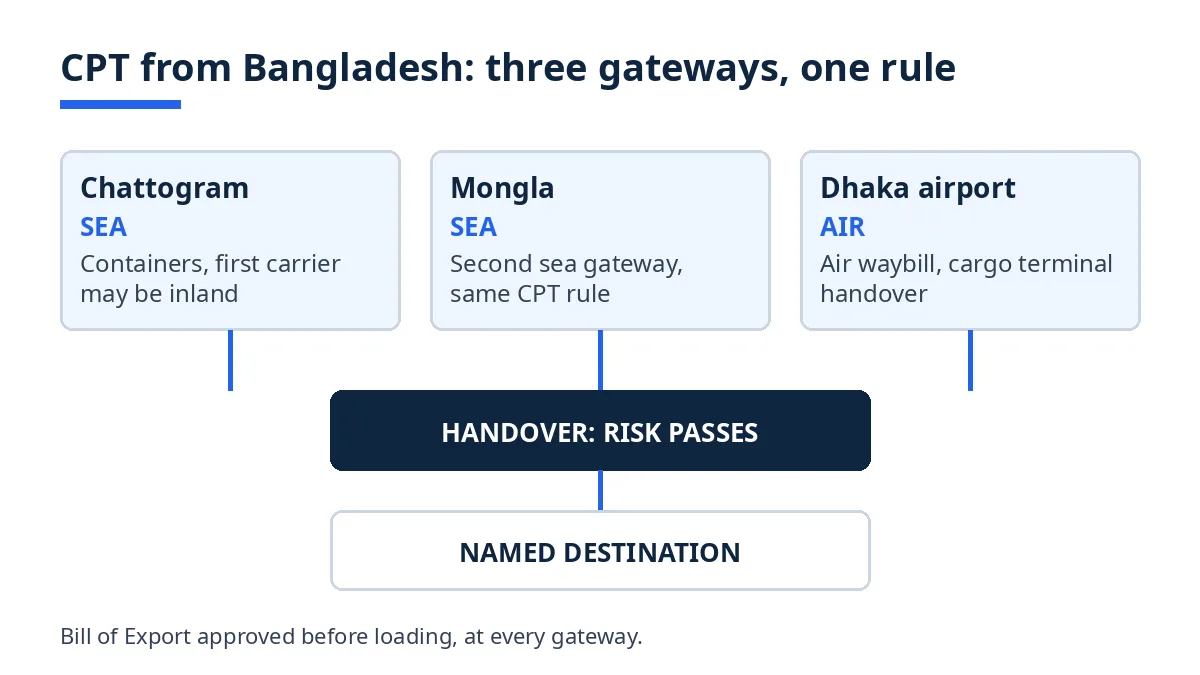
A CPT shipment from Bangladesh is one rule applied through three very different gateways: a sea container out of Chattogram, a sea shipment out of Mongla, or an air consignment out of Dhaka airport. The rule does not change between them. What changes is where the goods are handed to the first carrier, which transport document proves that handover, and how the freight is priced. This guide follows a CPT shipment from the factory gate to the named destination, gateway by gateway, with the costs, documents, and mistakes that belong to each.
Why CPT fits Bangladesh shipments, and where it does not
CPT fits Bangladesh exports well because it is one of the 11 Incoterms 2020 rules and works for any mode of transport, including sea, road, rail, air, and combinations.1 2 A consignment that starts on a truck, moves through an inland container depot, and then sails from Chattogram is a multimodal movement, and CPT covers it with a single term: delivery at handover to the first carrier, carriage paid to the named destination.1 The same term covers an urgent air consignment handed to an airline at Dhaka airport, where sea-only terms such as CIF and CFR cannot apply at all, because there is no vessel and no on-board moment.3
CPT also fits the way many Bangladeshi sellers sell. The seller contracts the carriage and pays the freight to the destination the buyer names, which keeps one party in charge of routing, while the buyer keeps control of insurance and import clearance.4 That division suits buyers who already have cargo cover in place, or who prefer to arrange it themselves from the handover date.
CPT does not fit every Bangladesh shipment. For bulk or breakbulk sea cargo loaded directly onto a vessel, CFR or CIF match the physical event of loading better, and CIF adds the seller insurance duty some buyers want.4 For a buyer who wants the seller to carry the risk to the destination, DAP records that bargain and CPT does not.4 And for a buyer who nominates the carrier and wants to control freight pricing, FCA is the closer term, since under FCA the buyer arranges and pays the main carriage.4 Choose the term that matches the bargain, then use it consistently across the quotation, the contract, and the documents.
Step by step: a CPT shipment from factory gate to named destination
Agree the term, both places, and the gateway. Write the contract as "CPT [named place of destination], Incoterms 2020", and add the place and point of delivery, for example delivery at the carrier's terminal at the inland container depot. Name the gateway the shipment will use, and the mode or modes for the main carriage. Parties are strongly encouraged to agree the delivery place as precisely as the destination, because the delivery point is where risk passes.1
The seller prepares the goods and completes export formalities. The seller packs the goods for the modes agreed, and completes export clearance at its own cost.1 Goods may not be loaded for export in Bangladesh until a Bill of Export has been submitted to Customs and approved, with the documents Customs lists for the consignment, including the signed invoice, the packing list, the AD-certified EXP form, and the certificate of origin.5
The goods are handed to the first carrier. This is delivery under CPT, and risk passes to the buyer at this moment. The first carrier may be a trucking company collecting at the factory gate, a carrier at an inland depot, or an airline at the airport cargo terminal. Delivery is complete at handover, not when the goods are loaded onto a vessel or aircraft.1
The seller gives notice and the buyer arranges cover. The seller must notify the buyer in a timely manner that delivery has occurred, with the information needed to receive the goods at the destination.1 The buyer uses that notice as the trigger for cargo insurance from the handover date, since the seller owes no insurance under CPT.1
The main carriage runs to the named destination. The seller's carriage contract carries the goods across every leg to the destination named in the contract, at the seller's cost, while the risk of loss or damage during that carriage is the buyer's.1 At a sea gateway, the leg is the ocean crossing. At Dhaka airport, it is the flight. In a multimodal movement, it is the chain of legs the seller contracted.
The buyer clears the goods and moves them onward. At the destination, the buyer completes import formalities, pays duty and taxes, and arranges and pays for any transport beyond the named destination.1 The buyer checks the arrival notice against the transport document, and collects the goods against the document the carrier requires for that mode.
The diagram below follows the same six steps, with the gateway handover marked as the risk point.
Costs, timelines and documents: what to budget and what to ask for
A CPT quotation from a Bangladeshi supplier should show the goods, the export costs, and the carriage to the named destination as separate lines. Ask for each line in writing, and compare quotations only on the same term, the same named destination, and the same gateway.
Example figures only. Confirm freight, duty, and premium positions with a forwarder and a broker before ordering.
Element of the example CPT price | Example figure (USD) |
|---|---|
Goods and export packing | 35,000 |
Export clearance and origin handling | 1,100 |
Inland movement to the gateway | 800 |
Ocean carriage to the named destination | 3,700 |
Other export and carriage charges | 600 |
CPT contract price | 41,200 |
The example is a sea shipment of woven garments, CPT New York, with handover to the first carrier at an inland container depot and loading at Chattogram. Cargo insurance is not in the price: the buyer arranges separate cover from the handover date, shown here as an example premium of USD 240 outside the CPT price. Duty, import clearance, and onward transport from New York are also outside the price, and they are buyer costs at destination.1 4
Timelines under CPT are set by the mode and the route, not by the term. A sea shipment and an air shipment under the same CPT term have different transit times, different cut-off times at the gateway, and different document deadlines. Do not accept a timeline quoted for one mode as a promise for another. Ask the forwarder for the cut-off time for the gateway and mode booked, the sailing or flight schedule, and the date the transport document will be available, and put the delivery date or period in the contract.1
The document set follows the mode. The seller provides the commercial invoice, the packing list, the transport document for the mode used, the delivery notice, the certificate of origin where required, and the Bill of Export set for export clearance.5 For air, the transport document is the air waybill, a non-negotiable document that records the carrier, shipper, and consignee, the departure and destination airports, and the freight prepaid notation.1 3 For sea, it is the bill of lading or multimodal bill of lading. The buyer provides the insurance document and the import set. No seller insurance document is due under CPT, and waiting for one only delays the file.1
Bangladesh gateways and rules: Chattogram, Mongla and Dhaka airport
Chattogram, by sea. The main sea gateway for container shipments. Under CPT, the first carrier handover may happen well before the port: at the factory gate, at an inland container depot, or at a terminal. The risk point is that handover, not the loading at Chattogram. Name the handover point in the contract, and check that the transport document records it. Where goods are loaded into containers at private inland depots or at the exporter's premises, Customs officers may check the goods before they proceed to the port area.5
Mongla, by sea. A second sea gateway, used where routing or the buyer's destination makes it the better port. The CPT rule is the same, and the same care applies: name the delivery point and the destination separately, and confirm which leg the seller's carriage contract covers. A CPT price to a named destination through Mongla should state the port in the carriage details, so the buyer is not charged twice for a leg the seller already paid for.
Dhaka airport, by air. The air gateway, for urgent, high-value, or small consignments. CPT is a natural fit here, because the ICC's any-mode rules, including CPT, are the ones that apply to air freight, while FOB, CFR, and CIF belong to sea and inland waterway transport only.3 Delivery happens when the goods are handed to the airline or to the carrier at the cargo terminal, and the air waybill is the transport document. The seller pays the air freight to the named destination airport, and the buyer clears the goods for import and arranges onward transport.1 3
Export clearance rules that apply at every gateway. Section 131 of the Customs Act, 1969 requires Customs clearance for export, and goods shall not be loaded or stuffed for export unless an export declaration, the Bill of Export, has been submitted and approved by Customs.5 The documents enclosed with the Bill of Export are the same at every gateway: the export letter of credit or contract, the signed commercial invoice, the packing list, the AD-certified EXP form, the certificate of origin, the VAT registration certificate, and the Taxpayer Identification Number.5 Product-specific permits apply on top of that list where the product requires them, such as the Export Registration Certificate for jute, jute goods, and tea.5
Mistakes and red flags
A quotation that names only the destination. Without a delivery point and a gateway, the risk point is undefined. Ask for both places in writing before booking.1
A sea term on an air shipment. FOB, CFR, or CIF on a Dhaka airport consignment leaves the risk point undefined, because there is no vessel and no on-board moment, and the air waybill does not fit the bill of lading assumptions behind those terms.3 Use CPT or CIP for seller-arranged air carriage, and FCA where the buyer arranges it.3
Freight quoted to the wrong destination. A CPT price to one port does not cover onward carriage to another. Check that the named destination in the quotation, the contract, and the transport document are the same place, and that the freight is marked prepaid to that place.1 4
Insurance assumed, not arranged. The most expensive mistake on a CPT shipment is an uninsured main leg. Arrange cover from the handover date, on the seller's delivery notice, or change the term to CIP so the seller must arrange it.1
A supplier who cannot name the first carrier. If the seller cannot say who the first carrier is, or where handover will happen, the delivery point is not agreed. Do not confirm the booking until it is stated in writing, with the gateway and the mode.
Documents built from different data. A quantity, weight, or place that differs between the invoice, the packing list, and the transport document will hold the set at the destination. Build every document from the invoice, and check the set before handover.
Checklist: before you confirm a CPT booking
The contract names the destination, the delivery point, the gateway, and the modes, with "Incoterms 2020" stated.
The quotation shows goods, export costs, and carriage as separate lines, with freight prepaid to the named destination.
The first carrier and the handover place are stated in writing.
The buyer has arranged cargo insurance from the handover date, or the term has been changed to CIP.
The Bill of Export set is complete, with the AD-certified EXP form and the certificate of origin enclosed.
The transport document for the mode is agreed, and the delivery notice will be sent on the day of handover.
Import requirements at the destination are confirmed, including who acts on the arrival notice.
Next steps on Exportain
Read the full rule in the Incoterms guide for shipments from Bangladesh, compare the sea-only counterpart in the CIF cost, insurance and freight guide, and work the buyer-side costs into your landed cost for imports from Bangladesh. The how to buy guide explains the buying steps on Exportain.
Post a free RFQ on Exportain and get quotes from Bangladeshi suppliers → https://exportain.com/rfqs
What should I know first about CPT?
CPT stands for Carriage Paid To. The seller delivers the goods to the first carrier, pays carriage to a named place of destination, and completes export formalities, while risk passes to the buyer at handover to that carrier. CPT works for any mode, and the seller has no obligation to insure the goods.1
What are the typical costs and timelines?
The CPT price covers the goods, export packing and clearance, and carriage to the named destination. Insurance, import clearance, duty, and transport after the destination are buyer costs. Timelines depend on the mode and route: a sea shipment and an air shipment under the same CPT term have different transit times and gateway cut-offs, so confirm the schedule for the mode booked.1 4
Which documents are needed?
The seller provides the commercial invoice, packing list, transport document for the mode used, delivery notice, certificate of origin where required, and the Bill of Export set with the AD-certified EXP form. The buyer provides the insurance document and the import set. No seller insurance document is due under CPT.1 5
What are the most common mistakes?
Naming only the destination and leaving the delivery point undefined, using a sea term on an air shipment, accepting freight quoted to the wrong destination, assuming insurance is included, and building documents from different data. Each is fixed the same way: name both places and the gateway in the contract, arrange cover from handover, and check the document set against the invoice before the goods move.
Sources
- CPT & CIP Incoterms 2020 explained: Key differences. ICC Academy (accessed )
- Incoterms® 2020. International Chamber of Commerce (ICC) (accessed )
- Air Freight Incoterms: Use FCA, Not FOB. Ovrseas (accessed )
- CPT (Carriage Paid To) Meaning in Incoterms: Risk Transfer and Who Pays. GoFreight, (accessed )
- Customs Clearance Procedures for Export. Bangladesh Customs, National Board of Revenue (accessed )
About the author
Sourcing from Bangladesh?
Post a request for quotation and suppliers on Exportain can send you their quotes directly.
Post an RFQ


