

CPT Freight Cost: Who Pays and How It Is Calculated
CPT freight cost: the seller pays carriage to a named, possibly inland, destination, while risk passes at first-carrier handover. How each leg is calculated, and which destination charges stay with the buyer.
Short answer
Under CPT, the seller contracts and pays carriage to the named place of destination, which may be an inland terminal, while risk passes to the buyer when the goods are handed to the first carrier. The buyer pays import clearance, duties and taxes, onward transport, and any destination charges outside the carriage contract, and arranges insurance from handover, since CPT imposes no insurance duty on the seller.
On this page
Key takeaways
Under CPT the seller contracts and pays carriage to the named place of destination, which may be an inland terminal, while risk passes to the buyer at handover to the first carrier.
CPT works for any mode of transport, including multimodal journeys, and the seller has no obligation to insure the goods, so the buyer arranges cover from the handover date.
Air legs bill the greater of actual and volumetric weight using the IATA divisor of 6,000, full containers bill a flat container rate, and shared loads bill the greater of weight and volume.
Destination terminal handling and unloading sit inside the seller-paid carriage only where the carriage contract says so; otherwise the buyer pays them on arrival, along with import clearance, duty, and onward transport.
A CPT freight cost quotation can look like a delivered price. It is not. The CPT freight cost is the seller-paid carriage to a named place of destination, which may sit inland, far past the port where the goods arrive. Risk, meanwhile, passed much earlier, when the seller handed the goods to the first carrier. This guide prices one such journey leg by leg.
CPT stands for Carriage Paid To. It is one of the 11 Incoterms 2020 rules published by the International Chamber of Commerce (ICC), and it works for any mode of transport, including combinations of modes.1 The seller contracts and pays for carriage to the named place of destination, completes export formalities, and meets transport security requirements at its own cost and risk.1 Neither party is obliged to insure the cargo under CPT, so the buyer arranges any cover from the handover point if cover is wanted.2
Two points decide every CPT freight bill
Every CPT quotation rests on two places, and confusing them creates most CPT disputes. The place of delivery is where the seller hands the goods to the carrier the seller contracted, usually in the exporting country.1 The named place of destination is the point written after the letters CPT, usually a port, airport, or terminal in the buyer's country, to which the seller must arrange and pay for transport.1 Risk transfers at the first of these places. The freight bill runs to the second.
Parties are encouraged to agree the place of delivery as precisely as the destination.1 Where the delivery place is not agreed, the seller may choose the place and point that best suits its purpose.1 Name both places in the contract, with the same care, before the goods move.
Write the citation in full on every document: "CPT [named place of destination], Incoterms 2020", plus the delivery place and point on a separate line. In the worked example below, the citation reads "CPT Duisburg inland terminal, Germany, Incoterms 2020", with delivery at an inland depot in Bangladesh.
The split also decides the insurance start date. The seller must notify the buyer in a timely manner that delivery has occurred, and provide the information the buyer needs to receive the goods at the destination.1 Treat that notice as the trigger for cover from the handover date, since delivery does not wait for loading.1
How the CPT freight cost is calculated when the mode changes
A CPT carriage figure is rarely one rate. Where several carriers handle successive legs, the seller contracts the chain and pays carriage across it to the named destination, even though delivery occurred at the first handover.1 Each leg is billed on its own basis, so a quotation showing only a single carriage total hides the basis on which each leg was priced.
Air legs are billed on chargeable weight
On an air leg, the airline bills the greater of actual weight and volumetric weight. Volumetric weight converts the space cargo takes up into kilograms using the IATA standard divisor of 6,000: multiply length, width, and height in centimetres, then divide by 6,000.3 Chargeable weight is the higher of the two figures, so a large, light carton can cost more to fly than a small, heavy one.3
Example figures: one carton of 120 cm by 80 cm by 100 cm gives a volumetric weight of 160 kg, billed ahead of a 100 kg scale weight.3 Confirm the carrier's divisor and rounding rule, since some express services use 5,000.3
Sea legs split between full containers and shared loads
For a full container load (FCL), the carrier charges a flat rate for the exclusive use of the container, regardless of whether the shipper fills it completely.4 For a less than container load (LCL), cargo shares a container, and the charge follows the greater of weight and volume: one cubic metre counts as one unit, and one metric ton counts as one unit, and the higher figure is billed.4 LCL also carries consolidation, deconsolidation, and container freight station fees.4 Price both options on the same cargo before choosing.
Road and rail legs follow the inland destination
CPT is the rule buyers reach for when the destination is inland, because the seller's carriage duty can run past the port to a rail terminal or inland depot. A road or rail leg is normally priced per shipment, per vehicle, or per container for the distance and route, with its own handling and terminal lines. Name the terminal, town, and country, and ask whether the carriage figure includes unloading there.
Fuel, currency, peak season, and security surcharges each have their own basis and date, so list them separately with the date that fixes each one.
The seller-paid chain, leg by leg
The diagram below follows the carriage chain in the order the charges arise, from handover to the named destination. The payer changes only at the destination terminal and at import clearance, which is why those two boundaries need written confirmation before sailing.
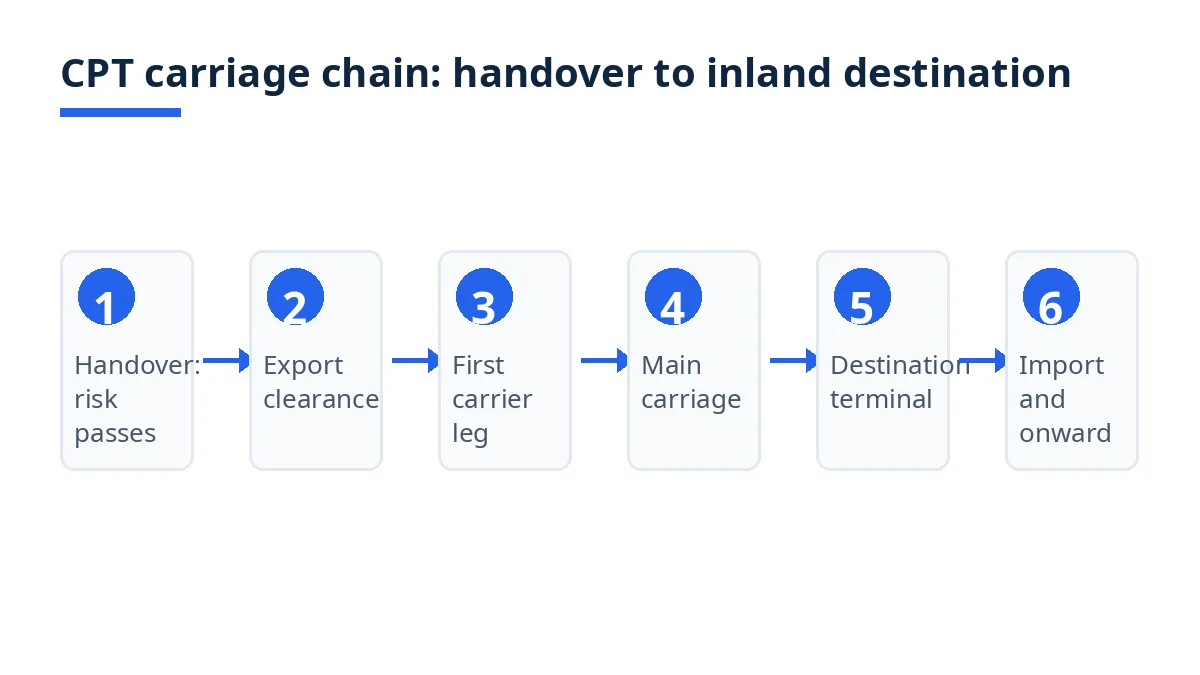
The seller packs the goods, completes export formalities, and hands them to the first carrier at the agreed delivery point.1 Delivery is fulfilled at that handover and does not wait for loading.1 From that moment, the buyer bears the risk of loss or damage, even though the seller keeps paying for carriage to the named destination.1 The seller then pays carriage across every leg, including any transshipment, and the transport document should cover the full contracted carriage, not only the first leg. At the destination, the buyer completes import formalities and pays for onward transport.1
Destination charges: what the carriage contract may already cover
Destination charges are the most common second bill in a CPT file, because the same phrase names charges on both sides of arrival. Terminal handling, unloading, delivery order, and storage lines can sit inside the seller-paid carriage contract or outside it, and only the contract decides which. In the ICC Academy worked CPT case, the contract of carriage included unloading charges at the destination, so those charges were for the seller's account under that contract.1
Ask the seller, in writing, for each destination line separately: terminal handling, unloading, delivery order or release fee, and storage or demurrage. Where the carriage contract already covers a line, the destination agent should not invoice the buyer for it again.
Unloading deserves its own line. CPT ends at the named destination place, and unloading is for the buyer unless the carriage contract or a separate agreement says otherwise. Demurrage, detention, and storage follow the same logic: they are time charges that run once free time ends, and Incoterms 2020 does not fix who bears them, so the carriage contract and the forwarder's quotation must state the position. Appoint the destination broker before sailing and record the free days.
Worked example: one multimodal shipment priced to an inland terminal
Example figures below are illustrative only, not a quotation or market rate. Confirm every line with a forwarder and a broker.
A buyer agrees "CPT Duisburg inland terminal, Germany, Incoterms 2020" for 8,000 knit polo shirts. The seller hands the goods to the first carrier at an inland depot, and the container moves by road, sea, and rail to Duisburg, at the seller's carriage cost.
Example line | Example figure (USD) | Payer |
|---|---|---|
Goods value, 8,000 polo shirts | 32,000 | Buyer, to the seller |
Export packing, clearance, and haul to the depot | 480 | Seller, inside the CPT price |
Carriage: depot to Chattogram, sea to Hamburg, rail to Duisburg | 2,650 | Seller, inside the CPT price |
Destination terminal handling, inside the carriage contract | 0 | Seller, already inside the carriage figure |
Example CPT price | 35,130 | Goods plus seller-paid build |
Cargo insurance from the handover date | 210 | Buyer, outside the CPT price |
Import clearance and broker fee at Duisburg | 260 | Buyer |
Duty and tax | Per broker schedule, not in the example total | Buyer |
Onward transport, Duisburg terminal to the warehouse | 340 | Buyer |
Example buyer-paid lines before duty and tax | 810 | Buyer |
Destination handling shows as zero only because this example contract includes it; on another contract it is a buyer charge. Insurance sits outside the CPT price because CPT imposes no insurance duty on the seller.2 Budgeting only the CPT price under-budgets arrival by USD 810 before duty and tax.
Leaving Bangladesh: the export papers and the inland handover
Export clearance belongs to the seller under CPT, and it gates the shipment before the first carrier moves.1 In Bangladesh, goods shall not be loaded or stuffed for export unless an export declaration, known as the Bill of Export or Shipping Bill, is submitted to Customs and approved.5 The declaration carries the description of goods, value, exporter and buyer names, and transport operator details.5
The standard enclosure set includes the export letter of credit or approved contract, commercial invoice, packing list, EXP form certified by an Authorized Dealer bank, certificate of origin, VAT certificate, and Taxpayer Identification Number.5 Product-specific documents sit on top of that set where the product requires them, including the export registration certificate for jute, jute goods, and tea.5 Confirm which product-specific documents the consignment needs before the handover window.
The handover point needs the same written care as the papers. Suppliers may hand goods to the first carrier at the factory, at an inland depot, or at a terminal, and each handover starts the buyer's risk and insurance period at a different point and date. Ask every supplier to name its handover point in the same form. Where goods are loaded into containers at a private inland container depot or at the exporter's premises, Customs may check the goods before they proceed to the port area.5 Keep the carrier receipt with the delivery notice.
Four mistakes that move cost or risk without a signature
Reading prepaid freight as seller risk. The seller pays carriage to the named destination, but risk passed at the first carrier handover. Damage during the main leg is the buyer's risk, and without cover arranged from the handover date, the buyer carries the loss.1
Assuming destination handling is inside the price. Terminal handling and unloading at the destination follow the carriage contract. In one ICC Academy case the contract included destination unloading charges, and in another contract the same charges fall to the buyer.1 If no document names the line, treat it as the buyer's until confirmed otherwise in writing.
Leaving the delivery point unnamed while naming the destination. A contract that names only Duisburg does not say where risk passed. Name the place and point of delivery, the first carrier, and the handover date or period, with the same precision as the destination.1
Comparing a CPT price with a CFR or CIF price as if they covered the same journey. CFR and CIF are sea and inland waterway rules only, with risk passing on board the vessel at the port of shipment, while CPT works for any mode and moves risk at the first carrier handover.6 CIF also adds seller-bought minimum insurance, which CPT does not.6
Quotation checklist: get these lines in writing before handover
Rule, named place of destination, delivery place and point, first carrier, and Incoterms 2020 stated on the contract, quotation, invoice, and transport document, in identical wording.1
Carriage build shown leg by leg, with surcharges listed separately.7
Shipment shape confirmed for each leg: container size, or weight, volume, and chargeable quantity.3 4
Destination lines confirmed one by one: terminal handling, unloading, delivery order or release fee, storage, demurrage, and detention, each marked inside or outside the carriage contract.1
Insurance position stated: buyer-arranged cover effective from the handover date, or a separate agreement that the seller will arrange cover, with the clause and value named before handover.2
Export set complete and approved before handover, including the Bill of Export and its enclosures.5
Import broker appointed before sailing, with duty and tax to be confirmed from the destination schedule for the confirmed code, and onward transport from the named destination priced in writing.
Delivery notice agreed, with handover place, date, carrier, and transport document details.1
What should I know first about CPT?
CPT stands for Carriage Paid To. Under CPT, the seller delivers the goods to the first carrier, contracts and pays for carriage to a named place of destination, and completes export formalities, while risk passes to the buyer at handover to that carrier.1 CPT works for any mode, including multimodal journeys, and the seller has no obligation to insure the goods.2 The buyer pays import clearance, duty, and onward transport, and arranges insurance from handover.6
What are the typical costs and timelines?
There is no typical CPT freight cost or transit time that holds for every order, because cargo form, mode, route, gateway, and destination schedule all change the total. The structure is stable: a seller-paid carriage build to the named destination, plus buyer-paid insurance, destination charges, clearance, duty, and onward transport. Ask for separate dates: price expiry, handover window, departure, arrival window, and free time. Record the delivery notice as the start of the risk and insurance period.1
Which documents are needed?
The seller-side set is the commercial invoice showing the CPT price and the named destination, the packing list, the export clearance papers including the approved Bill of Export with its enclosures, and the transport document covering carriage to the named destination.5 6 The buyer-side set is the import declaration papers, the duty and tax assessment, and the insurance policy or certificate for cover arranged from the handover point.6 The transport document should cover the full contracted carriage, and its handover place and date should match the contract.
What are the most common mistakes?
Treating the named destination as the risk point, leaving the delivery point unnamed, assuming insurance is included, and accepting destination handling twice, once inside seller-paid carriage and once from the destination agent. Each is fixed the same way: name both places and the first carrier in the contract, arrange cover from the handover date, and confirm in writing which destination charges the carriage contract already covers before the goods sail.1 2
Next steps on Exportain
Read the Incoterms guide for shipments from Bangladesh to place CPT among the eleven rules, then work the buyer-side lines into your total with the landed cost guide for imports from Bangladesh. When your specification and destination are settled, see how to buy on Exportain, where an RFQ states quantity and unit, target price, destination, Incoterm, required certifications, and deadline.8
Post a free RFQ on Exportain and get quotes from Bangladeshi suppliers → https://exportain.com/rfqs
Sources
- CPT & CIP Incoterms 2020 explained: Key differences. ICC Academy (accessed )
- CPT Incoterms 2020: Meaning, Costs and Responsibilities. Crane Worldwide Logistics, (accessed )
- Chargeable Weight Calculator: Air & Sea. Freightos, (accessed )
- FCL vs. LCL: How to Choose the Right Ocean Freight Strategy in 2026. Gateway Cargo, (accessed )
- Customs Clearance Procedures for Export. Bangladesh Customs, National Board of Revenue (accessed )
- CPT (Carriage Paid To) Meaning in Incoterms: Risk Transfer and Who Pays. GoFreight, (accessed )
- Incoterms® 2020. International Chamber of Commerce (ICC) (accessed )
- How to source and buy from Bangladesh. Exportain (accessed )
About the author
Sourcing from Bangladesh?
Post a request for quotation and suppliers on Exportain can send you their quotes directly.
Post an RFQ


