

Who Handles Customs Clearance Under CPT? Export vs Import Explained
CPT customs clearance: export filing by the seller before handover to the first carrier, import filing and duty by the buyer at the named destination, with no seller insurance duty.
Short answer
Under CPT, the seller clears the goods for export and pays carriage to the named place of destination, while the buyer clears the goods for import at that destination and pays the duty and taxes assessed there. Risk passes to the buyer when the goods are handed to the first carrier, which can be long before the destination. The seller has no obligation to insure the goods, so the buyer arranges cover from the handover date.
On this page
Key takeaways
Under CPT, the seller clears export customs and pays carriage to the named place of destination, while the buyer clears import customs at that destination and pays the duty and taxes assessed there.
Risk passes to the buyer at handover to the first carrier, which can be far earlier than the named destination, and CPT works for any mode of transport. The seller has no obligation to insure the goods.
In Bangladesh, export clearance means an approved Bill of Export, under section 131 of the Customs Act, 1969, with the letter of credit or contract, invoice, packing list, EXP form, certificate of origin, VAT certificate and TIN enclosed.
In the European Union, the buyer needs an EORI number, the entry summary declaration must meet mode-based deadlines, and goods are released for free circulation only once duties are paid and licences and authorizations are presented.
No duty rate or typical timeline is stated in this guide. Confirm every rate, charge and deadline with the destination broker against the live schedule.
CPT customs clearance is decided by two places, not one border crossing. The seller clears the goods for export before handing them to the first carrier, and the buyer clears the goods for import at the named place of destination and pays the duty and taxes assessed there. Between those two places, the seller keeps paying carriage while the buyer carries the risk, and no filing by either side covers the goods in transit.
This guide is for a buyer importing from Bangladesh into the United States, the United Kingdom, the European Union or the United Arab Emirates on CPT terms. It states no duty rate and no typical timeline as fact. Every rate, charge and deadline for a real shipment comes from the destination broker and the live tariff schedule.
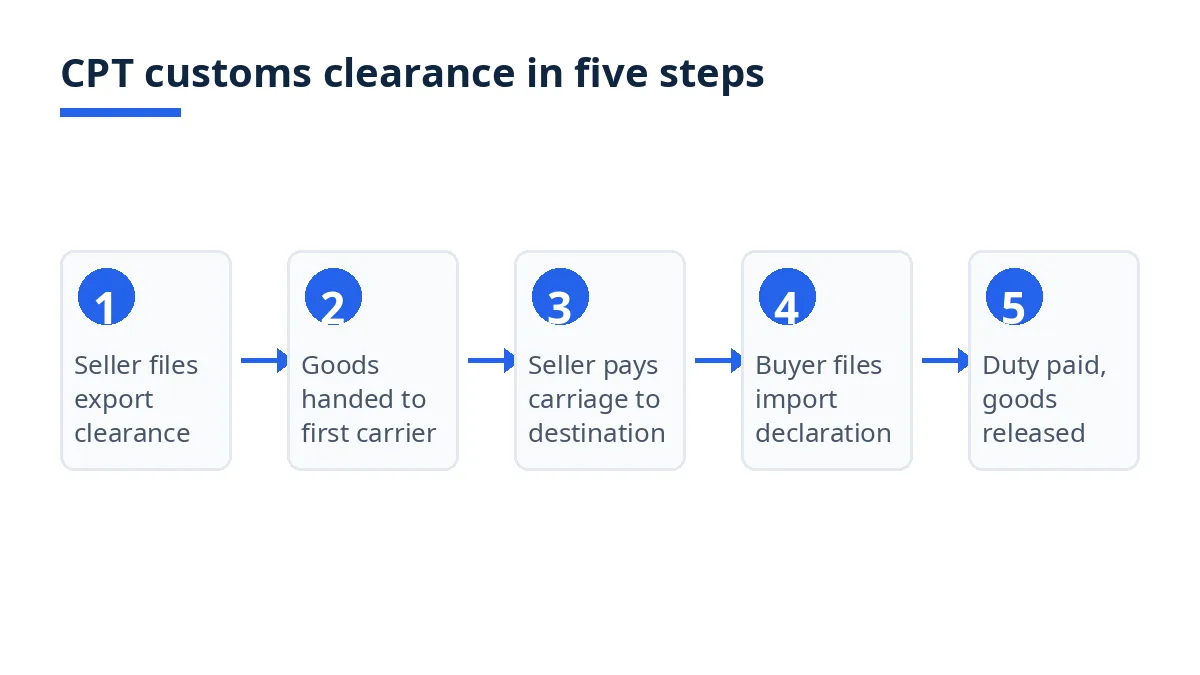
The two places that decide CPT customs clearance
Under CPT, Carriage Paid To, the seller delivers the goods to the first carrier, contracts and pays for carriage to a named place of destination, and completes export formalities, while risk passes to the buyer at handover to that carrier.1 2 CPT works for any mode of transport, including sea, road, rail, air and combinations of modes.2 The Incoterms 2020 rules set out security-related obligations on export and import clearance in the clearance articles of each rule, and gather the costs for each rule in a consolidated costs article.3
Place | What happens there | Customs filing | Owner |
|---|---|---|---|
Place of delivery | Goods are handed to the first carrier the seller contracted | Export clearance, completed before the goods move on | Seller |
Named place of destination | The seller's carriage contract ends | Import clearance, with duty and tax assessed | Buyer |
The delivery point may be a factory gate, depot, terminal or warehouse. The destination may be a port, airport or inland terminal. Write the term in full, for example "CPT Hamburg inland terminal, Incoterms 2020, delivery at the carrier depot, Gazipur". If the delivery place is not agreed, it must be clearly specified in the contract, because that is where risk transfers.2
Export clearance: the seller's filing before handover
Export clearance under CPT belongs to the seller. The seller completes export clearance and associated costs, delivers the goods to the first carrier, and contracts and pays for main transport to the agreed destination.2 The seller also provides documentation, including the commercial invoice and proof of delivery, and notifies the buyer of any requirements for cargo reception.2
For a shipment from Bangladesh, the export filing has a clear gate. Section 131 of the Customs Act, 1969 requires clearance of customs for export, and goods shall not be allowed to load or be stuffed in containers or a ship for export unless an export declaration, known as the Bill of Export or Shipping Bill, is submitted to Customs in the prescribed format and approved by the customs authority.4 The declaration specifies the description of goods, the value, the name of the exporter, the name of the foreign buyer or importer, and the name of the transport operator.4
The enclosures for the Bill of Export are the export letter of credit, or, where there is none, the approved export contract, purchase order or export guarantee; the signed commercial invoice; the packing list; the EXP form certified by authorized dealers; the certificate of origin, issued by the Export Promotion Bureau or a Chamber of Commerce and Industry; the VAT registration certificate; and the taxpayer identification number.4 Product-specific papers sit on top of that set where they apply, such as an Export Registration Certificate for jute, jute goods and tea.4
The buyer's work on the export side is checking, not filing. Ask for the invoice and packing list before handover, and check that names, description, quantities and values match the purchase order and the certificate of origin. A mismatch found before handover can still be corrected. The same mismatch at the destination becomes a query on the import declaration. Do not hold a CPT shipment for a seller insurance document. CPT does not require the seller to contract for cargo insurance, unlike CIP.1
The handover gap: carriage continues, clearance does not
Handover is where the two clearances separate. The seller's carriage contract runs on to the destination, but the seller files nothing further there. Loss or damage after handover is the buyer's risk, even though the seller still pays the freight.1 Where several carriers are involved, delivery still occurs at handover to the first carrier, and the seller pays carriage across the whole chain.2
That gap is why the delivery notice and the transport document carry more weight under CPT than under a sea-only term. The transport document records the carrier, the places of receipt and destination, and the freight-prepaid position, and the delivery notice fixes the date from which the buyer's cover and destination preparation run. Ask the seller to send both promptly after handover, and check that the handover place and date match the delivery point in the contract. If the goods move through a third country, ask the destination broker, before handover, which transit formalities apply.
Destination charges also sit in this gap. Unloading and inland transport after the destination are buyer costs where the seller's contract does not include them, and import clearance is a buyer cost.2 Ask the seller which charges sit inside the carriage price, and ask the broker to confirm the list.
Import clearance: the buyer's filing at the named destination
Import clearance under CPT belongs to the buyer. The buyer handles import clearance, including duties, VAT and taxes, and arranges insurance if cover is wanted.2 The buyer may file directly or appoint a broker, but the filing and the duty remain the buyer's. Appoint the broker before handover, not on arrival.
In the European Union, plan around three fixed features. The Economic Operators Registration and Identification (EORI) number is a unique identifier assigned by a customs authority in an EU country to economic operators, and importers established outside the EU are assigned an EORI the first time they lodge a customs declaration, an entry summary declaration or an exit summary declaration.5 The entry summary declaration carries advance cargo information so customs can conduct a risk analysis, with deadlines by mode: container maritime cargo at least 24 hours before loading commences in the foreign port, long-haul flights at least 4 hours before arrival at the first airport, and road traffic at least 1 hour before arrival.5 It requires information in documents originating with the exporter, such as the bill of lading and commercial invoices, so those documents must reach the lodging party in time.5 On arrival, goods are placed into temporary storage under customs supervision for no longer than 90 days, and release for free circulation follows once duties and other charges are paid, import licenses for quota goods are presented, and authorizations and certificates are presented.5 The date the declaration is accepted is also the date used for the duty, VAT and excise calculation.5
In the United Kingdom, import declarations are made on the Customs Declaration Service, and a buyer who has used that service can pay what is owed straight away, with a penalty, interest or both if payment misses the deadline.6 Ask the broker about deferment and postponed VAT accounting, and confirm the payment route before arrival. This guide states no UK duty rate.
In the United States and the United Arab Emirates, the same buyer-side structure applies in outline: the buyer, or the broker the buyer appoints, files the import declaration and settles the assessed charges. This guide states no filing system, registration number or duty rate for either destination, because none was verified for this guide. Confirm the filing route, importer registration, customs value basis and every rate with the destination broker before handover. Confirm the importer of record and that names match across both sets. An informal promise that duty is included in a CPT price should be treated as unconfirmed until it appears in the contract with a named duty-paid rule.
Who pays duty, tax and the charges between the two places
Duty and tax are assessed at the destination, on the import declaration, and they are buyer lines under CPT. The CPT price covers the goods, export packing and clearance, and carriage to the named destination, and it does not include cargo insurance, import clearance, duty or onward transport.1 2 Customs value is a destination-country question. In the EU, the date the declaration is accepted is the date used for the duty, VAT and excise calculation.5 Elsewhere, ask the broker which value the destination uses, whether freight and insurance form part of it, and whether any preference for Bangladesh-origin goods reduces the rate. No preference is assumed in this guide.
The example below shows the structure, not a quote. Every figure is an example figure only.
Cost element | Example figures (USD) | Owner |
|---|---|---|
CPT price: goods, export clearance and carriage to the named destination | 14,200 | Seller, inside the CPT price |
Cargo insurance arranged by the buyer from the handover date | 110 | Buyer, outside the CPT price |
Destination broker fee | 180 | Buyer |
Destination terminal handling not in the carriage contract | 240 | Buyer, confirm with broker |
Import duty | Your figure, confirm with broker | Buyer |
Onward transport from the named destination to the warehouse | 190 | Buyer |
Total excluding duty and import tax | 14,920 | Buyer cost on top of the CPT price |
Import VAT or a similar tax is separate from duty, and its treatment depends on the destination and on whether the buyer can reclaim it. Confirm the rate, base and reclaim position with the broker and the accountant before pricing. There is no typical CPT clearance cost or timeline that can be stated as fact. The fixed gates are Bill of Export approval before loading in Bangladesh,4 the EU entry summary declaration deadlines,5 and release in the EU only once assessed charges are paid and licenses and authorizations are presented.5 Ask each broker for its fee and timeline in writing, as a separate line.
Papers that prove each filing
Each paper under CPT proves one filing. The export set proves the seller's filing: the Bill of Export with the enclosures above.4 The transport document and delivery notice prove the handover: carrier, places, freight-prepaid position, and the date risk passed. The import set is built from the seller's papers, and the EU entry summary declaration needs exporter documents in time.5 The full mode-by-mode list is in the CPT documents checklist, and the handover moment is explained in the CPT risk transfer guide. The check on every paper is the same: names, description, quantity, weight, marks, places and values must read the same way on every document.
Where a letter of credit governs payment, build the set from the credit text. Agree the document list and sending dates before handover.
Three CPT clearance traps that look like seller duties
Treating arrival at the destination as clearance. The seller's carriage ends at the named destination, and the buyer's filing starts there. Risk transfers at handover to the first carrier, and import clearance is the buyer's work.1
Treating an inland named destination as a port delivery. CPT destinations are often inland: a terminal, a depot or a warehouse address well away from any port or airport. The seller pays carriage to that inland point, and the buyer still files import clearance and arranges transport beyond it. Check the arrival notice and release procedure at the inland terminal before arrival.
Waiting for a seller insurance document, or reading freight-paid as duty-paid. CPT does not require the seller to contract for cargo insurance, and the buyer arranges cover if cover is wanted.1 The insurance document in the file is the buyer's own. Duty is separate, and no CPT price includes it unless a duty-paid agreement says so.
Clearance sign-off: one page both sides complete before handover
Complete this sign-off before handover, and keep it with the purchase order.
Check | Owner | Done when |
|---|---|---|
CPT term, version, destination and delivery point | Both | Both places named |
Export set assembled | Seller | Confirmed before loading4 |
Bill of Export approved before loading | Seller | Approved copy supplied4 |
Transport document agreed, freight prepaid | Seller | Prepaid position checked |
Delivery notice on handover day | Seller | Date and recipient agreed |
Cargo cover from handover date, or CIP | Buyer | Cover note held |
Destination broker appointed | Buyer | Entry ready |
Registration and advance-declaration data | Buyer | EORI ready; EU data sent in time5 |
Duty, tax and broker charges estimated | Buyer | Estimate filed; no rate assumed |
Onward transport booked | Buyer | Booked for release date |
What should I know first about CPT?
Know the two places before the price. The seller delivers the goods to the first carrier, pays carriage to a named destination, and completes export formalities, while risk passes to the buyer at handover.1 2 CPT works for any mode, and the seller has no obligation to insure the goods.2 The buyer clears import, pays duty and taxes, and arranges transport after the destination.
What are the typical costs and timelines?
No typical costs or timelines can be stated as fact, because duty depends on classification and origin, and charges depend on the port, terminal and mode. The fixed gates are Bill of Export approval before loading,4 the EU entry summary deadlines,5 and EU release only once charges are paid and licenses are presented.5 Confirm every rate and date with the broker.
Which documents are needed?
The seller provides the invoice, packing list, transport document, delivery notice, certificate of origin where required, and the Bill of Export set.4 The buyer provides the insurance document where cover is arranged, and the import set built from the seller's papers.5 No seller insurance document is due under CPT. See the CPT documents checklist for the full set by mode.
What are the most common mistakes?
Treating the destination as the clearance point, leaving the delivery point unnamed, waiting for a seller insurance document, appointing the broker on arrival, and reading a CPT price as a landed cost. Fix each the same way: name both places, arrange cover from handover, appoint the broker before handover, and budget the buyer lines separately.
Next steps on Exportain
Read the Incoterms guide for shipments from Bangladesh, compare the sea-only CIF cost, insurance and freight guide, and work the buyer-side costs into your landed cost for imports from Bangladesh. When ready, see how to buy and browse suppliers.
Post a free RFQ on Exportain and get quotes from Bangladeshi suppliers → https://exportain.com/rfqs
Sources
- CPT Incoterms 2020: Meaning, Costs and Responsibilities. Crane Worldwide Logistics, (accessed )
- CPT Incoterms: Meaning, Freight & Risk. iContainers (accessed )
- Incoterms® 2020. International Chamber of Commerce (ICC) (accessed )
- Customs Clearance Procedures for Export. Bangladesh Customs, National Board of Revenue (accessed )
- Customs clearance documents and procedures. European Commission (accessed )
- Pay for imports declared using the Customs Declaration Service. GOV.UK (accessed )
About the author
Sourcing from Bangladesh?
Post a request for quotation and suppliers on Exportain can send you their quotes directly.
Post an RFQ


