

7 Costly CPT Mistakes Importers Make (and How to Avoid Them)
CPT mistakes that cost importers on Bangladesh shipments: risk passes at the first carrier handover, not at the destination. Seven errors, from unnamed inland delivery points to missing insurance, each with a fix.
Short answer
Under CPT, risk passes to the buyer when the seller hands the goods to the first carrier, while the seller still pays carriage to the named destination. The seven mistakes in this article all come from reading that split the other way round: naming only the destination, assuming insurance is included, and pricing the CPT figure as the warehouse cost.
On this page
Key takeaways
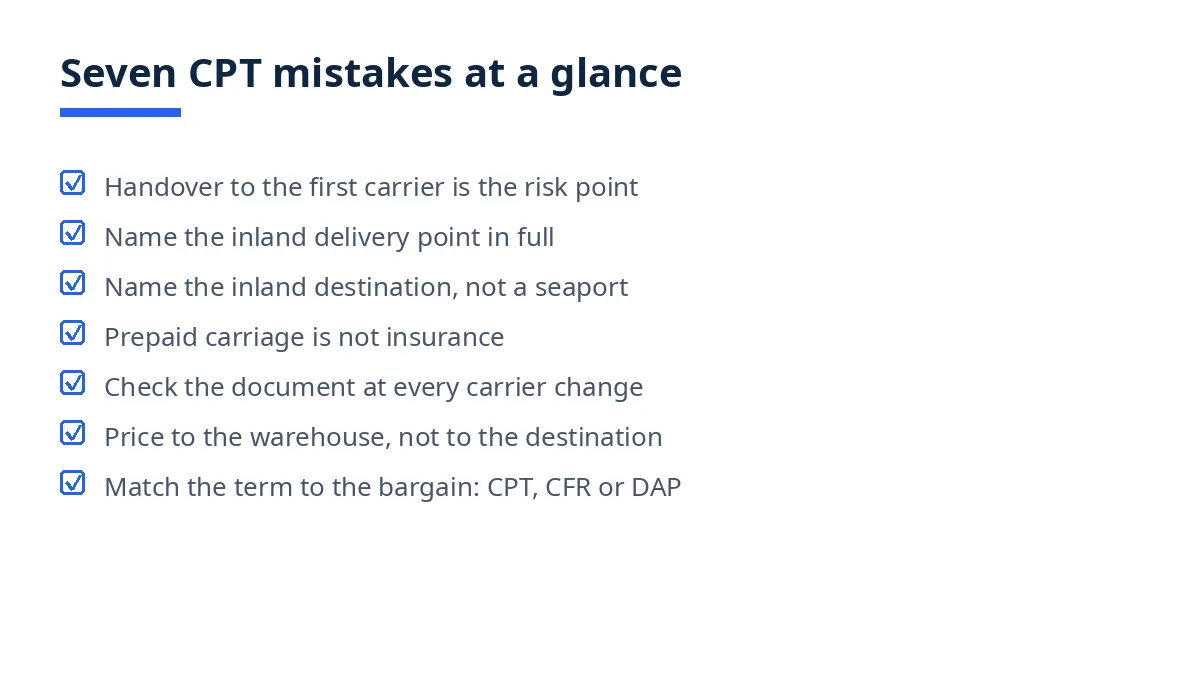
Under CPT, risk passes at handover to the first carrier, while the seller pays carriage to the named destination, which is rarely the same place.
If the contract does not name the inland delivery point, the seller may choose the place and point that suit its purpose.
CPT imposes no insurance duty on either party, so the buyer arranges cover from the handover date or the parties use CIP.
A CPT price ends at the named destination, and unloading, clearance, duty, and onward transport sit with the buyer unless the contract says otherwise.
CPT may record the wrong bargain where delivery at the destination, or a single on-board sea leg, is what the parties agreed.
A carton of knitwear leaves a factory in Gazipur on a truck, is handed to a carrier at an inland container depot, waits there, is loaded at Chattogram, sails, and is then moved by rail to an inland terminal in the buyer's country. Under CPT, the decisive moment happened at the first handover, at the depot, long before the vessel sailed and long before the named destination was reached. The CPT common mistakes in this list all come from reading that chain the other way round, as if risk, cost, and insurance all travelled together to the destination. They do not.
CPT stands for Carriage Paid To. Under Incoterms 2020, the seller delivers the goods by handing them to the carrier it contracted, at the agreed place and point of delivery, and risk passes to the buyer at that handover.1 The seller then pays carriage to the named destination, completes export formalities, and must notify the buyer of delivery.1 The buyer handles import and transit customs, and transport beyond the named destination.1 CPT applies to any mode or combination of modes, and where several carriers are involved, delivery occurs at handover to the first carrier.1
Key points to take away
Under CPT, risk passes at handover to the first carrier, while the seller's carriage payment runs to the named destination.
The delivery point is often inland. If the contract does not name it, the seller may choose it.
CPT imposes no insurance duty on either party. The buyer arranges cover from the handover date, or the parties use CIP.
A CPT price ends at the named destination. Unloading, clearance, duty, and onward transport sit with the buyer unless the contract says otherwise.
When the bargain is delivery at the destination or a single on-board sea leg, CPT may record the wrong bargain.
The CPT common mistakes, in the order the risk moves
Each mistake states the error, the cost, and the fix to agree before the goods move.
1. Treating handover to the first carrier as arrival at the destination
The error. The buyer watches the freight bill, not the handover. The seller pays carriage to the named destination, so the buyer assumes the seller also carries the risk until arrival. Under CPT, delivery is fulfilled once the goods are handed over to the carrier, at the carrier's terminal or warehouse, and delivery does not occur when the goods are loaded onto the aircraft, train, or vessel.1
What it costs. Damage after the first handover is the buyer's risk, even though the goods have not left the exporting country. A carton crushed at the inland depot after acceptance falls on the buyer. The ICC Academy calls the belief that risk transfers at the named destination, rather than at the much earlier delivery point, a common but critical mistake.1
The fix. Write the risk point into the order in one sentence: delivery occurs, and risk passes, on handover to the first carrier at the named delivery point. Date insurance and evidence from that handover, and ask the seller to send the delivery notice that day, with the carrier, place, and document reference.
2. Leaving the inland delivery point unnamed
The error. The contract names the destination in full and says nothing about where delivery happens. The citation for a C term names the destination, not the delivery point, and the ICC Academy encourages parties to agree the specific place of delivery as well as the place of destination.1 The delivery point is often inland: a warehouse, an inland container depot, or a cargo terminal.
What it costs. If the delivery place and point are not defined in the contract or by trade practice, the seller may choose the most suitable locations for both delivery and destination.1 The seller may choose the factory gate, while the buyer priced and insured the shipment from a depot handover days later. The gap is uninsured and disputed time if damage is found in between.
The fix. Name the delivery point with the same care as the destination: the depot or terminal, the town, and the point inside it, plus the date or period for delivery. Add the carrier's identity where it is known, as in "CPT Hamburg, Incoterms 2020, delivery at the inland container depot at Kamalapur, Dhaka".
3. Naming a seaport when the carriage should end inland
The error. The buyer writes CPT as if it were a port-to-port term and names a seaport as the destination, even though the goods must travel onward by road or rail to an inland terminal. The named place of destination under CPT can be an inland place, and the seller's carriage duty runs to whatever place the parties name, while the delivery point is a separate, earlier place.2
What it costs. The buyer pays the inland leg, the terminal handling at the port, and the waiting time while that leg is arranged, on top of a CPT price read as covering the journey to the buyer's area. The same error in reverse names Chattogram, the loading port, as if it were the destination.
The fix. Name the destination as the inland point where seller-paid carriage should end: the terminal, depot, or airport, with the town and the facility. Check that the same place appears on the quotation, order, invoice, and transport document, with freight prepaid to it. If inland carriage beyond a seaport is wanted, write it as a separate agreement.1
4. Reading prepaid carriage as insurance
The error. The buyer sees "freight prepaid" on the transport document and a seller who arranged the whole journey, and concludes the journey is insured. Under CPT, neither party is obliged to insure the goods. The ICC Academy states the position plainly: only CIP includes the seller's obligation to insure the goods, and that difference is the decisive factor when choosing between the two.1 Crane Worldwide Logistics states the same rule: CPT does not require the seller to contract for cargo insurance, unlike CIP.3
What it costs. The main carriage runs at the buyer's risk with no policy behind it. Under CIP, by contrast, the seller must provide Institute Cargo Clauses "A" cover, at maximum coverage, for at least 110 percent of the contract price, in favor of the buyer.1
The fix. State the insurance position in the contract: who arranges cover, from the handover date, for which legs, and for what sum. Example figures: on USD 40,000, cover at 110 percent gives USD 44,000, the CIP benchmark. Those are example figures only. If seller-bought cover is wanted, write CIP instead.
5. Letting each carrier change pass without a new check
The error. The buyer treats the first handover as the only check that matters, then stops watching the chain. Under CPT, the seller contracts carriage across every leg to the named destination, and the buyer bears the risk from the first handover through each successive carrier.1 Each carrier change is a new handling and a new chance for the recorded place, date, or description to drift. The seller must notify the buyer of delivery, yet delivery and risk transfer take place regardless of when that notification is given.4
What it costs. A claim that turns on where damage happened fails without a paper trail. If the transport document omits the first handover place and date, or a later document shows a different quantity, the buyer cannot tie the damage to a leg.
The fix. Ask for the transport document promptly after the delivery notice, and check carrier, handover place and date, description, quantity, destination, and the freight-prepaid notation against the contract. Query any difference in writing at once, while the goods are still in transit.
6. Pricing the CPT figure as the warehouse cost
The error. The buyer budgets the CPT price as the cost of getting the goods to the warehouse. A CPT price covers the goods, export packing and clearance, and carriage to the named destination. It does not include cargo insurance, import clearance, duty, or transport after the destination.3 The buyer handles import formalities and transit customs, and must arrange and pay for further transportation beyond the named destination.1
What it costs. Under the C terms, the seller pays unloading charges at the destination only if the contract of carriage stipulates it; otherwise they are the buyer's.4 A buyer who assumed they were inside the CPT price can pay them twice: inside the seller's price, and again at arrival.
The fix. Reprice every CPT quotation to the warehouse before accepting it, with each buyer line confirmed in writing by the forwarder or broker. Example figures only; replace every figure with a live quote.
Cost element | Who pays under CPT | Example figures |
|---|---|---|
Goods and export packing | Seller, inside the CPT price | USD 24,000 |
Export clearance and origin handling | Seller, inside the CPT price | USD 600 |
Carriage to the named destination | Seller, inside the CPT price | USD 2,700 |
Cargo insurance from handover | Buyer, outside the CPT price | USD 170 |
Unloading and terminal charges at the destination | Buyer, unless the carriage contract says otherwise | USD 280 |
Import clearance, duty and tax | Buyer | USD 1,150 |
Onward transport to the warehouse | Buyer | USD 420 |
Total warehouse cost on these example figures | Buyer total | USD 29,320 |
7. Using CPT where the bargain is delivery at the destination, or an on-board sea leg
The error. The buyer picks CPT because the seller offered to arrange freight, without asking what bargain the term records. CPT records a bargain in which the seller pays freight to a named place while the buyer carries the risk from the first handover.2 If the deal was that the seller carries the goods safely to the destination and the buyer takes the risk only on arrival, that bargain is a D term: under the D terms, delivery and risk transfer occur at the named place of destination, and both the costs and the risks of transportation up to that point are borne by the seller.4
What it costs. The same mismatch runs the other way on a single sea leg. For bulk or break-bulk cargo loaded directly on board, CFR records the on-board moment: under CFR, risk passes when the goods are on board the vessel, while CPT risk passes on handover to the carrier.2 A CPT term for such cargo leaves documents calling for an on-board bill of lading pointing at a different moment from the delivery term.
The fix. Match the term to the bargain before the price is agreed: DAP where the seller carries cost and risk to the destination, CFR for bulk or break-bulk loaded directly on board. Keep CPT for multimodal chains, inland container handovers, and air freight, where handover to the first carrier is the real delivery event.1
Summary table
Mistake | What it costs | Fix in one line |
|---|---|---|
Handover treated as arrival | Damage after the first handover falls on the buyer, uninsured | Date insurance from the handover |
Inland delivery point unnamed | Seller chooses the handover point; cover starts at the wrong place | Name the depot and the point inside it |
Seaport named instead of an inland destination | Inland leg, handling, and waiting time outside the CPT price | Name the inland terminal where carriage ends |
Prepaid carriage read as insurance | Main carriage with no policy behind it | State the insurance position; arrange cover from handover or use CIP |
Carrier changes unchecked | A claim with no paper trail tying damage to a leg | Check the transport document at handover |
CPT price read as the warehouse cost | Unloading, duty, clearance, and onward transport billed again at arrival | Reprice to the warehouse with the broker's lines |
CPT used for a destination or on-board bargain | Risk sits with the wrong party for the whole journey | Write DAP for destination risk, or CFR for an on-board leg |
How Exportain helps
Exportain is a B2B export marketplace where international buyers source products from Bangladeshi manufacturers and exporters, post RFQs, and receive quotations directly from suppliers.5 Quotations state unit price, minimum order quantity, lead time, Incoterm, payment terms, and validity, and the RFQ and every quotation version are stored on the platform.5 State both places in the RFQ, name the first carrier where known, and state the insurance position, so every supplier quotes the same delivery basis.
The buying steps set out searching, reviewing profiles, posting an RFQ, and comparing versioned quotations before accepting one.6 Treat badges as a starting filter: verification is a document and photo review, not a factory inspection, and a badge is not a guarantee.7 Keep the CPT wording and delivery point in the RFQ thread.
What is the biggest mistake?
Treating handover to the first carrier as arrival at the destination. Risk started at an inland handover days earlier.1 The check that catches most of the cost is one contract sentence naming both places, plus cover from the handover date.
How can I avoid it?
Work from one checklist before the goods move: name both places in full, arrange cover from handover or write CIP, check the transport document on the delivery notice, and reprice to the warehouse. Choose the term that matches the bargain.2
Who is responsible?
The seller delivers to the first carrier, completes export formalities, pays carriage to the named destination, and notifies the buyer.1 The buyer handles import and transit customs, transport beyond the destination, and any insurance, since CPT imposes no insurance duty.1
Where can I get help?
Brief a customs broker for classification, duty, and destination charges, and an insurance broker for the clause and sum insured from the handover date. Give both the term, both places, and the carrier in writing.
Next steps on Exportain
Compare CPT with the other ten rules in the Incoterms guide, and check the CPT clause guide before you sign. Then read How to Source and Buy from Bangladesh, and post a free RFQ stating both places, the first carrier, and the insurance position, so suppliers quote on the same delivery basis.
Sources
- CPT & CIP Incoterms 2020 explained: Key differences. ICC Academy (accessed )
- Place of delivery & risk transfer in trade contracts. ICC Academy (accessed )
- CPT Incoterms 2020: Meaning, Costs and Responsibilities. Crane Worldwide Logistics, (accessed )
- Incoterms® 2020 C rules vs D rules: Risk transfer explained. ICC Academy (accessed )
- About Exportain. Exportain (accessed )
- How to source and buy from Bangladesh. Exportain (accessed )
- Trust & Safety Center. Exportain (accessed )
About the author
Sourcing from Bangladesh?
Post a request for quotation and suppliers on Exportain can send you their quotes directly.
Post an RFQ


