

CPT Pros and Cons: When Should Importers Use It?
A balanced weighing of CPT for importers: where seller-paid carriage and any-mode flexibility earn their place, where early risk and no seller insurance cost the buyer, and five situations that settle the choice.
Short answer
CPT suits a buyer when the shipment is multimodal or by air, the seller is to arrange and pay carriage to a named destination, and the buyer has cargo cover from the handover date. CPT does not suit a buyer who wants the seller to carry transit risk or to insure the goods, who wants to nominate the carrier, or who is shipping bulk sea cargo. In those cases CIP, FCA, DAP, or CIF and CFR record the deal better.
On this page
Key takeaways
CPT earns its place on multimodal and air shipments, where the seller arranges and pays carriage to a named destination and the buyer already has cargo cover.
CPT costs the buyer where risk and insurance matter most: risk passes at the first carrier handover, and the seller owes no insurance.
The buyer has no say in the carrier under CPT, and destination charges, import clearance, duty, and onward transport are separate buyer costs.
Use CIP for seller-arranged insurance, FCA to nominate the carrier, DAP for seller-carried risk to destination, and CFR or CIF for bulk sea cargo.
CPT is not a good term or a bad term. It is a bargain: the seller pays the freight, and the buyer carries the risk from the first carrier handover. That bargain suits some shipments well and others badly, and the price alone never tells you which. This guide weighs the two sides on the same facts, then sets out the situations where CPT is the right choice and the situations where another term records the deal better.
The decision in one table
Question | Under CPT |
|---|---|
Who pays the main carriage? | The seller, to the named place of destination |
Who carries the risk in transit? | The buyer, from handover to the first carrier |
Who must insure the goods? | Nobody is obliged to. The buyer arranges cover if cover is wanted |
Which modes does it cover? | Any mode: sea, road, rail, air, and combinations |
Who clears the goods for export? | The seller |
Who clears the goods for import? | The buyer, including customs in transit countries |
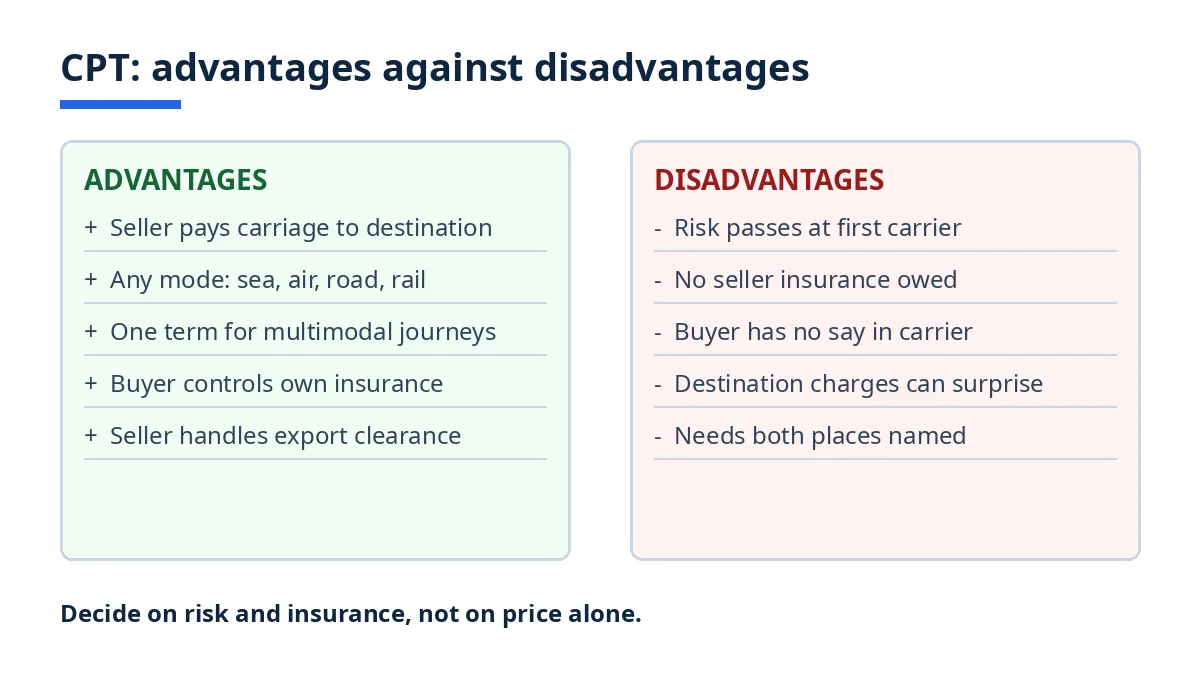
The table is the whole argument in miniature. Every advantage of CPT comes from the first and fourth rows: seller-paid carriage, usable on any mode. Every disadvantage comes from the second and third rows: buyer-carried risk, with no seller insurance behind it.1 A buyer who is comfortable with both sides of that split will find CPT straightforward. A buyer who wants the seller to carry transit risk, or to insure the goods, is asking for a different term.
The diagram below puts the two sides against each other, so the trade can be seen at a glance.
Where CPT earns its place
One term for a mixed journey. CPT covers a shipment that changes mode, which is common in Bangladesh exports: a truck to an inland depot, then a vessel from Chattogram, or a truck to Dhaka airport and a flight onward. The term does not need to change at each leg, and delivery is fixed once, at the first carrier.1 Sea-only terms cannot do this, because their delivery point is loading on board a vessel.2
The seller controls routing, the buyer controls insurance. Some buyers prefer to arrange cargo cover themselves, through a policy they already hold or an insurer they trust, rather than accept cover the seller chose. CPT leaves that choice with the buyer, and the seller's delivery notice gives the buyer the handover date to start cover from.1 Where the buyer has a standing cargo policy, CPT avoids paying twice for insurance, once in a CIP price and once in the buyer's own policy.
A single freight bill to the destination. The seller contracts and pays carriage across the whole chain to the named destination, so the buyer does not need to book or pay each leg separately.1 For a first order, or for a buyer without a forwarder at origin, that simplicity matters. The buyer still needs to know the delivery point and the gateway, but the carriage itself is the seller's arrangement.
Container and air cargo fit the rule. CPT was built for the way most general cargo now moves: containers handed to a carrier before loading, and air consignments handed to an airline at a cargo terminal. In both cases the real handover happens before loading, and CPT puts the delivery point at that handover.1 2 The ICC's any-mode rules, including CPT, are the ones that apply to air freight, while FOB, CFR, and CIF belong to sea and inland waterway transport only.3
Export formalities stay with the seller. The seller completes export clearance, which matters for a buyer who has no presence in Bangladesh. The buyer does not need to arrange export documents or deal with the exporting country's formalities, and the Bill of Export set is the seller's to prepare.1 4
Where CPT costs the buyer
Risk starts before the journey does. The buyer carries the risk from the moment the goods are handed to the first carrier, which may be at a factory gate or an inland depot, long before the main leg begins.1 A loss in the carrier's warehouse, at a transshipment point, or on the ocean leg is the buyer's loss, even though the seller paid the freight for that leg. Buyers who picture risk following the freight bill will discover the gap only when they claim.
No insurance is included, and none is owed. Under CPT the seller is not obligated to provide insurance, and the buyer arranges cover at its own risk and cost.1 A buyer who forgets, or who arranges cover only from the loading date, is uninsured for the period between handover and loading. For high-value, fragile, or theft-prone goods, that gap can be the whole value of the shipment. The ICC Academy notes that the seller's timely delivery notice is what allows the buyer to organise insurance accordingly, which means the protection depends on the buyer acting on the notice.1
The buyer has no say in the carrier. The seller contracts the carrier and sets the routing, because the seller pays the carriage.1 A buyer with a preferred carrier, a contracted freight rate, or a routing requirement has no control under CPT, and cannot change the carrier without changing the term. Where the buyer wants to nominate the carrier, FCA is the closer term, since under FCA the buyer arranges and pays the main carriage.2
Destination charges can surprise. Unloading and terminal charges at the destination follow the contract of carriage, and the buyer may find charges at arrival that the CPT price did not cover.2 The term does not promise a delivered price at the buyer's door. Transport after the named destination, import clearance, duty, and taxes are all buyer costs, and they should be budgeted separately from the CPT price.1
The two-point structure needs a well-written contract. CPT only works cleanly when the contract names both the delivery point and the destination. A contract that names only the destination leaves the risk point to be worked out later, and if no delivery point is agreed, the seller may choose it.1 A buyer who signs a one-line CPT term has signed an argument, not a bargain.
Five situations: use CPT, or use something else
Use CPT: air or multimodal, buyer has cover. An urgent air consignment from Dhaka airport, or a container moving by truck and sea, where the buyer holds cargo cover from the handover date. The seller arranges and pays the carriage, the buyer carries a risk it has already insured, and the term matches the movement.1 3
Use CIP instead: high-value goods, buyer wants seller-arranged cover. The same movement, but the buyer wants the seller to obtain insurance. CIP shares the CPT delivery and risk points, and adds a seller duty to obtain Institute Cargo Clauses (A) cover for at least 110 percent of the contract price.1 The price is higher by the premium, and the protection is in the contract rather than in the buyer's own arrangements.
Use FCA instead: buyer nominates the carrier. The buyer has a forwarder, a rate, or a routing requirement at origin, and wants to control the main carriage. FCA keeps the same delivery point as CPT, but the buyer arranges and pays the carriage from that point.2 The seller still completes export clearance.
Use DAP instead: seller to carry risk to destination. The commercial deal is that the seller delivers the goods safely to the named place. DAP records that deal: the seller keeps the risk until arrival, ready for unloading. CPT does not, and using CPT wording for a DAP bargain leaves the buyer carrying a risk the seller agreed to carry.2
Use CFR or CIF instead: bulk or breakbulk sea cargo. Cargo loaded directly onto a vessel, where the on-board moment is the real handover, and where the buyer wants the sea-only structure. CIF adds seller insurance at Clause C minimum level. Neither term fits air or container-terminal handovers.5 2
Bangladesh notes: what changes for a Bangladesh shipment
Little changes in the rule, and two things change in practice. First, the first carrier handover often happens inland, at a factory gate or an inland container depot, before the goods reach Chattogram or Dhaka airport. That makes naming the delivery point more important, not less, because the risk point may be far from any port or airport the buyer recognises. Second, export clearance is the seller's duty at every gateway, and goods may not be loaded for export until a Bill of Export has been submitted to Customs and approved, with the AD-certified EXP form, the signed invoice, the packing list, the certificate of origin, and the other documents Customs lists enclosed.4
A buyer importing from Bangladesh should also confirm the gateway and the mode in the contract, because a CPT price through Chattogram and a CPT price through Dhaka airport are different prices for different movements. The term is the same. The carriage is not.
Checklist: sign-off before you agree CPT
The delivery point, the named destination, and the gateway are all named in the contract.
The buyer has cargo cover from the handover date, or the term has been changed to CIP.
The quotation shows carriage prepaid to the named destination, with destination charges confirmed.
The seller will send the delivery notice on the day of handover, with the transport document to follow.
The buyer has budgeted import clearance, duty, and transport after the destination separately.
The carrier and routing are acceptable, since the seller chooses them under CPT.
Next steps on Exportain
Read the full rule in the Incoterms guide for shipments from Bangladesh, compare the sea-only counterpart in the CIF cost, insurance and freight guide, and work the buyer-side costs into your landed cost for imports from Bangladesh. The how to buy guide explains the buying steps on Exportain.
Post a free RFQ on Exportain and get quotes from Bangladeshi suppliers → https://exportain.com/rfqs
What should I know first about CPT?
CPT stands for Carriage Paid To. The seller delivers the goods to the first carrier, pays carriage to a named place of destination, and completes export formalities, while risk passes to the buyer at handover to that carrier. CPT works for any mode, and the seller has no obligation to insure the goods.1
What are the typical costs and timelines?
The CPT price covers the goods, export packing and clearance, and carriage to the named destination. Insurance, import clearance, duty, and transport after the destination are buyer costs, and timelines depend on the mode and route booked. Confirm the schedule and the gateway cut-off for the mode used, rather than assuming one mode's timing applies to another.1 2
Which documents are needed?
The seller provides the commercial invoice, packing list, transport document for the mode used, delivery notice, certificate of origin where required, and the Bill of Export set for export clearance. The buyer provides the insurance document and the import set. No seller insurance document is due under CPT.1 4
What are the most common mistakes?
Assuming the seller keeps the risk because the seller paid the freight, assuming insurance is included, leaving the delivery point unnamed, accepting a carrier and routing the buyer would not have chosen, and budgeting only the CPT price without destination and onward costs. Each is fixed the same way: name both places in the contract, arrange cover from handover, and budget the buyer-side costs separately.
Sources
- CPT & CIP Incoterms 2020 explained: Key differences. ICC Academy (accessed )
- CPT (Carriage Paid To) Meaning in Incoterms: Risk Transfer and Who Pays. GoFreight, (accessed )
- Air Freight Incoterms: Use FCA, Not FOB. Ovrseas (accessed )
- Customs Clearance Procedures for Export. Bangladesh Customs, National Board of Revenue (accessed )
- Incoterms® 2020. International Chamber of Commerce (ICC) (accessed )
About the author
Sourcing from Bangladesh?
Post a request for quotation and suppliers on Exportain can send you their quotes directly.
Post an RFQ


