Cotton T-Shirts Price in Bangladesh: FOB Cost Breakdown for Buyers
No official source publishes a single cotton T-shirt price for Bangladesh. This guide shows how the FOB price is built, what moves it, and how to compare itemised quotes on one specification.
Short answer
There is no single cotton t-shirts price in Bangladesh that an official source publishes. A buyer pays an FOB price built for one specification: fabric is the largest share, then trims, the cost of making, print or wash, packing, testing and commercial charges. Heavier fabric, more colours, smaller quantities and added finishes raise the price, so compare itemised quotes on the same specification, Incoterm and quantity.
On this page
Key takeaways
No official source publishes a single cotton t-shirts price in Bangladesh; each factory prices one specification, quantity and delivery term.
Fabric covers 60 to 70 per cent of the total garment cost, so fabric composition, GSM, dye and finish move the FOB price most.
An FOB price ends on board the vessel at the port of shipment; freight, insurance and duty after that point belong to landed cost.
The current garment minimum wage of Tk 12,500 feeds the cost of making, and buyers do not adjust prices retroactively on running orders.
Compare itemised quotes line by line on the same specification, Incoterm and quantity before comparing the totals.
If you are comparing the cotton t-shirts price in Bangladesh, the first point to settle is that no official body publishes a single typical price. Each factory prices one specification, in one quantity, on one delivery term, and the figure changes when any of those changes. A plain shirt in stock fabric and a printed shirt in custom-dyed fabric do not share a price.
Cotton T-shirts sit inside knitwear, the larger part of Bangladesh garment exports by value. In fiscal 2024-25, readymade garments earned US$39.34 billion and accounted for 81.49 per cent of total merchandise exports of US$48.28 billion, while knitwear exports rose 9.73 per cent to US$21.15 billion, according to Export Promotion Bureau (EPB) data reported by The Financial Express.1
Why this matters for buyers and sellers
A T-shirt price is useful only when the buyer knows what it includes. Most export quotes are given on Free On Board (FOB) terms, so the term decides where seller cost ends and buyer cost begins.
Under FOB in Incoterms 2020, the seller delivers the goods loaded on board the vessel nominated by the buyer at the port of shipment, and at that point the risk of loss or damage transfers to the buyer.2 The seller transports the goods to the port, loads them and completes export formalities, while the buyer contracts transport, pays freight and handles import formalities.2 An FOB price therefore covers the garment and origin-side work up to loading, not ocean freight, import duty or delivery in the buyer country. Compare FOB only with FOB, and use landed cost for imports from Bangladesh to add the remaining charges.
The ICC Academy notes that containerised goods are typically delivered to a container terminal rather than on board, and in those cases FCA is the more appropriate rule.2 If a supplier quotes FOB for a container shipment, ask which point the price runs to and record the answer.
How an FOB price is built
Garment costing covers fabrics and accessories, processing and finishing, sewing and packing, transport, shipping, banking charges and commissions.3 To cost a garment exactly, a factory works through fabric consumption and cost, trims and accessories, the cost of making, print, embroidery and washing, and other charges including laboratory, courier and buying commission.3 An itemised quote follows the same lines, so ask for the breakdown in that form.
Cost line | What it covers | What to check |
|---|---|---|
Fabric | Yarn, knitting, dyeing and finishing, from consumption per garment | Composition, GSM, consumption, wastage |
Trims and accessories | Items attached to the garment and items used for finishing, such as thread, labels and packing 3 | Buyer-supplied items, imported trims |
Cost of making (CM) | Cutting, sewing, finishing and packing labour and overhead | Whether CM is separate, and what it includes |
Print, embroidery and washing | Decoration and wet processing on the base garment | Print size and colours, stitch count, wash type |
Packing, testing and commercial charges | Cartons, testing, courier, freight to port, banking and commission 3 | Included or excluded testing and courier |
Fabric decides most of the total. Fabrics cover 60 to 70 per cent of the total garment cost, and fabric cost depends on fibre content and spinning process, GSM, knitting or weaving process, dye type, finishing, shrinkage and wastage.3 A heavier shirt uses more fabric per piece, and a finer yarn, costlier dye shade or added finish raises the fabric line before sewing starts.
Trims look small and still move the total. An overseas trim adds its cost and freight or air freight charge to the unit price.3 Print cost depends on print type, size and number of colours, embroidery on units of 1,200 stitches and colours, and washing on the technique applied.3
Worked example: reading one itemised quote
Example figures: the numbers below are illustrative only, not a quote or a typical price. They show how the lines add up for a plain cotton T-shirt with one chest print, per piece on FOB terms.
Cost line | Example figures, US$ per piece |
|---|---|
Fabric | 1.95 |
Trims and accessories | 0.20 |
Cost of making | 0.55 |
0.15 | |
Packing, testing and commercial charges | 0.15 |
FOB price | 3.00 |
Fabric is 65 per cent of the example total, inside the 60 to 70 per cent range stated above.3 Remove the print and the price falls by the print line. Raise the fabric weight and only the fabric line rises. If one quote is well below a rival, this table shows which line accounts for the gap.
Where cotton T-shirt factories are in Bangladesh
Production is concentrated in a few industrial areas. A mapping survey for the Mapped in Bangladesh project, a Brac University project backed by the trade bodies, found 3,485 export-oriented garment units: 1,351 in Dhaka, 1,057 in Gazipur, 615 in Narayanganj and 386 in Chattogram.4 The same survey recorded 1,951 factories affiliated with BGMEA and 520 with BKMEA, with 257 registered with both.4
Location matters to price. A factory near its fabric supply and the port carries a shorter transport leg inside the FOB price, and a knitwear specialist quotes from a different fabric base than a general factory. See cotton T-shirt manufacturers in Bangladesh.
What moves the price up or down
Fabric specification. Fibre content, yarn type, GSM, dye shade and finish set the fabric line, the largest share of the price.3
Decoration and washing. Each print position, print colour, embroidery area and wash adds a process cost, and a plain shirt carries none of these lines.3
Quantity and the minimum order. A small run spreads setup and fabric and trim buying over fewer pieces, so the unit price rises. Quantity is tied to the minimum order quantity, covered in typical MOQ for cotton T-shirts in Bangladesh. Ask for prices at two or three quantities on the same specification.
Labour cost inside the cost of making. The current minimum wage for garment workers is Tk 12,500, set in November 2023 and effective from December that year, after a history running from Tk 1,662.50 in 2006 to Tk 8,000 in 2018 and Tk 12,500 in 2023.5 Labour feeds the cost of making, so a wage revision changes the base for later orders. The Financial Express reported that many units were executing orders based on existing wage costs, and that buyers do not adjust prices retroactively.5
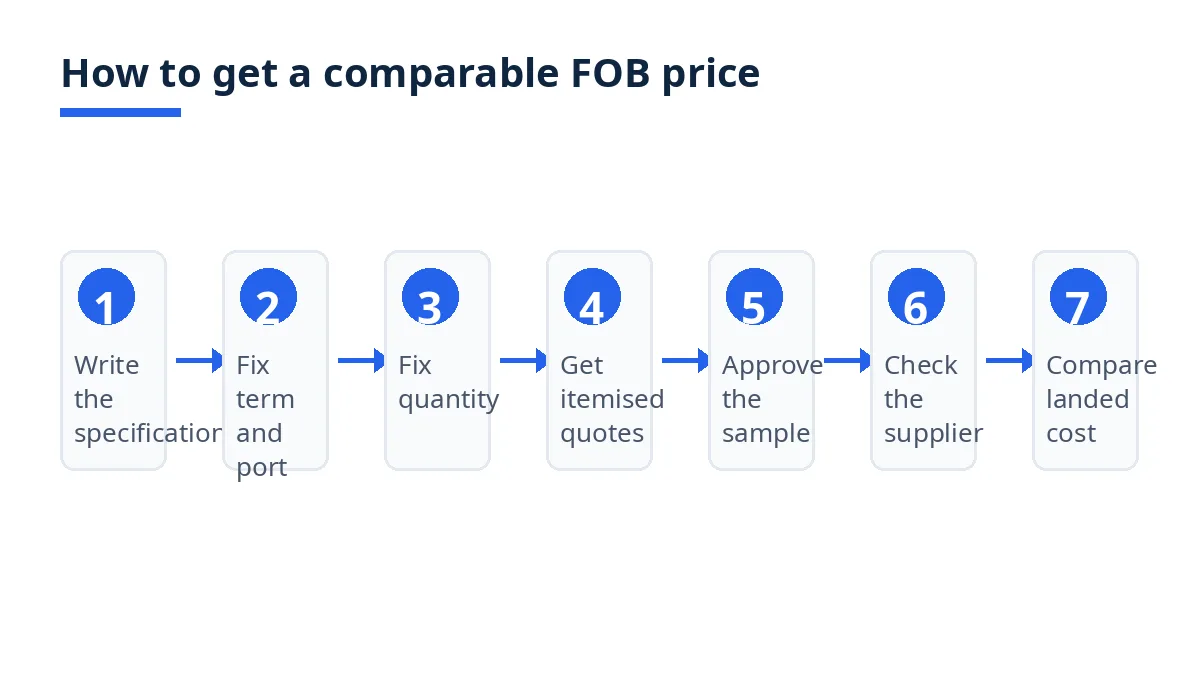
Step-by-step: how to get a comparable price
Write the specification first. State fabric composition and GSM, colours, sizes, print, trims, labels and packing.
Fix the delivery term and port. Quote on FOB with a named port, or on FCA where the terminal point applies, and keep the term constant across suppliers.2
Fix the quantity and ask for steps. Request the price at your first quantity and one higher quantity, and ask whether the minimum is per order, style or colour.
Ask for an itemised breakdown. Use the table lines: fabric, trims, cost of making, decoration, and packing, testing and commercial charges.3
Approve a sample on the bulk specification. Use the quoted fabric and trims, and file the sample record with the quotation.
Check the supplier. Read how supplier verification works on Exportain and keep quote, tech pack and sample record together.
Compare landed cost, not only FOB. Add freight, insurance, duty and destination charges on the same destination and shipment size.
Costs, timelines and documents
This guide states no typical timeline, because no official source publishes a standard production time and the time depends on fabric availability, decoration and the factory order book. Ask each supplier to state the delivery date from order confirmation, from fabric in house and from sample approval.
On payment, Bangladesh Bank rules shape what the factory can accept. Under revised instructions reported in September 2025, exporters must have an irrevocable letter of credit (LC) or contract to execute shipments, demonstrate satisfactory past performance and show sufficient capacity to fulfil the order, and advance payments must remain interest-free.6 The same instructions waived the requirement to keep back 10 per cent of advance remittances, so banks may now release the full advance, subject to due diligence.6
Hold the purchase order, pro forma invoice, technical pack, sample record and itemised quotation with the order. If an export is not executed, including failure to issue an EXP Form against an advance payment, refunds follow the Bangladesh Bank route, with funds first used from the Exporters Retention Quota account and the remainder from Taka accounts.6
For classification, the United States Harmonized Tariff Schedule lists heading 6109 as T-shirts, singlets, tank tops and similar garments, knitted or crocheted, and subheading 6109.10.00 as of cotton.7 Destination countries add their own digits and duty rates, so confirm the full code and current rate with your broker.
Bangladesh-specific rules and tips
Quote in the cluster that matches the garment. Cotton T-shirts are knitwear, and the mapping survey counted the factory base across Dhaka, Gazipur, Narayanganj and Chattogram, with BKMEA affiliation recorded alongside BGMEA membership.4 A knitwear factory quoting from its regular fabric base holds a different cost position from a factory buying that fabric for one order.
Expect the wage base to be reviewed. Amendments to the labour law reduced the wage revision cycle from five years to three, making a review timely as the three-year mark from the December 2023 structure approaches.5 Multi-season programmes need a written clause on statutory wage changes.
Keep the advance payment inside the banking route. Advance payments must remain interest-free, and the exporter must hold an LC or a contract, show past performance and show capacity.6 Pay through the banking channel named in the order documents, so a refund can be traced.
Separate FOB from destination cost. FOB ends on board the vessel.2 Duty, freight and insurance after that point differ by destination, so run one landed cost table per destination.
Mistakes and red flags
Comparing a single headline price. Two totals built from different fabric, trims or charges are not a comparison. Convert both quotes to the same cost lines first.3
Leaving the delivery term vague. A price with no named port, or FOB used for a terminal delivery that the ICC Academy describes as an FCA case, leaves loading charges open to dispute.2
Approving a sample that does not match the quoted fabric. Fabric is 60 to 70 per cent of garment cost.3 A substitute fabric changes the price basis and the garment at the same time.
Ignoring the minimum behind the price. A low unit price at a quantity you cannot sell through is not a saving. Check it against the style and colour minimum and your selling volume.
Accepting a price far below rival quotes with no explanation. Ask which cost line is lower and why. A missing testing charge, thinner fabric or excluded commission explains most unusually low totals.
Paying an advance outside the banking route. The refund route for a non-executed export runs through the Exporters Retention Quota account and Taka accounts.6 An untraceable payment sits outside it.
Checklist: before you accept a T-shirt price
Specification written in full: fabric, GSM, colours, sizes, decoration, trims, packing.
Quote itemised: fabric, trims, cost of making, decoration, and packing, testing and commercial charges.
Delivery term names the port or terminal point, and the price basis matches it.
Quantity, minimum basis and any higher-quantity price step stated on the quote.
Approved sample made from the quoted fabric and trims, with the record filed.
Payment under an LC or contract; any advance is interest-free and paid through the banking channel.
HS code confirmed for the destination; landed cost calculated separately from FOB.
Supplier documents and badges checked, with the limits of those checks understood.
How Exportain helps
On Exportain, suppliers can submit documents in five areas: identity and selfie, phone and email, business registration, and ERC and factory photos. The Exportain team reviews each one, and a badge appears only once its checks are approved.8 The site states that the review is not an inspection, and that a seller with no approved review shows no badge.8 Use the badges as a document check, then apply the price and sample checks in this guide.
Exportain also runs a structured workflow in which a buyer posts an RFQ, receives itemised quotations, negotiates versions and accepts one, which creates the order and its pro forma invoice from the accepted terms.8 Quotations are priced on quantity, specification and Incoterm, and listings carry MOQ and tiered prices where the seller has set them.8 Read how to import cotton T-shirts from Bangladesh and the cotton T-shirts quality control checklist.
FAQs
What should I know first about cotton t-shirts?
Know the specification and delivery term before you discuss price. Fabric is 60 to 70 per cent of total garment cost and depends on fibre content, GSM, dye, finish, shrinkage and wastage, so a price given without a fabric specification will be revised.3 Cotton T-shirts are knitwear, and knitwear earned US$21.15 billion in fiscal 2024-25 on EPB data.1
What are the typical costs and timelines?
There is no verified typical cost or timeline figure in this guide, because no official source publishes a single T-shirt price or a standard production time. Cost is built from fabric, trims, the cost of making, print, embroidery and washing, and other charges such as testing, courier and buying commission.3 Use the worked example to read a quote, and ask each factory for its delivery date from a named starting event.
Which documents are needed?
The exporter must have an irrevocable letter of credit or a contract to execute the shipment, and advance payments must remain interest-free under the Bangladesh Bank instructions.6 Hold the purchase order, pro forma invoice, technical pack, sample record and itemised quotation with the order, and keep the remittance record.6 Confirm destination documents, including the full HS code under heading 6109, with your broker.7
What are the most common mistakes?
The most common mistakes are comparing headline prices built from different specifications, leaving the term and port unnamed, approving a sample from a substitute fabric, and accepting a low price without asking which cost line is lower.3 2 Buyers also order to a volume step they cannot sell through, and pay advances outside the banking route.
Next steps on Exportain
Browse suppliers for cotton T-shirt makers, then post your specification through RFQs so factories quote on the same fabric, quantity and delivery term. Compare the itemised quotes with how to import cotton T-shirts from Bangladesh, check each minimum against typical MOQ for cotton T-shirts in Bangladesh, and confirm the classification in the HS code for cotton T-shirts before you accept a price.
Sources
- Exports fetch $48.28b in FY25. The Financial Express (accessed )
- FOB & FAS Incoterms® 2020 explained: Key differences. ICC Academy (accessed )
- Garment costing - the deciding factor in textile business. The Financial Express, (accessed )
- 2.7m workers on database. The Financial Express (accessed )
- New wage board in the works for RMG workers. The Financial Express, (accessed )
- BB eases rules to support exporters. The Financial Express, (accessed )
- Harmonized Tariff Schedule of the United States, Chapter 61: Articles of Apparel and Clothing Accessories, Knitted or Crocheted. U.S. International Trade Commission (accessed )
- Exportain | Bangladesh B2B Export Marketplace. Exportain (accessed )
About the author
Sourcing from Bangladesh?
Post a request for quotation and suppliers on Exportain can send you their quotes directly.
Post an RFQ