

Quality Control Checklist for Corrugated Cartons From Bangladesh
A numbered QC checklist for corrugated cartons from Bangladesh: board and flute, ECT and burst reports, dimensions, scores, slots, joints, die-cut accuracy, print registration, and bundle and pallet checks, with fixes for common failures.
Short answer
Use this corrugated cartons quality control checklist to check board construction and flute, edge crush and burst test reports, internal dimensions, scores, slots, manufacturer joints, die-cut accuracy, print registration and colour, and bundle and pallet build on cartons from Bangladesh before shipment. Agree the board grade, tolerances, test methods and acceptance levels in the purchase order.

On this page
Key takeaways
Agree the board construction, flute, box style, dimensions, print artwork and test reports before inspection, and draw the sample randomly across board lots and print runs.
Read edge crush and burst results as different properties: ECT predicts stacking strength and burst predicts puncture resistance, and neither substitutes for the other without a fresh test.
Measure internal dimensions, scores, slots, joints and die-cut features on erected cartons, because faults that are invisible when flat show when the carton is formed.
Check print registration, colour and barcodes from the start, middle and end of the run, and check bundle counts, pallet pattern and wrap before loading.
If you buy corrugated cartons from Bangladesh, use this checklist to check the cartons before they are filled and shipped. A carton that looks sound when flat can still fail in a stack, at a die-cut window, or under a print plate that drifted during the run. Check board, geometry, print, and pallet build against the specification, and record what you measured.
A corrugated carton is flat liners bonded to a wavy fluted medium. That structure carries the stack and cushions the contents, so most failures trace back to board, conversion, or packing. Use it at final inspection and earlier in production, while faults can still be corrected.
Why this checklist matters
Cartons fail in ways a quick look misses: a board with the wrong flute crushes under a pallet load, a score cut too deep tears when the box is erected, and a print panel out of register makes a retail carton unsellable. Each fault is cheap to catch at the converter and expensive to fix after shipment.
A written checklist also settles what was agreed. The purchase order should name board construction, flute, box style, dimensions, print artwork, and test reports required. The inspector checks each point against that specification and the approved sample, recording pass, fail, or not applicable. Where a test result is required, the report must name the test method, because edge-crush methods do not give interchangeable numbers.1
Before you start
Do not begin until the references are complete: an approved sample carton, the purchase order and board specification, the artwork and print proof, the box drawing or FEFCO code, and the packing and pallet specification. Agree the sampling plan in advance, and draw the sample randomly across board lots, print runs, and pallet positions.
Confirm the board construction first. Single-wall board has one fluted medium between two liners, double-wall board adds a second medium and a third liner, and triple-wall board uses three mediums and four liners.2
Check the flute against the specification. Flute height sets the balance between cushioning, stacking strength, and print quality: A flute, about 4.8 mm, gives the most cushioning; C flute, about 4.0 mm, is the general shipping default; B flute, about 3.0 mm, gives a stiffer, flatter face; E flute, about 1.5 mm, gives a smooth print surface; and F flute, about 0.8 mm, suits fine retail work.3 A flute substitution changes how the carton stacks and prints, so record any change as a failure unless agreed in writing.
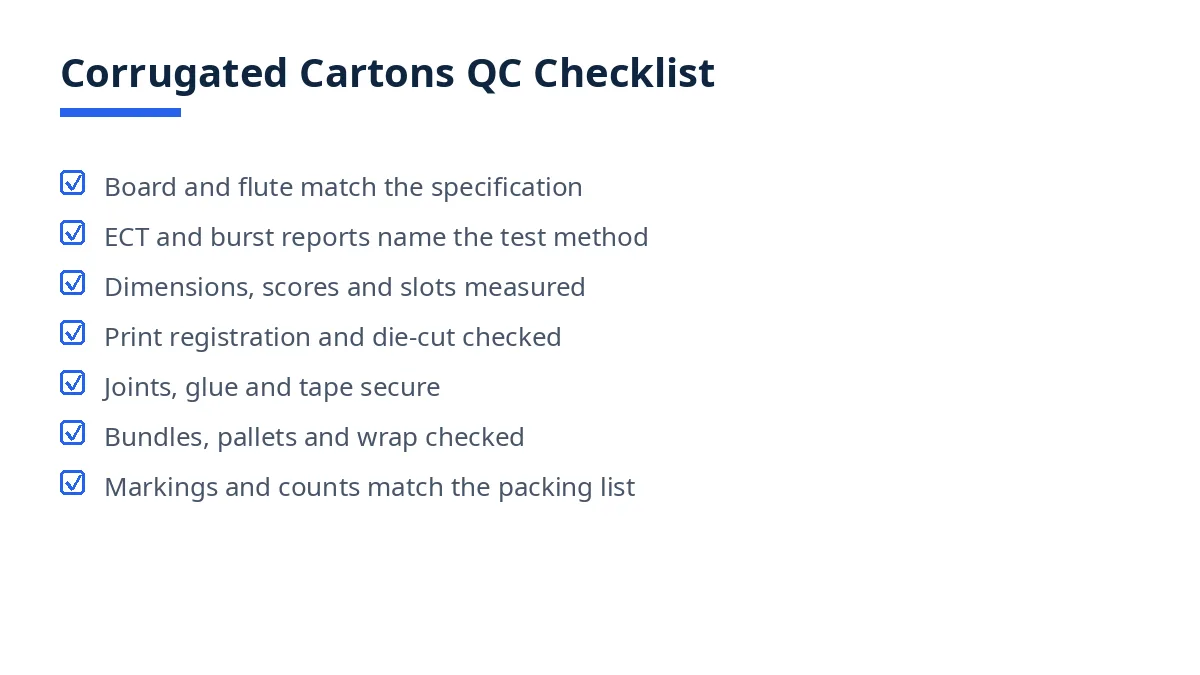
The full checklist (numbered, printable)
Board, liners, and strength
Check board construction against the specification: wall count, liner type, and flute letter, on samples from more than one board lot.
Check flute height and count, and look for crushed, flattened, or delaminated flutes on the face and inside the flaps.
Check liner quality on both faces: no holes, tears, stains, oil marks, or loose fibres, and no substitution between sample and bulk.
Review the edge crush test (ECT) report for the board grade ordered. ISO 3037:2022 defines edgewise crush resistance as the maximum force per unit length a test piece can support until failure, with force applied in the direction of the flute axis.1
Review the burst test report where burst strength was specified. TAPPI T 810 measures bursting strength of single-wall and double-wall board from 690 kPa (100 psi) to 4825 kPa (700 psi), using a disk-shaped diaphragm, and does not apply to triple-wall board.4
Do not treat ECT and burst results as the same property. They measure different things and cannot be directly related to each other.4 If a supplier offers one rating in place of the other, ask for a test on the board actually supplied before accepting the swap.
Check the moisture condition and conditioning on the test report. The standard atmosphere for testing paper and board is (23 ± 1) °C and (50 ± 2) % relative humidity, with (27 ± 1) °C and (65 ± 2) % relative humidity permitted in tropical countries.5 Agree the conditioning and any humidity margin in advance.
Check the Box Manufacturer's Certificate or equivalent stamp where the destination market uses one: it states board class, certified strength rating, and size and gross weight limits, and must match the test report.3
Dimensions, scores, slots, and joints
Measure internal dimensions in length by width by depth order, on the erected carton, against the drawing tolerance, on more than one carton per size.
Check score lines: straight, in position, and deep enough to fold cleanly without cracking the liner or cutting through the board.
Check slots: cleanly cut, in position, and free of hanging fibres that stop flaps closing flat.
Check flap lengths on a regular slotted container. In FEFCO 0201, all four flaps are equal and the outer flaps meet at the centre.2 Short flaps leave a centre gap; long flaps overlap and lift the tape line.
Check the manufacturer's joint: glued, stitched, or taped as specified, running the full joint length, and holding when the carton is erected and squared by hand.
Erect sampled cartons and check squareness: flat panels, square corners, and no twisting or rocking.
Check die-cut features where the design includes them: windows, hand holes, tear strips, and lock tabs are in position, cut cleanly, and work without tearing the surrounding board.
Print, colour, and markings
Check print registration against the approved proof: each colour plate in position, sharp text, and barcodes scanning at the first attempt.
Check colour against the approved proof under the same light, on cartons from the start, middle, and end of the print run. Colour drift across a run is a print failure even when each carton looks acceptable alone.
Check that no print element is cut off at a score, slot, or panel edge, and that mandatory markings sit where the destination market requires.
Check ink adhesion and rub resistance by hand: print must not smudge, flake, or transfer to the next carton in the bundle.
Check that print and material marks match the destination-market specification. New EU packaging rules aim for all EU-market packaging to be recyclable in an economically viable way by 2030, with paper and cardboard recycling targets of 75% by 2025 and 85% by 2030.6
Bundling, palletising, and loading
Check bundle counts: each bundle holds the specified number of flat cartons, matching the bundle label and packing list.
Check bundle condition: strapped or banded as specified, with no crushed edges, bent corners, or water damage on outer cartons.
Check pallet build: cartons stacked in the agreed pattern, the pallet square and stable, and no carton overhanging the edge.
Check pallet protection: top sheets, corner protection, and stretch wrap applied as specified, holding the load without crushing the top layer.
Check pallet markings and counts: pallet labels and total carton count per pallet matching the packing list and specification.
Check container loading where cartons are shipped flat: pallets loaded without forcing, cartons protected from floor moisture, and the load unable to shift in transit.
Common failures and how to fix them
The most frequent failure is a carton that measures correctly flat but crushes in a stack, usually from the wrong board grade, a crushed flute, or a test report that does not match the board delivered. Stop, compare the ECT report and test method with the specification, check flutes from more than one lot, and only then restart the run. Do not accept a burst rating in place of an ECT rating without a fresh test, because the two tests measure different failure modes.4
Next is a score or slot fault: cartons tearing at the fold, flaps that will not close flat, or a joint that peels. These point to die setting or adhesive application, so re-check a test carton from the corrected die before the bulk run continues. Print drift is the third common failure: registration or colour moving across a run. Compare samples from the start, middle, and end of the run against the proof, and hold the affected section for re-print or re-sort.
Moisture damage arrives last and costs most. Cartons stored or shipped damp lose stacking strength and arrive soft even when the dry test report passed. Check storage at the converter, confirm the conditioning on the test report,5 and protect bundles and pallets from floor and rain contact before loading.
Where failures exceed the acceptance level agreed in the purchase order, the options are re-inspection after sorting or rework, documented partial acceptance, or rejection. Record the decision and the affected quantity.
Downloadable template / summary table
Copy the checklist into your inspection sheet, add the specification, tolerances, and acceptance levels, and record a result per carton or bundle.
Section | Checks | Evidence |
|---|---|---|
Board and strength | Wall count, flute, liners, ECT, burst | Reports naming the method |
Dimensions and conversion | Internal size, scores, slots, joint, die-cut | Measurements, erected carton |
Print and markings | Registration, colour, barcode, marks | Proof comparison, scan check |
Bundling and pallets | Bundle count, pallet pattern, wrap | Packing list, pallet count |
How Exportain helps
Exportain is a B2B marketplace connecting buyers with Bangladeshi suppliers, so the specification, FEFCO code, artwork, and test reports behind this checklist can be agreed at enquiry. Browse suppliers, and use inspection services when you plan the check. Supplier profiles show which document and photo checks have been recorded, not factory inspections. Exportain is not a party to the goods contract and does not inspect goods.
FAQs
When should this checklist be used?
Use it at final inspection, when cartons are finished and largely palletised. For larger and first orders, also use it during production, while faults can still be corrected.
Who should complete it?
The buyer, a local agent, or an independent inspector can complete it, using the approved sample, the board specification, and a random sample across lots and runs.
What are the most common failures?
Crushed or substituted board, a score or slot fault, a joint that peels, print drift across a run, and moisture-softened cartons are the failures buyers find most often.
Can a third party do it?
Yes, if you share the approved sample, the specification, the tolerances, and the acceptance levels first, and require reports naming the test method used.
Next steps on Exportain
Before production starts, agree your board grade, flute, FEFCO code, dimensions, and test methods in writing, then read the AQL acceptance quality limit explainer and the pre-shipment inspection guide, and plan the check with inspection services.
Sources
- ISO 3037:2022 - Corrugated fibreboard — Determination of edgewise crush resistance (non-waxed edge method). International Organization for Standardization (accessed )
- Carton Box Guide — Types, Specs, Selection. SourceBySpec (accessed )
- Corrugated Box Standards Explained: ECT, Burst Test, FEFCO Codes and BMC Guide. WC Packaging (accessed )
- TAPPI T 810 - Bursting strength of corrugated board. TAPPI (accessed )
- ISO 187:2022 - Paper, board and pulps — Standard atmosphere for conditioning and testing and procedure for monitoring the atmosphere and conditioning of samples. International Organization for Standardization (accessed )
- Packaging - EU rules on packaging and packaging waste. Council of the European Union (accessed )
- pre-shipment inspection
- quality control
- importing from Bangladesh
- aql inspection
- Packaging Bangladesh
- Packaging
About the author
Sourcing from Bangladesh?
Post a request for quotation and suppliers on Exportain can send you their quotes directly.
Post an RFQ


