CIF Terms of Delivery: Meaning, Wording and Examples
Definition
CIF terms of delivery mean Cost, Insurance and Freight: for sea shipments, the seller pays for the goods, marine insurance and freight to a named destination port, and clears export. Risk passes to you, the buyer, when the goods are loaded on board at the port of shipment. Write the term in full, for example CIF Felixstowe, Incoterms 2020, in every document.
Published 8 min read
On this page
Key takeaways
Under CIF, the seller pays freight and minimum insurance to the named destination port, but risk passes to the buyer on board at the port of shipment.
Write CIF in full every time, with the named destination port and the version, for example CIF Felixstowe, Incoterms 2020.
Default CIF insurance is Institute Cargo Clauses (C) at 110 percent of the contract value, so wider cover must be agreed in the contract or bought separately.
A CIF price is not a delivered price: import duty, import clearance, destination charges outside the freight and onward delivery stay with the buyer.
If you buy by sea from Bangladesh, cif terms of delivery decide what a quoted price includes, who arranges the ship and the insurance, and when the shipment becomes your risk. This entry explains what CIF means, how to write it, and how a shipment from Chattogram works.
What CIF means in plain English
CIF stands for Cost, Insurance and Freight. It is one of the eleven three-letter Incoterms rules published by the International Chamber of Commerce (ICC), which clarify the tasks, costs and risks involved in delivering goods from sellers to buyers.1 The current edition, Incoterms 2020, entered into force on 1 January 2020.1
Under CIF, the seller pays for the goods, the freight and marine insurance to a named destination port, delivers the goods on board at shipment, and clears them for export. Risk, however, passes to you when the goods are on board, not when they arrive.2 Cost and risk transfer at different points, which is the fact most CIF disputes turn on.
CIF is a sea term: the ICC reserves the CIF rule for use in maritime trade,3 and GOV.UK lists CIF among the rules for sea and inland waterway transport only.2 The term allocates delivery, costs and risk only: price, payment method and ownership belong in the sales contract. See also CIF: Cost, Insurance and Freight.
How do you write CIF correctly?
A CIF term is complete only in its full form: the rule, the named port of destination, and the Incoterms version. The ICC Academy gives the pattern as "CIF Port of Antwerp, Belgium, Incoterms 2020": the named port is where the seller must arrange transport to, while delivery and risk transfer happen at shipment.4
Wording | Status | Why |
|---|---|---|
CIF | Incomplete | No destination port, so the freight endpoint is undefined |
CIF Felixstowe | Incomplete | Port named, but no version, so the governing edition is arguable |
CIF Felixstowe, Incoterms 2020 | Complete | Rule, named port and version are all stated |
CIF Felixstowe, Incoterms 2020, insurance Clauses (A) | Complete, with an addition | Insurance raised above the default and recorded |
Use the identical wording in the quotation, the contract, the invoices and any letter of credit documents: a port named in one document and missing in another creates two cost endpoints for one shipment. Name the point within the port exactly: Röhlig Logistics advises specifying the point up to which the seller bears costs at destination, and who pays unloading, before signing.5 Word two additions expressly: a higher insurance level than the default, and unloading, which the seller pays only if the carriage contract places it on the seller.4
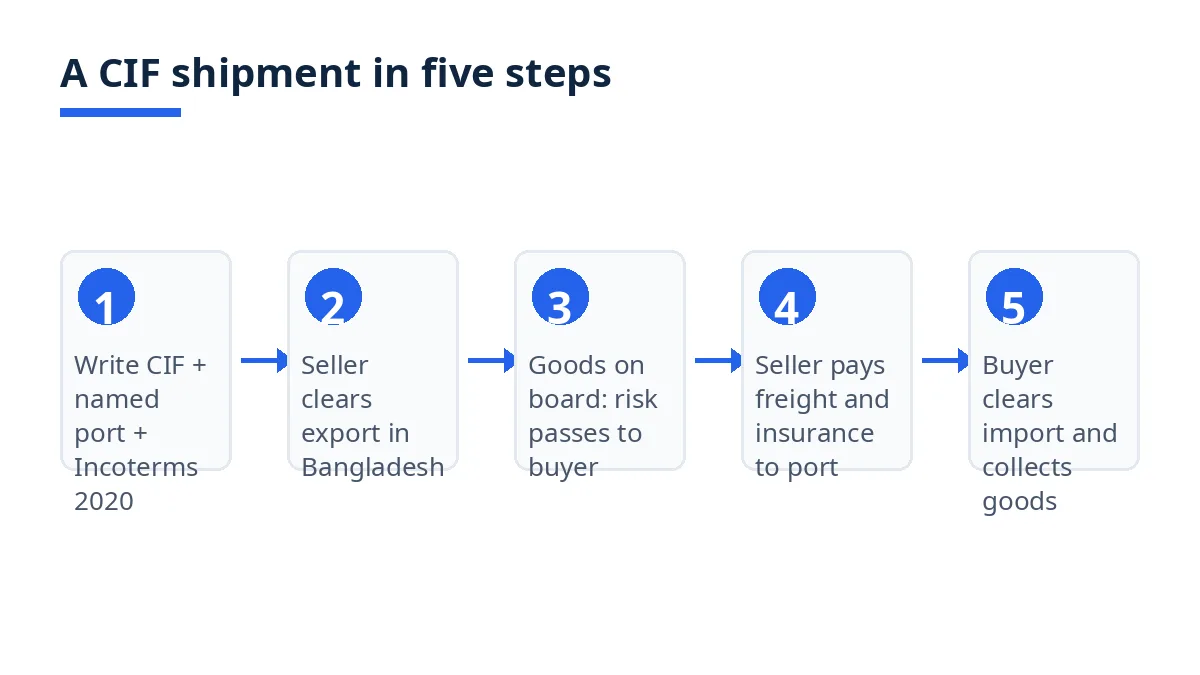
How CIF works step by step
Agree the wording. Both parties record the full term, for example "CIF Felixstowe, Incoterms 2020", plus any agreed insurance level, in the contract.
The seller prepares and export-clears the goods. The seller packs and marks the goods and completes export formalities.4 In Bangladesh, goods may not be loaded until a Bill of Export has been approved by Customs, supported by the export contract or purchase order, the commercial invoice, the packing list and the EXP form certified by an Authorized Dealer.6
The seller books carriage and insurance. The seller contracts and pays for carriage to the named port, and buys cargo insurance up to that port in a form that lets you claim directly from the insurer.4
The goods are loaded on board. Delivery takes place and risk passes to you at the port of shipment, typically Chattogram.4
The seller sends the documents. The seller provides the transport document, usually a bill of lading, which must enable you to claim the goods at destination, and the insurance document.5
You complete the import side. You pay the price, complete import formalities, pay duties, taxes and destination charges outside the freight, and arrange onward delivery.4
Who is responsible for what under CIF?
Task or cost | Seller | Buyer |
|---|---|---|
Goods, packing and marking | Pays | |
Export clearance in Bangladesh | Arranges and pays | |
Delivery on board at shipment | Arranges | |
Ocean freight to the named port | Contracts and pays | |
Marine insurance to the named port | Contracts and pays, minimum cover | Pays extra for wider cover |
Risk during the sea carriage | Bears it, from loading | |
Unloading at destination | Only if the carriage contract says so | Otherwise pays |
Import clearance, duties and taxes | Arranges and pays | |
Onward delivery from the port | Arranges and pays |
On insurance, the default matters. The ICC kept the CIF default at Institute Cargo Clauses (C), while CIP requires the higher Clauses (A) level.3 Under CIF the seller must insure for 110 percent of the goods sales price in the contract currency, covering named risks such as fire, stranding, capsizing and general average, and must provide proof of insurance to the buyer.5 GOV.UK states the same position: the seller must obtain only minimum cover, and a buyer who wants more must agree it expressly or arrange extra cover.2
Worked example with numbers for a Bangladesh shipment
Example figures only, showing how a CIF price is built. They are not market quotations.
A buyer in the United Kingdom orders garments from a seller in Bangladesh on the term "CIF Felixstowe, Incoterms 2020".
Goods, as priced in the sales contract: USD 24,000
Packing, delivery on board at Chattogram and export clearance, paid by the seller: USD 700
Ocean freight from Chattogram to Felixstowe, paid by the seller: USD 2,100
Marine insurance premium at the Clauses (C) default, arranged by the seller: USD 180
CIF price invoiced to the buyer: USD 26,980
At a goods value of USD 24,000, cover at 110 percent gives an insured amount of USD 26,400 in the contract currency.5 From loading at Chattogram, the voyage risk is yours, protected by the seller's policy. On arrival you add import duty and taxes, clearance fees, any Felixstowe charges outside the freight, and haulage. Only that total is your landed cost, as landed cost for imports from Bangladesh sets out. Never compare a CIF figure with an FOB figure: convert both to landed cost first.
How CIF compares with FOB, CFR and CIP
Rule | Main freight paid by | Seller must insure | Risk passes |
|---|---|---|---|
FOB | Buyer | No | On board at shipment |
CFR | Seller | No | On board at shipment |
CIF | Seller | Yes, Clauses (C) minimum | On board at shipment |
CIP | Seller | Yes, Clauses (A) | On handover to the first carrier |
FOB works like CIF up to loading, except that you arrange the freight and insurance yourself. See FOB (Free On Board). CFR is CIF without the seller's insurance duty. CIP covers any mode and fits container shipments better, because containers are usually handed to a carrier at a terminal before loading. Shipping Solutions likewise notes that CIF is best used for port-to-port shipments, particularly bulk or non-containerized goods.7 See also Incoterms for shipments from Bangladesh.
Common mistakes to avoid
Writing CIF without the port or the version. "CIF" alone leaves the cost endpoint and the governing edition open. Write the full form in every document.
Assuming the seller bears risk until arrival. Risk passed to you on board at shipment. If goods are damaged at sea, the claim is yours, under the seller's policy.
Accepting minimum insurance without reading it. Clauses (C) cover named risks only. For fragile or high-value goods, agree wider cover or buy a top-up.
Treating a CIF price as a delivered price. Duty, taxes, clearance, destination charges outside the freight and onward delivery are all extra.
Using CIF for a terminal handover. Where goods are handed to a carrier at a terminal before loading, discuss CIP instead, so the risk point matches the handover.7
Skipping the insurance document check. Confirm the policy covers your shipment and lets you claim directly.
How Exportain helps
Exportain is a marketplace where buyers find Bangladeshi suppliers and compare replies. Ask every supplier to quote on the same CIF wording, with the same named port and version, so prices cover the same legs. Supplier profiles show which document and photo checks have been recorded; those checks are reviews of documents and photos, not factory inspections. Exportain is not a party to your contract for goods and does not book freight or clear customs.
FAQs
What is CIF?
CIF means Cost, Insurance and Freight, an Incoterms 2020 rule for sea and inland waterway transport. The seller pays for the goods, freight and minimum marine insurance to a named destination port and clears export. Risk passes to the buyer on board at shipment.
How does CIF work in practice?
The seller prepares the goods, completes export clearance, loads them on board, pays freight to your named port and buys insurance, then sends you the transport and insurance documents. You pay the price, complete import clearance, and pay duties and destination charges outside the freight.
Is CIF used for shipments from Bangladesh?
Yes, for sea shipments. A typical form is "CIF Felixstowe, Incoterms 2020" for goods loaded at Chattogram. Confirm the named port, check the insurance level suits the cargo, and budget separately for destination charges and duties.
What are common mistakes with CIF?
Writing CIF without a named port or version, assuming the seller bears risk until arrival, accepting minimum Clauses (C) cover for cargo that needs wider protection, and using CIF for container handovers where CIP fits better.
Next steps on Exportain
Fix your CIF wording first: rule, named port and Incoterms 2020, plus the insurance level you need. Then browse suppliers, read the how to buy guide, and post an RFQ stating the full term, so every quotation is priced on the same basis.
Sources
- Incoterms® rules. International Chamber of Commerce (ICC) (accessed )
- Customs valuation: Incoterms. HM Revenue & Customs (GOV.UK) (accessed )
- Incoterms® 2020. International Chamber of Commerce (ICC) (accessed )
- Incoterms® 2020 C rules vs D rules: Risk transfer explained. ICC Academy (accessed )
- CIF (Cost Insurance and Freight) | Incoterms 2020. Röhlig Logistics (accessed )
- Customs Clearance Procedures for Export. Bangladesh Customs, National Board of Revenue (accessed )
- Incoterms 2020 CIF: Spotlight on Cost, Insurance and Freight. Shipping Solutions, (accessed )
Reviewed by Naim Islam
About the author
Sourcing from Bangladesh?
Post a request for quotation and suppliers on Exportain can send you their quotes directly.
Post an RFQ