

When Does Risk Transfer Under CIF? A Visual Guide for Importers
Definition
Under CIF (Cost, Insurance and Freight), risk transfers from seller to buyer the moment the goods are loaded on board the vessel at the port of shipment. The seller still pays ocean freight and arranges minimum insurance to the named destination port, but the buyer bears the risk of loss or damage during the voyage. CIF applies only to sea and inland waterway transport.
By Naim Islam
Published 7 min read
On this page
Key takeaways
Risk passes to the buyer when the goods are loaded on board at the port of shipment. The seller paying freight and insurance to the destination port does not keep the risk with the seller.
CIF is for sea and inland waterway transport only, port to port. For containers handed over at a terminal, check the handover point and consider CIP instead.
The seller must arrange minimum Institute Cargo Clauses (C) insurance for at least 110% of the contract price, in the contract currency. Wider cover must be agreed in the contract.
Name both ports in the contract: the port of shipment is where risk passes, and the named destination port is the point to which freight and insurance are paid.
A CIF price can look like a promise that the seller carries the goods safely to your port. It is not that promise. The seller pays for the voyage and arranges the insurance, yet risk moves to you at the port where the goods go on board. This guide follows that split along one shipment.
The short answer: risk passes on board, cost runs to destination
Under CIF, risk passes from seller to buyer when the goods are loaded on board at the port of shipment. The seller still pays carriage and insurance to the named destination port, but paying for the journey does not keep risk with the seller. From loading onward, loss or damage in transit is the buyer's risk, although the seller arranged the freight and minimum cover.1
What the three letters actually promise
CIF stands for Cost, Insurance and Freight. It is an Incoterms 2020 rule published by the International Chamber of Commerce (ICC), allocating delivery, cost and risk between seller and buyer.1 The seller loads the goods on board at the port of shipment, completes export formalities, pays ocean freight to the named destination port, and arranges insurance up to that port.1
Name the destination port in the contract, as in CIF Rotterdam, Incoterms 2020, since the freight and insurance duties are measured against it. The insurance is minimum cover at Institute Cargo Clauses (C) level, unless the parties agree more.2 The ICC confirms Clause C remains the default under CIF, while CIP now requires the higher Clause A level.2
The journey, stage by stage: where risk changes hands
The diagram below traces the shipment, with the transfer marked at loading.
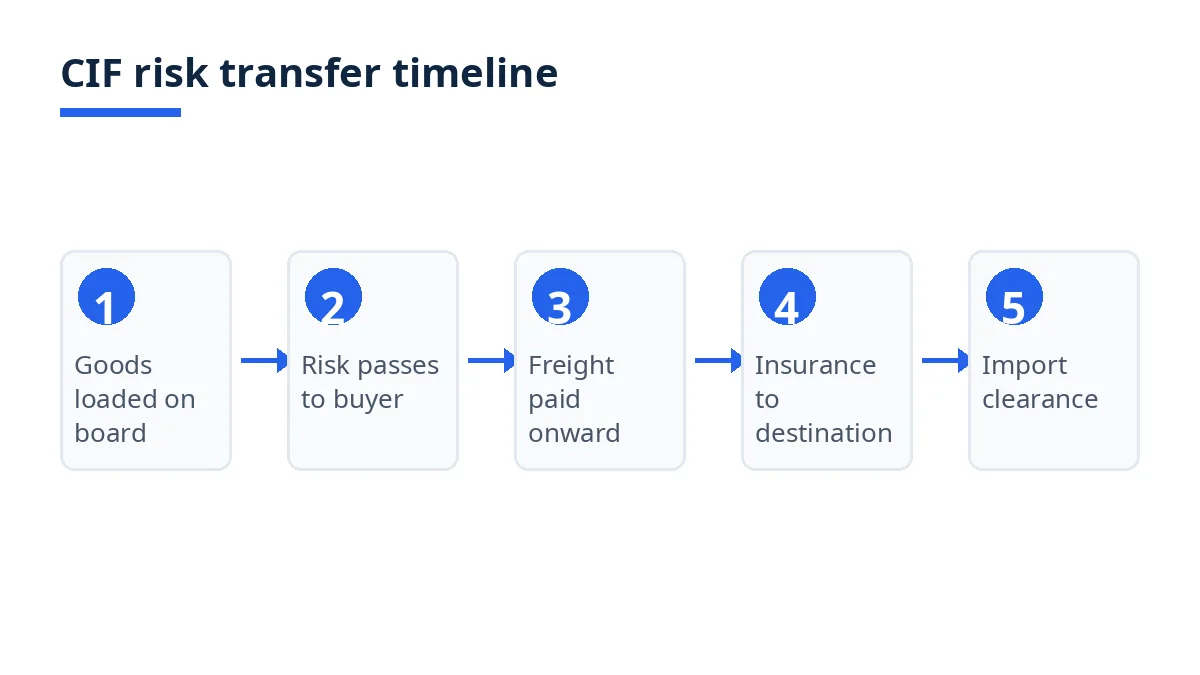
Agree the term and both ports. Record CIF, the destination port, the port of shipment where possible, and the Incoterms 2020 version. Clarify the port of shipment, since that is where risk passes.1
The seller prepares the goods and clears them for export, packing the goods and completing export formalities.1 Risk still sits with the seller ashore.
The goods are loaded on board. Delivery happens here, and risk transfers to the buyer.1 Damage on the quay before loading differs from damage after it.
The seller pays freight and arranges insurance. The seller pays port-to-port carriage and arranges Clause C minimum insurance, although the buyer already bears the risk.1 The cover must be for the buyer's benefit, so the buyer can claim under it.
The voyage runs at the buyer's risk. The C rules are shipment terms, not delivery terms: risk passes before the main leg.1
At arrival, the buyer takes over, completing import formalities, paying duty and taxes, and arranging onward transport.1 Unloading and quay charges follow the contract of carriage, so confirm in writing who pays them.3
The split, side by side: seller pays on, buyer carries risk
CIF belongs to the two-point clauses, where transfer of risk and transfer of costs occur at different points.3
Task or cost | Seller | Buyer |
|---|---|---|
Export clearance and packing | Pays and arranges | No |
Loading on board | Pays and arranges | No |
Ocean freight to the destination port | Pays and arranges | No |
Minimum insurance to the destination port | Arranges and pays | No |
Risk after loading | No | Bears the risk |
Import clearance and duty | No | Pays and arranges |
Unloading and quay dues | Per carriage contract | Per carriage contract |
Onward transport | No | Pays and arranges |
The seller pays transport, export costs and minimum insurance for the buyer's benefit, while the buyer pays unloading, quay dues and import expenses unless otherwise specified.3 Only CIF and CIP oblige a party to purchase insurance.4
A Chattogram to Rotterdam shipment, worked with example figures
Example figures only. Confirm the premium and duty positions with a broker.
A buyer agrees CIF Rotterdam, Incoterms 2020, for a consignment loaded at Chattogram, at USD 40,000.
Element of the example CIF price | Example figure (USD) |
|---|---|
Goods and export packing | 34,000 |
Ocean freight to Rotterdam | 4,800 |
Insurance premium | 250 |
Other export costs | 950 |
CIF contract price | 40,000 |
The minimum sum insured is 110 percent of the contract price, so on these figures it is USD 44,000, in the contract currency.3 Confirm duty with a broker.
Two scenarios show why timing matters. A carton damaged on the quay before loading has not yet passed into the buyer's risk. The same carton damaged at sea after loading is the buyer's risk, recoverable through the insurance the seller arranged, at Clause C minimum level.3 Keep the insurance document, bill of lading, invoice and packing list together, and check before sailing that the document names the goods, the voyage, the sum insured and the clause level.
CIF beside CFR, FOB and CIP: the transfer point is the difference
Term | Where risk passes | Seller pays freight | Seller must insure |
|---|---|---|---|
CIF | On board at the port of shipment | Yes, to the destination port | Yes, Clause C minimum |
CFR | On board at the port of shipment | Yes, to the destination port | No |
FOB | On board at the port of shipment | No, the buyer arranges it | No |
CIP | When handed to the first carrier | Yes, to the destination | Yes, Clause A level |
CFR matches CIF on risk and freight, and differs only on insurance, so a buyer who wants control over the insurer may prefer CFR plus a policy of their own. FOB shares the on-board risk point but leaves main carriage to the buyer. CIP differs on both points: any mode, risk on handover to the carrier, and higher insurance.1
CIF suits shipments where the seller has direct access to the vessel, as with bulk cargo, and CIP is usually better for containerised goods.4 Containers are commonly delivered to a terminal before loading, and a seller who only hands goods to a terminal may not meet the on-board delivery CIF requires.3 For a container shipment from Bangladesh, check the handover point and discuss FCA or CIP with the broker.
Four mistakes that leave the buyer holding the loss
Treating prepaid freight as seller risk. Paying freight to Rotterdam does not keep risk with the seller after loading. The two points differ, and the buyer bears the voyage risk.3
Assuming minimum cover protects against every loss. Clause C is named-perils cover. Theft, for example, is not insured at this level, and better cover for fragile, valuable or theft-prone goods is advisable, with the buyer bearing the added cost.3 Confirm which perils the certificate covers before the goods move.
Using CIF for air freight or containers handed to a terminal. CIF should only be used for sea and inland waterway transport.4 Air freight, or a container handed over at a terminal, needs a term whose delivery point matches the real handover, such as CIP.
Leaving the ports unnamed. Without a named destination port, the end of the freight and insurance duties is unclear, and without a named port of shipment, the risk point is harder to prove. Name both ports and state the clause level and sum insured agreed.
Next steps on Exportain
Read the CIF cost, insurance and freight guide for the full rule, compare the other terms in the Incoterms guide for shipments from Bangladesh, and work the figures into your landed cost for imports from Bangladesh. The how to buy guide explains the buying steps on Exportain.
Post a free RFQ on Exportain and get quotes from Bangladeshi suppliers → https://exportain.com/rfqs
What is CIF?
CIF stands for Cost, Insurance and Freight. It is an Incoterms 2020 rule for sea and inland waterway transport: the seller delivers goods on board at the port of shipment, pays freight and arranges minimum insurance to a named destination port, while risk passes to the buyer on loading.1 The three words name what the seller pays for, not how long the seller carries the risk.
How does CIF work in practice?
The seller loads the goods, clears them for export, books and pays the vessel to the destination port, and arranges Clause C minimum insurance for the buyer's benefit.1 The buyer takes the risk from loading, completes import formalities, and pays duty, taxes and onward transport. Check the insurance document before sailing.
Is CIF used for shipments from Bangladesh?
Yes. CIF is a standard Incoterms rule, not a term limited to any one country, and it can be used for a sea shipment loading at a Bangladeshi port such as Chattogram, provided the shipment is port to port by sea or inland waterway.1 Name both ports in the contract, and check the handover point for containerised cargo, since goods handed to a terminal may fit CIP better than CIF.3
What are common mistakes with CIF?
Assuming the seller keeps the risk because the seller paid the freight, accepting Clause C cover without checking the perils it leaves out, using CIF for air freight or containers handed to a terminal, and signing a contract that names neither port. Fix each the same way: name both ports, state the insurance clause and sum insured, check the document before loading, and confirm duty and premium with a broker.
Sources
- CIF & CIP Incoterms 2020 explained: Key differences. ICC Academy, (accessed )
- Incoterms® 2020. International Chamber of Commerce (ICC) (accessed )
- CIF (Cost Insurance and Freight) | Incoterms 2020. Röhlig Logistics (accessed )
- Incoterms 2020 CIF: Spotlight on Cost, Insurance and Freight. Shipping Solutions (accessed )
Reviewed by Nourin Tabassum
About the author
Sourcing from Bangladesh?
Post a request for quotation and suppliers on Exportain can send you their quotes directly.
Post an RFQ


