

How to Choose the Named Place for CIF Correctly
CIF named place choice from the insurance certificate outward: Clause C cover, freight contract, terminal and broker checks, identical wording everywhere, and Chattogram loading checks.
Short answer
The CIF named place must be one specific seaport or inland waterway port, written as CIF [named port of destination], Incoterms 2020. The seller pays freight and buys minimum Clause C insurance to that port, while risk passes to the buyer on loading at the port of shipment. Name the port the insurance certificate, freight contract, bill of lading and broker all use, in identical words, and insure onward from that port yourself.
On this page
Key takeaways
The CIF named place is one specific seaport or inland waterway port, written as CIF [named port of destination], Incoterms 2020; it marks where seller-paid freight and insurance end, not where risk ends.
Risk passes on loading on board at the port of shipment, while the seller buys minimum Institute Cargo Clauses (C) insurance of at least 110 percent of the contract price to the named port.
Check the draft insurance certificate, the freight contract terminal, and the broker's ability to work from that port before naming it, and price each candidate port to the warehouse.
Keep the port name identical on the quotation, order, invoice, packing list, insurance certificate and bill of lading, and use a location code only as a cross-check.
A CIF quotation names two places that buyers often merge into one. The first is the port of shipment, where the goods go on board and the risk passes to the buyer. The second is the named port of destination, where the seller-paid freight and the seller-bought insurance end. The named place in CIF is the second of those two places, and choosing it decides where the freight contract stops, where the insurance certificate stops, and where the buyer-paid part of the journey starts.
That split is what makes the choice matter. A buyer who reads a CIF price as a delivered price will budget for the wrong finish line. A buyer who names a port the freight service does not serve, or a terminal the broker cannot work from, will hold a valid insurance certificate for a voyage that ends somewhere unusable. This guide works from the insurance certificate outward: the port that the certificate, the freight contract, the bill of lading and the broker all name in the same words.
The CIF named place is where insurance and freight end, not where risk ends
Under CIF (Cost, Insurance and Freight), the seller delivers the goods by placing them on board the vessel at the port of shipment, and contracts and pays for carriage and insurance to the named port of destination.1 The risk of loss or damage passes to the buyer as soon as the goods are loaded on board, before the international carriage takes place.1 The seller keeps paying freight and keeps the insurance in force to the named destination port, while the buyer already carries the risk. Cost and risk therefore travel to different points, and the named place marks the cost and insurance finish, not the risk finish.
Point in the journey | What happens | Who carries it |
|---|---|---|
Loading on board at the port of shipment | Delivery; risk passes to the buyer | Buyer, from loading |
Ocean carriage to the named port | Seller contracts and pays freight | Seller, to the named port |
Insurance to the named port | Seller buys minimum cover for the buyer | Seller buys; buyer is the beneficiary |
After the named port | Unloading outside the freight contract, import clearance, duty, onward haul | Buyer, unless the freight contract says otherwise |
Start from the insurance certificate, not from the map
Most buyers start with a map and pick the port nearest the warehouse. Start instead with the document that pays when the voyage goes wrong. Ask the seller for the insurance position in writing before the order is confirmed, and check five items against the named port you intend to use.
First, the level of cover. Under Incoterms 2020, CIF keeps Clause (C) as the minimum level,2 covering at least 110 percent of the contract value, in the contract currency, at least to the point of delivery.1 Clause (C) is minimum, named-perils cover: it covers major casualties such as fire, explosion, stranding and collision, and it does not cover every risk, including theft, breakage and freshwater damage.3 Agree Clause (A) in the contract if broader protection is needed, with who pays the extra premium stated.3
Second, the voyage described. The certificate should describe cover from the point of delivery, on board at the port of shipment, to at least the named port of destination.1 If the certificate names a different port, a shorter voyage, or cover that ends at discharge at an intermediate port, the named place in the contract and the named place in the insurance do not match, and the mismatch will surface only when a claim is filed.
Fourth, the currency and the amount. The insured amount should be at least 110 percent of the contract price, in the currency of the contract.1 3 A certificate in another currency, or for the goods value without the freight and insurance elements, leaves the buyer under-insured against the same loss the CIF price was meant to cover.
Six decisions that fix the named place
Work through the six decisions in this order. A port that fails an early decision should be dropped even when its CIF price looks lower, because the insurance and freight built into that price end at a place the buyer cannot use.
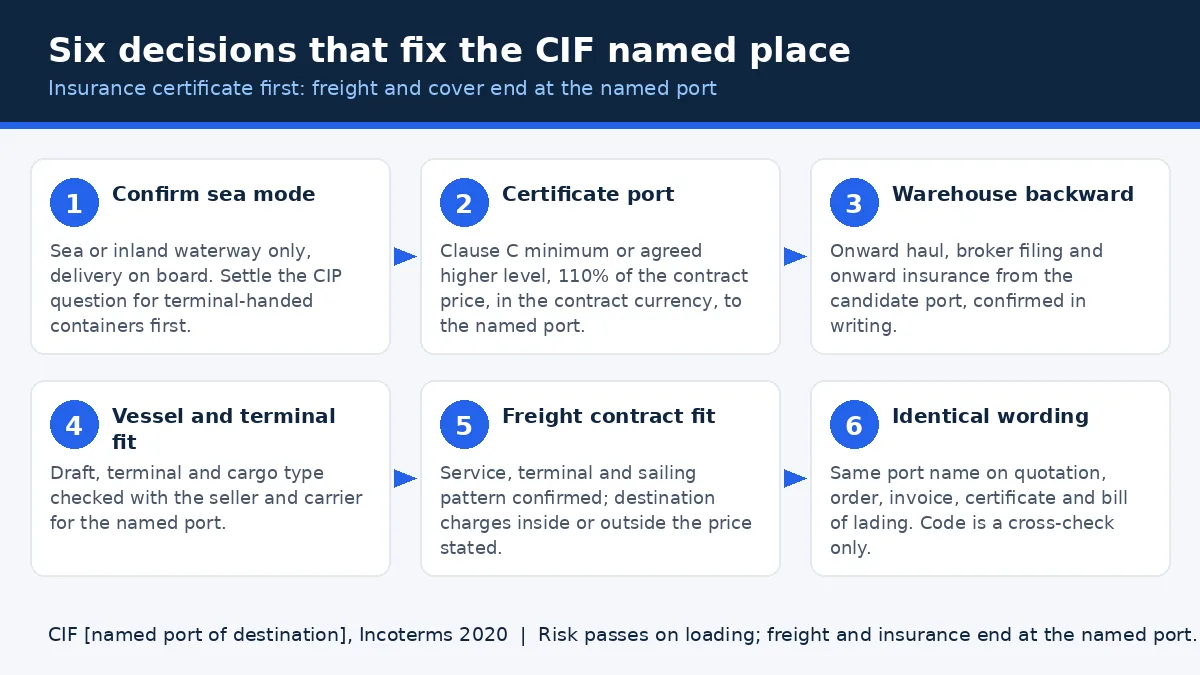
Confirm the mode fits CIF. The goods must travel by sea or inland waterway, with delivery on board the vessel. For container cargo handed over at a terminal, settle the CIP question first, in writing, before naming a CIF port.3
Name the port the insurance certificate will name. Agree the Clause (C) minimum or the higher agreed level, the 110 percent amount, the contract currency, and cover to at least the named port, and get the seller to confirm that the certificate will carry that port name.1
Work backward from the warehouse. Start from the final warehouse and check which ports give a workable onward haul, which broker can file at that port, and whether the buyer's onward insurance runs from that port. Ask the broker to confirm in writing that it can handle the port and the cargo.
Check that the port can take the vessel and the cargo. A port name covers several terminals, berths and depths. Confirm the draft, the terminal and the cargo type with the seller and the carrier, and confirm which terminal the freight contract names. A port can be the right market and the wrong terminal.
Check that the seller's freight contract serves that port and terminal. Ask the seller to confirm the service, the terminal and the sailing pattern in writing, and which destination charges sit inside the freight price. The buyer pays destination unloading and handling charges not included for the seller's account in the carriage contract, so treat any charge named in neither document as the buyer's until the broker confirms otherwise.3
Write the name identically everywhere. Use the same port name, spelling and edition wording on the quotation, order, commercial invoice, packing list, insurance certificate and bill of lading. Record the location code from the booking confirmation as a cross-check, not a substitute: a UN/LOCODE is a five-character identifier, two letters for the country code and three letters for the location, and codes should be verified against the official UNECE database.4 Hamburg and the Port of New York and New Jersey each serve their regions through several terminals, so the code alone never tells the broker which terminal the freight contract names.
What the named place does to the CIF price and the claim
The named place moves the CIF price and the claim in the same direction: both follow the port the freight contract and the insurance certificate name. A longer sea leg can raise the CIF price, while a shorter onward leg can lower the total to the warehouse. A low CIF price to a distant port can produce a high total once the buyer adds the onward haul, handling, broker fee and duty. Price every candidate port to the warehouse, using the landed cost guide for the full build, and read the insurance position beside the price, not after it.
Example figures: one container of garments, Chattogram to two destination ports, goods value USD 40,000, illustrative only. To Hamburg, the example freight and insurance build inside the CIF price is USD 1,900 and the example onward lines total USD 700, giving USD 42,600 before duty and tax. To the Port of New York and New Jersey, the example build is USD 2,400 and the onward lines total USD 450, giving USD 42,850.
Example line | Hamburg | New York and New Jersey |
|---|---|---|
Goods value, example figures | USD 40,000 | USD 40,000 |
Freight and insurance inside the CIF price, example figures | USD 1,900 | USD 2,400 |
Onward lines to the warehouse, example figures | USD 700 | USD 450 |
Total before duty and tax, example figures | USD 42,600 | USD 42,850 |
The claim follows the same port. If goods are damaged during the ocean voyage, the loss is the buyer's risk from loading, and the buyer claims on the seller-bought insurance the buyer can present directly.3 The claim turns on the certificate: the right port, the right voyage, the agreed level of cover, and the 110 percent amount. Damage after the named port falls to the buyer's own onward cover.
Documents that carry the name
Bangladesh loading checks: Chattogram, the export set and the loading port
Name the loading port as carefully as the destination port, and keep the two fields separate. The CIF named place is the destination port; the port of shipment is a different field, and confusing the two puts the risk point and the insurance finish in the wrong places.
Most container exports load at Chattogram. The New Mooring Container Terminal, including its Overflow Container Yard, sits at Chittagong Port under the ownership of the Chittagong Port Authority, with operation and maintenance under a 15-year concession signed in October 2026.5 Confirm which terminal and yard the booking names, and use its spelling in the bill of lading. A booking that names only "Chattogram" leaves the terminal open, and a terminal change after the freight contract is signed can move the loading point the insurance certificate describes.
Export clearance belongs to the seller under CIF and happens before loading. The documents enclosed with the Bill of Export include the export letter of credit, or the approved contract, purchase order or guarantee where there is no letter of credit, the signed invoice, the packing list, the EXP form certified by Authorized Dealers, the certificate of origin, the VAT registration certificate, and the Taxpayer Identification Number.6 Request the EXP form and certificate of origin first, because both depend on third parties.6
Seven naming errors that leave a claim unpaid or a container at the wrong terminal
Naming a country, a region or a trade lane. "CIF Europe", "CIF USA" and "CIF Middle East" name no port. The seller then chooses the freight endpoint and the insurance endpoint. Name one port in full, with the edition, on every document.
Naming an airport, an airport city or an air cargo terminal. CIF applies only to sea and inland waterway transport, so no airport wording can make a CIF term work for air freight.1 Agree FCA or CIP for the air leg and remove the CIF wording.
Assuming Clause (C) covers every loss. Clause (C) is the minimum, named-perils level, and theft, breakage and freshwater damage fall outside it alone.3 A buyer who needs wider cover and never agrees it in the contract holds a certificate that pays for major casualties only. Agree Clause (A) or a top-up in writing, with who pays the extra premium stated.
Naming a port the insurance certificate does not name. The freight contract and the insurance certificate can each name a different port if neither is checked against the other. The claim then describes a voyage the goods did not take. Check the draft certificate against the draft bill of lading before sailing.
Letting a location code replace the port name. A five-character location code is a cross-check, not a contract term. The code identifies a location, but the contract, the certificate and the bill of lading must still name the port in words, with the edition.4 Write the name in full and keep the code secondary, verified against the official UNECE database.4
Checklist before the CIF wording goes into the contract
Before the order is confirmed, every line should be answered in writing.
Journey confirmed as sea or inland waterway, with delivery on board; air freight routed to FCA or CIP instead.1
One named destination port agreed, in the form "CIF [named port of destination], Incoterms 2020".
Insurance level agreed: Clause (C) minimum or the higher agreed level, at least 110 percent of the contract price, in the contract currency, to at least the named port.1
Draft insurance certificate checked: port name, voyage, amount, currency and claim route match the contract and the bill of lading.3
Onward insurance from the named port arranged or agreed in writing, with who arranges it stated.
Vessel and terminal fit confirmed: draft, terminal and cargo type checked for the named port and the service.
Freight contract confirmed to serve the named port and terminal, with destination charges inside and outside the freight price stated in writing.
Broker confirmed in writing to handle the named port and terminal, with filing and release steps stated.
Onward leg priced to the warehouse for each candidate port, with broker, haul and storage stated separately.
Port name identical on every document; location code only as a cross-check, verified against the official UNECE database.4
Loading port confirmed separately; Bill of Export set approved before loading.6
Landed cost repriced to the warehouse, with no CIF quotation treated as a delivered, duty-paid or fully insured cost.3
Next steps on Exportain
On Exportain, post a request for quotation stating the quantity, the named destination port, the full CIF wording, the insurance level required and the loading port, so suppliers quote against the same port, the same certificate and the same basis.7 Compare replies on the same port, insurance level, inclusions and validity. Read the CIF guide and the Incoterms guide for shipments from Bangladesh before choosing between CIF and CIP for container cargo.8 Follow the how-to-buy guide for the steps from search to shipment.7
Post a free RFQ on Exportain and get quotes from Bangladeshi suppliers →
What should I know first about CIF?
CIF is a sea and inland waterway rule under which the seller pays freight and buys minimum insurance to the named destination port, while delivery and risk transfer occur when the goods are loaded on board at the port of shipment.1 The named place must be one specific port, written as "CIF [named port of destination], Incoterms 2020".
What are the typical costs and timelines?
There are no typical CIF costs or transit times a guide can state as fact, because the freight build, premium, destination charges and service pattern depend on the route, port and shipment. Ask for the freight build, insurance position, validity and destination lines in writing, and confirm each line with the broker.
Which documents are needed?
The contract set is the quotation, purchase order, commercial invoice and packing list, each carrying the same CIF wording and port name. The transport and insurance set is the bill of lading and the insurance policy or certificate, each checked in draft form.3 The export set is the Bill of Export with the invoice, packing list, EXP form, certificate of origin, VAT certificate and Taxpayer Identification Number.6
What are the most common mistakes?
The most common mistakes are naming a country, region, inland city or airport instead of one port; assuming Clause (C) cover pays for every loss; naming a port the insurance certificate does not name; pricing the choice on the CIF price alone without the onward leg and onward insurance; copying a port name from another quotation; and letting a location code replace the port name.4 3 Fix each the same way: run the six decisions, get the port, terminal and insurance position in writing, and keep the wording identical everywhere.
Sources
- Incoterms 2020 CIF: Spotlight on Cost, Insurance and Freight. Shipping Solutions (accessed )
- Incoterms® 2020. International Chamber of Commerce (ICC) (accessed )
- CIF Meaning (Cost, Insurance & Freight). Exportain (accessed )
- International Port Codes 2025: Complete Guide & UN/LOCODE. FreightAmigo, (accessed )
- Bangladesh's Chittagong Port Authority and DP World sign 15-year concession for New Mooring Container Terminal. DP World, (accessed )
- Customs Clearance Procedures for Export. Bangladesh Customs, National Board of Revenue (accessed )
- How to source and buy from Bangladesh. Exportain (accessed )
- Incoterms for Shipments From Bangladesh. Exportain (accessed )
About the author
Sourcing from Bangladesh?
Post a request for quotation and suppliers on Exportain can send you their quotes directly.
Post an RFQ


