

Who Handles Customs Clearance Under CFR? Export vs Import Explained
Under CFR, export clearance belongs to the seller in Bangladesh and import clearance belongs to the buyer at destination. This guide follows each border, the broker on each side, and the documents and charges each clearance carries.
Short answer
Under CFR, the seller clears the goods for export in Bangladesh, pays ocean freight to the named destination port, and delivers the goods loaded on board, where risk passes to the buyer. The buyer arranges marine insurance from loading, clears the goods for import at destination, and pays import duty, VAT and other taxes there. The seller's freight payment covers neither the import clearance nor the duties at destination.
On this page
Key takeaways
Under CFR, the seller clears export customs in Bangladesh and pays ocean freight to the named destination port, while the buyer clears import customs at destination and pays duties and taxes.
Risk passes to the buyer when the goods are loaded on board, but the seller's freight payment continues to the destination port, and CFR imposes no insurance obligation on the seller.
Two separate filings exist: the Bill of Export in Bangladesh, filed through the seller's C&F agent, and the import declaration at destination, filed by the buyer or the buyer's broker.
CFR is sea and inland waterway transport only; a CFR term for air freight is invalid, and any destination charge not named in the contract is 'confirm with broker' until confirmed.
A CFR price that includes ocean freight still leaves two customs borders to cross, and the seller pays for only one of them. Under CFR, the seller clears export in Bangladesh and pays freight to the named destination port, while the buyer clears import at destination and pays duties and taxes there. This guide follows the shipment border by border and names the broker on each side.
Why freight-paid does not mean duty-paid under CFR
CFR is Cost and Freight, one of eleven Incoterms rules from the International Chamber of Commerce, which clarify the tasks, costs and risks involved in the delivery of goods.1 Under CFR, the seller contracts and pays for carriage to the named port of destination, but delivery and risk transfer happen when the goods are loaded on board at the port of shipment. The seller bears costs up to the destination port, but unlike CIF, the seller is not obligated to provide insurance.2
That split causes most clearance confusion. A buyer who reads "freight paid" as "delivered cleared" waits for a seller's agent who has no filing to make at destination. Name the rule, version and named port in full — "CFR Rotterdam, Incoterms 2020" — and keep that wording identical on the quotation, order, invoice and bill of lading. Where the contract is silent on a destination charge, ask the import broker to confirm who bears it, in writing, before sailing.
CFR fits only sea and inland waterway transport.2 A "CFR Dhaka airport" term is invalid on its face: there is no port of destination, no vessel and no loading on board.
Export clearance in Bangladesh: the seller's border
Export clearance is the seller's obligation under CFR, and it happens before loading. The seller must complete export clearance, deliver the goods on board, and pay the freight to the destination port.2
Who files the export declaration?
The seller usually files through a customs clearing and forwarding (C&F) agent, or files directly where the seller holds the access and staff to do so. The seller remains responsible for its accuracy, so check the declared description, value, quantity and buyer name against the invoice before submission. Appoint the agent early: a query in the loading window can hold the container at the gate.
Section 131 of the Customs Act, 1969 requires clearance of customs for export, and goods shall not be loaded or stuffed for export unless an export declaration, known as the Bill of Export or Shipping Bill, is submitted and approved.3 The declaration specifies the goods, value, and the names of the exporter, the foreign buyer and the transport operator.3
Which papers travel with the Bill of Export?
Bangladesh Customs lists the documents enclosed with the Bill of Export: the letter of credit, or the approved contract, purchase order or guarantee where there is no letter of credit; the signed invoice; the packing list; the EXP form; the origin certificate; the VAT certificate; and the Taxpayer Identification Number.3 Product-specific papers sit on top of that set where they apply, such as an Export Registration Certificate for jute, jute goods and tea.3
The buyer rarely sees this set in full, but should ask for three items before sailing: the invoice, the packing list, and the bill of lading details once issued. Those three let the destination broker prepare the import filing and let the buyer check that names, quantities, weights and ports match across every document.
The sea leg: what CFR freight payment does and does not buy
Between the two borders, the seller's freight contract carries the goods to the named destination port, and the buyer's risk travels with them. The seller's obligations include origin inland transport, export clearance, origin port charges and sea freight to the destination port.2 The buyer's obligations include destination unloading charges outside the carriage contract, import clearance, duties, VAT and onward transport.2
The practical question is which destination charges the carriage contract already includes. Some contracts include unloading at the destination port and some do not, and the CFR rule alone does not settle it. Ask the seller to state in the quotation which charges sit inside the freight price, and ask the destination broker to confirm the list against the bill of lading. Treat any charge named in neither place as the buyer's until the broker confirms otherwise.
Insurance follows the same logic. CFR imposes no insurance obligation on the seller, so the buyer arranges cover starting at loading on board, when risk passes.2 Where the seller should arrange insurance instead, use CIF, under which the seller must procure cover at the default level of Institute Cargo Clauses (C).4
Containers deserve a separate warning. Containers are often handed to a carrier at a terminal before loading, and under CFR that handover does not normally transfer risk, because delivery and risk transfer occur on board.2 For container shipments where the seller pays carriage, CPT fits the handover better, and CIP fits where the seller also arranges insurance.2
Import clearance at destination: the buyer's border
Import clearance is the buyer's obligation under CFR, a separate filing from the export clearance, usually made by a different broker in a different country. The buyer handles import clearance at destination and pays all import duties and taxes.2 The seller's freight payment and export declaration have no standing in that filing. Appoint the destination broker before sailing.
Who files the import declaration?
The buyer files the import declaration directly, or appoints a customs representative to file it. In the European Union, the customs clearance can be lodged by the importer or by a customs representative, who is the person appointed by the importer to complete all the customs formalities required under EU customs legislation.5 The representative acts on the buyer's instructions, but the buyer remains the importer of record and carries the duty and tax liability.
Registration comes first. An Economic Operators Registration and Identification (EORI) number is mandatory for customs operations in the EU, such as import, export and transit, and uniquely identifies economic operators.6 An operator established in the EU needs one, and an operator not established there needs one where it lodges declarations or acts as a carrier.6 Registration can take some time, so plan and apply well ahead.5 Ask the broker which registration other destinations require.
Which papers does the destination broker ask for?
The deadline for the Entry Summary Declaration depends on the mode of transport.5
On arrival, goods are placed into temporary storage under customs supervision for no longer than 90 days until cleared, and may be cleared on the submitted documents or selected for a document or physical check.5 Import duties are often paid by the importer.5 Under CFR that "often" is a certainty: the buyer pays. Value added tax varies in each Member State and is usually paid by the importer, with VAT-registered firms able to reclaim it as input tax.5 Duty rates are schedule lines: only the destination tariff or the broker's written schedule confirms the rate for a given shipment.
Who pays what: the CFR cost split at each border
The table states the default CFR split. A contract can move a cost by agreement, but a moved cost should appear in the contract in words, not only in a freight quotation.
Cost or charge | Seller | Buyer |
|---|---|---|
Export clearance in Bangladesh, including the Bill of Export filing | Pays | Does not pay |
Inland transport to the port of shipment and loading on board | Pays | Does not pay |
Ocean freight to the named destination port | Pays | Does not pay |
Marine insurance for the sea leg | No obligation | Arranges and pays, from loading on board |
Destination unloading and handling, where not in the carriage contract | Does not pay | Pays |
Import clearance at destination, including the broker filing | Does not pay | Pays |
Import duty, VAT and other taxes at destination | Does not pay | Pays |
Inland transport from the destination port to the final warehouse | Does not pay | Pays |
Two brokers, two filings: the handover step by step
The clearance story under CFR is two filings that never meet. The seller's C&F agent files the export declaration in Bangladesh; the buyer's broker files the import declaration at destination. The bill of lading is the bridge: it proves loading on board, names the ports and parties, and carries the freight-prepaid mark.
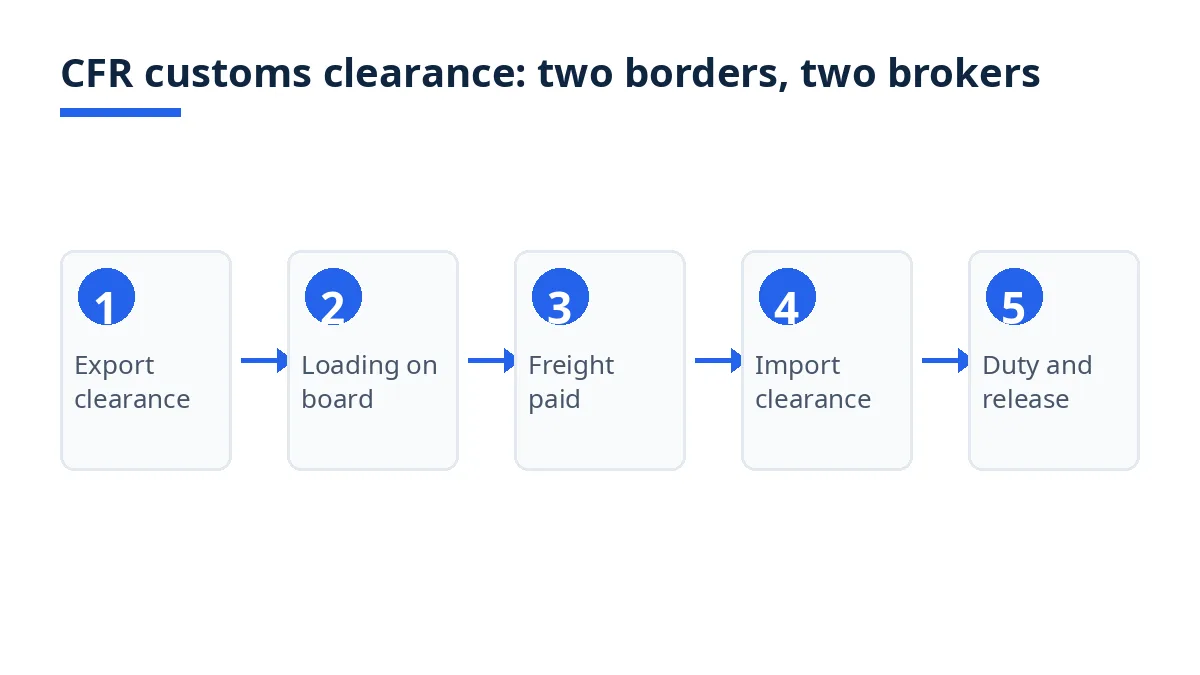
Seller appoints a C&F agent in Bangladesh. The agent prepares the Bill of Export from the contract or letter of credit, invoice, packing list, EXP form and origin certificate.3
Customs approves the export declaration. Goods are loaded only after approval, and the officer signs the shipping bill as shipped on board once the vessel leaves.3
Seller loads the goods on board and pays freight. Risk passes to the buyer at loading, while freight runs to the named destination port.2
Buyer appoints a destination broker before sailing. The broker receives the invoice, packing list and bill of lading details, and confirms registration, classification and the duty schedule.
Buyer files the import declaration at destination. The broker lodges the declaration, answers checks, and confirms the duty and tax payable.
Buyer pays duty and taxes and takes delivery. The buyer pays the destination charges outside the carriage contract and arranges onward transport.2
An illustrative example: a buyer in Rotterdam orders towels from a supplier in Chattogram on CFR Rotterdam, Incoterms 2020. The C&F agent files the Bill of Export, customs approves it, and the towels are loaded on board. The buyer arranges cover from loading, appoints a broker before sailing, and pays the duty and VAT assessed. Quantities, charges and duty lines here are illustrative.
Costs, timelines and documents
What are the typical costs and timelines?
There are no typical costs or timelines a guide can state as fact for CFR clearance, because each border prices its own filing. The export side carries the C&F agent's fee and origin port charges, the sea leg carries the freight, and the destination side carries the broker's fee, handling charges outside the carriage contract, and duty and tax. Timelines follow the same split: export approval depends on the origin set and verification, import release on the destination set and checks.3 5 Ask each broker for its fee and timeline in writing, as separate lines.
Which documents are needed?
The export and destination sets are listed in the two border sections above. The bill of lading sits between them: it proves loading on board, names the destination port, and carries the freight-prepaid mark. Check the same fields on every paper: names, description, quantity, weight, marks, ports, vessel and shipment date.
Bangladesh-specific rules and tips
File before loading, not after. The Bill of Export must be submitted and approved before goods are loaded or stuffed for export.3 Request the EXP form and origin certificate first, because those two depend on third parties: the authorized dealer bank and the issuing body.3
Keep one name across every paper. The export declaration names the exporter, the foreign buyer and the transport operator.3 The name on the trade licence, quotation, invoice, packing list and payment account should match, and the buyer name on the export set should match the importer name on the destination set.
Mistakes and red flags
What are the most common mistakes?
Reading freight-paid as duty-paid. The seller pays freight to the destination port, but the buyer clears import customs and pays duties and taxes.2 A buyer who budgets only the CFR price arrives short of the duty, the VAT and the handling charges outside the carriage contract.
Leaving insurance to the seller by assumption. CFR imposes no insurance obligation on the seller.2 Arrange cover from loading on board, in writing, before the vessel sails.
Appointing the destination broker at arrival. The broker needs the invoice, packing list and bill of lading to prepare the declaration, and registration such as an EORI number takes time to arrange.5 6
Using CFR for air freight. CFR applies exclusively to maritime or inland waterway transport.2 Use FCA where the buyer arranges the main carriage by air.
Accepting a freight quotation as a landed cost. A CFR quotation states the goods and the freight. It does not state the destination broker fee, the handling charges outside the carriage contract, or the duty and tax. Reprice every CFR quotation to a landed cost with the destination broker's written lines added.
Treating a badge as a clearance guarantee. Verification on Exportain is a document and photo review, not a factory inspection.7 A badge does not clear customs.
Checklist: CFR customs clearance, split by party
Before the vessel sails, every line should be answered in writing by the party who owns it.
Contract names the rule, version and named port in full, with the same wording on quotation, order, invoice and bill of lading.
Seller's C&F agent appointed; export declaration filed and approved before loading.3
Export set complete: contract or letter of credit, invoice, packing list, EXP form, origin certificate, VAT certificate and Taxpayer Identification Number, plus product papers.3
Bill of lading checked: on-board notation, freight-prepaid mark, ports, vessel, names, quantities and weights matching the invoice and packing list.
Buyer insurance arranged from loading on board, in writing, covering the sea leg and storage during clearance.
Destination broker appointed before sailing; EORI registration confirmed for EU destinations.6
Destination document set sent to the broker: invoice, packing list, bill of lading details, origin proof, licenses and certificates.
Destination charges confirmed in writing, with unconfirmed lines marked "confirm with broker".
Landed cost repriced with the broker's lines added; no CFR quotation treated as a delivered cost.
How Exportain helps
On Exportain, browse suppliers and post a request for quotation on the RFQ board stating the quantity, destination port and term in full, so suppliers on Exportain quote CFR against the same named port. The how-to-buy guide sets out the steps from search to shipment, including comparing versioned quotations and agreeing inspection and shipment conditions in writing before settling payment directly with the supplier.8 Ask each reply which destination charges sit inside its freight price, and keep the answer on the quotation.
Read the badges for what they record. Verification is free, staff review every submission, and approved checks earn badges shown on the company page, product listings and quotations, as a document and photo review rather than a factory inspection.7
Questions buyers ask before signing
What should I know first about CFR customs clearance?
Two separate clearances exist: the seller clears export in Bangladesh and pays freight to the named destination port, while the buyer clears import at destination and pays duties and taxes.2 Arrange insurance and the destination broker before sailing, because risk passes at loading on board.
What are the typical costs and timelines for CFR clearance?
There are no typical figures, because the export filing, freight and import filing are priced and timed separately. The seller bears the export and freight lines; the buyer bears the broker fee, handling charges outside the carriage contract, duty, tax and onward transport.2 Ask each broker for its fee and timeline as separate written lines.
Which documents are needed for CFR customs clearance?
The export side needs the Bill of Export with the contract or letter of credit, invoice, packing list, EXP form, origin certificate, VAT certificate and Taxpayer Identification Number, plus product papers.3 The destination side needs the customs declaration, transport document, invoice, packing list, origin proof and any license or certificate required, with an Entry Summary Declaration before arrival where required.5
What are the most common mistakes in CFR customs clearance?
Reading freight-paid as duty-paid, assuming the seller insured the voyage, appointing the destination broker at arrival, using CFR for air freight, and treating a CFR quotation as a landed cost. The contract should assign export clearance to the seller and import clearance to the buyer in the same words on every document.2
Next steps on Exportain
Browse suppliers, then post the quantity, destination port and full CFR wording on the RFQ board so suppliers on Exportain quote against the same named port. Before you confirm, read the CFR documents checklist, the CFR risk transfer guide, and the Incoterms comparison.
Sources
- Incoterms® rules. International Chamber of Commerce (accessed )
- CFR Incoterms: Meaning, Costs & Risk. iContainers (accessed )
- Customs Clearance Procedures for Export. Bangladesh Customs, National Board of Revenue (accessed )
- Incoterms® 2020. International Chamber of Commerce (ICC) (accessed )
- Guide to import goods. European Commission, Access2Markets (accessed )
- Economic Operators Registration and Identification number (EORI). European Commission, Taxation and Customs Union (accessed )
- Supplier verification: Earn trust badges buyers can see. Exportain (accessed )
- How to source and buy from Bangladesh. Exportain (accessed )
About the author
Sourcing from Bangladesh?
Post a request for quotation and suppliers on Exportain can send you their quotes directly.
Post an RFQ


