

7 Costly CFR Mistakes Importers Make (and How to Avoid Them)
CFR mistakes cost importers at the destination port, not at loading. This guide names the seven errors, why each one costs money, and the fix for each.
Short answer
Under CFR, the seller pays ocean freight to the named destination port, but risk passes to the buyer when the goods are loaded on board, and CFR imposes no insurance obligation on either party. The seven costly mistakes are naming the destination loosely, reading the CFR price as the landed cost, leaving insurance until after loading, using CFR where it does not fit, letting documents disagree, arranging the import side after sailing, and signing a clean receipt before inspection.
On this page
Key takeaways
Under CFR, the seller pays freight to the named destination port, but risk passes to the buyer on loading on board, and neither party is obliged to insure.
A CFR price is not a landed cost: destination handling outside the carriage contract, import clearance, duty, tax and inland transport sit with the buyer.
CFR is sea and inland waterway transport only, for port-to-port bulk or break-bulk cargo; for air freight use FCA, and for containers consider CPT or CIP.
Fixes happen before sailing: one named port on every document, insurance checked before loading, the broker appointed early, and inspection before signing on arrival.
CFR looks like a delivered price. The seller pays the ocean freight to your named port and the invoice shows one CFR value. The cost of the seven mistakes in this guide does not appear on that invoice. It appears later, at the destination port, in charges the buyer had not budgeted for, in a container waiting for a filing that was never made, or in damaged goods with no policy to claim on.
Under CFR (Cost and Freight), the seller contracts and pays for carriage to the named port of destination, but delivery and risk transfer happen when the goods are loaded on board at the port of shipment.1 The buyer bears the risk from loading onward and handles import clearance, duties and taxes at destination.1 CFR imposes no insurance obligation on either party.2 Each mistake below is written as what happens, why it costs money, and how to fix it, for buyers in the United States, the United Kingdom, the European Union and the United Arab Emirates sourcing from Bangladesh.
The list: seven CFR mistakes that cost importers money
If any item is still open when the vessel sails, fixing it after sailing usually costs more.
1. Naming the destination loosely
What happens. The order says "CFR USA", "CFR UK" or "CFR Europe" instead of naming one port, or it names an inland city with no seaport. The seller then books freight to a port of its own choosing. CFR is written as "CFR [named port of destination]", and the named port is the point the seller's freight payment runs to.1 A country name is not a port.
Why it costs money. The buyer pays inland transport and handling at a port it never planned to use, while the terminal free days keep running.
How to fix it. Write the term in full on every document, in the form "CFR Felixstowe, Incoterms 2020", using the port the seller's freight contract actually serves. Use the same wording on the quotation, order, invoice and bill of lading, and ask the seller to confirm the port in writing.
2. Reading the CFR price as the full landed cost
What happens. The buyer budgets the CFR price as the cost of getting the goods to the warehouse. The CFR price covers the goods and freight to the named port, but the buyer must also pay destination handling outside the carriage contract, import clearance, duties, VAT and taxes, and inland transport.1 In the EU, import tariffs are often paid by the importer, and VAT is usually paid by the importer.3
Why it costs money. The gap shows up as a second bill at arrival. Containers add a clock: demurrage is charged when a full container remains at the destination terminal longer than the allowed free days, and detention is charged when the container, once taken out for unpacking, is not returned empty within the agreed free days.4
How to fix it. Reprice every CFR quotation to the warehouse before accepting it: the CFR price plus each destination line the broker confirms in writing. Ask the seller to state which destination charges sit inside its freight price, and mark any unconfirmed charge as "confirm with broker". Example figures: a container collected seven days after discharge, with four free days at USD 100 a day, accrues USD 300 in demurrage.4
3. Leaving insurance until after loading
What happens. The buyer assumes the seller has insured the voyage because the seller paid the freight, or plans to arrange cover "once the goods sail". Under CFR there is no insurance duty on either side: in only two of the eleven Incoterms 2020 rules, CIP and CIF, is the seller obliged to provide the buyer with insurance for its risk.2 Risk passes to the buyer when the goods are placed on board, so the period with no cover is the whole sea leg.2 1
Why it costs money. An uninsured loss is paid from margin, or not paid at all. Clause A covers all risks unless an exclusion applies, while Clause C covers only listed perils and does not cover washing overboard, earthquake or theft.5 The CIF default does not rescue a CFR buyer: under CIF, Institute Cargo Clauses (C) remains the default level of cover, and that default belongs to CIF, not to CFR.6 Cover can end early: at the earliest of delivery to the named warehouse, delivery to other storage, or 60 days after discharge.5
How to fix it. Brief an insurance broker before confirming the order, and get the recommended clause, sum insured, currency and transit wording in writing. Check the certificate before loading, and confirm whether cover runs warehouse to warehouse or ends at the destination port.5 If the seller offers cover voluntarily, get its terms in writing as a separate agreement.
4. Using CFR where it does not fit the journey
What happens. The buyer agrees CFR for air freight, or for a container handed to the carrier at a terminal days before loading. CFR is one of four rules intended only for port-to-port bulk or break-bulk shipments, and not suitable for container shipments in their current form.2 For air freight there is no vessel, no port of destination and no loading on board, so the CFR delivery point cannot happen. For containers, handover and delivery fall on different days: a container handed to a carrier at a terminal before loading does not transfer risk under CFR, because delivery and risk transfer occur on board.1
Why it costs money. If goods are damaged in the terminal yard between gate-in and loading, each side can point to a different date as the risk point. For air freight, the parties must improvise the delivery point after the goods have flown. In both cases the buyer pays in delayed release or a disputed claim.
How to fix it. For air freight, use an any-mode rule: seven of the eleven rules do not mention the mode of transport and can cover air, road, rail and sea.2 FCA fits where the buyer arranges the main carriage. For container shipments where the seller pays carriage, consider CPT, or CIP if the seller also arranges insurance, because those rules pass risk at handover to the first carrier.1 Write the handover point into the contract.
5. Letting the documents disagree with each other
What happens. The quotation, invoice, packing list and bill of lading name different ports, quantities or buyer names. In Bangladesh, the Bill of Export must be submitted and approved before goods are loaded or stuffed for export, and it specifies the goods, value, exporter, foreign buyer and transport operator.7 The enclosed documents include the contract or purchase order, signed invoice, packing list, EXP form, certificate of origin, VAT certificate and Taxpayer Identification Number.7
Why it costs money. The destination broker files from the papers it receives. If the invoice, packing list and bill of lading disagree, the broker must stop and query, and the container waits while the demurrage clock runs.4 A missing on-board notation or freight-prepaid mark leaves the buyer unable to show that the goods were loaded and freight was paid.
How to fix it. Ask for a draft bill of lading before sailing and check names, description, quantity, weight, ports, vessel and shipment date against the invoice and packing list. Confirm the on-board notation and the freight-prepaid mark are present, and that the named destination port matches the contract term exactly. Check the Bill of Export the same way, and send the checked set to the destination broker before sailing.
6. Arranging the import side after the vessel sails
What happens. The buyer appoints the destination broker on arrival, or discovers at arrival that an import registration is still outstanding. In the EU, an Economic Operators Registration and Identification (EORI) number is mandatory for customs operations such as import, export and transit.8 Registration can take some time, so apply well ahead.3 An Entry Summary Declaration must be presented before arrival at the first EU point of entry, with the declaration, invoice, transport documents and certificates ready for the broker.3
Why it costs money. A filing that starts at arrival starts late. While registration or a missing certificate is chased, the goods sit in temporary storage under customs supervision, for no longer than 90 days, and may be selected for a check.3 The terminal clock still runs, so a paperwork delay becomes a demurrage charge too.4 Duty and tax are also settled late, because both are usually paid by the importer.3
How to fix it. Appoint the destination broker before sailing. Give the broker the invoice, packing list and bill of lading details early, and ask for written confirmation of the registration, the duty and tax schedule, and the documents still needed. Apply for any registration, such as an EORI number for EU destinations, well ahead of sailing.3 8 Hold the funds for arrival charges ready before the vessel berths.
7. Signing a clean receipt and settling before inspection
What happens. The goods arrive, the driver waits, and the buyer signs the delivery receipt without counting the packages or looking inside the container. Payment is then settled in full before anyone has checked the goods against the bill of lading. The arrival inspection is the first point at which the buyer can establish what the voyage did to the goods.1 A clean signature is the record the carrier and insurer will read first.
Why it costs money. Damage found after an unqualified signature is harder to attribute, and the insurer can ask why no remark was made. Insurers assess a claim strictly against the wording of the clause attached to the certificate, and delayed notification can give an insurer grounds to reduce or reject a claim.5 Once the price is settled in full, a claim for damaged goods becomes a fresh negotiation with a seller who has already been paid.
How to fix it. Inspect before signing. Count the packages against the bill of lading, photograph damage in the container, and write the damage, affected packages and date on the receipt before signing. Document the damage before goods are moved or repaired, retain all packaging, and notify the insurer as soon as you become aware of any loss.5 Agree inspection and shipment conditions in writing before settling payment, as the Exportain buying steps set out.9
Summary table
Mistake | What it costs | Fix in one line |
|---|---|---|
Naming the destination loosely | Inland haulage and terminal time at the wrong port | Name one port, in full, identically on every document |
Reading the CFR price as the landed cost | Destination charges, duty, tax and demurrage on arrival | Reprice to the warehouse with the broker's written lines |
Leaving insurance until after loading | An uninsured sea leg | Broker brief and certificate checked before loading |
Using CFR where it does not fit | A risk gap between handover and loading, or an inoperable air term | FCA for air, CPT or CIP for containers |
Letting the documents disagree | Delayed filing and terminal waiting time | Cross-check the draft bill of lading before sailing |
Arranging the import side after sailing | Storage, checks and demurrage while registration and filing catch up | Broker appointed and registration in place before sailing |
Signing a clean receipt before inspection | A damage claim with no contemporaneous record | Count, photograph and remark before signing |
Next steps on Exportain
Compare CFR with the other ten rules in the Incoterms guide for shipments from Bangladesh, and read the seller-insured alternative in the CIF guide . Then follow the buying steps in How to Source and Buy from Bangladesh, which set out searching products, reviewing profiles and badges, posting an RFQ, and comparing versioned quotations.9 Read each badge for what it records: verification is a document and photo review by the Exportain team, not a factory inspection, and membership never grants a badge.10
Post a free RFQ on Exportain and get quotes from Bangladeshi suppliers → https://exportain.com/rfqs
What is the biggest mistake?
The biggest mistake is treating the CFR price as a delivered, insured price. A CFR price is the goods plus freight to the named port, with risk passing at loading and no insurance included.1 Budgeting only that figure leaves out destination charges, duty, tax, the broker fee, the inland leg and insurance. The fix is one repricing step before accepting any quotation: CFR price plus every destination and insurance line, confirmed in writing by the broker and the insurer.
How can I avoid it?
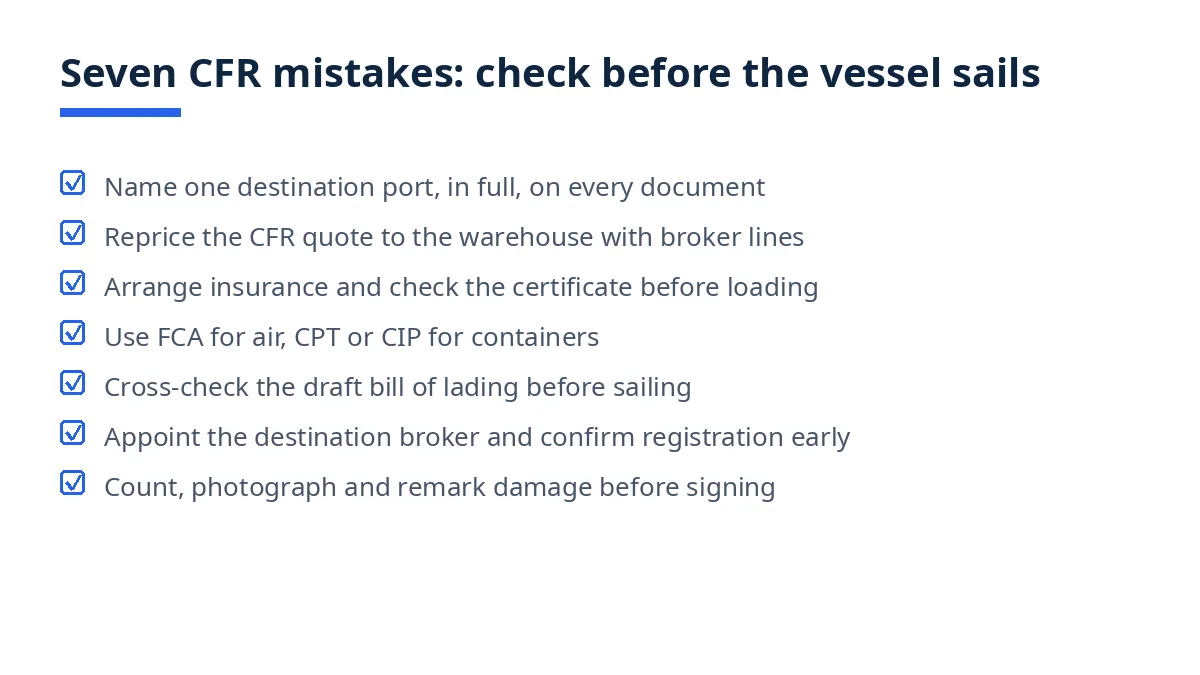
Work from one checklist before the order is confirmed. Name the port in full on every document. Reprice the quotation to the warehouse with the broker's lines added. Brief the insurance broker and check the certificate before loading. Choose a rule that fits the journey: FCA for air, CPT or CIP for containers. Cross-check the draft bill of lading against the invoice and packing list. Appoint the destination broker and confirm registration before sailing. Inspect, count and photograph before signing on arrival, and settle only after inspection.
Who is responsible?
The seller is responsible for export clearance, for delivering the goods loaded on board, and for contracting and paying freight to the named destination port.1 The buyer is responsible for import clearance, duties and taxes at destination, destination charges outside the carriage contract, and inland transport onward.1 Risk passes from seller to buyer when the goods are loaded on board, and neither party is obliged to insure under CFR.2 Any different split must be written into the contract as a separate agreement.
Where can I get help?
Start with the two advisers the shipment already needs: a customs broker at destination for classification, duty, tax and filing, and an insurance broker for the clause, sum insured and transit wording. Brief both before sailing, with the term, port, goods and value in writing. For the sourcing side, use the Exportain guides and RFQ route named above, and keep the exchange and agreed terms in one thread. If a charge, a document field or a registration requirement is unclear, ask the broker or insurer to confirm it in writing before the vessel sails.
Sources
- CFR Incoterms: Meaning, Costs & Risk. iContainers (accessed )
- Insider thoughts: Bob Ronai on Incoterms 2020 Rules; What are they about?. International Chamber of Commerce (accessed )
- Guide to import goods. European Commission, Access2Markets (accessed )
- The Basics of D&D: Demurrage Calculation & More. VIZION (accessed )
- Institute Cargo Clauses Explained: A, B and C Cover Compared. National Cover (accessed )
- Incoterms® 2020. International Chamber of Commerce (ICC) (accessed )
- Customs Clearance Procedures for Export. Bangladesh Customs, National Board of Revenue (accessed )
- Economic Operators Registration and Identification number (EORI). European Commission, Taxation and Customs Union (accessed )
- How to source and buy from Bangladesh. Exportain (accessed )
- Supplier verification: Earn trust badges buyers can see. Exportain (accessed )
About the author
Sourcing from Bangladesh?
Post a request for quotation and suppliers on Exportain can send you their quotes directly.
Post an RFQ


