CFR Shipping From Bangladesh to Saudi Arabia: Costs, Steps and Timeline
CFR from Bangladesh to Saudi Arabia: who pays freight, when risk passes, what Jeddah or Dammam arrival costs, and which SABER and customs documents a shipment needs.
Short answer
Under CFR, a Bangladeshi seller pays the ocean freight to a named Saudi port such as Jeddah Islamic Port or King Abdulaziz Port in Dammam, while risk passes to the Saudi buyer when the goods are loaded on board at Chattogram. The buyer then handles Saudi import clearance, duty and 15% VAT, and inland delivery. For regulated goods, SABER conformity certificates must be in place before the shipment can clear Saudi customs.
On this page
Key takeaways
Under CFR the seller pays ocean freight to the named Saudi port, but risk passes to the buyer when the goods are loaded on board at Chattogram.
Neither party must insure under CFR, so the buyer arranges cargo cover for the sea leg unless the parties agree otherwise.
Jeddah Islamic Port serves the western region while King Abdulaziz Port in Dammam serves Riyadh and the Eastern Province, so the named port must fit the final destination.
For regulated goods, SABER product and shipment certificates must be in place before the shipment can clear Saudi customs.
Saudi duty is generally assessed on the CIF value by classification, with standard 15% VAT applied to the CIF value plus the duty assessed.
A CFR sale from Bangladesh to Saudi Arabia splits the shipment at two different points, and that split is the whole deal. The Bangladeshi seller pays the ocean freight to a named Saudi port, while the risk of loss or damage passes to the Saudi buyer much earlier, when the goods are loaded on board at the port of shipment in Bangladesh. The price looks simple because freight is included, but the buyer still carries the sea risk and still pays for Saudi import clearance, duty, VAT and inland delivery.
The named port matters as much as the term. Jeddah Islamic Port on the Red Sea coast is the Kingdom's largest port and handles about 65% of Saudi Arabia's imports by sea, which makes it the natural arrival point for buyers in Jeddah, Makkah and Madinah.1 King Abdulaziz Port in Dammam, on the Arabian Gulf coast, is the largest port on the eastern coast and the main entry point for goods bound for Riyadh and the Eastern Province, with a rail link to the Riyadh Dry Port.1 Name the port that fits the final destination, not just the first port a seller offers, because inland transport from the wrong coast is paid by the buyer.
Why this matters for buyers and sellers
For the seller, CFR keeps control of the export side: production, export clearance, loading and the freight booking. For the buyer, CFR keeps control of the import side: Saudi clearance, tax payment and delivery to the warehouse. Each side prices only the part it controls, so a CFR quotation from two sellers can only be compared when both name the same destination port and the same inclusions.
What should I know first about CFR?
CFR stands for Cost and Freight, and it is one of the Incoterms 2020 rules for sea and inland waterway transport only.2 The seller contracts and pays the freight to the named port of destination, but delivers, and passes risk, when the goods are placed on board the vessel at the port of shipment.2 The Incoterms 2020 rules give a clear allocation of cost, risk and obligations for each rule, and CFR is the rule where cost runs to the destination port while risk stops at loading.3
Three points follow from that split. First, neither party is obliged to insure under CFR, so the buyer must arrange cargo cover from the point the goods go on board if the cargo is to be insured at sea.2 Second, the buyer pays destination unloading and handling charges that are not included for the seller's account in the carriage contract, together with import clearance, duties, VAT and inland transport.2 Third, containers create a gap: a container is handed to a terminal days before it is loaded, yet delivery and risk transfer under CFR still occur on board, so damage between gate-in and loading can be hard to attribute.2
Step-by-step: how it works
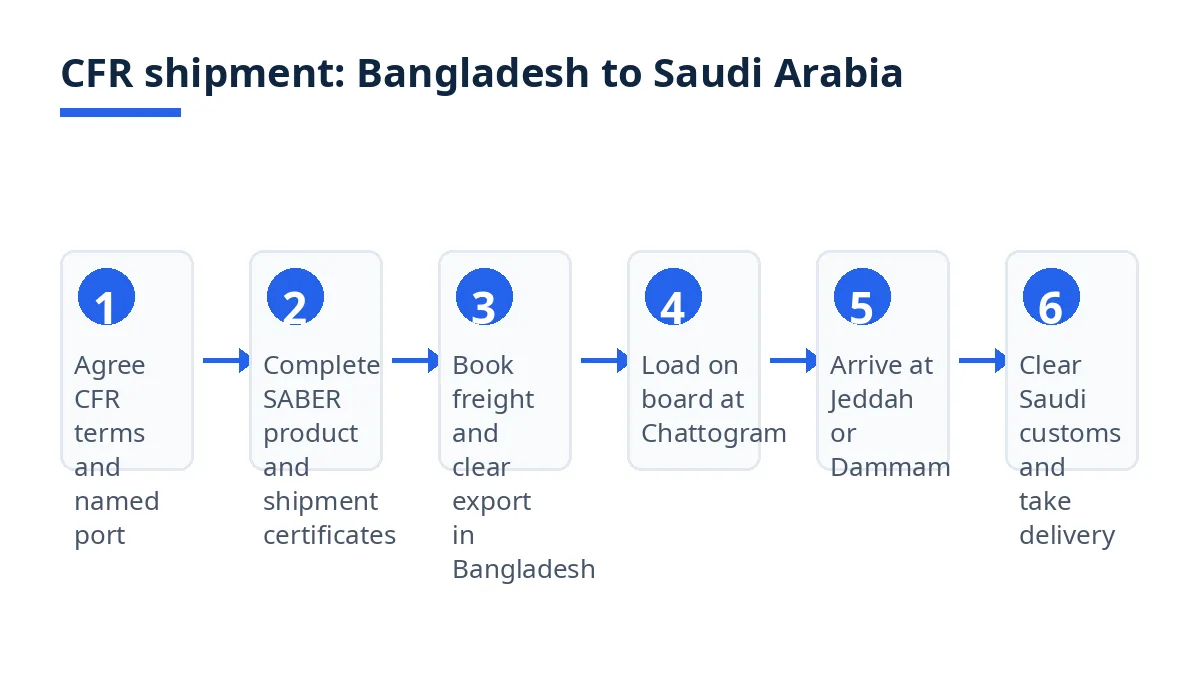
Agree the term, the port and the inclusions in writing. Write "CFR Jeddah Islamic Port, Incoterms 2020" or "CFR King Abdulaziz Port Dammam, Incoterms 2020" on the quotation and purchase order, and state whether destination unloading and handling are included in the seller's carriage contract.2
Start the SABER work before production finishes. For regulated products, register the product on the SABER platform, work with a recognized conformity assessment body, and pass testing against the relevant Saudi technical regulation.4 The Product Certificate of Conformity covers the product type and is valid for up to one year, while a Shipment Certificate of Conformity is issued per consignment and is required for customs clearance.4
Clear the goods for export in Bangladesh. Goods may not be loaded unless an export declaration, the Bill of Export or Shipping Bill, is submitted to Customs and approved.5 The enclosed documents include the export contract or purchase order where there is no export letter of credit, the commercial invoice, the packing list, the EXP form certified by an authorized dealer, and a certificate of origin issued by the Export Promotion Bureau or a Chamber of Commerce and Industry.5
Load on board at Chattogram and take the bill of lading. Risk passes to the buyer when the goods are on board, so the on-board bill of lading is the document that proves delivery under the term.2
Sail to Jeddah or Dammam and file the Saudi declaration. Saudi clearance runs through FASAH, the national single-window platform, where the customs declaration (Bayan) and manifest are submitted electronically before arrival.6 Cargo is then routed to a green, yellow or red inspection track based on risk, and duties and VAT are paid online before an electronic release permit is issued.6
Pay, release and deliver inland. The buyer pays duty and VAT, collects the release permit, and arranges transport from the port to the warehouse. For Dammam arrivals bound for Riyadh, the rail link to the Riyadh Dry Port is one inland option to price against road transport.1
Costs, timelines and documents
What are the typical costs and timelines?
There is no fixed freight rate a guide can state for this lane, because ocean freight moves with vessel capacity, fuel, season and the sailing chosen. What can be fixed in advance is who pays each line, and that split is what the quotation must show.
Cost line | Paid by | Note for this lane |
|---|---|---|
Inland transport in Bangladesh and export clearance | Seller | Part of the CFR price |
Origin port charges and ocean freight to Jeddah or Dammam | Seller | To the named port only |
Cargo insurance for the sea leg | Buyer, unless agreed otherwise | No insurance obligation exists under CFR2 |
Destination unloading and handling | Depends on the carriage contract | Confirm in writing whether it sits inside the seller's freight2 |
Saudi customs duty | Buyer | Generally assessed on the CIF value, at a rate set by the product's classification6 |
Saudi VAT | Buyer | Standard 15% on the CIF value plus the duty assessed6 |
Inland transport from the Saudi port | Buyer | Jeddah for the west, Dammam for Riyadh and the Eastern Province1 |
Customs duty in Saudi Arabia generally ranges between 5% and 25%, set by the product's tariff classification, and VAT at a standard 15% is applied to the combined total of the CIF value and the assessed duty.6 Because duty is assessed primarily on the CIF value rather than the invoice price alone, the freight and insurance figures feed the customs value even though CFR itself carries no seller insurance.6
Example figures: take a shipment with a CIF value of SAR 100,000 and a 5% duty rate. Duty is SAR 5,000, VAT at 15% on SAR 105,000 is SAR 15,750, and the total border charge is SAR 20,750. The example shows the formula only, not a rate for any product, since the duty rate follows the product's classification.6
For timelines, plan the door-to-door move in weeks rather than days, with each stage as a separate line: origin handling and export clearance in Bangladesh, the ocean leg to Jeddah or Dammam, Saudi clearance through FASAH, and inland delivery. Ask the carrier whether the sailing is direct or transships, and get the transshipment port and scheduled arrival in writing. Allow extra time before sailing for SABER testing and certificate issue, since a certificate problem found at the Saudi port is far harder to fix than one found before loading.4
Which documents are needed?
The Bangladesh export set is the Bill of Export, the commercial invoice, the packing list, the EXP form certified by an authorized dealer, and a certificate of origin issued by the Export Promotion Bureau or a Chamber of Commerce and Industry, plus the export letter of credit or, where there is none, the export contract or purchase order.5
The Saudi import set is the commercial invoice, the bill of lading, the packing list, a certificate of origin attested by an authorized Chamber of Commerce, and, for regulated items, the SABER Product Certificate of Conformity and Shipment Certificate of Conformity.6 Keep one legal name, one product description and one value across every paper.6
Bangladesh-specific rules and tips
File the Bill of Export before loading, not after. Section 131 of the Customs Act, 1969 requires clearance for export, and goods shall not be loaded or stuffed for export unless the export declaration is submitted and approved by Customs.5
Keep the EXP form with the right bank. The EXP form must be certified by an authorized dealer to ensure realization of export proceeds.5
Match the certificate of origin to the Saudi file. The certificate of origin issued by the Export Promotion Bureau or a Chamber of Commerce and Industry is part of the Bangladesh export set,5 and an attested certificate of origin is also part of the Saudi import set.6 Ask which attestation the Saudi broker needs, and get it before sailing.
Check labelling and origin marking early. Failing to mark origin visibly and permanently on products or outer packaging can lead to rejected entry, and inaccurate classification can trigger reassessment, back-duty payments and fines.6 Confirm the HS code, the marking and the SABER scope with the Saudi broker while the goods are still in production, when a correction costs little.
Price Jeddah and Dammam as two different lanes. Jeddah Islamic Port handles about 65% of Saudi Arabia's imports by sea and serves the western region,1 while King Abdulaziz Port in Dammam serves Riyadh and the Eastern Province and connects to the Riyadh Dry Port by rail.1
Mistakes and red flags
What are the most common mistakes?
Treating CFR as delivery at the Saudi port. The seller pays freight to Jeddah or Dammam, but delivery and risk transfer happen on board at Chattogram.2 A buyer who waits until arrival to arrange insurance has left the sea leg uncovered.
Naming no port. "CFR Saudi Arabia" does not fix the freight, the arrival port or the inland leg. Without a named port, two quotations cannot be compared and a dispute over the destination has no written answer.
Leaving destination handling unpriced. The buyer pays destination unloading and handling charges that are not included for the seller's account in the carriage contract.2 Ask which terminal charges sit inside the seller's freight and which fall to the buyer, and put the answer on the quotation.
Starting SABER after sailing. Regulated products must be registered on SABER before they can clear Saudi customs, and the Shipment Certificate of Conformity is required for customs clearance.4 Attempting to clear regulated goods without an active shipment certificate leads to a port hold.6
Classifying by guesswork. Duty rates vary by classification, and an incorrect tariff code can trigger reassessment and fines.6 Confirm the 10-digit HS classification with the Saudi broker before the invoice is issued, not after the Bayan is filed.
Accepting mismatched papers. Invoice, bill of lading and packing list must agree on description, quantity, weight and value. Mismatches trigger document checks and physical inspection tracks, and inspection tracks cost days at the port.6
Comparing CFR with CIF as if they were the same price. The cost and risk split is identical, but under CIF the seller must also contract insurance for the buyer, while under CFR there is no insurance obligation on either side.2 A CFR price that looks lower than a CIF price may simply exclude the insurance the buyer must then buy.
Checklist
Before the goods leave Bangladesh, every line should be answered in writing.
Named port written on the quotation and purchase order: CFR Jeddah Islamic Port or CFR King Abdulaziz Port Dammam, Incoterms 2020.
Destination unloading and handling confirmed as inside or outside the seller's freight.2
Buyer cargo insurance arranged from the on-board point, since CFR carries no seller insurance obligation.2
SABER product registration done, Product Certificate of Conformity in hand, and Shipment Certificate of Conformity applied for before sailing.4
Bangladesh export set agreed: Bill of Export, invoice, packing list, EXP form, certificate of origin.5
Saudi import set agreed: invoice, bill of lading, packing list, attested certificate of origin, SABER certificates, and any sector permits.6
HS classification confirmed with the Saudi broker, with duty and 15% VAT estimated on the CIF value plus duty.6
FASAH declaration route agreed with the broker, with the Bayan filed before arrival.6
Inland transport priced from the named port to the final warehouse, not from the other coast.1
How Exportain helps
On Exportain, browse suppliers and post a request for quotation (RFQ) on the RFQ board with the term written in full, the named Saudi port, and the freight inclusions you need stated, so sellers quote against the same arrival point. Ask each reply whether destination unloading and handling sit inside its freight, and whether its price assumes Jeddah or Dammam. For the wider term, read the incoterms for shipments from Bangladesh guide, and to build the full arrival cost, read the landed cost imports from Bangladesh guide. If the buyer would rather have the seller carry the goods to a named place inland instead of a port, compare the DAP shipping from Bangladesh to Saudi Arabia route before confirming CFR.
FAQs
What should I know first about CFR?
CFR is a sea and inland waterway rule under Incoterms 2020: the seller pays freight to the named destination port while risk passes to the buyer on board at the port of shipment.2 Neither party must insure under CFR, so the buyer arranges cargo cover for the sea leg unless the parties agree otherwise.2
What are the typical costs and timelines?
The seller pays export clearance, origin charges and ocean freight to the named Saudi port, while the buyer pays insurance, destination handling outside the carriage contract, duty, VAT and inland delivery.2 Duty generally ranges from 5% to 25% by classification, and VAT at 15% applies to the CIF value plus the duty assessed.6 Plan the move in weeks, with SABER work completed before sailing.4
Which documents are needed?
The Bangladesh set is the Bill of Export, commercial invoice, packing list, EXP form certified by an authorized dealer, and certificate of origin.5 The Saudi set adds the bill of lading, an attested certificate of origin, SABER certificates for regulated goods, and any sector permits such as Saudi Food and Drug Authority approvals.6
What are the most common mistakes?
The most common mistakes are treating CFR as delivery at the Saudi port, naming no port, leaving destination handling unpriced, starting SABER after sailing, and comparing CFR with CIF as if the insurance position were the same.2
Next steps on Exportain
Browse suppliers, then post your CFR enquiry with the named port and the freight inclusions on the RFQ board. Before you confirm, read the incoterms for shipments from Bangladesh guide to check the term against the alternatives for this lane.
Sources
- Saudi Arabia Port List: Jeddah Islamic, Dammam, Yanbu, King Abdullah. Tradlinx (accessed )
- CFR Incoterms: Meaning, Costs & Risk. iContainers (accessed )
- Incoterms® 2020. International Chamber of Commerce (ICC) (accessed )
- What Is a SASO Certificate? SABER Certification Guide. Tetra Inspection (accessed )
- Customs Clearance Procedures for Export. Bangladesh Customs, National Board of Revenue (accessed )
- What Are Saudi Customs Tariffs and Import Duties? Guide. TrustAngle (accessed )
About the author
Sourcing from Bangladesh?
Post a request for quotation and suppliers on Exportain can send you their quotes directly.
Post an RFQ