Ceiling Fans Lead Time From Bangladesh: Production and Shipping Timeline
Ceiling fans lead time from Bangladesh, planned backwards: sampling, materials, production, inspection, clearance and transit ranges, plus the mistakes that cost weeks.
Short answer
Ceiling fan lead time from Bangladesh is a chain, not a single number: sampling, materials supply, bulk production, inspection, export clearance, and transit. Plan backwards from your in-stock date, ask suppliers for stage-by-stage dates, and treat the motor and blade supply as the usual critical path. A standard order often needs roughly 10 to 18 weeks from confirmed specification to arrival, and custom or newly certified models need longer.

On this page
Key takeaways
Lead time is a chain of stages, not a single factory number; plan backwards from your in-stock date.
Motor and blade supply is usually the critical path; confirm stocked, made-to-order, or imported status with dates.
Run certification in parallel with sampling; a test failure found after production is the costliest delay.
Compare quotations only on the same specification and Incoterm; transit varies by route and service.
Keep stage-by-stage dates, written sample approval, and an inspection plan in the purchase order.
The ceiling fans lead time Bangladesh buyers should plan for is not a single number from a factory. It is a chain of stages that run partly in sequence and partly in parallel: specification and sampling, materials supply, bulk production, inspection, export clearance, and transit. If one stage slips, the delivery date slips with it, so the useful question is not "how long does it take" but "which stage sets the date, and how much buffer does each stage need."
This guide works backwards from the date you need stock on hand, names the stage that usually controls the schedule, and shows where buyers most often lose weeks. Use the ranges as planning ranges, not promises.
Why this matters for buyers and sellers
For the buyer, lead time decides when to order, not just what to order. A retailer planning a summer season, a wholesaler filling a project, and a distributor rebuilding stock all face the same trap: ordering by factory production time alone and forgetting sampling, certification, clearance, and transit.
For the seller, lead time decides how the factory schedules its lines and orders its inputs. A custom finish or a made-to-order motor cannot start bulk production until it arrives. A buyer who confirms the specification late, changes a finish mid-order, or approves a sample slowly hands the factory a later start date.
Start with the date the fans must be in your warehouse, subtract transit and clearance, then production, then materials and sampling, and you get the latest date you can confirm the order. Add a buffer at the stages you do not control, such as shipping connections, and a smaller buffer at the stages you do control, such as sample approval.
Step-by-step: how it works
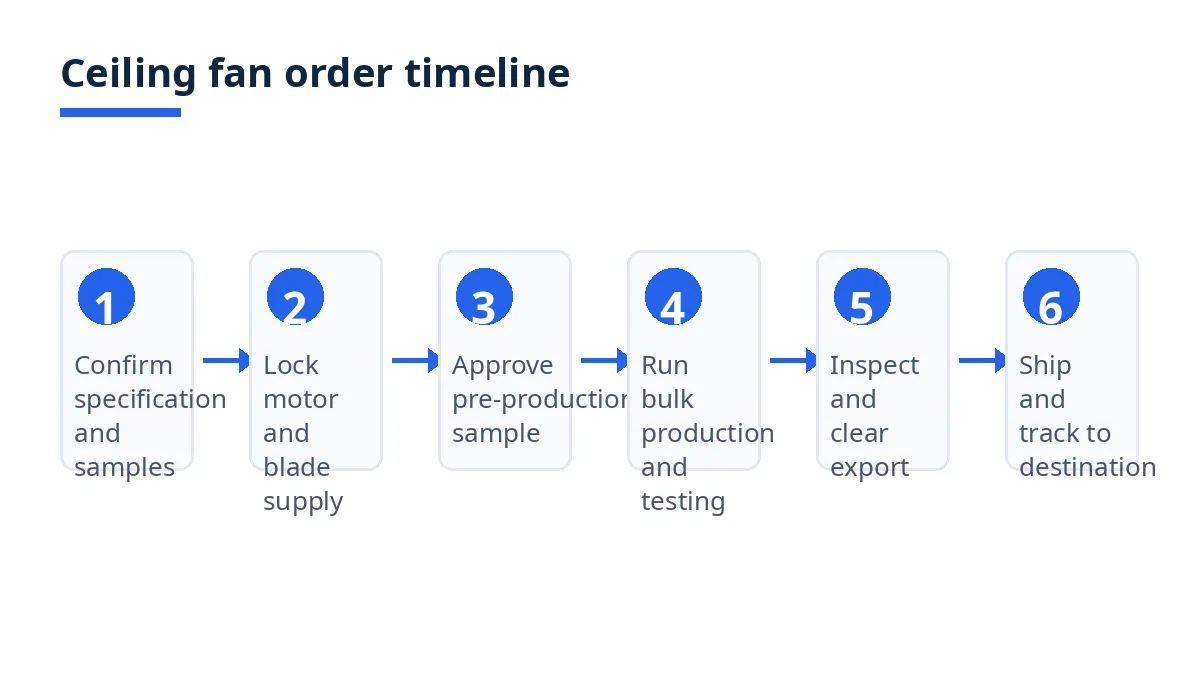
Write one specification and send it to every candidate supplier. State blade span and count, motor type, voltage and frequency for your market, control type, light kit or no light kit, blade material and finish, down rod length, color, packing, and quantity by variant.
Ask for a dated plan, not a single lead time. Ask each supplier to split the schedule into enquiry response, sample dates, materials ready date, production start and finish, inspection date, and shipped date.
Run sampling in two rounds. Order a proto sample to check the design, finish, and control, then a pre-production sample in the exact production materials, finish, and packing. Measure it, run it, and approve it or list corrections in writing. Every correction round adds days, so approve promptly.
Lock the materials before bulk production starts. Ceiling fan production involves sheet metal cutting and forming, motor winding and assembly, blade manufacturing and balancing, surface finishing and coating, final assembly, testing, and packaging.1 The motor and the blades are the usual critical path: if either is made to order, bulk production waits for it.
Approve the pre-production sample in writing, then release production. The written approval should name the model, finish, motor type, control, light kit, packing, and inspection plan. Verbal approval is where later disputes start.
Track production against the dated plan, not against silence. Ask for a production update at materials arrival, at the midpoint of the run, and before packing. Blade balancing and testing sit late in the process, so a problem found at testing has little room left to fix without moving the ship date.1
Inspect, clear, and ship on the agreed dates. Book inspection before production finishes, so the inspector is not the reason for a missed vessel. After inspection, export clearance and port handling still take days, and a missed feeder cut-off at Chattogram can cost a week.
For the inspection points that matter on the finished fan, read the ceiling fans quality control checklist.
Costs, timelines and documents
Ceiling fans lead time Bangladesh: planning ranges by stage
The table below gives typical planning ranges for a standard ceiling fan order. Treat each range as a planning allowance to confirm with your supplier, not as a quoted figure. Custom motors, new finishes, new certification, and large quantities push toward the long end.
Stage | Typical planning range | What moves it |
|---|---|---|
Enquiry and quotation | 1 to 2 weeks | Specification detail, number of variants |
Proto sample | 1 to 3 weeks | Stocked versus custom finish, control type |
Pre-production sample and corrections | 2 to 4 weeks | Correction rounds, materials availability |
Materials, stocked inputs | 1 to 2 weeks | Stock levels, blade and motor availability |
Materials, made-to-order motors or blades | 3 to 6 weeks | Motor type, blade material, import lead time |
Bulk production | 3 to 6 weeks | Quantity, line capacity, variant count |
Inspection and export clearance | 1 to 2 weeks | Inspector booking, document readiness |
Transit to destination port | 2 to 6 weeks | Route, direct versus transshipment service |
Added together, a standard order with stocked inputs often needs roughly 10 to 18 weeks from confirmed specification to arrival at the destination port, and a custom or newly certified model needs longer. Confirm the motor and blade supply and transit first, since together they are usually the longest driver.
On cost, the drivers are the motor type, blade material and finish, control and light kit, quantity, packing, and the delivery term. A brushless DC motor, a wooden blade, a remote control, and a light kit each change both the unit cost and the schedule, so compare quotations only when they cover the same specification and the same delivery term. The Incoterms 2020 rules set out 11 rules with a clear allocation of cost, risk, and obligations, so the term you choose changes who pays for freight and insurance and where risk passes.2 Read the Incoterms guide for shipments from Bangladesh before you compare a FOB price with a CIF price.
Transit time depends heavily on the route you buy. Where direct services from Chattogram are available, shipment to European destinations has been reported at 15 to 20 days, against at least 40 to 45 days through transshipment ports, and container cargo still often moves by feeder vessel to Colombo, Singapore, Port Klang, or Tanjung Pelepas before joining a mother vessel for Europe, a process taking about 40 days.3 For the United Arab Emirates, an indicative port-to-port transit of about 10 days and 9 hours has been listed for Chattogram to Jebel Ali.4 For the United States, transshipment services have been listed at 28 to 35 days, with direct services at 25 to 28 days.5 Ask your forwarder for the actual service on your sailing week.
On documents, two sets matter: your order papers, and the export set for Bangladesh. Goods may not be loaded unless an export declaration, the Bill of Export or Shipping Bill, is submitted to Customs and approved, and the enclosed documents include the export contract or purchase order where there is no export letter of credit, the commercial invoice, the packing list, the EXP form certified by an authorized dealer, and a certificate of origin issued by the Export Promotion Bureau or a Chamber of Commerce and Industry.6 Ceiling fans fall under HS heading 8414, and the commonly cited classification is 8414.51.00, covering ceiling or roof fans with a self-contained electric motor.7 Confirm the exact code with your customs broker for your model.
Bangladesh-specific rules and tips
Run certification in parallel with sampling, not after production. For the European Union, the Low Voltage Directive 2014/35/EU covers electrical equipment within certain voltage limits and requires protection against electric shock and other hazards, and sellers into the EU and European Economic Area must show compliance before applying the CE mark.8 The directive applies to electrical appliances with rated voltages between 50 and 1000 volts for alternating current and 75 to 1500 volts for direct current.8 If your model needs a new test report, start it with the proto sample: discovering a test failure after bulk production is the most expensive delay in this guide.
Confirm market requirements variant by variant. Voltage, frequency, plug type, safety listing, and labeling differ between the United States, the United Kingdom, the European Union, and the United Arab Emirates. Put the market requirements in the specification itself, so the sample you approve is the sample for that market.
Keep one legal name across every paper. The export declaration names the exporter and the foreign buyer,6 so the name on the trade licence, quotation, proforma invoice, and payment account should match. A mismatch found at clearance costs days.
Ask which inputs are imported for your order. Motors, capacitors, bearings, and some finishes may be bought in for your specification, and an imported input sets the earliest production date. Ask plainly which stages are done in-house and which are bought in.
Order ahead of the selling season. Fans sell into warm-weather demand, so factories and shipping lanes fill before the season. Place the order while sampling and materials can still be done without rushing, because rushed sampling is how wrong finishes ship.
Mistakes and red flags
What are the most common mistakes?
Accepting a single delivery date with no stage split. A single date hides which stage controls the schedule, so when the date moves you cannot tell which stage caused it.
Comparing quotations on different delivery terms. The Incoterms 2020 rules allocate cost, risk, and obligations differently under each rule,2 so compare only replies to the same specification on the same term with the same named place.
Approving a sample in a different finish or configuration. A sample approved in a stock finish does not approve a custom finish, and a sample approved without the light kit does not approve the light kit.
Treating certification as paperwork after production. Test reports, declarations, and labeling take calendar time. If certification is left until the goods are packed, the shipment waits while the paper catches up.
Skipping inspection to recover lost time. Inspection under an agreed sampling plan is the last control before the goods become your stock. ISO 2859-1 defines a system of acceptance sampling plans for inspection by attributes, indexed by acceptance quality limit (AQL) for lot-by-lot inspection.9 Cutting inspection to save a week risks receiving a full container of a problem you could have caught.
Planning transit on the shortest published time. Published transit times describe a good sailing, not your sailing. A transshipment service, a missed feeder, or a congested hub can add weeks.3 Plan on the slower service and treat a faster arrival as a bonus.
Ignoring the split by variant. A fan order is rarely one variant. Blade span, finish, control, and light kit each carry their own materials and production timing, so an order can be on schedule for the main variant and weeks late on one finish, and the shipment still waits for the late variant.
Checklist
Before you confirm a ceiling fan order, every line below should be answered in writing.
Specification complete: blade span and count, motor type, voltage and frequency, control, light kit, blade material and finish, down rod, color, packing, quantity by variant.
Dated plan received: sample dates, materials ready date, production start and finish, inspection date, shipped date.
Critical path named: motor and blade supply confirmed as stocked, made to order, or imported, with dates.
Market requirements in the specification for the United States, United Kingdom, European Union, or United Arab Emirates as applicable.
Certification plan running in parallel with sampling, with test lab and report dates named.
Pre-production sample approved in writing in the exact production finish and configuration.
Inspection plan agreed: sampling standard, acceptance quality limit values, inspector booking date.9
Quotations compared on the same specification and Incoterm with the same named place.2
Export set agreed: Bill of Export, commercial invoice, packing list, EXP form, certificate of origin.6
Shipping plan confirmed: service type, feeder cut-off, one spare week for a missed connection.
In-stock date protected: the backwards plan leaves a buffer between arrival and the selling or project date.
How Exportain helps
On Exportain, browse suppliers and post your specification, quantity by variant, target in-stock date, and delivery term on the RFQ board, so suppliers quote against the same plan. Ask each reply for stage-by-stage dates, not only a total lead time, and keep the dated plan in the purchase order.
FAQs
What should I know first about ceiling fans?
Start with the specification and the critical path. A ceiling fan order passes through motor winding and assembly, blade manufacturing and balancing, finishing, final assembly, testing, and packaging,1 and the motor and blade supply usually sets the earliest bulk production date. Ceiling fans are commonly classified under HS 8414.51.00.7 Plan backwards from your in-stock date.
What are the typical costs and timelines?
There is no single typical figure, because motor type, blade material and finish, control and light kit, quantity, and delivery term all move both cost and time. As planning ranges, allow 1 to 3 weeks for a proto sample, 2 to 4 weeks for a pre-production sample with corrections, 3 to 6 weeks for made-to-order motors or blades, 3 to 6 weeks for bulk production, 1 to 2 weeks for inspection and export clearance, and 2 to 6 weeks for transit. A standard order often needs roughly 10 to 18 weeks from confirmed specification to arrival, and a custom or newly certified model needs longer.
Which documents are needed?
Your order papers are the specification, itemized quotation, purchase order with the dated plan, written sample approvals, and inspection report. The Bangladesh export set enclosed with the Bill of Export includes the export contract or purchase order where there is no export letter of credit, the commercial invoice, the packing list, the EXP form certified by an authorized dealer, and a certificate of origin issued by the Export Promotion Bureau or a Chamber of Commerce and Industry.6 Add destination market documents for your model, such as test reports and declarations for the European Union under the Low Voltage Directive 2014/35/EU.8
What are the most common mistakes?
The most common mistakes are accepting a single delivery date with no stage split, comparing quotations on different delivery terms,2 approving a sample in a different finish or configuration, leaving certification until after production, skipping inspection to recover lost time, and planning transit on the shortest published time. Each is avoided by the same habit: get stage-by-stage dates, in writing, before you confirm.
Next steps on Exportain
Browse suppliers, then post your specification, quantity by variant, target in-stock date, and delivery term on the RFQ board so suppliers reply with stage-by-stage dates. Before you compare replies, read the Incoterms guide for shipments from Bangladesh so every quotation is judged on the same delivery term. Post a free RFQ on Exportain and get quotes from verified Bangladeshi suppliers through the RFQ board.
Sources
- Ceiling Fan Manufacturing Plant Project Report 2026. IMARC Group (accessed )
- Incoterms® 2020. International Chamber of Commerce (ICC) (accessed )
- Direct Routes from Ctg to Major Ports Halve Shipment Time and Cost. Bangladesh Institute of Maritime Research and Development (accessed )
- Chittagong to Jebel Ali FCL Shipping Rates | Schedules & Transit Time. Cogoport (accessed )
- Shipping from Bangladesh to New York. GoCubic (accessed )
- Customs Clearance Procedures for Export. Bangladesh Customs, National Board of Revenue (accessed )
- HS Code for Ceiling Fan: Find Accurate Classification. Accio (accessed )
- Low Voltage Directive 2014/35/EU. TÜV SÜD (accessed )
- ISO 2859-1:2026 - Sampling procedures for inspection by attributes — Part 1: Sampling schemes indexed by acceptance quality limit (AQL) for lot-by-lot inspection. ISO (accessed )
- Incoterms
- export documents
- quality control
- buyer guide
- importing from Bangladesh
- Bangladesh sourcing
- Electrical products
About the author
Sourcing from Bangladesh?
Post a request for quotation and suppliers on Exportain can send you their quotes directly.
Post an RFQ