Quality Control Checklist for Bicycle Parts From Bangladesh
A part-level QC checklist for bicycle parts from Bangladesh: frame, fork, wheel, tire, saddle, handlebar, brake and drivetrain measurements, compatibility checks, common defects and parts packing checks before shipment.
Short answer
Use this checklist to inspect bicycle parts from Bangladesh as individual parts before shipment: measure each part against the order specification, check threads, diameters and finishes, confirm interchangeability with its mating part, record defects by part type, and check kit completeness and surface protection in packing.

On this page
Key takeaways
Agree the sample, dimension and tolerance tables, compatibility matrix and acceptance numbers before inspection, and draw the sample randomly across part types, sizes and cartons.
Judge every part against its own specification and its mating part, since a thread, diameter or bead seat mismatch cannot be fixed by adjusting another part in the carton.
Record actual measurements per part type, including wheel runout readings and chain wear gauge readings, rather than pass marks alone.
Check packing as strictly as dimensions: cap machined threads, separate finished surfaces, label small-parts bags by part number, and count every kit item against the packing list.
A carton of bicycle parts is judged part by part, not as a finished machine. A frame with the wrong bottom bracket thread, a rim whose bead seat diameter does not match the tire, or a kit short by one bag of bolts each creates a separate problem. This checklist treats each part as a standalone item: measure it, check its finish and threads, confirm it fits its mating part, and only then pack it.
ISO 4210-2:2023 sets safety and performance requirements for the design, assembly and testing of bicycles and sub-assemblies, covering brakes, handlebars, steering, frames, forks, wheels, tires, pedals, chain, saddles and seat posts.1
Why this checklist matters
Parts orders carry a failure mode that complete-bike orders do not: interchangeability. A headset, bottom bracket or tire that does not match its mating part cannot be fixed otherwise.
A second risk is damage in transit. Machined threads, brake tracks, bearing seats and painted tubes are finished surfaces, and a part within tolerance can arrive unusable if it rubs against another part.
Check each point against the approved sample, the order specification and the packing list, and record it as pass, fail or not applicable, with actual measurements.
Before you start
Do not begin until the references are complete: an approved sample per part type, a specification sheet per part, dimension tables, a compatibility matrix, and the packing specification. Agree the sampling plan in advance, and draw the sample randomly across part types, sizes, colors and cartons.
ISO 2859-1 specifies an acceptance sampling system for inspection by attributes, indexed by acceptance quality limit (AQL), for lot-by-lot inspection, and its schemes apply to components as well as end items.2 Set acceptance numbers per defect class in the purchase order, keeping critical defects separate from minor finish faults. See the AQL acceptance quality limit explainer first.
Check the marking plan before bulk marking: each part type needs a part number, size code, and, where required, a lot or batch mark.
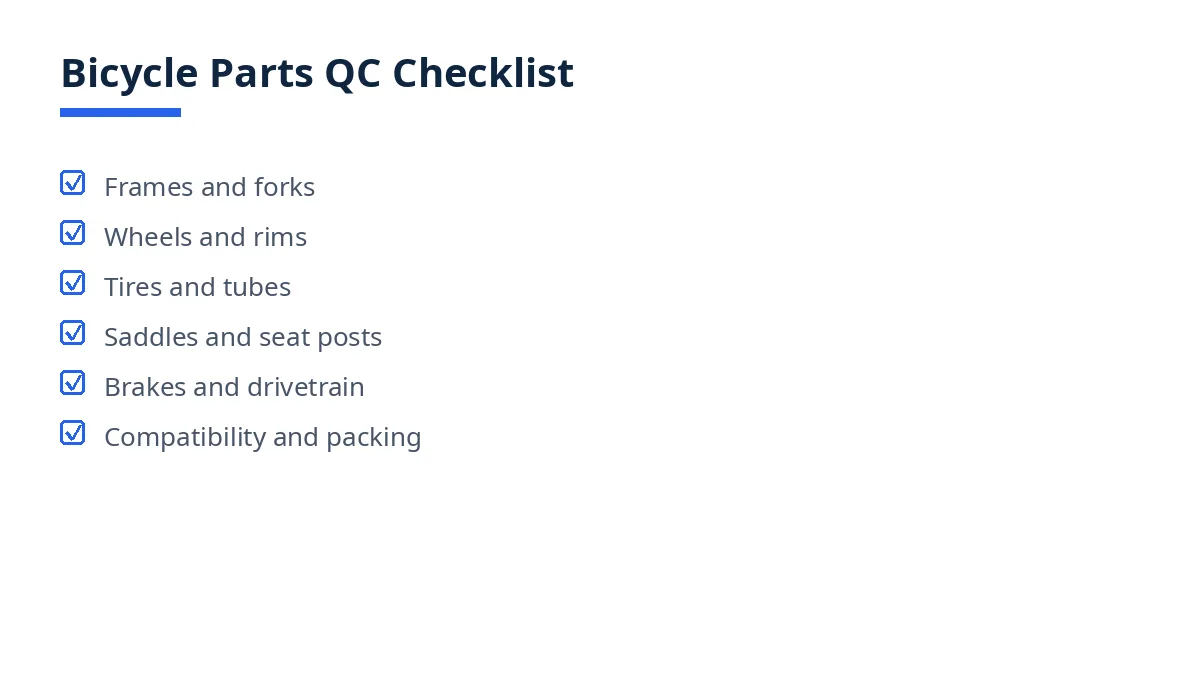
The full checklist (numbered, printable)
Frames and forks
Frame dimensions: head tube, top and seat tube lengths, bottom bracket shell width and thread, seat tube diameter, dropout spacing.
Fork: steerer diameter and length, dropout spacing, steerer thread type; match to frame and headset.
Welds and alignment: reject cracks, porosity, undercut and missed welds; dropouts share a plane, tube angles follow the specification, no tube bent or twisted.
Finish and threads: coating coverage, color against the sample, runs, chips and bare metal at welds, threads clear of paint; test every hole by hand, rejecting cross-threaded, stripped or paint-blocked holes.
Wheels, rims, hubs and spokes
Rim: bead seat diameter, width, depth, valve hole diameter and type, spoke hole count; reject cracks at spoke holes, dents, flat spots and sharp edges.
Spokes: count and lacing per specification, none missing, bent or loose.3
Trueness: record lateral and radial runout per wheel against the buyer-agreed tolerance; Light Bicycle sets 0.4 mm for its rims, its own tolerance, not a universal rule.4
Hubs and axle hardware: axle diameter and length, dropout fit, bearing smoothness by hand, seals, and, where supplied loose, lever or nut threads and springs.
Tires and tubes
Tire markings and condition: sidewall size code, pressure range and direction arrow where fitted, matched to the order and its rim; reject cuts, bulges, exposed casing threads, bead damage and sidewall cracking.
Bead seat match: second ETRTO number must match the rim bead seat diameter; 25-622 means 25 mm wide, 622 mm diameter.5
Tubes and counts: printed size range covers the tire width, valve type matches the rim hole, valve length suits rim depth, no valve stem bent, cracked or loose; check counts per size and carton against the packing list.
Saddles and seat posts
Saddle: length, width, rail diameter and spacing, matched to the specification and its seat post clamp; reject stitching faults, splits, loose staples or rivets, padding faults and shell cracks around rail mounts.
Seat post: diameter, length and setback where specified, matched to the frame seat tube with no forcing or loose fit; bolt threads, clamp jaws and shims matched to the saddle rail diameter.
Insertion mark: seat posts must carry a permanent minimum-insertion mark; a post without a legible mark fails.3
Handlebars, stems and grips
Handlebar and stem: handlebar width, clamp diameter, rise or drop and grip diameter; stem steerer and handlebar clamp diameters, length and angle, each matched to its mating part.
Condition: reject handlebar bends, dents, cracks at the clamp area and grip ends and burrs at cut ends; check stem bolt threads, bolt count and cracks at bolt holes, and grips for splits, loose fit and correct inner diameter where supplied loose.
Brakes as parts
Brake units: as standalone parts, reject caliper cracks, bent arms, damaged mounts and missing springs; check pad holders for secure attachment.
Brake pads: material retained in the holder without movement, shape and compound code per order; pads must engage the braking surface without contacting the tire or spokes.6
Brake levers: body condition and pivot smoothness by hand, grip dimension per order; grip dimension must not exceed 89 mm between the pivot point and the lever midpoint.6
Cables and housing: cable length and end fittings, housing cuts square and free of burrs, ferrules present and correctly sized; cable anchor bolts must not cut cable strands.6
Drivetrain parts
Chains: link count or length and width for its speed count; reject stiff links, rust, damaged plates and missing pins.
Chain wear: gauge sampled chains; Park Tool gauges read 0.5, 0.75 and 1.0 percent, with 5-to-10-speed chains replaced by 0.75 percent and 11-to-13-speed chains by 0.5 percent.7
Bottom brackets: shell thread, shell width, spindle diameter and length; ISO threaded uses 1.37 in x 24 TPI, 68 mm road and 73 mm mountain bike shells, Italian uses 70 mm.8
Cranks, cassettes, derailleurs: tooth counts per order, chainring bends, chips and burrs, cassette spacing, lockring threads, cage straightness, pulley spin, spring return by hand; gear performance is not judged here.
Pedals: axle thread size and condition per order, tread surface secured against movement, bearing smoothness by hand, inserts where specified.
Compatibility and interchangeability
Mating pairs: sign off each matrix row: bottom bracket shell, steerer, handlebar clamp, seat post, rim bead seat, hub spacing, saddle rail.
Thread pitch and small interfaces: check direction and pitch on every threaded pair, not only diameter; check valve type against the rim hole, brake mount type against frame and fork mounts, and cassette driver type against the hub freehub body.
Variants: where more than one size or standard ships together, keep cartons, bags and labels separated by variant, with no variant mixed into another variant's bag.
Packing for parts
Surface protection: cap or tape machined threads, keep brake tracks and bearing seats clear of other parts, separate painted tubes, separate disc rotors from pads and each other.
Small parts and kit completeness: bag bolts, nuts, shims, ferrules and valve caps by part number and quantity, label and seal each bag, and count every item in a sampled kit against the packing list, with no substitution across variants.
Carton packing: brace parts so they cannot shift, keep heavy parts off light or finished parts, add liners and moisture protection where specified, match carton markings and quantities to the packing list.
Common failures and how to fix them
The most frequent failure is a thread or diameter mismatch in the compatibility matrix, most often a bottom bracket thread, a steerer, or a seat post diameter. Stop, re-measure the mating pair, and segregate the mismatched variant before more cartons are packed.
Next is a tire and rim size mismatch, where bead seat diameters differ or a tube valve type does not match the rim hole. Re-check the tire sidewall code and the rim marking together, and re-sort mixed sizes before packing. A rim judged only by eye can also fail, so judge from the indicator record.4
Bent or damaged drivetrain parts form a third group: a chain over the wear limit for its speed count, a bent derailleur cage, or a chainring tooth defect. Segregate the affected part type and re-inspect that type across the lot.7
Packing failures are the last group: unprotected threads, mixed small parts, and short kits. Re-bag by part number, re-count sampled kits, and separate finished surfaces before closing the carton.
Downloadable template / summary table
Copy the checklist into your inspection sheet, add the order tables, and record results per part type.
Section | Checks | Evidence |
|---|---|---|
Frames and forks | Dimensions, welds | Measures |
Wheels and rims | Size, spokes, trueness | Readings |
Tires and tubes | Size, bead seat, valve | Sidewall |
Saddles, seat posts | Rail, post, mark | Measures |
Bars and stems | Clamps, bolts | Measures |
Brakes | Pads, levers, cables | Pad check |
Drivetrain | Chain wear, bracket | Gauges |
Compatibility | Pairs, pitch | Sign-off |
Packing | Protection, bagging | Packing list |
How Exportain helps
Exportain is a B2B marketplace connecting buyers with Bangladeshi suppliers of bicycle parts, so the specification sheet, dimension table and compatibility matrix behind this checklist can be agreed at the enquiry stage. Use inspection services when you plan the check, and read the bicycles quality control checklist only where the order also includes complete bikes, since that guide covers the finished machine, not standalone parts. Supplier profiles show which document and photo checks have been recorded, not factory inspections. Exportain is not a party to the goods contract.
FAQs
When should this checklist be used?
Use it at final inspection, when parts are finished and packed. For larger and first orders, also use it in production, while faults can still be corrected.
Who should complete it?
The buyer, a local agent or an independent inspector can complete it, using the approved sample, specification sheet, matrix and a randomly drawn sample.
What are the most common failures?
Thread and diameter mismatches, tire and rim mismatches, rims outside tolerance, chains over the wear limit, and mixed or incomplete kits.
Can a third party do it?
Yes, if you share the approved references, tables, matrix and acceptance levels first, with actual measurements recorded per part type.
Next steps on Exportain
Before production starts, agree your specification sheet, dimension tables, compatibility matrix and packing specification, then read the AQL acceptance quality limit explainer and the pre-shipment inspection guide, and plan the check with inspection services.
Sources
- ISO 4210-2:2023 - City, Trekking, Mountain & Racing Bicycles. ANSI, (accessed )
- ISO 2859-1:1999 - Sampling procedures for inspection by attributes — Part 1: Sampling schemes indexed by acceptance quality limit (AQL) for lot-by-lot inspection. International Organization for Standardization (accessed )
- 16 CFR Part 1512 - Requirements for Bicycles. U.S. Consumer Product Safety Commission (accessed )
- Tests for Rims / Wheels. Light Bicycle (accessed )
- How to Select the Right Tire and Tube Size for Your Bicycle. Tesway (accessed )
- 16 CFR § 1512.5 - Requirements for braking system. Cornell Law Institute (accessed )
- Park Tool CC-4.2 Chain Checker. BikeTiresDirect (accessed )
- The complete guide to bottom bracket standards. BikeRadar (accessed )
About the author
Sourcing from Bangladesh?
Post a request for quotation and suppliers on Exportain can send you their quotes directly.
Post an RFQ