Best Incoterm for Importing Jute & Jute Products From Bangladesh
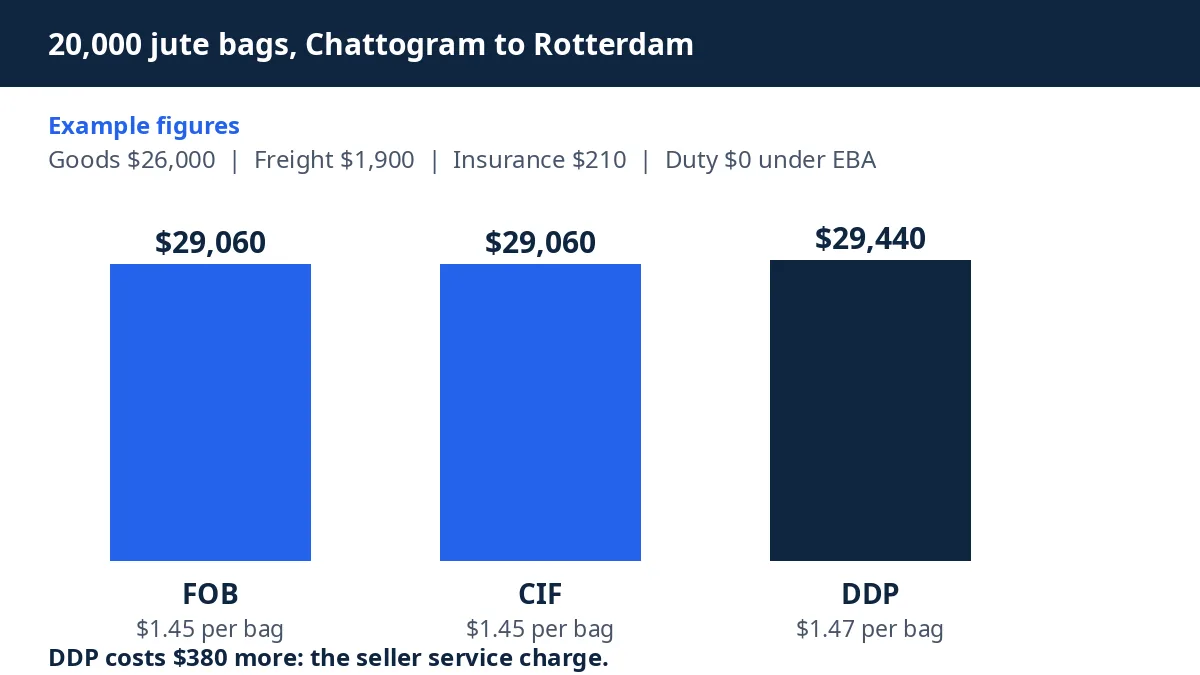
FOB, CIF and DDP behave differently for jute from Bangladesh, where bulk, moisture and duty change the maths. A worked example prices 20,000 jute bags to Rotterdam three ways: FOB and CIF land at $29,060, DDP at $29,440.
Short answer
For most jute orders from Bangladesh, FOB suits a repeat buyer with a forwarder who can control the freight and buy all-risks cover, CIF suits a first sea shipment that wants one price to port, and DDP suits small orders of finished bags where a single landed price is worth more than freight control. Raw jute bales suit FOB or FCA, and Clause A cover matters because Clause C does not cover damp or mouldy jute.
On this page
Key takeaways
FOB suits a repeat jute buyer with a forwarder, because you control the freight and buy your own all-risks cover.
CIF bundles freight and minimum Clause C insurance into one price, but Clause C does not cover damp or mouldy jute.
DDP suits small orders of finished jute bags, since the seller clears import and pays duty before delivery.
Raw jute is 5303, jute yarn 5307, woven jute fabric 5310 and jute sacks and bags 6305, and the heading decides the duty and the documents.
Example figures put 20,000 jute bags to Rotterdam at $29,060 landed under FOB and CIF and $29,440 under DDP, a $380 gap for the seller service charge.
A Rotterdam buyer orders 20,000 jute shopping bags from a Dhaka mill and receives three prices: FOB Chattogram, CIF Rotterdam and DDP at the warehouse. The bags, vessel and sailing match, yet the totals differ by hundreds of dollars and the risks differ more. Jute is the reason: it is heavy for its value, it holds moisture, and it crosses borders under rules that change with the form it ships in.
This guide compares FOB, CIF and DDP for jute and jute products from Bangladesh.
What makes jute different from other Bangladesh exports
Bangladesh earned $820.16 million from jute and jute goods in the 2024-25 fiscal year, per Export Promotion Bureau figures, down from $1.16 billion in 2020-21.1 Jute yarn and twine earned the most at $461.83 million, raw jute $148.48 million, sacks and bags $125.96 million.1
First, jute is heavy for its value, so freight is a large share of the landed cost, and a term that hides the freight hides the largest cost line.
Second, jute is a plant fibre that holds moisture. A bag that feels dry can still carry enough water to support microbial growth in a sealed carton, and odour appears before visible mould does.2 A damp bale is rejected, and the term decides who carries that loss.
Third, jute ships in several forms, and the form changes the border work. Raw jute bales, jute yarn, hessian cloth and finished bags are different goods for customs, with different codes, documents and, for India, duties.
Raw jute, yarn and finished bags need different terms
Jute splits across a handful of headings, and the heading decides the duty, the documents and often the term: raw jute is 5303, jute yarn 5307, woven jute fabric such as hessian 5310, and sacks and bags of jute 6305.3
Raw jute travels as compressed bales, bought by mills and spinners that already run their own freight. Those buyers tend to buy FOB or FCA, because they want the sailing in their own hands. A bale order also carries plant-health paperwork: whether the destination asks for a phytosanitary certificate depends on the importing country.4
Jute yarn and twine ship on cones and pallets, denser than bales. Yarn buyers often choose CIF for a first sea shipment, because one seller-arranged price covers goods, freight and minimum insurance to the destination port. The seller chooses the vessel and the insurer, and risk still passes to the buyer when the yarn is loaded at Chattogram.
Finished bags, rugs and other diversified jute products are the form most retail buyers order, and where DDP earns its keep. A small order of printed shopping bags has a high value per carton, so a single landed price to the warehouse is worth more than freight control.
FOB, CIF and DDP for a jute shipment
Incoterms 2020, in force since 1 January 2020, gives eleven rules for delivery, carriage, insurance and customs clearance.5 Three cover most jute orders.
Term | Who arranges transport | Seller insurance | Risk moves to you | Import duty and clearance |
|---|---|---|---|---|
FOB (Free On Board) | You | None | When loaded at Chattogram | You clear and pay |
CIF (Cost, Insurance and Freight) | Seller, to the destination port | Seller buys Clause C minimum | When loaded at Chattogram | You clear and pay |
DDP (Delivered Duty Paid) | Seller, to the named place | Seller arranges it | On arrival at the named place | Seller clears and pays |
FOB: you control the freight and the insurance
Under FOB, the Dhaka seller loads the goods onto the vessel you name at Chattogram, having cleared them for export. From the moment they are on board, the risk sits with you: you arrange the sea freight, buy your own insurance, and handle import clearance and duty. FOB suits a buyer who already works with a forwarder, because the sailing, the insurance and the freight bill stay in your hands.
CIF: one price to the port, risk still yours at loading
Under CIF, the seller contracts the sea freight to the destination port you name and takes out marine insurance in your favour, so a single invoice covers the goods, the freight and the insurance. The cover the seller owes you under CIF is the minimum level in Institute Cargo Clauses (C), at least 110 percent of the contract price.6 Clause C pays only for listed major casualties such as fire and sinking, not for water that gets into the container.6 For jute, that gap is the whole argument: the loss a buyer is most likely to suffer is damp bales and mould, and Clause C does not cover it. Agree Clause A cover, or buy your own top-up cover.
DDP: the seller takes the goods to your door
Under DDP, the seller takes the goods to the place you name, import-cleared and ready to unload, and holds the cost and the risk until they get there. No other rule puts import clearance and duty on the seller. Check first whether the seller can act as importer of record in your country; if not, DAP is the usual substitute. DDP suits a first order of finished jute goods or a small order. It suits raw jute badly: a bale shipment into a market with an anti-dumping duty needs a buyer with a broker.
Moisture and mould: the risk that follows the term
Jute fibre absorbs water from the air, and the damage starts before the container is loaded. Most moisture comes from four sources: fabric not fully dried after finishing, cartons stored in a humid place, packing in a warehouse without humidity control, and condensation when warm air cools.2 A jute bag that feels dry can still carry enough water to support microbial growth in a sealed carton.2
Mould does not establish itself when indoor relative humidity stays below 60 percent, ideally between 30 and 50 percent, per guidance Tiiocti cites from the US Environmental Protection Agency.2 A bag that sits for three months in a humid season accumulates risk no packing method can offset, so pack promptly and ship on schedule.2
The term decides who pays when the moisture wins. Under FOB and CIF, risk passes to you at loading in Chattogram, so damp goods at Rotterdam are your claim. Under DDP, the seller carries the risk until the goods arrive at your warehouse.
Write the moisture standard into the contract under every term: a moisture reading on the finished goods, recorded against the order, and an odour check when a carton is opened, both before the container is sealed.2 Add desiccant sized for the carton volume and the journey, and polybag individual bags or bundle them in tens inside a sealed inner bag.2
Duty, HS codes and the India exception
Raw jute is 5303, jute yarn 5307, woven jute fabric 5310, and sacks and bags of jute 6305, with hessian bags at 6305.10.30 and sacking bags at 6305.10.40.3 Check the line for your exact product.
For the European Union, preference decides the duty as much as the tariff line does. Bangladesh currently enters the EU without duty or quota under the Everything But Arms scheme.7 The EU has agreed to keep those preferences for three more years after graduation, so standard tariffs would apply from 2029.7
India is the exception that changes the term. India imposed anti-dumping duties on jute products from Bangladesh on 5 January 2017, from $6.03 to $351.72 per tonne on jute yarn, twine, hessian fabric, sacking bags and sacking cloth, and extended the levy on 30 December 2022.8 India also restricted imports of Bangladeshi woven fabrics and jute items by land routes in June 2025, allowing them only through Nhava Sheva seaport.8 Ask the seller to show the duty line per tonne before you sign a DDP price into India.
With any term other than DDP, the importer of record is you: you lodge the declaration, claim the preference, and settle any duty that applies. With DDP the seller takes that job on, and a seller new to clearing jute in your country may price the duty from the wrong heading.
Worked example: 20,000 jute bags from Chattogram to Rotterdam
Example figures. A Rotterdam buyer orders 20,000 printed jute shopping bags from a Dhaka mill, shipped from Chattogram to Rotterdam, then by road. The FOB price is $26,000, ocean freight is $1,900 and Clause A marine insurance is $210. Duty is $0 because the bags enter the EU duty-free under the Everything But Arms preference, claimed with a certificate of origin.7
Cost line | Under FOB | Under CIF | Under DDP |
|---|---|---|---|
Goods, FOB Chattogram | $26,000, seller price | $26,000, inside seller price | $26,000, inside seller price |
Ocean freight, Chattogram to Rotterdam | $1,900, buyer pays | $1,900, inside seller price | $1,900, inside seller price |
Cargo insurance, Clause A | $210, buyer pays | $210, inside seller price | $210, inside seller price |
Import duty, EU preference claimed | $0 | $0 | $0 |
Destination handling, road and broker | $830, buyer pays | $830, buyer pays | $830, inside seller price |
Seller importer service charge | $0 | $0 | $380, inside seller price |
Unloading at the warehouse | $120, buyer pays | $120, buyer pays | $120, buyer pays |
Landed cost | $29,060 | $29,060 | $29,440 |
Landed cost per bag | $1.45 | $1.45 | $1.47 |
Priced to your warehouse, FOB totals $29,060, CIF totals the same $29,060, and DDP totals $29,440. FOB is the lowest landed price, but it carries only the insurance you buy yourself. CIF costs the same but carries only Clause C cover unless you agree a higher level. DDP costs $380 more and removes the import work.
The per-bag gap is two cents, on a large order with zero duty. The gap widens on a small order, where the $380 seller service charge spreads across fewer bags.
Mistakes that cost jute buyers money
Buying CIF and assuming the insurance covers damp bales. Clause C is only minimum cover, and water getting into the container is outside it.6 Agree Clause A cover.
Accepting DDP without checking who clears import. If the seller has no broker or importer of record in your country, the shipment stalls at arrival.
Leaving the duty assumption out of a DDP price. EU preference under Everything But Arms ends, with standard tariffs due from 2029.7 India adds anti-dumping duty of $6.03 to $351.72 per tonne on jute goods.8
Skipping the moisture check because the bags look dry. A bag that feels dry can still carry enough water to support microbial growth, and odour appears before visible mould.2
Loading on unmarked wooden pallets. Unmarked wood can lead to a hold, a treatment order, or the packaging being destroyed at the exporter's cost.4
Checklist before you sign
The term matches the product form: FOB or FCA for raw jute bales, CIF or FOB for yarn, DDP only for finished goods.
The named port or place and Incoterms 2020 follow the three-letter rule.
The insurance is written down: no seller cover under FOB, Clause C under CIF unless Clause A is agreed, or Clause A under CIP.6
The HS code, the preference claimed and the duty line are written.
The moisture standard is written: a moisture reading, an odour check, desiccant, and dry cartons and pallets.
The phytosanitary certificate, fumigation certificate and ISPM 15 marks are named where the destination requires them.
Next steps on Exportain
Begin with the product pages for your order: read our jute bags HS code guide, check jute bag prices in Bangladesh, and read the jute products sourcing guide. In every RFQ, name the term, the port or place and Incoterms 2020, and ask each supplier to quote goods, freight and insurance separately. Our Incoterms guide walks through all eleven rules; search Bangladeshi suppliers or post an RFQ.
Sources
- Exports of jute and jute goods keep falling. The Financial Express, (accessed )
- Mould and Odour Prevention in Stored Bags. Tiiocti, (accessed )
- Jute Export From India 2026: Buyers, Data, HS Codes. ShipScout, (accessed )
- Agricultural Export Documents: Phytosanitary Certificates, Fumigation, and the Paperwork That Clears Ag Cargo. Atlantic Pacific Lines (accessed )
- Incoterms® 2020. International Chamber of Commerce (ICC) (accessed )
- Cargo Insurance: Institute Cargo Clauses A, B and C Compared, 110% Cover and CIF vs CIP. TriplicateDocs, (accessed )
- Govt takes twin-track approach to retain EU duty-free access. The Daily Star (accessed )
- India blocks BD jute-goods export with bloated anti-dumping duty. The Financial Express (accessed )
About the author
Sourcing from Bangladesh?
Post a request for quotation and suppliers on Exportain can send you their quotes directly.
Post an RFQ