Best Incoterm for Importing Handicrafts & Eco Products From Bangladesh
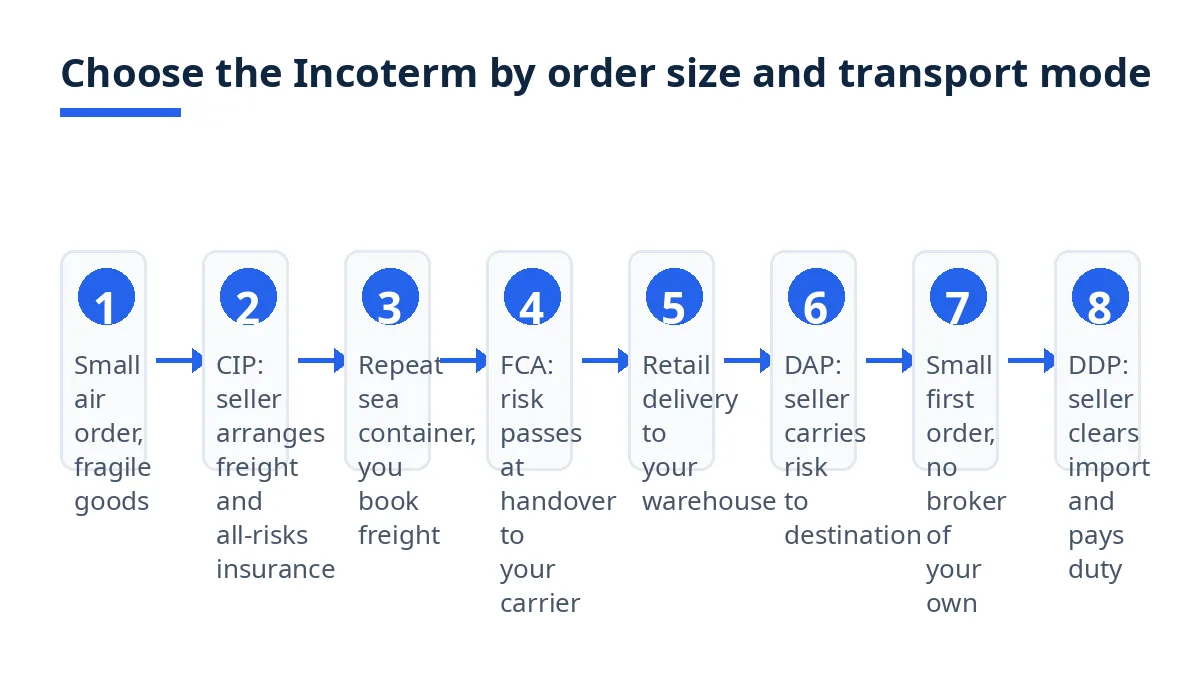
CIP fits most small, fragile, air-freighted handicrafts orders from Bangladesh, with all-risks insurance bought by the seller. FCA suits repeat sea containers, DAP suits retail warehouse deliveries, and DDP fits small first orders only.
Short answer
For most handicrafts and eco product orders from Bangladesh, CIP is the strongest default: the seller arranges carriage to your named destination and must buy all-risks insurance, which suits fragile, high-value, small-batch goods that often travel by air. Use FCA for repeat sea container orders where you control freight, DAP for deliveries to a retail warehouse, and DDP only for small first orders.
On this page
Key takeaways
CIP is the strongest default for small, fragile handicrafts orders, with all-risks Clauses (A) insurance bought by the seller.
FCA suits repeat sea container orders better than FOB, because risk passes when the container is handed to the carrier.
CIF buys only minimum Clauses (C) cover, which does not cover handling damage, theft or water damage.
An FSC claim survives only if every change of ownership sits inside a verified chain of custody system.
Bangladesh handicraft exports earned USD 32.13 million in FY 2025-26, with baskets, jute goods and cane ware shipped to more than 50 countries.
Handicrafts from Bangladesh arrive in small, varied lots: a few hundred seagrass baskets from one workshop, a carton of nakshi kantha cushions from another, a pallet of terracotta tiles from a third. No two cartons are alike, and the order is often too small to fill a container. The Incoterm written into your contract settles who arranges the freight, who bears the risk while the goods travel, and who deals with customs at either end.
Export Promotion Bureau figures cited by The Financial Express put handicraft exports at USD 32.13 million in fiscal year 2025-26, down from USD 37.68 million in FY 2024-25.1 The goods reached more than 50 countries, and the basket covers jute carpets, metal crafts, stone carvings, bamboo and cane goods, and lifestyle products made from hogla, water hyacinth and palm fibres.1 Behind those exports sit 73,542 handicraft establishments, of which 97.6 percent are household-based.2
Which Incoterm fits handicrafts and eco products from Bangladesh?
For most orders, CIP (Carriage and Insurance Paid To) is the usual first choice: the seller funds carriage as far as the named destination and must arrange all-risks insurance, which suits fragile goods travelling in small lots, often by air.3 FCA (Free Carrier) suits repeat sea container orders where you control freight. DAP (Delivered at Place) suits deliveries to a retail warehouse, and DDP (Delivered Duty Paid) fits a small first order only. See our guide to Incoterms on Bangladesh shipments.
Why do handicrafts change the Incoterm decision?
Incoterms 2020, the ICC's set of 11 standard trade terms, spell out who pays for carriage, the point where risk moves from seller to buyer, and which side handles export and import clearance.3 They took effect on 1 January 2020; seven of them apply to any mode of transport, while FAS, FOB, CFR and CIF apply to sea and inland waterway carriage only.3
Four traits of this trade change which term fits:
Small batches. A handicraft order is often a few hundred pieces from several small makers, consolidated into one shipment, and the seller rarely has an export desk, so a term that leaves freight booking to the seller helps.
Fragile by nature. Terracotta chips, cane bends, woven fibres crush and stain. The damage that matters is handling damage, not a ship sinking.
High value for the weight. A carton of hand-embroidered textiles or carved wood is worth far more per kilogram than a carton of bulk goods, so air freight is often worth paying, and all-risks cover is worth buying.
Eco papers travel with the goods. Where you buy on an eco claim, the certificate must arrive with the shipment, and the chain behind it must hold.
How does each Incoterm work for a handicrafts shipment?
The table below compares the seven terms a handicrafts buyer is most likely to use. EXW, FCA, CIP, DAP and DDP work for any mode of transport, while FOB and CIF are sea and inland waterway rules only.3
Incoterm | Mode | Risk passes to buyer | Seller pays | Insurance | Fit for handicrafts |
|---|---|---|---|---|---|
EXW | Any | At the seller premises | Nothing | Buyer arranges | Avoid with household sellers |
FCA | Any | Handover to your carrier | Delivery to carrier | Buyer arranges | Repeat sea containers |
CIP | Any | Handover to first carrier | Freight, all-risks insurance | Seller, Clauses (A) | Small air orders, fragile goods |
FOB | Sea only | On board the vessel | Loading on board | Buyer arranges | Bulk sea loads only |
CIF | Sea only | On board the vessel | Freight, minimum insurance | Seller, Clauses (C) | Simple sea price to the port |
DAP | Any | At named place, ready for unloading | Freight to destination | Seller carries risk | Retail warehouse delivery |
DDP | Any | At named place, duty paid | Freight, import clearance, duty | Seller carries risk | Small first orders |
Why does CIP fit most handicrafts orders?
CIP works for any mode of transport, including air, so it covers the small air shipments behind most first orders.3 The seller must contract the carriage and take out cover matching Institute Cargo Clauses (A), with the sum insured at no less than 110% of the contract price.4 That matters for handmade goods, because the losses that actually happen are a dropped carton, a crushed basket or water in a warehouse. Clauses (A) pays for accidental physical loss or damage of any kind, apart from the exclusions the wording lists, while Clauses (C) pays only for named major perils.4
With CIP, the seller funds the freight, yet the risk moves to you the moment the first carrier takes the goods.3 That is why the insurance wording matters more than the freight price: ask for the policy before the goods leave Dhaka, and check that it names Clauses (A) and the insured value.
When does FCA suit a repeat sea order?
Once your orders grow to a full container of baskets, mats or jute bags, FCA takes over from CIP. The seller completes export clearance and passes the sealed container to the carrier you chose, and the risk moves to you at that point.3 From there, the ocean freight, the insurance and the import clearance are yours to arrange.
FOB looks similar but fits worse. FOB was written for goods loaded directly onto a vessel, not for a container sealed at a workshop, so the ICC advises FCA, or CPT and CIP, for containerised cargo rather than the sea-only terms.3 Under FCA you arrange your own insurance, so buy all-risks cover.
When do DAP and DDP suit a handicrafts buyer?
With DAP, the seller brings the goods to a named place, ready for unloading, and bears the risk all the way there, while you deal with import clearance and duty.3 That suits a retail buyer who wants stock delivered to a warehouse.
With DDP, the seller goes further and clears the goods for import, paying the duty as well.3 Use it for a small first order, when you have no broker of your own, and only after the seller confirms in writing that it can act as importer of record.
Duty is separate from the term. For the EU, Bangladesh still ships duty-free and quota-free under the Everything But Arms scheme for least developed countries.5 In November 2026 Bangladesh moves out of least-developed-country status; the EU has agreed to keep the preference until November 2029, after which the country must qualify for GSP+ or sign a free trade agreement.6 Confirm the preference with your broker before each shipment.
What cover do CIF and CIP actually buy?
Just two of the eleven terms make the seller buy insurance: CIF and CIP.4 Under the 2020 rules, CIF calls for minimum cover under Institute Cargo Clauses (C), while CIP calls for cover under Institute Cargo Clauses (A).3 In both cases the sum insured must be at least 110% of the contract price.4
Clauses (C) pays only for named major perils: fire, explosion, stranding, sinking, collision, general average and jettison.4 Clauses (A) pays for accidental physical loss or damage of any kind, apart from the exclusions the wording lists, so theft, pilferage, rain and rough handling all fall inside the cover, unless an exclusion bites.4
A chipped terracotta tile or a water-stained carton will usually fall outside Clauses (C). If you buy on CIF, ask for a higher level of cover in the contract, or take out your own extra policy. In every clause level, insufficient packing is an exclusion, so flimsy packing can turn a claim into a refusal.4 Agree the packing in the purchase order: double-wall cartons and inner wrapping for fragile pieces.
How do eco certificates and origin documents travel with the goods?
An eco claim is only as strong as the paper behind it. Under the Forest Stewardship Council chain of custody system, the chain of custody is the path a product takes from the forest, or from the reclamation site for recycled materials, to the point of sale with an FSC claim, covering each stage where ownership changes.7 Every change of ownership along that path needs a verified management system, checked by an independent FSC-accredited certification body.7
That means two checks: ask for the seller's FSC certificate code and confirm it appears on the sales documents, and name the eco documents in the purchase order next to the packing list, commercial invoice, certificate of origin, bill of lading or airway bill, and insurance certificate.
The main destinations for Chapter 46 handicraft products include Spain, the United Kingdom, Australia, Germany, France and Italy.2 Confirm the HS code with your broker before you agree the term. Read our HS code guide for eco-friendly home products and our quality control checklist for eco-friendly home products before the balance is paid.
A worked example: one air shipment and one sea container
A buyer in Germany orders 600 seagrass baskets and 400 jute bags from Dhaka, worth USD 9,600, and compares CIP by air with FCA by sea.
Cost line | CIP by air to Hamburg | FCA by sea to Hamburg |
|---|---|---|
Goods | 9,600 | 9,600 |
Main freight | 1,850 (seller) | 780 (buyer) |
Insurance | 145 (seller, Clauses A) | 120 (buyer, all-risks) |
Import duty | 0 under EBA5 | 0 under EBA5 |
Total landed cost | 11,595 | 10,500 |
The air route costs USD 1,095 more, but the goods arrive in days and the seller carries the insurance duty under CIP; the sea route is cheaper, but the buyer arranges freight and insurance.
What mistakes do handicrafts buyers make with Incoterms?
Using FOB for a container sealed at a workshop. FOB was written for cargo loaded directly onto a ship. Use FCA instead.3
Reading CIF as full cover. CIF buys minimum Clauses (C) insurance. For fragile handmade goods, ask for CIP or buy your own all-risks policy.4
Using EXW with a household seller. EXW leaves export clearance with you, and a workshop with no export desk cannot prepare the papers.
Agreeing DDP without checking import clearance. With DDP the seller must handle import customs itself, which a foreign seller cannot always manage.
Leaving the eco papers out of the contract. An FSC claim without the certificate code on the sales documents cannot be used by your customers.7
Naming a vague place. "CIP Europe" does not name a place at all. Write the airport or warehouse, the city and the country.
How do you put the Incoterm in the contract?
Spell the term out in full, in identical words, in the sales contract, the proforma invoice and the purchase order: "CIP Hamburg, Germany, Incoterms 2020." Where the seller buys cover, add the insurance clause, for example "cover under Institute Cargo Clauses (A) worth 110% of the contract price."
Settle the paperwork together: packing list, commercial invoice, bill of lading or airway bill, certificate of origin, eco certificate or FSC claim documents where they apply, and the insurance certificate where one is due. For FCA sea freight, the buyer and seller can agree that the carrier hands the seller an on-board bill of lading after loading.3
Before you sign, confirm the order size, the transport mode, the insurance clause by name and who books the freight.
Next steps on Exportain
Shortlist handicraft and eco-product suppliers on Exportain suppliers, then raise a request for quotation through the RFQ page, naming the product, the quantity and the Incoterm you want quoted. Read the handicrafts sourcing guide and the how to buy guide before you place a first order.
Sources
- FY26 handicraft exports fall 15pc amid weak demand. The Financial Express, (accessed )
- Handicraft sector of Bangladesh: employment, exports and policy support. Bangladesh Foreign Trade Institute (accessed )
- Incoterms® 2020. International Chamber of Commerce (ICC) (accessed )
- Institute Cargo Clauses A, B, C: Which Cover Do You Need?. SilenSea Trading, (accessed )
- EU invites Bangladesh to share success story in preferential market access. The Financial Express (accessed )
- EU's GSP+: The lifeline Bangladesh must win before 2029. The Daily Star, (accessed )
- FSC-STD-40-004 V3-0 EN Chain of Custody Certification. Forest Stewardship Council (accessed )
About the author
Sourcing from Bangladesh?
Post a request for quotation and suppliers on Exportain can send you their quotes directly.
Post an RFQ