

HS Code for Eco-Friendly Home Products: Classification Guide for Importers
Eco-friendly home products have no single HS code: a bamboo basket, a bamboo chair, a candle and a ceramic plate each take a different heading, so classify by product family and confirm the national code before filing.
Short answer
There is no single HS code for eco-friendly home products, because the HS system classifies goods by what they are, not by an eco claim. A bamboo basket is tested under heading 4602, a bamboo chair under 9401, a candle under 3406, and ceramic tableware under 6912 or 6911 by material. Classify each product family separately, then confirm the full national code for the destination before filing.
On this page
Key takeaways
There is no single HS code for eco-friendly home products: classification follows material, form and use, not the eco claim, so each product family needs its own tested code.
Bamboo splits by form: baskets at 4602.11, seats at 9401.52 and other furniture at 9403.82, all indicative until the national code is confirmed.
Candles sit at 3406, ceramic tableware at 6912 or 6911 by material, glass tableware at 7013, recycled-plastic tableware at 3924.10 and jute packing sacks at 6305.10, all indicative.
Only the first six digits are shared worldwide: the EU extends to eight digits and the US and UK to ten, so confirm the full national code per destination and get a binding decision for borderline goods.
If you import bamboo baskets, candles, ceramic tableware and recycled-plastic kitchenware under one "eco-friendly home products" label, the hs code for eco-friendly home products will not be one number. The Harmonized System is a multipurpose international product nomenclature developed by the World Customs Organization (WCO), comprising more than 5,000 commodity groups, each identified by a six-digit code, and used by more than 200 countries and economies as a basis for their customs tariffs.1 The system classifies goods by what they are, and no heading rewards a product for being eco-friendly: a bamboo basket and a bamboo chair sit in different chapters. This guide works through the product families one by one.
Quick answer: indicative HS heading (with verify note)
There is no single heading: start from the product family, not the eco claim, and treat every code as indicative until you confirm the full national code for the destination.
Product family | Indicative code territory | Why |
|---|---|---|
Bamboo basket, plaited or woven to shape | Heading 4602, subheading 4602.11 | Basketwork of vegetable plaiting material, with a bamboo line 2 |
Bamboo seat or chair | Heading 9401, subheading 9401.52 | Seats of cane, osier, bamboo or similar materials 3 |
Other bamboo furniture, such as a shelf | Heading 9403, subheading 9403.82 | Furniture of other materials, including bamboo 4 |
Candle, including soy and beeswax candles | Heading 3406 | Candles, tapers and the like, whatever the wax 5 |
Ceramic tableware, other than porcelain or china | Heading 6912 | Ceramic tableware, kitchenware and other household articles, other than porcelain or china 6 |
Ceramic tableware of porcelain or china | Heading 6911 | Porcelain or china takes its own heading, separate from 6912 6 |
Glass tableware and kitchen glassware | Heading 7013 | Glassware of a kind used for table, kitchen, toilet, office or indoor decoration 7 |
Recycled-plastic tableware and kitchenware | Heading 3924, subheading 3924.10 | Tableware, kitchenware and other household articles of plastics 8 |
Jute sacks and bags for packing goods | Heading 6305, subheading 6305.10 | Sacks and bags of a kind used for the packing of goods, with a jute line 9 |
Verify the product, not the label. An "eco bamboo chair" is still a seat, and a "recycled plastic plate" is still plastic tableware.
How HS codes are structured (2-4-6 digits)
The Harmonized System organizes its approximately 5,000 six-digit product categories in a hierarchy of sections, chapters at 2 digits, headings at 4 digits and subheadings at 6 digits.10 Each pair narrows the category: chapter 46, heading 4602 for basketwork, then subheading 4602.11 for bamboo.2 Countries add national subheadings, and the European Union uses eight-digit codes.10 The current version is HS 2022.10
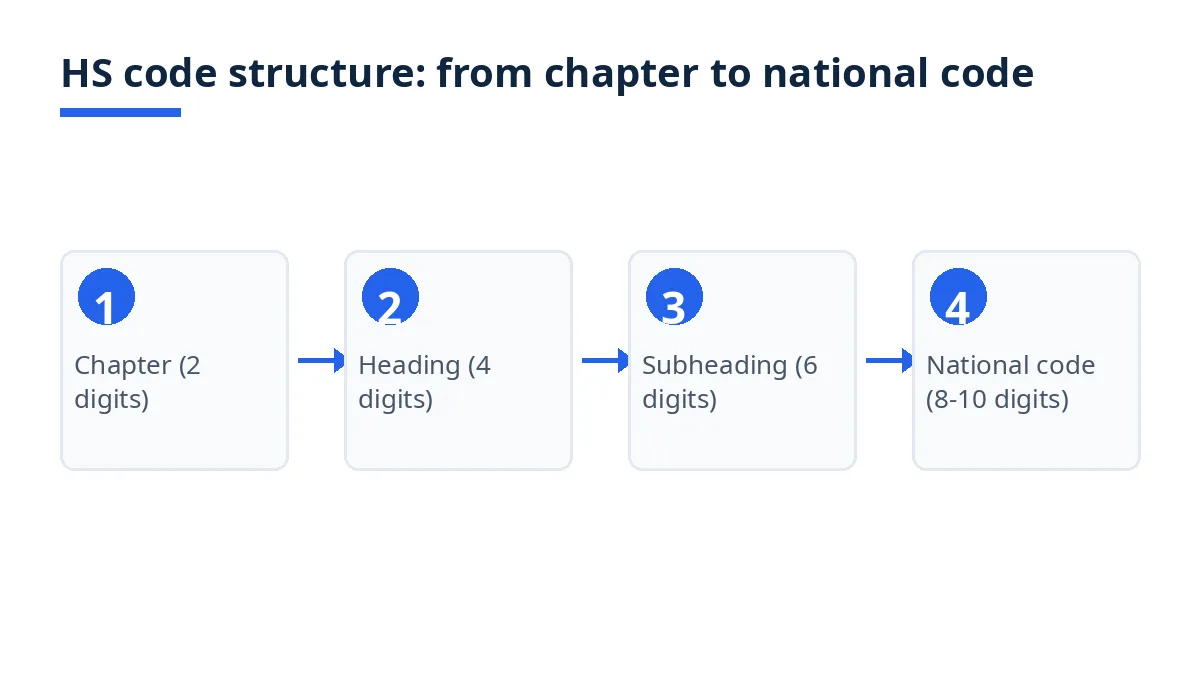
Read left to right: chapter sets the broad group, heading names the product group, subheading fixes the shared detail, and everything after the sixth digit is national.
Factors that decide the code for eco-friendly home products
Material and use come before the eco claim. The heading texts name materials and uses, not sustainability claims. Heading 3924 names tableware, kitchenware and other household articles of plastics, with no separate line for recycled feedstock.8 A recycled-plastic plate is therefore tested under the same heading text as a plate made from new plastic, and the bamboo test is likewise about form, not growing method.2 3 4
Form decides the bamboo heading. A plaited bamboo basket is basketwork under heading 4602.2 A bamboo chair is a seat under heading 9401, at 9401.52 for bamboo seats.3 A bamboo shelf or cabinet is other furniture under heading 9403, at 9403.82 for bamboo furniture.4 The chapter 46 notes also exclude chapter 94 articles, so a woven bamboo chair cannot stay in basketwork.2
Use decides the ceramic and glass headings. A ceramic plate, bowl or cup made for serving food is tableware under heading 6912 when it is not porcelain or china.6 A ceramic vase sold only for display is tested as an ornament, and a glass tumbler as glassware under heading 7013.7 A glass bottle sold as packaging is tested as a container, not as tableware.
Mixed materials are tested by essential character. When goods fit two or more headings, the component giving them their essential character decides, under the rule for mixtures, composite goods and sets.11 Record material percentages and the manufacturing method, because the test turns on facts, not on the product name.
Eco gift sets are tested as sets, or item by item. A set put up for retail sale is classified as a whole under its essential-character component's heading, but only when three conditions are all met: at least two articles in different headings, put up together for one particular need, and packed for sale directly to users without repacking.11 An eco gift box with a candle, a bamboo brush and a cloth bag does not automatically meet the single-need condition. If any condition fails, it is not a set, and each item is classified separately.11
Green labels never replace the heading text. Words such as natural, organic, recycled and plastic-free describe how a product was made, not its heading. None of them appears in the heading texts for 4602, 3406, 3924, 6305, 6912, 7013 or 9401.2 5 8 9 6 7 3 If a supplier offers a code justified only by an eco label, ask for the supporting heading text and chapter notes, and check them in the destination tariff before filing.
National codes: US HTS, EU CN/TARIC, UK commodity code
United States: HTS, ten digits. The United States schedule extends the six digits with national rate lines and statistical suffixes, producing ten-digit import numbers, as chapter 69 lines such as 6912.00.41 00 show.6 Read the full ten-digit line for each family.
European Union: CN at eight digits, TARIC for measures. The Combined Nomenclature of the European Union uses eight-digit codes, comprising the HS codes with further EU subdivisions.10 TARIC adds further digits at EU level for tariff and non-tariff measures. Read the confirmed line in TARIC for the entry date and for origin Bangladesh.
United Kingdom: commodity code. The United Kingdom builds its commodity code on the same first six digits, with its own extension after them, running to ten digits, as the 7013.99 and 4602.11 lines show.2 7 The United Kingdom tariff also splits bamboo basketwork and bamboo furniture into hand-made and other lines at ten digits, so state the making method on the invoice.2 4
United Arab Emirates. The same method applies: start from the six shared digits, then read the destination tariff. The six-digit starting point travels, while the national extension does not.1
How to confirm the code officially
Write a precise description: material and material percentages, form and function, making method, dimensions and intended use.
Start from the official tariff for the destination: the United States International Trade Commission schedule, TARIC or the United Kingdom Trade Tariff, and read the heading text and chapter notes.
Check published rulings for similar goods. For the United States, the United States International Trade Commission advises traders to use the Customs Rulings Online Search Service (CROSS), because the correct classification of many items can be found there.12
For a borderline product, apply for a binding decision before you ship. In the European Union, a Binding Tariff Information decision needs a separate application for each type of product, with a detailed description of the goods.13 In the United Kingdom, a legally binding decision is generally valid for 3 years, through an Advance Tariff Ruling, which requires an EORI number starting with GB for Great Britain.14 In the United States, if the merchandise is not described in any ruling on CROSS, you may request a binding ruling from United States Customs and Border Protection.12
Give your broker the description and the confirmed code for each product family, and use the same codes throughout the entry.
Common classification mistakes
Filing the whole eco range under one code. A range mixing baskets, seats, candles and tableware spans chapters 46, 94, 34, 69, 70 and 39, so one code cannot cover it.2 3 5 6 7 8
Filing a bamboo chair as basketwork. Basketwork under heading 4602 covers articles made to shape from plaiting materials, while seats sit under heading 9401, and chapter 46 excludes articles of chapter 94.2 3 A woven chair is still a seat.
Filing a jute fashion bag as a packing sack. Heading 6305 covers sacks and bags of a kind used for the packing of goods, with the jute line at 6305.10.9 A finished fashion bag is tested by its own use and design, not by its jute material.
Filing a candle in a glass jar as glassware. The candle is the product and the jar its container, so test heading 3406 and the composite-goods rule before settling on glassware.5 11
Treating a gift box as one product. A box is a set only when it meets all three set conditions, and when it does not, each item takes its own code.11
Copying a code from another country. The European Union extends the six digits to eight,10 and the United States and the United Kingdom use ten digits with their own splits inside the same six-digit lines.6 2
Leaving hand-made status off the invoice. In the United Kingdom, bamboo basketwork and bamboo furniture split into hand-made and other at ten digits.2 4
Related duties and documents
This guide states no duty rates: the code decides which duty line customs applies, and a rate on one line does not carry to another line or another country. Read the rate beside your confirmed code, and check what proof of origin a preference claim requires. A legally binding decision helps calculate duties and restrictions in advance, and alerts you to licensing requirements or quotas.14 Keep the product description, confirmed codes, any binding decision and the origin evidence in the shipment file, with each family as a separate invoice line.
FAQs
What is the HS code for eco-friendly home products?
There is no single code. A bamboo basket is tested under indicative heading 4602, a bamboo seat under 9401, a candle under 3406, ceramic tableware under 6912 or 6911 by material, glass tableware under 7013, recycled-plastic tableware under 3924, and jute packing sacks under 6305.2 3 5 6 7 8 9
Is the HS code the same in every country?
Only the first six digits are shared worldwide: the HS is used by more than 200 countries and economies as a basis for their customs tariffs.1 Beyond six digits, each country adds its own lines: eight digits in the European Union,10 and ten digits in the United States and the United Kingdom.6 2
How do I confirm the correct code?
Describe each product precisely, read the heading text and chapter notes in the destination tariff, and check published rulings such as CROSS.12 For a borderline product, apply for a binding decision before shipping: a Binding Tariff Information decision for the European Union,13 an Advance Tariff Ruling for Great Britain,14 or a CBP binding ruling for the United States.12
What happens if I use the wrong code?
Duty, licensing and quota treatment are worked out from the code on the declaration, so a wrong code brings the wrong treatment. A binding decision in advance helps you calculate the duties and restrictions that will apply.14
Next steps on Exportain
Browse Bangladeshi suppliers on Exportain and post a free RFQ with the confirmed codes stated per product family. The hs code harmonized system guide is the background read, and the hs codes classification guide covers the steps for your next product. Exportain is not a party to the goods contract and does not inspect goods, book freight or clear customs, so keep your broker and your binding decision at the center of the entry.
Sources
- What is the Harmonized System (HS)?. World Customs Organization (accessed )
- Basketwork, wickerwork and other articles, made directly to shape from plaiting materials (heading 4602). GOV.UK, UK Integrated Online Tariff (accessed )
- Seats (other than those of heading 9402), whether or not convertible into beds, and parts thereof - UK Integrated Online Tariff. GOV.UK, HM Revenue and Customs (accessed )
- Furniture of other materials, including cane, osier, bamboo or similar materials. GOV.UK, HM Revenue and Customs (accessed )
- Commodity code 3406000000: Candles, tapers and the like. GOV.UK, Northern Ireland Online Tariff (accessed )
- Harmonized Tariff Schedule, Chapter 69: Ceramic Products. U.S. International Trade Commission (accessed )
- Other glassware (subheading 701391). GOV.UK, Northern Ireland Online Tariff (accessed )
- Tableware, kitchenware, other household articles and hygienic or toilet articles, of plastics - UK Integrated Online Tariff, heading 3924. GOV.UK, HM Revenue and Customs (accessed )
- Sacks and bags, of a kind used for the packing of goods - Northern Ireland Online Tariff, heading 6305. GOV.UK (accessed )
- Harmonised System. European Commission (accessed )
- General Interpretative Rules (GIR): classification rules. CustomsClear (accessed )
- MTB 2019: Get Out Ahead of the Pack with a Binding Ruling from CBP. U.S. International Trade Commission (accessed )
- European Binding Tariff Information (EBTI). European Commission, Taxation and Customs Union, (accessed )
- Check what you'll need to get a legally binding decision on a commodity code. GOV.UK, HM Revenue and Customs (accessed )
About the author
Sourcing from Bangladesh?
Post a request for quotation and suppliers on Exportain can send you their quotes directly.
Post an RFQ


