

Quality Control Checklist for Eco-Friendly Home Products From Bangladesh
A numbered QC checklist for eco-friendly home products from Bangladesh: material and claim evidence, dimensions, workmanship, dyes and finishes, eco labels, compostability and recyclability wording, and packing, with fixes for common failures.
Short answer
Use this eco-friendly home products quality control checklist to check material identity, dimensions and function, workmanship, dyes and finishes, eco labels and certificates, compostability and recyclability wording, and labels and packing on jute, bamboo, coconut, seagrass and recycled products from Bangladesh before shipment. Agree tolerances, acceptance numbers and certificate evidence in the purchase order.
On this page
Key takeaways
Check the eco claim first: a product can pass physical checks and still fail if its organic, recycled or compostable wording has no matching certificate or transaction record.
Agree the sample, tolerances, acceptance numbers and certificate evidence before inspection, and draw the sample randomly across styles, materials and cartons.
Work material by material: bamboo and wood split, woven fibres unravel, and dye varies by lot, so each material needs its own hands-on checks.
Treat industrial and home composting as different claims, and check the whole item, including inks, glues and linings, not only the main material.
For jute baskets, bamboo trays, coconut bowls, recycled cotton throws and seagrass mats sold as eco-friendly, this checklist covers two checks at once: whether the product is made well, and whether its eco claim has evidence behind it. A basket can measure correctly and still fail on its label claim. Use it before shipment.
Why this checklist matters
Eco-friendly home products fail in a different place from ordinary homeware. The physical faults are familiar: a split bamboo slat, a basket that will not sit flat, a bowl that leaks at the joint. The claim faults are quieter: a label that says organic, recycled or compostable with no certificate, test report or transaction record behind it.
ISO 14021 covers self-declared environmental claims, including terms such as compostable, degradable, recyclable and recycled content, and sets requirements for their use.1 That is why this checklist treats every eco word on the product, hangtag and carton as a check with its own evidence, not as decoration.
Before you start
Do not begin until the references are complete: an approved sample per style and material, the purchase order, the size chart with tolerances, the label artwork, and every certificate or test report the eco claim relies on. Agree the sampling plan and acceptance numbers per defect class in advance. ISO 2859-1 specifies an acceptance sampling system for inspection by attributes, indexed in terms of the acceptance quality limit (AQL).2 Draw the sample randomly across styles, materials, colours and cartons, never from pieces the factory selects.
Check the label plan before bulk labels are printed. Under Regulation (EU) No 1007/2011, a textile product shall be labelled with the name and percentage by weight of all constituent fibres in descending order.3 Confirm destination-market wording for the USA, UK, EU and UAE before printing. See the AQL acceptance quality limit explainer.
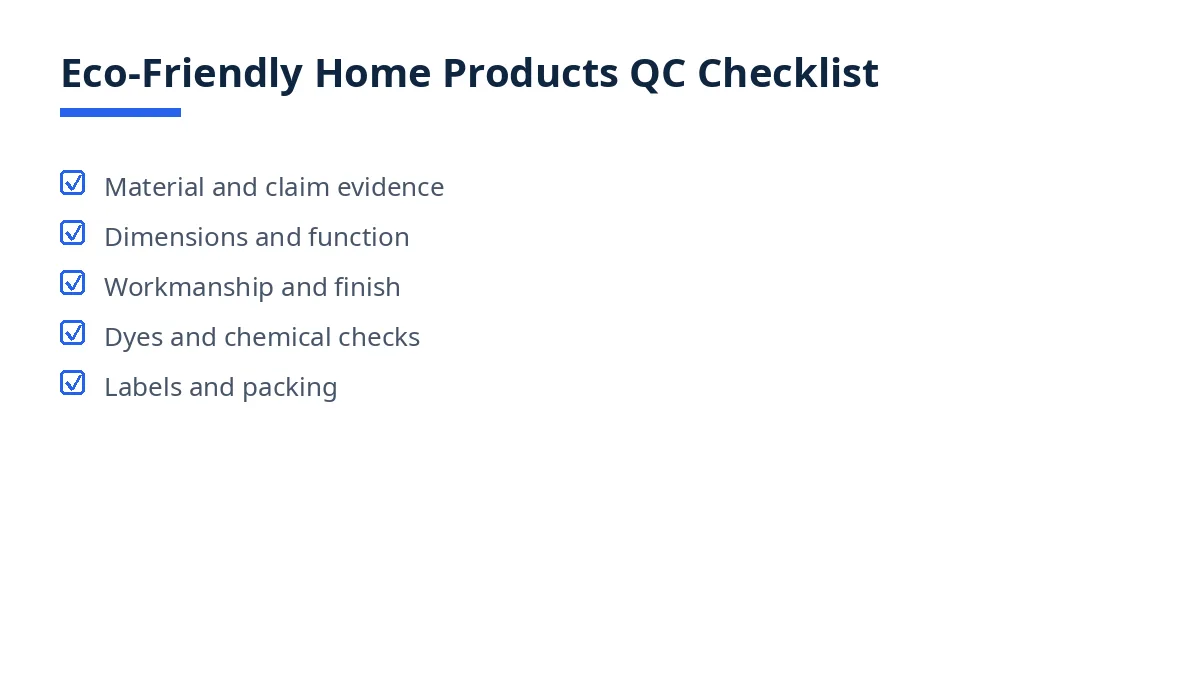
The full checklist (numbered, printable)
Material identity and eco-claim evidence
Identify the main material on each sampled piece against the sample: jute, bamboo, seagrass, coconut shell, wood or recycled cotton. Record any substitution in bulk as a failure.
For a woven or braided product, check the weave or braid is even, tight and consistent with the sample, with no loose ends, gaps or unravelled sections.
For an organic fibre claim, check the certificate name, scope and expiry date, and confirm the product and material fall inside that scope. Under the GOTS levels described by Ecocert, level 1 requires at least 95% fibres from organic agriculture, and level 2 at least 70%.4
For a recycled-content claim, check the certificate scope and ask for the transaction record for this shipment, not only a facility certificate. The Global Recycled Standard is a full product standard to verify and track recycled raw materials through the supply chain.5
Check that the percentage on the label or hangtag matches the evidence for this lot, and that pre-consumer and post-consumer content are not mixed up.
Check that no eco word appears on a product whose evidence covers only one component, such as a recycled lining inside an otherwise conventional basket.
Dimensions, shape and function
Measure length, width, height and diameter on each sampled piece, laid flat, and compare every measurement with the chart tolerance.
Check the product sits flat and stable: a basket, tray or bowl must not rock, and a mat must lie flat without curling edges.
Check openings, handles and lids: handles are secure, lids fit their base, and nested pieces separate without forcing.
Test function against the sample: a tray carries its load without flexing, a bowl holds water where the pack claims it does, and a filled basket holds its shape.
For sets, check every piece is present, sizes graduate as specified, and labels match measured pieces.
Workmanship, finish and durability
Check bamboo and wood for splits, cracks, sharp splinters and rough edges, checking every edge, handle and foot.
Check coconut shell and similar hard materials for cracks, thin spots and rough rims, and confirm any food-contact finish is even, with no bare patches or flaking.
Check joints, bindings and stitching: bindings are tight, glued joints show no gaps or excess glue, and stitching is even with no loose ends.
Check colour and finish: dye or stain is even within each piece and across the set, against the sample, with no blotches or dye transfer.
Check for odour, mould, damp spots and insect damage, especially on stored natural fibres; segregate affected pieces.
Check durability where the pack names it: flex handles, open and close lids, and fold or roll mats, recording any breakage or distortion.
Dyes, finishes and chemical compliance
Review dye and finish evidence where required, confirming every report names the bulk material, colour tested and this lot.
If a harmful-substances claim will appear on the product, check the certificate scope covers the finished product. Under OEKO-TEX STANDARD 100, the certificate and label are only awarded if all components of an item meet the required criteria without exception, including threads, dyes, finishes and prints.6
Check that no finish contradicts the eco claim: a heavy synthetic lacquer on a product sold as untreated natural material is a claim failure.
For food-contact pieces such as bowls, boards and cutlery, confirm the finish is the one named in the pack, the care wording matches it, and no unsupported claim is made.
Eco labels, certificates and wording
Check every eco label, logo and seal on the product, hangtag and carton against its certificate: certifier name, scope and expiry date must match the evidence for this lot.
Check that a logo is not used outside its certified scope, and that expired certificates are not presented as current.
Check the wording word by word: "natural", "eco-friendly", "sustainable" and "plastic-free" must name the specific attribute, such as the material or recycled share, rather than standing alone.
The FTC Green Guides were issued to help marketers ensure claims are true and substantiated, covering general principles, how consumers interpret claims, and how to qualify claims.7
Compostability, recyclability and end-of-life claims
For a compostable claim, check whether it means industrial or home composting, and confirm the wording says so. Under EN 13432, compostable packaging must biodegrade by at least 90% within six months under industrial composting conditions, with disintegration to fragments smaller than 2 mm and no more than 10% visible residue after 12 weeks.8
Check that the whole item meets the compostability claim, including inks, glues, coatings and linings, not only the main material.
For a recyclable claim, check the claim names the recyclable part and route, and do not accept it for a mixed-material product whose parts cannot be separated.
For a reusable claim, check the product survives repeated use and washing as the care wording promises, recording any piece that distorts, sheds or loses its finish.
Labels, barcodes and packing
Verify that care, fibre, origin, size and brand labels are present and legible, and that EU fibre wording matches Regulation (EU) No 1007/2011.3
Check that barcode and set-content stickers scan and match the purchase order, and that carton wording matches product wording.
Confirm each piece is packed as directed, with inserts where specified, and that sets, colours and ratios per carton match the specification.
Check that packing protects natural materials in transit: no damp cartons, no crushed woven rims, no hard insert that dents the product.
Weigh and measure sample cartons, and check markings and carton count against the packing list.
Common failures and how to fix them
The most frequent failure is a claim without evidence: a hangtag that says organic or recycled while the certificate covers a different material or style. Stop, ask for the certificate scope and the shipment transaction record, and correct the wording before packing continues. Next is mixed material presented as a single natural fibre, from a substituted yarn, lining or finish: re-check the material declaration against the sample before more units are packed.
Splits and splinters in bamboo and wood usually point to dry material or rushed finishing: re-sand and re-finish a test piece before the bulk is finished. Uneven dye across a set points to more than one dye lot: re-sort complete sets before packing. Baskets that will not sit flat usually trace to uneven weaving or damp storage: dry and re-shape a test piece before the rest of the lot is packed.
Downloadable template / summary table
Copy the checklist into your inspection sheet, add tolerances, acceptance numbers and certificate numbers, and record a result per piece.
Section | Checks | Evidence |
|---|---|---|
Material and claims | Fibre identity, organic and recycled evidence | Certificates, transaction records |
Dimensions and function | Size, stability, lids, sets | Measurements, function test |
Workmanship | Splits, joints, finish, colour | Hands-on check, photos |
Dyes and chemicals | Reports, finishes, food contact | Reports per material and lot |
Labels and wording | Logos, scope, expiry, wording | Certificate match, label check |
End of life | Compostable, recyclable, reusable | Standard, wording, test |
Packing | Labels, barcodes, ratios, cartons | Packing list |
How Exportain helps
Exportain is a B2B marketplace connecting buyers with Bangladeshi suppliers of home products, so material and claim evidence can be agreed at the enquiry stage. Browse suppliers, see the home textiles category and use inspection services when you plan the check. Supplier profiles show which document and photo checks have been recorded, not factory inspections. Exportain is not a party to the goods contract and does not inspect goods.
FAQs
When should this checklist be used?
Use it at final inspection, when goods are finished and packed. For larger or first orders, also use it in production, while finishing and labelling can still be corrected.
Who should complete it?
The buyer, a local agent or an independent inspector can complete it, using the approved sample, certificates and a randomly drawn sample.
What are the most common failures?
A claim without matching evidence, mixed material sold as a single natural fibre, splits and splinters, uneven dye, and baskets that will not sit flat are the failures buyers find most often.
Can a third party do it?
Yes, if you share the approved references, tolerances and certificate evidence first.
Next steps on Exportain
Before production starts, agree material declaration, claim evidence, tolerances and label wording, then read the AQL acceptance quality limit explainer and the pre-shipment inspection guide, and plan the check with inspection services. You can also post a free RFQ via RFQs.
Sources
- EN ISO 14021:2026 - Self-declared environmental claims. International Organization for Standardization (accessed )
- ISO 2859-1:1999 - Sampling procedures for inspection by attributes — Part 1: Sampling schemes indexed by acceptance quality limit (AQL) for lot-by-lot inspection. International Organization for Standardization (accessed )
- Regulation (EU) No 1007/2011 on textile fibre names and related labelling and marking of the fibre composition of textile products. European Union, (accessed )
- Organic textile certification (GOTS). Ecocert (accessed )
- What is the Global Recycled Standard (GRS)?. Textile Exchange (accessed )
- OEKO-TEX STANDARD 100 for textiles tested for harmful substances. Hohenstein (accessed )
- Green Guides. Federal Trade Commission (accessed )
- EN 13432:2000 for Compostable & Biodegradable Packaging. Pacific Certifications (accessed )
About the author
Sourcing from Bangladesh?
Post a request for quotation and suppliers on Exportain can send you their quotes directly.
Post an RFQ


