Batteries Lead Time From Bangladesh: Production and Shipping Timeline
Batteries lead time from Bangladesh, stage by stage: sampling, cell sourcing, UN38.3 safety testing, production, inspection, dangerous-goods booking and transit, with planning ranges and a confirmation checklist.
Short answer
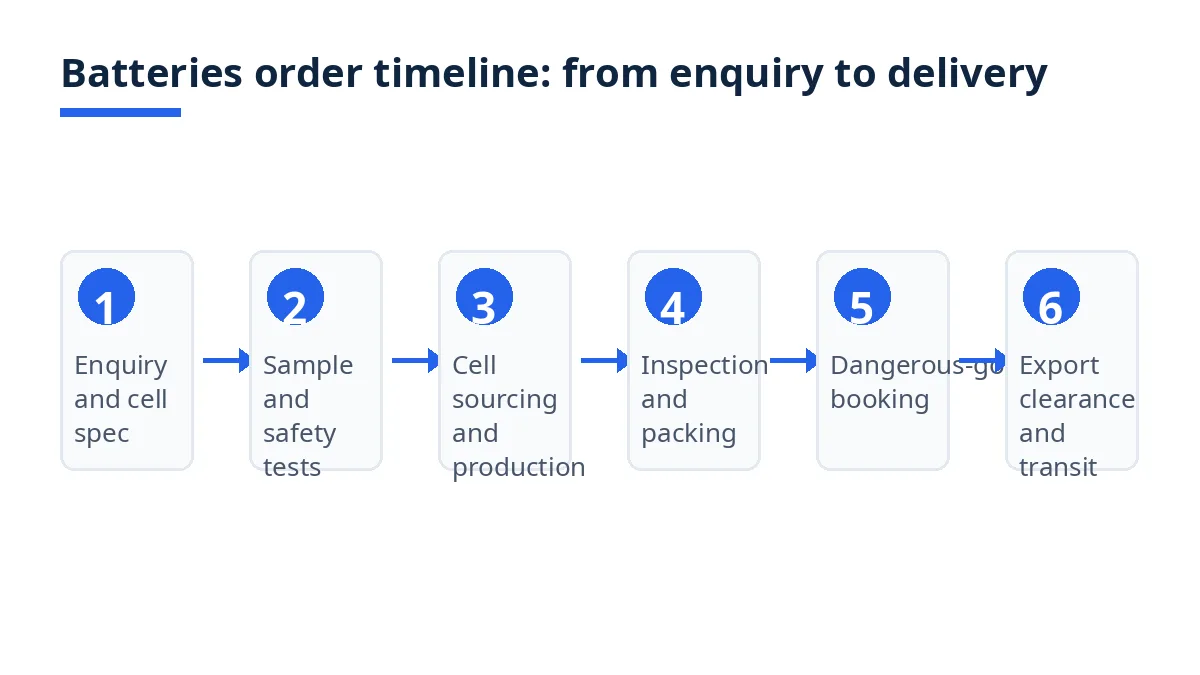
Batteries lead time from Bangladesh has no single figure. A realistic plan runs in stages: enquiry and samples, safety testing for lithium models, cell sourcing, production, inspection, dangerous-goods booking and transit, with imported cells and UN38.3 testing the most common causes of delay. Ask for each stage date in writing, on one delivery term, before you confirm.
On this page
Key takeaways
Plan a battery order in dated stages, not one delivery week: enquiry, sample and safety tests, cell sourcing, production, inspection, dangerous-goods booking and transit each carry their own range.
Chemistry sets the timeline: lithium batteries need UN38.3 transport-test evidence for the exact model before shipment, while lead-acid and dry-cell orders face different classification and handling checks.
Imported cells are the most common hidden delay: confirm whether cells are stocked, ordered to specification, or already tested for your configuration before you agree a production start date.
Ask for every stage date in writing, on one delivery term, and treat any date that bundles sampling, testing and transit into a single week as unconfirmed.
A dangerous-goods booking, an EU market-entry file, or an export document can each stop a finished order at the port, so start those files while production runs, not after it ends.
A battery order from Bangladesh rarely slips because one factory is slow. It slips because the buyer counted only production days, while sampling, cell sourcing, safety testing, dangerous-goods booking and export clearance each added weeks. This guide maps the batteries lead time bangladesh buyers should plan around, stage by stage, so a delivery date promised to a customer in the USA, UK, EU or UAE rests on dated gates rather than a single hopeful week.
Batteries are not ordinary cargo. A lead-acid battery, a lithium-ion pack and a small dry cell follow different classification, testing and transport rules, and the chemistry you choose changes the timeline more than the order size does. A supplier who can ship lead-acid units next month may still need extra weeks before a lithium-ion pack of the same capacity can legally board a vessel or an aircraft. The timeline below separates those gates so you can see which one is holding your order.
Why this matters for buyers and sellers
For the buyer, lead time is working capital and credibility. Batteries ordered for a solar installation, a retail season or a fleet must arrive in a window set by someone else: a booked installer, a shelf reset, or a project milestone. A battery that arrives three weeks late can strand inverters, installers and customers who were promised a working system. For the seller, a realistic timeline protects the order itself. Cells ordered for your specification, a BMS tuned to your voltage, and labels printed with your brand cannot be sold to another buyer if you cancel, so a factory that rushes a date to win the order often pays for it in rework, failed inspection or a refused shipment.
The second reason timing matters is that battery rules sit on top of ordinary export rules. The UN38.3 test sequence evaluates whether a lithium cell or battery type can withstand transport stresses including altitude, temperature change, vibration, shock, short circuit, impact, overcharge and forced discharge.1 UN38.3 is a transport safety requirement, not a general product-quality certificate, and a battery that performs well in normal use still needs to meet the applicable transport requirements before it can be shipped.1 Treat safety-test evidence as a production input, checked before the order is confirmed, rather than as shipping paperwork handled at the end.
Step-by-step: how it works
Send one specification to every candidate. State the chemistry (lead-acid, lithium-ion, lithium iron phosphate, nickel-metal hydride or dry cell), voltage, capacity in amp-hours and watt-hours, cell source, BMS and protection features, terminals, housing, labels and packing. A quote without the watt-hour rating cannot be checked against transport rules, and a quote without the cell source cannot be checked against cell lead time.
Ask which tests already exist for your exact model. For lithium batteries, ask for the UN38.3 test summary for the exact model and configuration, not a summary for a neighbouring model. IATA notes that manufacturers and subsequent distributors must make available a test summary demonstrating that the relevant lithium cell or battery type has met the UN Manual of Tests and Criteria, Part III, subsection 38.3, and that states and operators can impose additional requirements.1 If no summary exists, testing joins the critical path before any shipment date can be trusted.
Confirm cell sourcing in writing. Ask whether cells are stocked, imported to order, or assembled from imported cells, with the cell delivery date as its own line. A factory assembling packs from imported cells cannot start your production before the cells land.
Approve samples in writing, including a transport check. Order a production-representative sample in your exact chemistry, voltage, capacity, BMS and housing. Test capacity, charging and fit, then approve or list corrections in writing. For lithium orders, confirm the sample matches the tested model covered by the UN38.3 summary.1
Agree inspection and one delivery term before you confirm. Write the inspection level and acceptance criteria into the purchase order. ISO 2859-1 defines acceptance sampling plans for inspection by attributes, indexed by acceptance quality limit (AQL) for lot-by-lot inspection.2 State one Incoterm and named place for every quotation: the Incoterms 2020 rules set out 11 rules with a clear allocation of cost, risk and obligations.3
Book transport as dangerous goods where the rules require it. Tell the forwarder the chemistry, watt-hour rating, UN number and packing configuration at booking, not at the port. Lithium batteries are regulated as dangerous goods in many transportation systems, and airlines, shipping companies, freight forwarders and customs authorities may require specific information before accepting a shipment.1 Air, sea and road rules differ, and a carrier may add its own requirements.1
Run export clearance and destination files in parallel with production. The export set is covered below. For EU-bound batteries, start the market-entry file early: Regulation (EU) 2023/1542 applies to all categories of batteries placed on the EU market, whether produced in the Union or imported, and whether sold on their own or incorporated into another product.4
See the batteries quality control checklist for capacity, BMS and labelling points to check at inspection.
Costs, timelines and documents (batteries lead time bangladesh)
What are the typical costs and timelines?
There is no single typical cost or timeline a guide can state as fact, because each supplier prices your chemistry, cell source, capacity, BMS, housing, quantity and delivery term, and each order moves through different gates. Use the planning ranges below as a budgeting frame, then replace every range with a dated commitment from your supplier and forwarder.
Stage | Typical planning range | What moves it |
|---|---|---|
Enquiry, quotes and comparison | 1–2 weeks | Specification completeness |
Samples, corrections and approval | 2–4 weeks | Cell availability; correction rounds |
UN38.3 testing for a new lithium model | Allow extra weeks beyond sampling | Lab scheduling; failures and retesting |
Cell sourcing (imported cells) | 3–6 weeks on top of production | Cell origin; stocked or made to order |
Bulk production | 3–6 weeks | Chemistry; quantity; line capacity |
Inspection, packing and labelling | About 1 week | Lot size; rework |
Dangerous-goods booking and export clearance | 1–2 weeks | Carrier acceptance; document gaps |
Transit | Weeks by sea, days by air | Route; transshipment |
Costs follow the same logic. The items that most often surprise buyers are not the unit price: they are retesting after a model change, dangerous-goods packaging and surcharges, inspection and rework, and storage or demurrage when a finished order waits for a document. Ask for each as its own line before you confirm, and compare quotations only on the same specification and the same Incoterm.3
Which documents are needed?
For export clearance in Bangladesh, goods may not be loaded unless an export declaration, the Bill of Export or Shipping Bill, is submitted to Customs and approved.5 Enclosed documents include the export contract or purchase order where there is no export letter of credit, the commercial invoice, the packing list, the EXP form certified by an authorized dealer, and a certificate of origin issued by the EPB or a Chamber of Commerce and Industry.5 For batteries, add the chemistry-specific set to that base: the UN38.3 test summary for the exact lithium model,1 the safety data sheet (SDS), the dangerous-goods declaration where the carrier requires one, and the destination-market file (for the EU, the conformity and labelling information required under Regulation (EU) 2023/15424).
Bangladesh-specific rules and tips
Confirm cell origin before you confirm a start date. Bangladesh assembles and manufactures several battery types, but cells for some chemistries are imported. An imported cell sets both the earliest production date and the cost exposure if a shipment is delayed, so ask for the cell supplier, the cell delivery date and what happens to your date if the cells slip.
Keep one legal name and one model identity across every paper. The export declaration names the exporter and the foreign buyer,5 so the name on the trade licence, quotation, proforma invoice and payment account should match. The same discipline applies to the battery itself: the model on the UN38.3 summary, the SDS, the labels and the packing list must be the model you approved, because a summary for a different configuration does not cover your shipment.1
Check the EU file early, not at the port. Regulation (EU) 2023/1542 sets harmonised rules for the whole life cycle of batteries placed on the EU market, including sustainability, safety, labelling, collection and recycling requirements.4 Its obligations phase in on different dates for different battery categories, so ask your EU importer which obligations apply to your category and what evidence they need from the supplier before production ends.
Mistakes and red flags
What are the most common mistakes?
Counting only production days. Sampling, cell sourcing, safety testing, inspection, dangerous-goods booking and transit are separate stages with separate owners. A "four-week lead time" that never names those stages is not a timeline; it is a hope.
Accepting a UN38.3 summary for the wrong model. A test summary covers a specific cell or battery type and configuration.1 A summary for a different capacity, voltage, BMS or cell source does not cover your order, and discovering that at booking can strand finished goods at the port.
Changing the model after testing. Any change to chemistry, capacity, BMS, enclosure or cell source can trigger retesting. Freeze the specification at sample approval, and treat any later change as a new timeline, not a minor edit.
Booking transport as ordinary cargo. Lithium batteries are regulated as dangerous goods in many transport systems,1 and a booking made without the chemistry, watt-hour rating and packing configuration risks refusal at acceptance, when the goods are already packed and the sailing is already chosen.
Comparing timelines on different terms. A date quoted on one Incoterm and a date quoted on another are not comparable, because they hand over cost and risk at different points.3 Compare only replies to the same specification on the same term.
Treating a profile or badge as a timeline guarantee. A supplier profile is a starting point for enquiries. It does not test whether a supplier can make your battery, hold your cell stock, or pass a dangerous-goods acceptance check, and no badge guarantees a delivery date.
Checklist
Before you confirm, every line should be answered in writing.
Specification sent: chemistry, voltage, capacity in amp-hours and watt-hours, cell source, BMS, terminals, housing, labels, packing.
UN38.3 test summary received for the exact lithium model and configuration, or testing scheduled with its own dates.1
Cell status recorded: stocked, imported to order, or assembled from imported cells, with a cell delivery date.
Sample measured, charged and approved in writing, matching the tested model.
Stage dates agreed separately: sampling, testing, cell delivery, production, inspection, booking, clearance, transit.
Inspection level and acceptance criteria in the purchase order.2
Quotations compared on the same specification and the same Incoterm.3
Dangerous-goods booking confirmed with the forwarder: chemistry, watt-hour rating, UN number, packing configuration.
Export set agreed: invoice, packing list, EXP form, certificate of origin, Bill of Export, plus SDS and test summary where required.5
Destination file agreed: EU conformity and labelling evidence where applicable.4
HS classification confirmed for your chemistry and configuration.6
How Exportain helps
On Exportain, browse suppliers and post a request for quotation (RFQ) on the RFQ board with your chemistry, voltage, capacity, cell-source question and delivery term, so suppliers quote against the same specification and state their stage dates separately. Ask each reply for its UN38.3 summary position for your exact model, its cell sourcing route, and its inspection plan. Exportain verification is a document and photo review, not a factory inspection, and a badge is not a guarantee of capacity, quality or delivery, so sample approval and inspection stay with you.
FAQs
What should I know first about batteries?
Know your chemistry before you ask for a date. It decides classification, testing and transport treatment: lithium batteries need UN38.3 transport-test evidence for the exact model,1 rechargeable batteries sit under HS heading 8507,6 and EU-bound batteries fall under Regulation (EU) 2023/1542.4 A supplier who cannot state your chemistry, watt-hour rating and cell source cannot give you a reliable lead time.
What are the typical costs and timelines?
There are no typical figures a buyer can rely on, because each supplier sets price and lead time for your specification. As a planning frame only: enquiry 1–2 weeks, samples 2–4 weeks, imported cells 3–6 weeks, bulk production 3–6 weeks, inspection and packing about 1 week, booking and clearance 1–2 weeks, then transit. Replace every range with dated commitments, and compare quotations only on the same specification and Incoterm.3
Which documents are needed?
The order documents are the specification, itemized quotation and purchase order, with stage dates and the inspection plan on both. The export set is the Bill of Export, commercial invoice, packing list, EXP form certified by an authorized dealer, and a certificate of origin from the EPB or a Chamber of Commerce and Industry.5 Add the UN38.3 test summary for the exact lithium model,1 the SDS, any dangerous-goods declaration the carrier requires, and the EU evidence for EU orders.4
What are the most common mistakes?
The most common mistakes are counting only production days, accepting a UN38.3 summary for the wrong model,1 changing the model after testing, booking lithium batteries as ordinary cargo, and comparing timelines on different delivery terms.3 Freeze the specification at sample approval, book transport with the full dangerous-goods details, and keep every stage date in writing.
Next steps on Exportain
Browse suppliers, then post your chemistry, voltage, capacity and delivery term on the RFQ board so suppliers state their stage dates separately. Before you confirm, read how to import batteries from Bangladesh and the Incoterms guide for shipments from Bangladesh. Post a free RFQ on Exportain and get quotes from verified Bangladeshi suppliers → https://exportain.com/rfqs
Sources
- UN38.3 for Lithium Batteries: Why It Matters for International Shipping and Solar Storage Projects. Anern (accessed )
- ISO 2859-1:2026 - Sampling procedures for inspection by attributes — Part 1: Sampling schemes indexed by acceptance quality limit (AQL) for lot-by-lot inspection. ISO (accessed )
- Incoterms® 2020. International Chamber of Commerce (ICC) (accessed )
- Regulation (EU) 2023/1542 concerning batteries and waste batteries. European Union (accessed )
- Customs Clearance Procedures for Export. Bangladesh Customs, National Board of Revenue (accessed )
- Classification Detail — HS, 2012 - Code 850780. United Nations Statistics Division (accessed )
About the author
Sourcing from Bangladesh?
Post a request for quotation and suppliers on Exportain can send you their quotes directly.
Post an RFQ