

E-Commerce Woven Garments & Denim Sourcing From Bangladesh
For e-commerce brands, woven garments and denim from Bangladesh work when the order is planned around small drops, listing-ready photography and packaging, correct labels, and duties on every parcel. This guide covers the buying steps, costs, documents, and checks that protect online margins.
Short answer
E-commerce brands sourcing woven garments and denim from Bangladesh should plan the order around a small drop: a fixed split by style, colour and size, wash approval on a finished garment, labels approved for each destination market, and packing suited to a fulfilment centre. Price duty and import tax into each market separately, and hold shipment until samples, packing and inspection are approved in writing.
On this page
Key takeaways
Plan the drop first: a fixed split by style, colour and size, not a single total quantity.
Approve the denim wash on a finished garment and set the size guide from washed measurements.
Print and approve labels per destination market, with fibre percentages matching the listing.
Price duty and import tax into each market separately, including the United States after the de minimis suspension.
Exportain badges record document and photo reviews, not factory inspections, so sample approval and inspection stay with you.
An e-commerce brand does not buy woven garments and denim the way a store chain does. The order is smaller, the styles turn over faster, and every unit has to arrive ready for a listing photo, a parcel bag, and a customer who may send it back. A shirt that looks right in a factory photo can still fail online if the size curve is wrong, the wash fades after one home wash, or the label does not match the market where it will be sold.
Bangladesh is a practical place to source this kind of range. Woven garment exports from Bangladesh reached $4,614.80 million in July to September 2026, up 5.11 percent year on year, within ready-made garment exports of $10,578.56 million, according to data released by the Export Promotion Bureau (EPB).1 That scale covers woven shirts, trousers, jackets, and denim jeans. This guide sets out the work in the order an e-commerce buyer meets it: drop plan, samples, labels, packing, duties, and returns.
Why this matters for buyers and sellers
For an e-commerce buyer, the first order is a test of a listing, not only a test of a factory. The buyer needs enough units to photograph, to list in a full size range, and to replace faulty units, without holding a warehouse full of a style that does not sell. The seller, in turn, needs a clear split by style, colour, and size, because fabric is bought and cut by colour and size.
Duties now sit inside the online price in a way they did not a few years ago. For the United States, duty-free de minimis treatment for goods of all countries was suspended effective 29 August 2025, and CBP guidance states that goods may not receive de minimis clearance regardless of value, country of origin, mode of transport, or method of entry.2 A brand selling into the United States therefore has to price duty into the product or the checkout, rather than assuming a small parcel will pass duty free.
The same logic applies in the European Union, where value-added tax (VAT) treatment decides whether a customer faces a surprise charge at delivery. The Import One-Stop Shop (IOSS) is a VAT scheme for distance sales of goods imported from outside the EU and sold directly to EU consumers in consignments with an intrinsic value of no more than 150 euros, under which the retailer charges the VAT rate of the destination country at checkout and reports it through one monthly return.3 Settle the VAT route before listing, because a parcel held for a VAT payment becomes a return and a complaint.
For the seller, an e-commerce order also differs from a store order. Individual polybag packing, a barcode on each unit, a hang tag, and a flat-pack carton for a fulfilment centre each change the packing line, so they belong in the tech pack and the quotation, not in a message sent after production has started.
Step-by-step: how it works
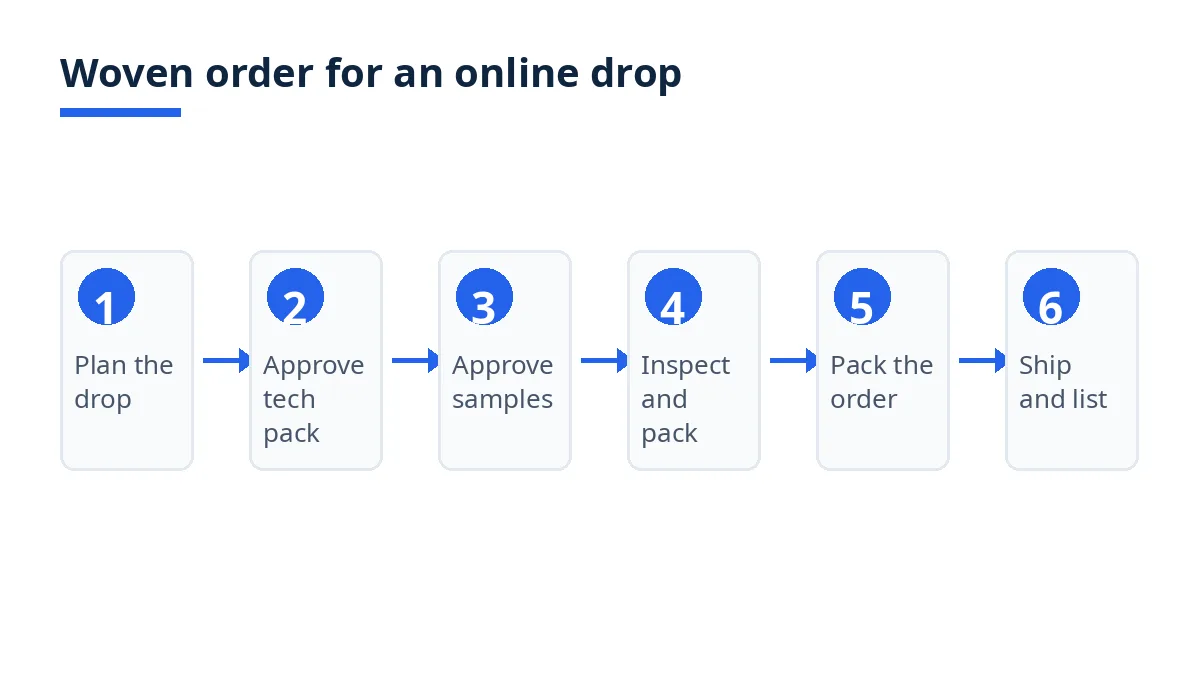
Start with the drop, not with a catalogue. Decide how many styles will launch together, how many colours each style will carry, and which sizes each colour will cover.
Write the drop plan. List each style, colour, and size, with the quantity per size. Mark which styles are core repeats and which are tests.
Send one tech pack per style. Include fabric composition and weight, weave or denim weight, wash type, fit measurements, pocket and button details, stitching, label and hang tag artwork, barcode placement, and packing method.
Ask for the split minimums. Ask for the minimum per style, per colour, and per size, and which line is binding. A total that clears the factory minimum can still fail on one small colour.
Approve samples in stages. Approve a proto sample for fit, then a pre-production sample in the actual fabric, wash, labels, and packing. Photograph the pre-production sample for the listing only after approval, so the listing shows the garment customers will receive.
Agree inspection, packing, and delivery terms in writing. Put the inspection level, the packing checklist, and one named delivery term on the purchase order, and agree who pays duty and import tax per destination market.
Ship, list, and track returns. Release the listing when the bulk shipment is confirmed, keep a small reserve for faulty-unit replacements, and log every return by reason.
Costs, timelines and documents
What are the typical costs and timelines?
There are no typical costs or timelines a guide can state as fact for woven garments and denim, because each factory prices your fabric, wash, construction, labels, and packing, and each destination market adds its own duty and tax. Ask for fabric, cutting and sewing, washing and finishing, labels and hang tags, individual and carton packing, inspection, freight, duty, and import tax as separate lines. When those lines are combined into one unit price, a change in wash or packing cannot be priced.
Example figures: a first drop of 400 jeans across two washes at 200 per wash carries a different wash and finishing cost from 400 jeans in one wash, because each wash is a separate run. The example shows structure only, not a typical price, minimum, or lead time.
For timelines, ask for sampling, fabric ready, bulk production, washing, inspection, and shipping dates as separate lines. Denim washing sits between sewing and packing, so a wash delay moves the packing date even when sewing finishes on time. Do not accept a single delivery week for a washed denim order.
Which documents are needed?
The order documents are the tech pack, the itemized quotation, and the purchase order, with the split per style, colour, and size on each. The export documents for Bangladesh follow the shipping bill route. The Bangladesh Trade Portal lists the documents needed to obtain a shipping bill as the export letter of credit, telegraphic transfer, purchase order or contract, the commercial invoice, the packing list, the EXP form certified by an authorized dealer, the certificate of origin issued by the EPB or a Chamber of Commerce and Industry, the VAT registration certificate, the taxpayer identification number, and the export registration certificate.4
For an e-commerce order, add three documents of your own: a label approval sheet signed for each market, a packing and barcode sheet with a photo of one packed unit, and an inspection report tied to the purchase order and carton numbers, so a faulty unit can be traced to its batch.
Bangladesh-specific rules and tips
Classify each style before you quote duty. Denim jeans are woven trousers, and classification follows the wearer and the fabric. A United States customs ruling classifies boys trousers and breeches of cotton, blue denim, under subheading 6203.42, and girls trousers and breeches of cotton, blue denim, under subheading 6204.62.5 Confirm the heading for each style with your broker before you set the retail price, because a wrong heading can change the landed cost of the whole drop.
Print labels per market, not per order. In the European Union, a textile product shall be labelled or marked with the name and percentage by weight of all constituent fibres in descending order.6 A cotton and elastane jean therefore needs its fibre percentages in descending order on the EU label, matching the listing description. For the United States, most textile and wool products sold in the country must carry a label disclosing fibre content, country of origin, and the identity of the manufacturer or marketer, with fibre content listed by generic name and percentage by weight in descending order, and a care instruction on most wearing apparel.7 Build one label table per market into the tech pack, and approve the artwork for each market separately.
Approve the wash on a garment, not on a swatch. A denim swatch shows colour, but a finished jean shows how the wash falls on seams, pockets, and hems, and how the fabric behaves after washing. Ask for the wash approval sample in your size range, wash it once using the care label instructions, and measure it before and after. Set the listing size guide from the washed measurements, not from the unwashed pattern.
Photograph what the customer will open. The listing photo set should show the approved bulk garment, not only the proto sample: front, back, and a close view of fabric and stitching. Keep photo file names tied to style and colour, so a repeat drop does not reuse a photo of a different wash.
Plan returns before the first sale. Example figures: if 12 of 100 jeans come back, and 8 of those come back for fit, the fix belongs in the size guide or the fit, not in the fabric. If 8 come back for a broken button or a loose seam, the fix belongs in inspection. The example shows how return reasons point to different fixes, not a typical return rate. Agree who pays for replacement units for factory faults, and keep faulty units until the claim is settled.
Mistakes and red flags
What are the most common mistakes?
Ordering for the listing, not for the size curve. A drop that lists five sizes but stocks only the middle three will sell out of the sizes customers want and sit on the sizes they do not. Do not add a size to the listing that has no stock behind it.
Approving one wash and shipping another. Denim washes drift between batches. If the bulk wash is not compared with the approved sample under the same light, the listing photo and the delivered jean will differ, and the difference will appear as returns. Require a bulk wash sample for each wash, and hold that wash until it is approved.
Using one label set for every market. An EU fibre label, a United States fibre and care label, and a marketplace listing description are three different documents. When one label set is printed for all of them, at least one market will be wrong. Approve labels per market, and check the listing text against the approved label before launch.
Pricing without duty and tax. A landed cost that leaves out duty, import tax, and the carrier handling fee will look profitable until the first shipment lands. Price each destination market separately, with duty and tax as their own lines.
Treating a profile or a badge as a factory check. A supplier profile is a starting point for enquiries. It does not test whether a factory can cut your size curve, wash your denim, or pack for a fulfilment centre. Sample approval and inspection stay with you. See the men's woven shirts MOQ guide for how minimums are set per style and colour.
Shipping before the packing photo is approved. A fulfilment centre rejects or reworks cartons that do not match its packing rules. Approve a photo of one packed carton, with the barcode position visible, before bulk packing starts.
Checklist
Before you confirm, every line should be answered in writing.
Drop plan fixed: styles, colours, sizes, and quantity per size, with core and test styles marked.
Tech pack sent per style: fabric, weight, wash, fit, trims, labels, hang tags, barcode, and packing.
Minimums confirmed per style, per colour, and per size, with the binding line named.
Proto sample and pre-production sample approved in writing, in the actual fabric, wash, labels, and packing.
Wash approved per wash on a finished garment, with washed measurements in the size guide.
Labels approved per market: EU fibre percentages in descending order,6 and United States fibre, origin, identity, and care labels.7
Packing and barcode photo approved, with one packed unit and one packed carton on record.
Inspection level and report format agreed, tied to purchase order and carton numbers.
Delivery term, duty payer, and import tax route agreed per destination market.
Export set agreed: invoice, packing list, EXP form, certificate of origin, and shipping bill.4
Returns plan agreed: reserve units held, return reasons logged, and factory-fault replacements priced.
Listing text checked against the approved label, wash, and measurements before launch.
How Exportain helps
On Exportain, browse suppliers and post a request for quotation (RFQ) on the RFQ board with your drop plan, tech pack summary, split per style, colour, and size, and delivery term, so suppliers quote against the same specification. Ask each reply for its per-style and per-colour minimums, its wash approval process, and its packing method for online fulfilment.
Read the badges for what they record. Exportain Verified means Exportain has checked identity, phone, email and business registration, and Export Verified means it has checked the Export Registration Certificate (ERC).8 Factory Verified means it has reviewed photos of the manufacturer factory, while Trading Company Verified means it has reviewed photos of the trading company office or warehouse.8 Verification is a document review by staff, free, and never granted by membership plans.9 It is not a factory inspection,8 9 so sample approval and inspection stay with you.
FAQs
What should I know first about Woven Garments & Denim Sourcing From Bangladesh for E-Commerce Brands?
Know the drop before you know the factory. Fix the styles, colours, sizes, and quantity per size, then ask for minimums per style and per colour, wash approval on a finished garment, labels per market, and packing that suits a fulfilment centre. Woven exports from Bangladesh reached $4,614.80 million in July to September 2026, up 5.11 percent year on year, according to EPB data.1
What are the typical costs and timelines?
There are no typical costs or timelines a buyer can rely on, because each factory prices your fabric, wash, construction, labels, and packing, and each destination market adds its own duty and tax. Ask for each cost line and each date separately.
Which documents are needed?
The order documents are the tech pack, itemized quotation, and purchase order, with the split per style, colour, and size on each. The export set for Bangladesh includes the commercial invoice, packing list, EXP form certified by an authorized dealer, certificate of origin, and shipping bill.4 Add a label approval sheet per market, a packing and barcode sheet, and an inspection report tied to the purchase order and carton numbers.
What are the most common mistakes?
The most common mistakes are ordering for the listing instead of the size curve, approving one denim wash and shipping another, printing one label set for every market, pricing without duty and tax, and reading a profile or a badge as a factory check. Fix them in the tech pack, the sample approval, and the purchase order, before bulk production starts.
Next steps on Exportain
Browse suppliers, then post your drop plan, tech pack summary, and split per style, colour, and size on the RFQ board so suppliers quote on the same specification. Before you confirm, read the woven garments sourcing guide and the Incoterm guide for woven garments.
Sources
- RMG exports rise 6.10pc to US$10.58b in July-Sept of FY27. The Financial Express, (accessed )
- CSMS # 66065494 - GUIDANCE: Suspension of Duty-Free De Minimis Treatment for All Countries. U.S. Customs and Border Protection (accessed )
- IOSS and EU VAT Compliance for Ecommerce Sellers. Asendia (accessed )
- Bangladesh Trade Portal FAQ: Export Registration Certificate (ERC). Bangladesh Trade Portal (accessed )
- Customs Ruling NY N033021 - Classification and country of origin determination of boys' and girls' pants and shorts. U.S. Customs and Border Protection (accessed )
- Regulation (EU) No 1007/2011 on textile fibre names and related labelling and marking of the fibre composition of textile products. European Union, (accessed )
- How to Import Textiles into the U.S.. Reidel Law Firm (accessed )
- Trust & Safety Center. Exportain (accessed )
- Supplier verification: Earn trust badges buyers can see. Exportain (accessed )
About the author
Sourcing from Bangladesh?
Post a request for quotation and suppliers on Exportain can send you their quotes directly.
Post an RFQ


