Government & Tender Buyers: Knitwear Sourcing From Bangladesh
For government and tender buyers, knitwear sourcing from Bangladesh is a documentation job first: a bid-ready specification, comparable quotations, and a paper trail that survives audit. This guide covers tender wording, framework terms, costs, timelines, and checks.
Short answer
Government and tender buyers sourcing knitwear and T-shirts from Bangladesh should start from their own procurement framework, not from a supplier catalogue. Write a measurable tender specification, publish the evaluation method before bids arrive, run one question channel for all bidders, and check delivery against the awarded sample. Require bid documents, price schedules on one delivery term, and the Bangladesh export set, and keep scoring sheets, award records, and inspection reports in the audit file.
On this page
Key takeaways
Tender buying is judged on the audit file as well as the garments: a measurable specification, published evaluation criteria, and recorded scores are what make an award defensible.
Check market access first: whether your framework permits bids from Bangladeshi suppliers, and whether any preference, eligibility, origin, or local-content rule applies.
Compare bids only on the same delivery term and the same specification, with price lines for garment, packing, inspection, and delivery kept separate.
Require bid samples in the tendered fabric, colour, construction, artwork, and labels, and inspect bulk goods against the awarded sample.
Exportain badges record a document and photo review, not a factory inspection, and never a guarantee of capacity, quality, or delivery.
A government or tender purchase of knitwear from Bangladesh is judged twice: on the garments, and on the paper trail. An auditor, a losing bidder, or a review panel can ask why a supplier was chosen, what each bid was compared on, and whether the delivered goods match the tendered specification. If the answer sits in scattered emails and verbal assurances, the purchase is exposed even when the T-shirts are fine.
This guide is for buyers who spend public money, or buy under a tender framework, in the USA, the UK, the EU, or the UAE, and who source knitwear and T-shirts from Bangladesh. It covers tender specifications, bid documents, like-for-like comparison, and the audit record. It states no tender rule as universal: the framework governing your purchase decides thresholds, procedures, deadlines, and remedies.
Bangladesh has a knitwear sector with depth behind it. The Bangladesh Knitwear Manufacturers and Exporters Association (BKMEA), established in 1996, is the apex trade body for the knitwear sector and represents approximately 2,540 knitwear member factories.1 That scale makes tender documents more important.
Why tender buying changes the sourcing job
A commercial buyer can pick a supplier on a sample and a price and move on. A tender buyer must show that every bidder faced the same specification, deadline, and evaluation method, and that the award followed from that method. The UNCITRAL Model Law on Public Procurement (2011) aims at value for money and avoiding abuses, promoting objectivity, fairness, participation, competition, and integrity, with transparency so compliance can be confirmed.2 Whatever your framework, the test is the same: could an outsider reconstruct the decision from the file.
That test changes the job in four ways. Write the specification before approaching suppliers, in measurable terms. Send every question and answer to all bidders. Evaluate on the criteria published in the tender, in the order and weight published, with scores recorded. Check delivery against the awarded specification and sample, and record any change as a variation with its price and approval.
Settle market access before invitations go out. Government procurement is generally exempt from the main disciplines of the General Agreement on Tariffs and Trade and the General Agreement on Trade in Services. Liberalisation has proceeded mainly through the plurilateral Agreement on Government Procurement (GPA), revised in force on 6 April 2014.3 The WTO notes that government procurement accounts for 10 to 15 per cent of the GDP of an economy on average.3 Check whether your framework permits bids from Bangladeshi suppliers, and whether any preference, eligibility, origin, or local-content rule affects the award.
Step-by-step: from tender notice to delivery
Tender sourcing follows a sequence that protects comparability.
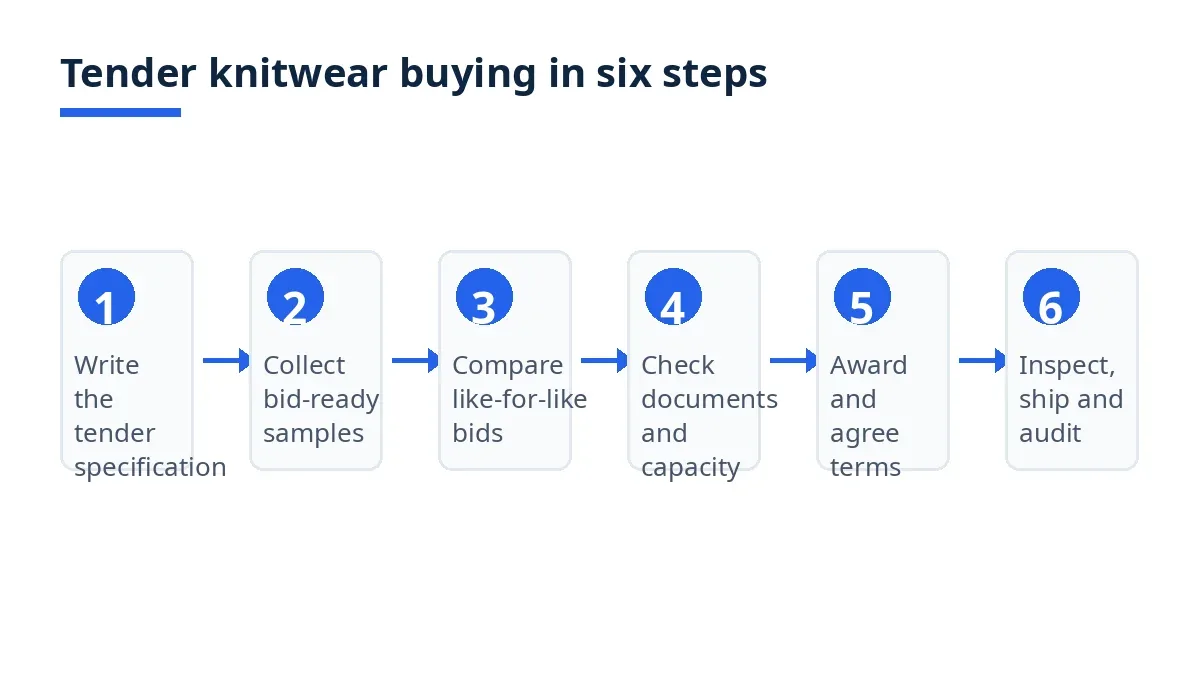
Confirm the framework and route. Record the governing rules, threshold, procedure, and approver, and whether the route is a framework agreement, single tender, or call-off. Define lots now: a supplier may bid for one lot and not another.
Write a measurable specification. State garment type, fabric composition and weight, construction, colour, size range and ratio, artwork, labels, packing, and inspection, plus quantity per size and colour, delivery lots, place, and term.
Set bid documents and evaluation in the tender. List every document a bid must contain, the price schedule format, and the criteria and weights, plus the sample requirement, deadline, bid validity period, and question process.
Run one question channel. Send the same tender pack to every invited supplier, log every question and answer, and issue answers to all bidders. Correct specification errors by amendment to all bidders, extending the deadline if required.
Collect samples against the specification. Require a sample in the tendered fabric, colour, construction, artwork, and labels, not a catalogue sample in a different fabric. Keep it as the bulk-inspection reference.
Evaluate on the published criteria and record scores. Score each bid on the same criteria with the same method, and keep the scoring sheets. Check price schedules for arithmetic, missing lines, and delivery terms that differ from the tendered term.
Award, contract, and freeze the specification. Issue the award notice your framework requires, agree the contract with the awarded specification, quantities, price schedule, lots, inspection plan, and payment terms attached, and record any post-award change as a variation.
Inspect, receive, and close the audit file. Inspect bulk goods against the awarded sample and specification, record the result lot by lot, and file the inspection report with delivery notes, invoice, packing list, and payment record.
Costs, timelines and documents
What are the typical costs and timelines?
There are no typical costs or timelines for tender knitwear that a guide can state as fact: each tender prices its own fabric, construction, artwork, packing, inspection, and delivery term. The Incoterms 2020 rules provide 11 rules with a clear allocation of cost, risk, and obligations.4 That allocation is why the delivery term must be fixed in the tender: bids on different terms cannot be compared.
Build costs from the price schedule, with separate lines for garment, packing, inspection where charged separately, and delivery to the tendered place on the tendered term. State whether the price is firm for the bid validity period, and how framework call-off prices are set.
Ask bidders to state sampling, fabric ready, production, inspection, and delivery dates as separate lines. State the bid validity period, award timetable, and latest delivery date, and record extensions in writing. Timelines are set by the governing framework, including any standstill or challenge period between award and contract.
Example figures: a tender for 12,000 T-shirts might be split into three delivery lots of 4,000, each with its own size ratio and delivery date. The figures show structure only, not a typical order size or lead time.
Which documents are needed?
Two document sets matter: the bid set proves the bidder and the bid, and the export set moves the goods out of Bangladesh.
The bid set, as defined by your tender, should normally include the price schedule on the tendered delivery term, the technical offer, the bid sample record, company and factory information, and any declarations on eligibility, conflicts, or past performance. Require the bidder to state its legal name exactly as it appears on its trade licence and bank account.
The export set is defined by Bangladesh Customs. Goods shall not be loaded for export unless an export declaration, known as the Bill of Export or Shipping Bill, is submitted to Customs and approved, with goods, value, exporter, foreign buyer, and transport operator specified.5 Enclosed documents include the export letter of credit, or where there is none, the export contract, purchase order, or export guarantee approved by the negotiating bank, the commercial invoice, the packing list, the EXP form certified by an authorized dealer, and a certificate of origin issued by the EPB or a Chamber of Commerce and Industry.5 For ready-made garments, a Utilization Declaration or Utilization Permission under bonded warehouse arrangements may also apply.5
For classification, state the HS heading in the tender so customs and duty treatment can be checked on the same basis. Heading 6109 covers T-shirts, singlets, and other vests, knitted or crocheted, with subheadings for cotton and for other textile materials.6 Confirm the full national code for the destination with your customs adviser or broker.
Bangladesh-specific rules and tips
Confirm association claims at the source. If a bidder claims BKMEA membership, confirm it with the association. BKMEA represents the knitwear sector and its member factories,1 and it states that it addresses environmental and labour standard issues in its member factories.1 Membership signals an active knitwear business, not capacity for your quantity, lots, or specification.
Keep one legal name across every paper. The export declaration names the exporter and the foreign buyer,5 so the name on the trade licence, bid, contract, proforma invoice, and payment account should match. A trading company bidding on behalf of a factory should state that relationship in the bid.
Ask which inputs are imported for your order. Yarn, dyes, trims, zips, and labels may be bought in for your specification, and an imported input can set both the earliest production date and the minimum run for a colour.
Write inspection into the tender, not into a later email. State who inspects, at what stage, against which sample and tolerance, what happens on failure, and who pays for re-inspection.
Plan for size and colour splits in the award. A tender total can hide a problem: a lot may clear the total quantity while one colour or size sits below a workable run. Require quantity per size and colour in the price schedule, and evaluate the split, not only the total.
Mistakes and red flags
What are the most common mistakes?
Writing a specification that cannot be inspected. Adjectives without measurements, such as "premium fabric" or "good stitching", cannot be scored at bid stage or checked at delivery. Every quality claim needs a measurable point.
Comparing bids on different terms. A bid priced without packing, without inspection, or on a different delivery term is not comparable to a complete bid. The Incoterms 2020 rules allocate cost, risk, and obligations for each rule,4 so compare bids only when the term and named place match the tender.
Accepting a verbal change after award. A fabric substitution, size-ratio change, or split delivery agreed by phone and never written into the contract will not survive an audit. Record every change as a variation with its price, approval, and effect on delivery lots.
Treating a profile or a badge as due diligence. A supplier profile is a starting point for enquiries. Exportain verification is a document review by staff, not a factory inspection, and a badge is not a guarantee of production capacity, product quality, or delivery.7 Verification is free and never purchased, and membership plans never grant a trust badge.8
Giving one bidder a clarification others do not receive. Log every question, answer every bidder, and amend the tender in writing when a question exposes an error. A clarification given to one bidder alone makes the competition unequal.
Starting production before the award is final, or filing the export set late. Under many frameworks, an award is not final until a notice period, challenge period, or contract signature has passed. Record the point at which production may start. The Bill of Export and its enclosed documents are required before loading,5 so require the export document plan in the bid.
Checklist
Before you issue the tender, answer every line in writing.
Governing framework, procedure, threshold, and approver recorded; supplier eligibility checked.
Lots defined, with quantity per size and per colour for each lot.
Specification measurable: fabric, weight, construction, colour, sizes and ratio, artwork, labels, packing, inspection.
Delivery term and named place fixed, with price lines for garment, packing, inspection, and delivery.4
Bid documents listed, with sample requirement, deadline, validity, and question process.
Evaluation criteria and weights published before bids arrive; scoring sheets prepared.
HS heading stated in the tender; national code to be confirmed for the destination.6
Export document plan required: Bill of Export, invoice, packing list, EXP form, certificate of origin.5
Inspection plan in the tender: who inspects, at what stage, against which sample, and on failure.
Award, variation, and production-start rules written; audit file list agreed.
Payment terms, bid validity, and framework re-pricing method stated.
How Exportain helps
On Exportain, browse suppliers and post a request for quotation (RFQ) on the RFQ board with your tender specification summary, quantity per size and colour, delivery term, and deadline, so suppliers quote against the same specification. Every quotation is versioned with unit price, MOQ, lead time, Incoterm, payment terms, and validity.9 Accepting a quotation creates an order record with those terms.9 Keep the formal tender file outside the platform as well: your framework's notices, scoring sheets, and award record remain your responsibility.
Read the badges for what they record. Exportain Verified means Exportain has checked identity, phone, email, and business registration, and Export Verified means it has checked the Export Registration Certificate (ERC).7 Factory Verified means it has reviewed photos of the manufacturer's factory, while Trading Company Verified means it has reviewed photos of the trading company's office or warehouse.7 Verification is a document and photo review, not a factory inspection.8 Use the badges to shortlist, and decide on the bid sample and inspection plan.
See the knitwear sourcing guide for the general picture, the sustainable knitwear guide for certification questions, and the cotton T-shirts import guide for imports.
FAQs
What should I know first about Knitwear & T-Shirts Sourcing From Bangladesh for Government and Tender Buyers?
Know that the tender file is the purchase. Your framework governs thresholds, procedures, deadlines, and remedies, and the award must be reconstructable from the file. Write a measurable specification, publish the evaluation method before bids arrive, and check delivery against the awarded sample. Check eligibility of Bangladeshi suppliers before invitations go out, because government procurement is generally exempt from the main GATT and GATS disciplines and market access has proceeded mainly through the plurilateral GPA.3
What are the typical costs and timelines?
There are no typical figures a buyer can rely on, because each tender prices its own fabric, construction, artwork, packing, inspection, and delivery term.4 Build costs and timelines from the price schedule and delivery lines, and add the framework timetable before promising a delivery date.
Which documents are needed?
The bid set is defined by your tender: price schedule, technical offer, bid sample record, company and factory information, and any eligibility or conflict declarations. The export set is defined by Bangladesh Customs: the Bill of Export, the commercial invoice, the packing list, the EXP form certified by an authorized dealer, and a certificate of origin issued by the EPB or a Chamber of Commerce and Industry, with the export contract or purchase order where there is no export letter of credit.5 State the HS heading in the tender; heading 6109 covers T-shirts, singlets, and other vests, knitted or crocheted.6
What are the most common mistakes?
The most common mistakes are writing a specification that cannot be inspected, comparing bids on different delivery terms,4 accepting verbal changes after award, treating a profile or badge as due diligence,7 giving one bidder a clarification others do not receive, starting production before the award is final, and filing the export set late.5 Each of these mistakes damages the audit file even when the garments are acceptable.
Next steps on Exportain
Browse suppliers, then post your tender specification summary, quantity per size and colour, delivery term, and deadline on the RFQ board so suppliers quote on the same basis. Before you issue the tender, read how to buy from Bangladesh and the knitwear sourcing guide.
Sources
- BKMEA at a Glance. BKMEA (accessed )
- UNCITRAL Model Law on Public Procurement (2011). United Nations Commission on International Trade Law (accessed )
- Government procurement gateway. World Trade Organization (accessed )
- Incoterms® 2020. International Chamber of Commerce (ICC) (accessed )
- Customs Clearance Procedures for Export. Bangladesh Customs, National Board of Revenue (accessed )
- Classification Detail — HS Code 6109. United Nations Statistics Division (accessed )
- Trust & Safety Center. Exportain (accessed )
- Supplier verification: Earn trust badges buyers can see. Exportain (accessed )
- How to source and buy from Bangladesh. Exportain (accessed )
About the author
Sourcing from Bangladesh?
Post a request for quotation and suppliers on Exportain can send you their quotes directly.
Post an RFQ