

Home Textiles for Corporate Buyers: Sourcing From Bangladesh
Corporate and promotional buyers: how to source branded home textiles and towels from Bangladesh, with logo, kitting, approval and event-date controls.
Short answer
Corporate and promotional buyers sourcing home textiles and towels from Bangladesh should buy a branded programme, not just textiles: agree the logo artwork, price logo application and kitting as separate lines, approve a branded sample, set delivery dates per recipient group backwards from the event, and confirm inspection and carton marking in writing before production.
On this page
Key takeaways
A corporate order is a branded programme: textile, logo application, kit packing and distribution to each recipient group are separate lines with separate approvals.
Price embroidery digitising or screen set-up, logo application per placement and colour, labels, kit boxes and carton marking apart from the textile price.
Approve a branded sample carrying the actual logo, colours and placement inside the actual kit packing, and sign it off in writing before bulk production.
Set artwork freeze, sample, production, inspection, kitting and shipment dates backwards from the event, with a buffer before the event date.
Exportain verification is a document and photo review, not a factory inspection, and a badge is not a guarantee of logo quality or delivery to an event date.
A corporate buyer does not buy home textiles the way a shop buyer does. The towels, bed linen and table linen in this guide are bought for a purpose outside resale: staff welcome kits, client gifts, delegate bags, trade-show giveaways, employee onboarding packs and branded items for a company event or campaign. That purpose changes almost every decision, from how the logo is applied to how the order is packed, approved and delivered.
Bangladesh is a practical source for this kind of order because home textiles are an established export line. In the July to September 2026 quarter, home-textile exports rose 11.94 percent to $231.29 million, according to Export Promotion Bureau figures reported by TEXtalks.1 Every item must arrive ready to hand over, with the brand correct, the kit complete and the delivery date tied to an event or campaign that cannot move.
Why this matters for buyers and sellers
For a corporate buyer, the risk is not unsold stock. It is a branded item that arrives late, with a logo in the wrong colour, or in cartons that still need sorting before an event. A welcome kit handed to a new employee or a gift sent to a client carries the company name, so a defect is visible in a way a plain towel defect is not. The approval chain also matters: brand, procurement, finance and sometimes legal each need a say, and a supplier who only deals with one contact will stall when the artwork needs a second sign-off.
For the seller, a corporate order is a different kind of production run. The base textile may be standard, but the order adds logo work, special packing and often several delivery groups, each with its own carton marking. Sellers who price only the towel and treat logo application and kitting as an afterthought will either absorb that work or miss the date.
Home textiles in this guide sit mainly under HS heading 6302, which covers bed linen, table linen, toilet linen and kitchen linen, including cotton terry towelling under subheading 630260.2 Confirm the heading for each item with your customs broker, because a bath towel, a bed sheet and a tablecloth can fall under different subheadings even within the same programme.
Step-by-step: how it works
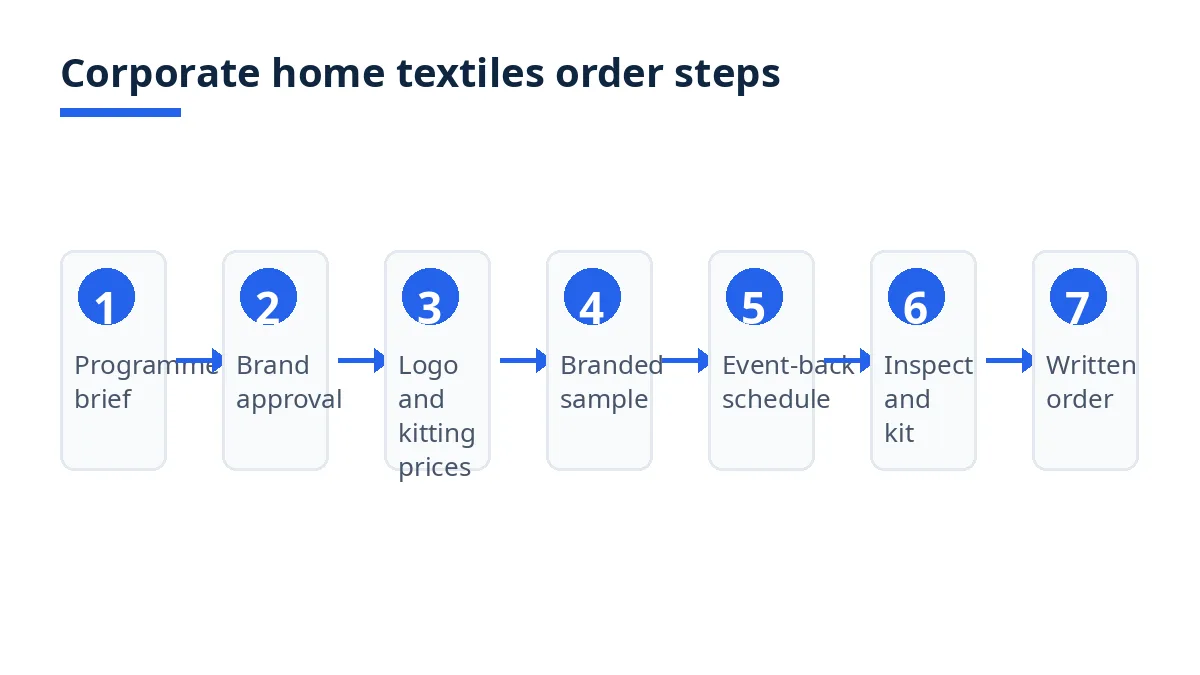
Write the programme brief before you ask for prices. State the occasion, the recipient groups, the quantity per group, the delivery date for each group and the budget holder. A brief that says "2,000 towels for events" cannot be quoted accurately; a brief that says "1,200 staff kits by 15 March and 800 client gifts by 2 April" can.
Get brand approval in writing at the start. Send the logo files, the approved colours, the minimum clear space around the logo and the placements that are not allowed. Name the person who signs off artwork, and agree how many proof rounds are included before extra charges apply.
Ask for logo and kitting prices as separate lines. Embroidery digitising, screen set-up per logo colour, woven labels, individual gift boxes, sleeves, insert cards and master-carton marking are separate pieces of work. A combined unit price hides them and makes repeat orders hard to compare.
Approve a branded sample, not a plain sample. The sample must carry the actual logo, in the actual colours and placement, on the actual towel or linen, inside the actual kit packing. Wash it and handle it the way a recipient will, then sign it off in writing or list corrections.
Lock the production and delivery schedule backwards from the event. Work from the date the kits must be in recipients hands, then set dates for artwork freeze, sample approval, bulk production, inspection, kitting, freight and local distribution. Put a buffer between bulk completion and the event, and name who pays if a missed artwork round moves the date.
Agree inspection, packing and distribution before production starts. State the inspection method, who inspects, and how defects are handled. State how kits are packed per recipient group, how cartons are marked, and whether the supplier ships to one address or to several offices or venues.
Confirm the order in one written document. The purchase order should carry the item specification, logo artwork version, quantity per group, packing per kit, delivery term, delivery dates per group, inspection terms and payment terms. Verbal changes after this point should be confirmed in writing the same day.
Costs, timelines and documents
What are the typical costs and timelines?
There are no typical costs or timelines that hold for every corporate programme, because the logo work, the kit contents and the delivery split drive the price as much as the textile does. Ask for the price broken into lines: base textile per piece, logo application per placement and per colour, digitising or screen set-up, labels and tags, kit packing per kit, carton and freight costs under the agreed delivery term, and inspection charges if any. The Incoterms 2020 rules set out 11 rules with a clear allocation of cost, risk and obligations,3 so compare quotations only when they use the same rule and named place.
Example figures: a programme of 1,200 staff kits, each holding one branded bath towel and one hand towel, with a two-colour embroidered logo and a printed gift box, is priced as 2,400 towels plus 1,200 logo applications, 1,200 boxes and one digitising charge, not as 1,200 of one combined item. If the same programme adds 800 client gifts with a different logo placement, that placement is a second logo line with its own set-up, even though the towel is the same. The example shows cost structure only, not a typical price, MOQ or lead time.
For timelines, ask for separate dates for artwork proof, branded sample, bulk production, logo application, inspection, kitting and shipment. Logo approval is the stage most likely to move a corporate date, because it waits on people inside the buying company rather than on the factory. Freeze the artwork by a written date, and agree what happens to the delivery date if approval slips past it.
Which documents are needed?
For export clearance in Bangladesh, goods may not be loaded unless an export declaration, the Bill of Export or Shipping Bill, is submitted to Customs and approved.4 Enclosed documents include the export contract or purchase order where there is no export letter of credit, the commercial invoice, the packing list, the EXP form certified by an authorized dealer, and a certificate of origin issued by the EPB or a Chamber of Commerce and Industry.4
For a corporate programme, add your own document set to that export set: the approved artwork file with its version number, the signed branded-sample record, the kit packing instruction per recipient group, the carton-marking sheet, and the distribution list showing which cartons go to which address. Keep the artwork version number on the purchase order, the sample record and the inspection report, so a dispute about a logo can be traced to one approved file.
Bangladesh-specific rules and tips
Put fibre labelling in the specification for EU destinations. Regulation (EU) No 1007/2011 covers textile fibre names and related labelling and marking of the fibre composition of textile products.5 State the fibre composition, the label wording and the label placement in the specification, and check the branded sample label against it, because a logo label and a fibre label are different labels with different jobs.
Treat chemical-safety claims by certificate, not by logo alone. OEKO-TEX Standard 100 tests a finished textile against a catalogue of over 1,000 potentially harmful substances, with certificates issued for one year at a time and scoped to specific certified articles.6 Ask for the certificate number, the certified article scope and the product class, and check that the scope covers your towel or linen rather than a different product from the same supplier. A certificate for one article does not cover a different article, and a claim of organic content needs a different certification entirely.6
Name one contact for artwork and one for logistics. Ask for a named artwork contact and a named shipment contact, with a single thread for each, and copy both on the final purchase order.
Plan kitting as production, not as packing. Kitting needs its own time, space and checking step: towels folded, logo checked, insert card added, box closed, carton marked for its recipient group. If kitting is left to the last day before shipment, a short count in one group is found too late to fix. Ask for a kit-count sheet per group, signed at packing, and keep a sample kit sealed as the reference for inspection.
Check carton marking against the distribution list. Each carton should show its recipient group, its kit contents and its carton number within that group, so a venue team can confirm receipt without opening every box.
Mistakes and red flags
What are the most common mistakes?
Approving a plain sample and assuming the logo will match. Colour, size, placement and thread or print quality can only be judged on a branded sample. A plain towel sample approves the textile, not the branded item your recipients will receive.
Sending logo files without a brand rule sheet. A logo supplied as a single image, with no approved colours, minimum size or placement rules, will be redrawn or resized by someone guessing. Supply vector files where possible, state the colours by name or code, and list placements that are not allowed.
Pricing the programme as one combined unit price. A combined price hides logo set-up, kitting and distribution, so a repeat order or a quantity change cannot be priced fairly. It also hides which part of the price moves when one recipient group changes size.
Leaving the event date out of the purchase order. A supplier cannot protect a date it has not been given. Put each delivery date per group in the order, with the buffer and the artwork-freeze date beside it.
Treating a profile or a badge as a capacity check. Exportain verification is a document and photo review by staff, not a factory inspection, and membership plans never grant a trust badge.7 A badge tells you which checks were reviewed; it does not confirm that a supplier can run your logo programme to your event date. Sample approval and inspection stay with you.
Accepting a late artwork change without a date consequence. Every artwork change after the freeze date should carry a written note of its effect on production and delivery. A change accepted without that note becomes a missed event date with no agreed owner.
Checklist
Before you confirm, every line should be answered in writing.
Programme brief written: occasion, recipient groups, quantity per group, delivery date per group, budget holder named.
Brand rule sheet sent: logo files, approved colours, minimum size, allowed and excluded placements, sign-off owner named.
Logo and kitting priced apart: digitising or screen set-up, application per placement and colour, labels, boxes, sleeves, insert cards, carton marking.
Branded sample approved in writing: actual logo, colours, placement, textile, kit packing, washed and handled.
Artwork freeze date agreed, with the delivery consequence of a late change stated.
Schedule set backwards from the event: proof, sample, bulk, logo work, inspection, kitting, freight, local distribution.
Inspection method, defect handling and reference kit agreed.
Carton marking per recipient group agreed, matched to the distribution list.
Purchase order carries artwork version, quantities per group, packing per kit, delivery term and dates, inspection and payment terms.3
Export set agreed: invoice, packing list, EXP form, certificate of origin, Bill of Export.4
How Exportain helps
On Exportain, browse suppliers and post a request for quotation (RFQ) on the RFQ board with your programme brief, recipient groups, logo placement and delivery dates per group, so suppliers quote against the same specification. Ask each reply for its logo set-up, kitting and distribution lines apart from the textile price. Read the badges for what they record: verification is a document and photo review, not a factory inspection, and it is free, with membership plans never granting a badge.7
Exportain's buying steps run from catalogue search through supplier profiles, RFQ, quotation comparison and order acceptance, with freight and inspection providers listed for the buyer to arrange.8 When you accept a quotation, the accepted terms form the order record, so keep the artwork version, kit packing and delivery dates per group in the terms you accept.8 For logo quality points, read the bath towels quality control checklist and the private-label bath towels guide, and compare delivery terms in the best Incoterm for home textiles guide.
FAQs
What should I know first about Home Textiles & Towels Sourcing From Bangladesh for Corporate and Promotional Buyers?
Know that you are buying a branded programme, not just textiles. The textile, the logo application, the kit packing and the distribution to each recipient group are four separate pieces of work, each with its own price line, approval step and date. Home textiles under HS heading 6302 cover bed, table, toilet and kitchen linen, including cotton terry towelling,2 and the export set for Bangladesh clearance includes the Bill of Export, invoice, packing list, EXP form and certificate of origin.4
What are the typical costs and timelines?
There are no typical figures a buyer can rely on, because logo work, kit contents, recipient groups and delivery terms drive the price and the schedule. Price the textile, logo set-up and application, labels, kit packing and freight as separate lines, compare quotations only on the same Incoterms 2020 rule and named place,3 and set artwork, sample, production, inspection, kitting and shipment dates backwards from the event.
Which documents are needed?
The order documents are the programme brief, brand rule sheet, itemized quotation, purchase order carrying the artwork version and delivery dates per group, signed branded-sample record, kit packing instruction and carton-marking sheet. The export set is the Bill of Export, commercial invoice, packing list, EXP form certified by an authorized dealer, and a certificate of origin issued by the EPB or a Chamber of Commerce and Industry.4
What are the most common mistakes?
The most common mistakes are approving a plain sample instead of a branded one, sending logo files without a brand rule sheet, pricing the programme as one combined unit, leaving event dates out of the purchase order, and reading a badge as a capacity guarantee. Verification is a document and photo review, not a factory inspection,7 so branded-sample approval and inspection stay with the buyer.
Next steps on Exportain
Browse suppliers, then post your programme brief, recipient groups and delivery dates on the RFQ board so suppliers state their logo, kitting and distribution lines apart from the textile price. Before you confirm, read how to buy from Bangladesh and check your delivery term against the best Incoterm for home textiles guide.
Sources
- Bangladesh's September exports rise 8.54%, but garment recovery remains uneven. TEXtalks (accessed )
- HS 2017 - Code 6302: Bed linen, table linen, toilet linen and kitchen linen. United Nations Statistics Division (accessed )
- Incoterms® 2020. International Chamber of Commerce (ICC) (accessed )
- Customs Clearance Procedures for Export. Bangladesh Customs, National Board of Revenue (accessed )
- Regulation (EU) No 1007/2011 on textile fibre names and related labelling and marking of the fibre composition of textile products. European Union, (accessed )
- OEKO-TEX Standard 100 Meaning: What It Certifies & Doesn't. Affix Apparel (accessed )
- Supplier verification: Earn trust badges buyers can see. Exportain (accessed )
- How to source and buy from Bangladesh. Exportain (accessed )
About the author
Sourcing from Bangladesh?
Post a request for quotation and suppliers on Exportain can send you their quotes directly.
Post an RFQ


