

Private Label Bath Towels Manufacturing in Bangladesh: A Brand Owner's Guide
Private label bath towels from Bangladesh, bought as a matched range: what to fix across bath, hand and face pieces, how to approve the washed set, and which label duties stay with the brand owner.
Short answer
Private label bath towels from Bangladesh mean a Bangladeshi maker produces your towel range to your specification and applies your labels, tags and packing. You own the range, the colour story and the label content. Approve the washed set together, fix shade, GSM, wash and lint limits across pieces, and keep label duties in your market in mind, since they stay with the brand owner.
On this page
Key takeaways
Private label bath towels from Bangladesh are bought as a matched range, not as single towels: bath, hand and face pieces must match in shade, pile, weight and wash behaviour.
Your name on the label carries the label duty in your market: fibre names and percentages must match the fabric you specified and the sample you tested.
Approve the washed set together, laid out side by side, before you confirm bulk, because size, shade, pile and lint change after washing.
Set a shade tolerance across the range as well as per piece, and a minimum per piece, per colour and per set format, with the binding line named.
Exportain verification is a document and photo review, not a factory inspection, and a badge is not a guarantee.
Private label bath towels from Bangladesh mean a Bangladeshi maker weaves, dyes, finishes and packs a towel range to your specification and puts your brand on it, instead of selling you its own stock range. You own the range, the colour story, the label content and the packing. The factory owns the production run. For a brand owner, the product is a matched range: usually a bath towel, a hand towel and a face cloth, sold as sets or singles that must match on the shelf and after washing.
That range view changes every decision in the order. A bath towel approved on its own can still fail your brand if the hand towel in the same colour looks lighter, if the face cloth sheds more, or if one piece shrinks more than the others in the wash. This guide is written for a brand owner buying a private label towel range from Bangladesh for sale in the United States, the United Kingdom, the European Union or the United Arab Emirates.
A cotton terry towel range sits in heading 6302, which covers bed linen, table linen, toilet linen and kitchen linen, and subheading 630260 covers kitchen and toilet linen of terry towelling or similar terry fabrics, of cotton.1 Confirm the full national code for every piece before you price or ship.
Why this matters for buyers and sellers
For the buyer, a private label range is shelf identity. A customer who buys a bath towel and returns for the matching hand towel judges your brand by whether the two pieces look like one range. Colour, pile feel, weight and wash behaviour must line up across pieces. That is why the range specification is the document that protects the brand.
For the seller, a private label range is steadier than a one-off towel order when the brand repeats it, because the dye shades, label runs and packing format are already approved. Terry fabric dyed to your colour story, labels woven with your name and retail sets packed in your format cannot be sold to another buyer, so the maker carries your branding risk inside its minimum and its price.
Your name on the label carries a legal duty that does not move to the factory. In the European Union, Regulation (EU) No 1007/2011 states that a textile product shall be labelled or marked with the name and percentage by weight of all constituent fibres in descending order.2 The same regulation treats a distributor as a manufacturer where the distributor places a product on the market under its own name or trademark.2 In the United States, federal law requires that most textile and wool products have a label that lists the fiber content, the country of origin, and the identity of the manufacturer or another business responsible for marketing or handling the product.3 The factory sews the label you approve, so its fibre names and percentages must match the fabric you specified.
Two controls protect both sides. The first is an inspection plan agreed before production. ISO 2859-1 defines a system of acceptance sampling plans for inspection by attributes, indexed by acceptance quality limit (AQL) for lot-by-lot inspection.4 The second is one delivery term for every quotation. The Incoterms 2020 rules set out 11 rules with a clear allocation of cost, risk and obligations.5 Compare ranges only on the same specification and the same term.
Range control | Fix in the specification | Check at inspection |
|---|---|---|
Colour across the range | One colour standard per colour, for every piece | Shade of bath, hand and face pieces side by side |
Weight and pile | GSM and pile description per piece, with tolerance | Weight per piece and pile feel against the approved set |
Absorbency and lint | Test method and limit, before or after washing | Absorbency and lint on each piece type |
Step-by-step: how it works
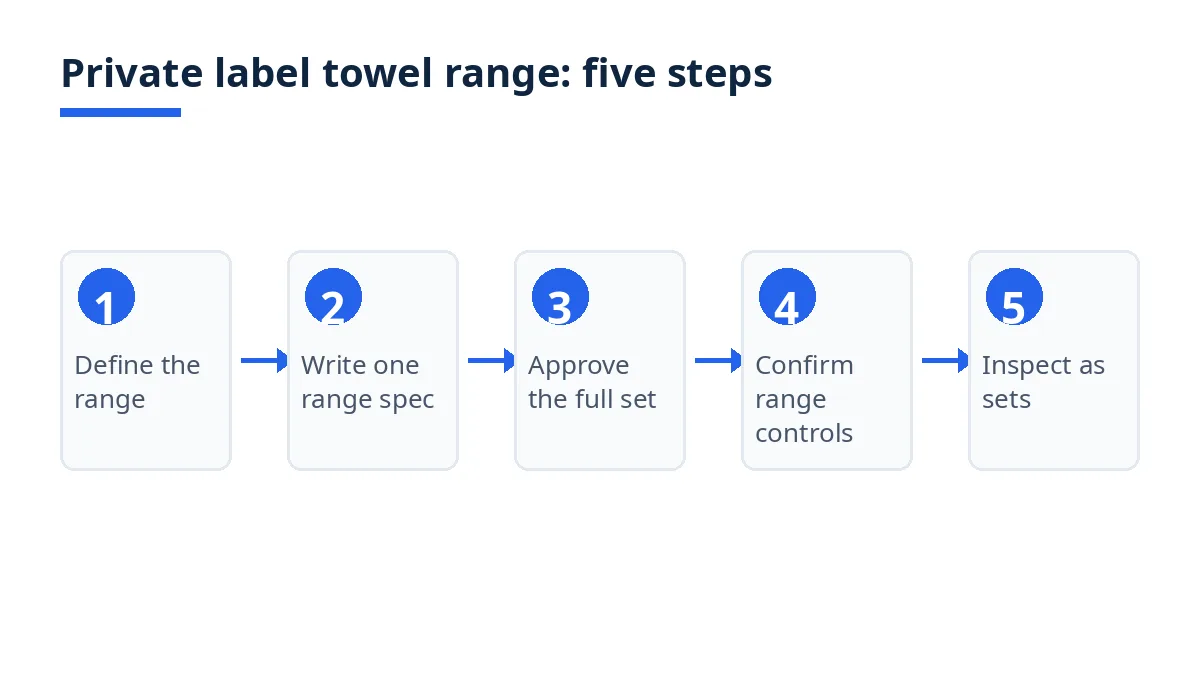
Define the range and the colour story first. List every piece in the range, the colours in the story, and whether pieces are sold as sets, as singles, or both. A set needs a set barcode and set packing; singles need a barcode per piece.
Write one range specification, not one towel specification. State fibre composition, terry construction, GSM and tolerance, dimensions and tolerance, pile description, border or dobby treatment, hem and hanging loop, colour standards, and wash behaviour for each piece. Add the across-range rules: the shade tolerance between pieces in one colour and the wash and lint limits for the whole range. Add the label pack: main label, care and content label, hang tag, barcode data and carton marks.
Send the same pack to several makers and ask range questions. Ask whether terry weaving is in-house or bought in as fabric, where dyeing happens, whether one dye lot can cover every piece in a colour, and how shade is checked between pieces. Ask for the minimum per piece, per colour and per set format, and which line is binding. See the bath towels quality control checklist for the piece checks behind the range checks.
Approve the full set together, after washing. Order a sample set in your fabric and colours with your labels sewn in, not a single bath towel. Measure it, wash the whole set by the agreed procedure, then judge shade, size, pile, absorbency and lint as a set. Approve or list corrections in writing for the set.
Confirm the order with the range controls written in. Put the piece list, the split per colour and per set format, the across-range tolerances, the inspection level and AQL values following ISO 2859-1,4 the packing spec and the delivery term into the purchase order.
Inspect as sets, then ship on the agreed term. Draw full sets from packed cartons and check shade across pieces, label placement, barcode scans and set contents. Release shipment only on the agreed term.5
Costs, timelines and documents
What are the typical costs and timelines?
There are no typical costs or timelines a guide can state as fact. Each maker prices your fibre, GSM, terry construction, dyeing, finishing, hemming, label and tag runs, set packing, inspection and the delivery term you choose.5 Private label adds its own lines: woven labels, printed tags, barcode stickers and printed cartons are ordered separately from the weaving run, each with its own minimum.
For timelines, ask for each stage as a separate line: label and tag production, sampling and corrections, fabric and dyeing, bulk production, set packing, inspection and shipment. The slowest piece in the range sets the ship date for the set.
Example figures: a brand plans a three-piece range, a bath towel, a hand towel and a face cloth, in three colours, sold as sets. The label run is sized for the full range total, while each colour still carries its own dye minimum across the pieces in that colour. If one colour is cut back, the set total can clear the label minimum while that colour falls below its dye minimum, so the colour is removed or repriced. The example shows structure only, not a typical price or lead time.
Which documents are needed?
Your order documents are the range specification, the colour standards, the label pack with approved proofs, the itemized quotation and the purchase order, with the split per colour and per set format on both. For export clearance in Bangladesh, goods may not be loaded unless an export declaration, the Bill of Export or Shipping Bill, is submitted to Customs and approved.6 Enclosed documents include the export contract or purchase order where there is no export letter of credit, the commercial invoice, the packing list, the EXP form certified by an authorized dealer, and a certificate of origin issued by the EPB or a Chamber of Commerce and Industry.6
Bangladesh-specific rules and tips
Ask where the terry is woven and dyed. A maker that weaves its own terry controls pile and dyeing in one place. A maker that buys terry fabric in has a second supplier inside your range, so ask who that supplier is, whether one dye lot covers every piece in a colour, and how shade is checked between lots.
Fix one colour standard per colour, and keep it. A colour name is not a standard. Give a physical standard or a numbered reference for each colour, state the light it is judged under, and keep the same standard for bulk production and repeats.
Keep one legal name across every paper. The export declaration names the exporter and the foreign buyer,6 so the trade licence, quotation, proforma invoice and payment account names should match.
Ask which inputs are bought in for your range. Yarns, border yarn, dyes, label materials and carton board may be bought in for your specification, and a bought-in input can set both the earliest production date and a separate minimum. Ask for its lead time before you fix your launch date.
Agree the set ratio before production. State the sets per colour and pieces per carton in the purchase order and check them at inspection.
Confirm the classification for every piece. Subheading 630260 covers kitchen and toilet linen of terry towelling or similar terry fabrics, of cotton.1 A non-terry piece in the range needs its own check before it is priced as part of the set.
Mistakes and red flags
What are the most common mistakes?
Approving one towel instead of the set. A bath towel sample tells you nothing about whether the hand towel in the same colour matches it, or whether the face cloth sheds more. Approve the washed set before bulk.
Approving unwashed samples only. Towels are used wet and washed repeatedly, so size, shade, pile and lint after washing are part of the product. A sample approved dry can pass on the table and fail in use.
Setting a shade standard per piece instead of across the range. A tolerance that each piece passes on its own still allows the bath towel at one end and the hand towel at the other, which reads as a mismatch on the shelf. Set the across-range tolerance as well as the per-piece tolerance.
Comparing a set price with a piece price. A quotation for a packed set and a quotation for loose pieces are different offers, even when the towels are the same. Compare only replies to the same specification, set format and Incoterm.5
Approving the towel and skipping the labels. Buyers measure the towel and skip the sewn-in labels, then find a wrong fibre percentage at inspection. The label content is your legal statement in your market,2 3 so proof it like the specification.
Changing a colour after labels are woven. A late shade or spelling change restarts the label run and can move the whole range. Freeze the colour story and label artwork at purchase order stage and record the freeze in writing.
Reading a badge as a guarantee. A profile badge records a document or photo review. It is not a guarantee of capacity, quality or delivery,7 and it does not replace sample approval or inspection.
Skipping set inspection. Sampling under ISO 2859-1 checks a lot against an agreed AQL,4 and for a range the lot check must include full sets.
Checklist
Before you confirm, every line should be answered in writing.
Range defined: every piece, every colour, sets, singles, or both.
Range specification sent: fibre, construction, GSM, dimensions, pile, border, hems, per piece.
Across-range rules fixed: shade tolerance between pieces, wash and lint limits.
Colour standard per colour agreed, judging light stated, kept for repeats.
Label pack sent and proofs approved: main, care and content labels, hang tag, barcode, carton marks.
Fibre names and percentages checked against the fabric specification.2 3
Minimum confirmed per piece, per colour and per set format; binding line named.
In-house and bought-in steps named: weaving, dyeing, finishing, label printing.
Set-up and label costs itemized apart from the unit price; paid set-ups recorded.
Sample set measured, washed and approved in writing, judged as a set.
Inspection level and AQL values in the purchase order, with sets drawn, and quotations compared on the same specification, set format and Incoterm.4 5
Export set agreed: invoice, packing list, EXP form, certificate of origin, Bill of Export.6
How Exportain helps
On Exportain, browse suppliers and post a request for quotation (RFQ) on the RFQ board with your range specification, colour story, set format and delivery term, so makers quote against the same range. State your target market in the RFQ, because your labelling duties follow the market you sell into.2 3 When you accept a quotation, Exportain creates one order and issues one proforma invoice from the accepted terms.7
Read the badges for what they record. Exportain Verified means Exportain has checked identity, phone, email and business registration, and Export Verified means it has checked the Export Registration Certificate (ERC).7 Factory Verified means it has reviewed photos of the manufacturer factory, while Trading Company Verified means it has reviewed photos of the trading company office or warehouse.7 Verification is a document review by staff, free, and never granted by membership plans.8 It is not a factory inspection,7 8 so range approval and set inspection stay with you.
FAQs
What should I know first about private label?
Private label means a Bangladeshi maker produces your towel range to your specification and applies your labels, tags and packing. You own the range, the colour story and the label content, and the label duties in your market stay with you.2 3 Approve the washed set together.
What are the typical costs and timelines?
There are no typical figures a buyer can rely on, because each maker sets its price, minimum and lead time for your range. Fibre, GSM, construction, dyeing, finishing, label and set packing, inspection and the delivery term drive the price,5 and label runs and dyeing drive the timeline.
Which documents are needed?
The order documents are the range specification, colour standards, label pack with approved proofs, itemized quotation and purchase order, with the split per colour and per set format on both. The export set is the Bill of Export, commercial invoice, packing list, EXP form and certificate of origin.6
What are the most common mistakes?
The most common mistakes are approving one towel instead of the washed set, setting a shade tolerance per piece but not across the range, comparing a set price with a piece price on a different Incoterm,5 changing a colour after labels are woven, and reading a badge as a guarantee.7
Next steps on Exportain
Browse suppliers, then post your range specification, colour story and set format on the RFQ board so makers state their minimum per piece, per colour and per set format. Before you confirm, read how to import bath towels from Bangladesh and the bath towels quality control checklist.
Sources
- HS 2017 - Code 6302: Bed linen, table linen, toilet linen and kitchen linen. United Nations Statistics Division (accessed )
- Regulation (EU) No 1007/2011 on textile fibre names and related labelling and marking of the fibre composition of textile products. European Union, (accessed )
- Textile, Wool, Fur, Apparel and Leather Matters. Federal Trade Commission (accessed )
- ISO 2859-1:2026 - Sampling procedures for inspection by attributes — Part 1: Sampling schemes indexed by acceptance quality limit (AQL) for lot-by-lot inspection. ISO (accessed )
- Incoterms® 2020. International Chamber of Commerce (ICC) (accessed )
- Customs Clearance Procedures for Export. Bangladesh Customs, National Board of Revenue (accessed )
- Trust & Safety Center. Exportain (accessed )
- Supplier verification: Earn trust badges buyers can see. Exportain (accessed )
- supplier verification
- quality control
- buyer guide
- woven garments
- Bangladesh sourcing
- home textiles
- Private label
About the author
Sourcing from Bangladesh?
Post a request for quotation and suppliers on Exportain can send you their quotes directly.
Post an RFQ


